
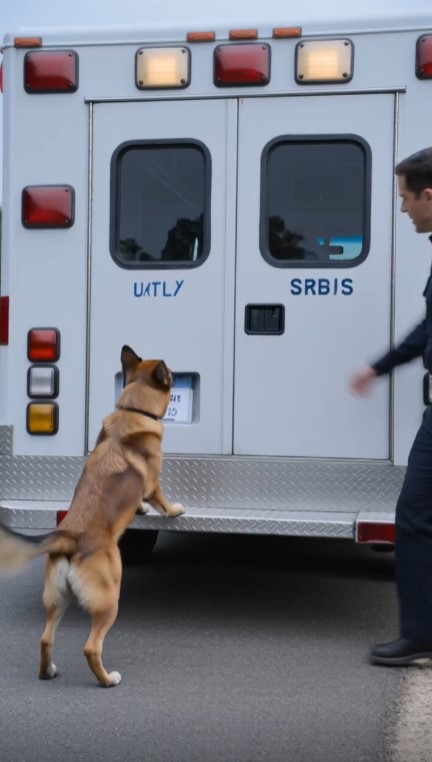
The paramedics had already loaded the elderly woman into the ambulance when the muddy stray dog jumped onto the rear step.
He planted all four paws there and refused to move.
“Get him down!”
One paramedic reached toward him.
The dog did not growl.
He did not bare his teeth.
He did not try to attack anyone.
He simply stared past them at the unconscious woman inside the ambulance.
She had been found collapsed beside a quiet country road.
No purse.
No identification.
No phone anyone could see.
When the emergency crew arrived, the dog had been lying beside her as though guarding her.
Everyone assumed he belonged to her.
Then the woman briefly opened her eyes.
She looked toward the rear doors.
Saw the dog.
And whispered:
“That’s not my dog.”
The paramedic nearest her froze.
“Then why is he following you?”
The woman’s eyes closed again before she could answer.
Outside, the stray suddenly jumped from the ambulance.
He ran about twenty yards down the roadside.
Then stopped beside an old wooden fence.
And started digging.
One of the paramedics followed.
The dog tore through wet soil and dead leaves with frantic determination.
Within seconds, something blue appeared beneath his paws.
A scarf.
The paramedic pulled it free.
Then the dog scratched again.
A woman’s shoe emerged from the dirt.
A few inches farther down, he uncovered an old leather handbag.
The paramedic opened it.
Inside was identification.
He ran back toward the ambulance.
“We found her name!”
But the dog did not follow.
He kept digging.
Something else was buried beneath the fence.
A small wooden box.
The paramedic carried it back.
When the elderly woman opened her eyes again and saw the box, she tried to sit up.
“Where did you get that?”
The paramedic pointed toward the dog.
“He found it.”
The woman began crying.
“My husband buried that.”
The crew looked at one another.
Her husband had been missing for six years.
Police had eventually concluded that he may have left voluntarily.
The woman never believed it.
She had spent years insisting that her husband would never simply disappear without telling her.
Now a stray dog had uncovered a box she said belonged to him.
The dog scratched against the lid until it shifted.
Inside was an old wedding photograph.
A small key.
And a hand-drawn map.
The woman stared at the map for a long time.
Then, for the first time, she really looked at the dog.
Her expression changed.
“Check his collar.”
One paramedic shook his head.
“He doesn’t have one.”
“Under his fur.”
The dog stood still as the paramedic carefully moved the thick hair around his neck.
Hidden beneath it was a thin, faded cord.
Something small hung from it.
A metal tag.
The paramedic lifted it into view.
The elderly woman read the engraving.
Then covered her mouth.
“That was my husband’s.”
Nobody spoke.
The paramedic looked at the dog.
“You recognize him?”
The woman shook her head.
“No.”
Then she looked past the ambulance toward the narrow road leading into the forest.
“But I know where he came from.”
The stray suddenly turned toward the same road.
He began barking.
Once.
Twice.
Then he ran several steps forward and looked back.
The message was clear.
He wanted them to follow.
The paramedics could not leave their patient, so one of them called law enforcement and explained what they had found.
Within minutes, a deputy arrived.
The dog immediately moved toward him.
Then headed down the forest road.
The deputy followed slowly in his cruiser.
The road narrowed until the pavement disappeared.
Ahead, the stray turned onto an old logging path nearly hidden by brush.
He kept moving.
A quarter mile later, he stopped beside a collapsed fence.
The hand-drawn map from the wooden box showed the same bend in the road.
The deputy radioed for additional units.
Then he followed the dog on foot.
The path led toward an abandoned hunting cabin deep in the trees.
The building looked empty.
One window was broken.
The roof sagged.
The front door hung crooked on its hinges.
The dog approached the porch.
Then stopped.
He whined.
The deputy called out.
“Sheriff’s department! Anyone inside?”
No answer.
The dog moved around the side of the cabin.
There, partly concealed beneath fallen branches, was an old storm-cellar door.
The key from the wooden box fit the lock.
When officers opened it, they found evidence that someone had been living there.
Blankets.
Food containers.
Old clothing.
Medication bottles.
And photographs.
Dozens of them.
Many showed the elderly woman from years earlier.
Others showed her missing husband.
Then an officer found a notebook.
The handwriting matched samples the woman later identified as her husband’s.
The early pages described him leaving home after receiving threats connected to a dispute involving land his family once owned.
He believed someone was watching the house.
He feared that staying would place his wife in danger.
So he disappeared.
Not because he wanted to abandon her.
Because he thought leaving would protect her.
But the final pages told a different story.
He had become ill.
Too weak to travel.
And sometime during those years, a dog began appearing near the cabin.
The notebook mentioned feeding a young stray.
There was one line written near the end:
“If anything happens to me, maybe he’ll find his way back to her.”
The deputy stared at the dog.
The stray sat quietly beside the cellar door.
The husband had apparently attached his old metal tag to the animal’s neck.
The same dog may have been carrying the only clue connecting the cabin to the woman he had left behind.
Search teams expanded the area around the property.
Later that evening, they found remains in a wooded section behind the cabin.
The discovery would require formal identification, but the elderly woman already understood what it likely meant.
Her husband had not abandoned her.
He had spent his final years believing distance would keep her safe.
And somehow, a stray dog had carried part of his story back.
The woman remained in the hospital overnight.
The next morning, the dog was brought to see her.
He hesitated at the doorway.
She held out one hand.
“Come here.”
The stray approached slowly.
She touched the faded cord around his neck.
Then she looked at the old metal tag.
“You stayed with him, didn’t you?”
The dog rested his head against the side of her bed.
For six years, the woman had been told to accept that her husband had chosen to leave.
One muddy dog changed that.
He found her unconscious beside the road.
He refused to let the ambulance leave.
He led rescuers to the buried box.
And then he led police toward the place where the truth had been waiting.
When the woman was discharged, she did not leave the hospital alone.
The stray walked beside her.
She had never known him before that day.
But he had known someone she loved.
And sometimes that is enough to make a stranger feel like family.