
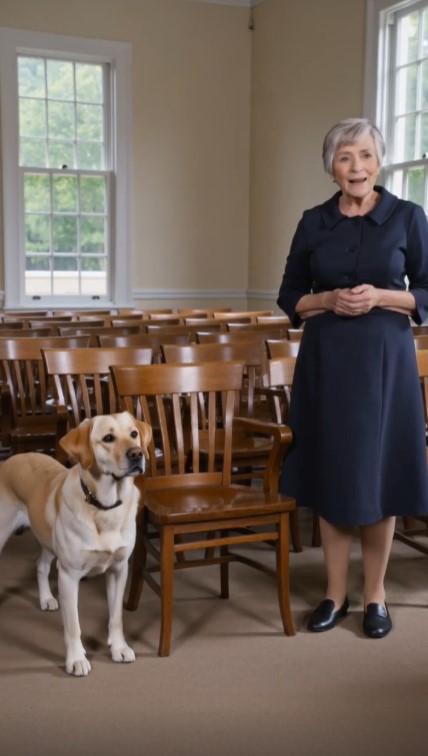
The funeral was about to begin.
Every seat in the chapel was filled except one.
Then Buddy, the deceased man’s old Labrador, slowly walked down the aisle and stopped beside that empty chair.
The family called him back.
“Buddy, come here.”
He ignored them.
The chair was not reserved.
Nobody was supposed to sit there.
Yet Buddy remained beside it, staring toward the entrance as though he were waiting for someone.
Then the chapel doors opened.
A seven-year-old girl stepped inside.
Alone.
She hesitated for only a second before walking directly toward the Labrador.
Buddy changed instantly.
His tail began wagging so hard his entire body moved.
He whined.
He licked the girl’s hands.
He pressed against her legs as though greeting someone he had known for years.
The family stared.
Nobody recognized her.
Thomas’s widow stood slowly.
“Sweetheart… who are you?”
The girl reached into her backpack and pulled out a photograph.
“Mr. Thomas was my friend.”
The widow took it.
Her husband was sitting on a park bench beside the little girl.
Buddy was between them.
The photograph had clearly been taken recently.
For almost two years, Thomas had apparently visited the same park every Wednesday.
His family knew he sometimes went walking with Buddy.
They had never known why.
The girl looked down at the dog.
“My mom was sick,” she explained.
“Mr. Thomas brought us groceries.”
The widow covered her mouth.
“He helped me with homework.”
The girl paused.
“And Buddy walked me home.”
The chapel became completely silent.
Thomas had never told his family about any of it.
No stories.
No mention of a struggling mother.
No explanation for why Wednesday afternoons had become so important to him.
He had simply helped.
Week after week.
Quietly.
The girl pointed toward the empty chair.
“He told me if I ever needed him and he wasn’t there…”
She placed one hand on Buddy’s head.
“…I should find the dog.”
Thomas’s widow knelt in front of her.
“Do you need help now?”
The little girl’s eyes immediately filled with tears.
She nodded.
Then she opened her backpack again.
This time, she removed a sealed envelope.
“Mr. Thomas gave me this last week.”
The widow froze.
Thomas had died unexpectedly six days earlier.
Last week, he had been alive.
Talking to this child.
Preparing something.
The girl handed her the envelope.
The widow looked at the front.
Her first name was written across it in Thomas’s handwriting.
Her hands started shaking.
She opened it.
Inside was a small key.
And one short note.
She began reading.
Then suddenly sat down.
Her adult son rushed forward.
“Mom, what does it say?”
She looked toward the little girl.
Then toward Buddy.
Her face had gone pale.
“He knew this was going to happen.”
The son stared at her.
“What do you mean?”
The widow read the first lines aloud.
Thomas had written that if she was reading the letter, there was a chance he had not been able to explain everything himself.
He asked her not to be angry that he had kept something from the family.
Then he wrote about the girl.
Her name was Lily.
Her mother, Rachel, had been seriously ill.
Thomas met them almost two years earlier when Buddy wandered over to Lily at the park.
What began as a conversation became a routine.
Thomas learned that Rachel was struggling to manage treatments, bills, groceries, and raising her daughter alone.
So he started helping.
He brought food.
Fixed things around their apartment.
Helped Lily with schoolwork.
When Rachel had medical appointments, Thomas sometimes sat with Lily at the park until she returned.
Buddy became part of the arrangement too.
The Labrador walked beside Lily on the short route home.
Thomas never told his family because he did not want praise.
According to the letter, Rachel’s health had recently become worse.
Thomas feared there might come a day when Lily had nowhere stable to go.
The widow’s hands trembled as she continued.
Then she reached the part that explained the key.
Thomas had rented a small apartment near the family home.
He had paid several months in advance.
The key belonged to it.
He had written that if Rachel needed temporary housing or if Lily needed somewhere safe while arrangements were made, the apartment was available.
The son stared at his mother.
“He planned all that?”
The widow nodded.
Then she reached the final paragraph.
Thomas wrote that he had recently received medical test results of his own.
He had not yet told the family.
The results suggested a serious heart problem.
Doctors had warned him that he needed further testing immediately.
He wrote that he expected to be fine.
But he also wrote:
“If I’m wrong, please don’t let Lily think she lost everyone at once.”
The widow stopped reading.
That was what she meant when she said he knew.
Not that Thomas knew the exact day he would die.
But he knew something could happen.
And he had prepared for the child who had come to depend on him.
Then Buddy suddenly left Lily.
The Labrador walked toward a side door of the chapel.
He scratched at it.
Once.
Twice.
Everyone looked over.
Then something scratched from the other side.
Buddy’s tail began wagging.
The funeral director cautiously opened the door.
Another dog stood outside.
A thin black mixed-breed wearing an old green collar.
Lily gasped.
“Max!”
She ran toward him.
The dog rushed inside and pressed against her.
The widow looked confused.
Lily explained that Max belonged to her mother.
Thomas had been caring for him during Rachel’s latest hospital stay.
Nobody in Thomas’s family knew.
The funeral director looked toward the side parking lot.
A woman was standing near the entrance with a hospital bracelet around her wrist.
She was pale and moving slowly.
Lily screamed.
“Mom!”
Rachel had been discharged that morning.
She had insisted on coming.
She had learned about Thomas’s death from a hospital social worker and refused to let the funeral happen without telling his family what he had done.
Lily ran into her arms.
Buddy and Max circled both of them.
Thomas’s widow approached slowly.
Rachel looked at her.
“I’m so sorry.”
The widow shook her head.
“No. I’m sorry we never knew.”
Rachel began crying.
“He didn’t want you to know.”
“That sounds like him.”
For the first time that morning, the widow smiled.
The funeral started late.
Nobody complained.
Lily sat in the empty chair Buddy had chosen.
Her mother sat beside her.
Buddy lay between their feet.
During the service, Thomas’s family learned that the man they were mourning had lived a larger life than they realized.
He had been a husband.
A father.
A grandfather.
And quietly, without asking anyone’s permission or recognition, he had become something close to family for a frightened little girl and her mother.
Afterward, the widow gave Rachel the apartment key.
Rachel tried to refuse it.
The widow closed her hand around it.
“He wanted you to have it.”
Then she looked toward Lily.
“And he asked us not to let her lose everyone at once.”
The little girl hugged her.
Buddy rested his head against the widow’s leg.
Everyone had assumed the Labrador was standing beside an empty chair because he missed his owner.
But Buddy had not been waiting for Thomas.
He had been waiting for the person Thomas knew would come looking for him.
Sometimes the people we lose leave behind more than memories.
Sometimes they leave unfinished acts of kindness.
And sometimes the one who remembers where those promises belong is the dog sitting patiently beside an empty chair.