
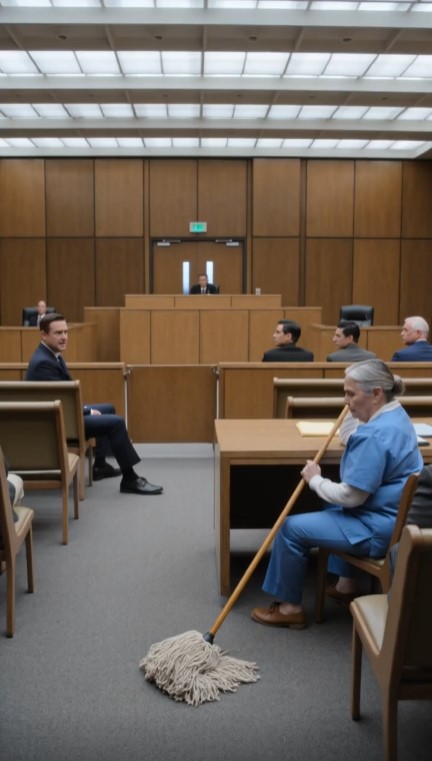
The courtroom was already full before the hearing even began.
Reporters sat near the back. Lawyers whispered over stacks of papers. Businessmen in expensive suits checked their watches as if the entire court schedule existed only to delay their important day.
At the defense table sat Victor Langford, the richest billionaire in the city.
He looked calm, confident, and completely untouched by worry.
To most people in that courtroom, Victor was untouchable. He owned office towers, hotels, shopping centers, and half the buildings on the street outside. His name appeared on charity plaques, political dinners, and luxury development projects across the city.
He was used to people moving out of his way.
He was used to winning.
That morning, he leaned back in his chair with a small smile on his face, speaking quietly to his lawyer. He did not look like a man preparing for a serious case. He looked like a man waiting for an inconvenience to be removed.
Then the side door opened.
An old cleaning lady stepped into the courtroom.
The room changed almost immediately.
She walked slowly, carrying a worn mop in one hand and a small folder pressed against her chest. Her shoes were old. Her coat was faded. Her gray hair was tied neatly at the back of her head, and her hands looked tired from years of work.
She looked completely out of place among the polished tables, dark suits, and expensive briefcases.
A few people turned to stare.
Then someone laughed.
It was quiet at first, but it spread quickly.
One man covered his mouth. Another whispered something to the person beside him. Even a few of Victor Langford’s associates smiled as if the old woman had walked into the wrong room.
The cleaning lady kept walking.
She did not look at them.
She did not answer the laughter.
She simply moved toward the plaintiff’s table and sat down.
That was when Victor finally noticed her.
His smile grew wider.
He looked at his lawyer, then back at the old woman, unable to hide his amusement.
“This won’t take long,” he said.
His words were soft, but the courtroom was quiet enough for many people to hear them.
More laughter followed.
To Victor, the case was already finished.
What could an old cleaning lady possibly do against him?
She had no expensive team. No powerful friends sitting behind her. No designer clothes. No dramatic entrance. No sign of influence.
She had only an old folder, a tired face, and a quiet kind of dignity that the people in the courtroom failed to notice.
The woman placed her mop carefully beside her chair.
Then she folded her hands on the table and waited.
Across from her, Victor Langford continued smiling.
He believed the courtroom belonged to people like him.
People with money.
People with connections.
People whose names opened doors before they even knocked.
The old cleaning lady was, in his eyes, nothing more than a mistake sitting in the wrong seat.
A clerk called the room to order.
The courtroom doors opened.
Everyone stood as the judge entered.
But then something strange happened.
The judge did not walk straight to the bench.
He stopped.
The room grew still.
At first, people thought he had noticed some problem in the courtroom. Maybe a missing document. Maybe an issue with the case file. Maybe a delay.
But the judge’s eyes were fixed on the plaintiff’s table.
He looked directly at the old cleaning lady.
For a moment, no one moved.
Then the judge stepped down from the center aisle and began walking toward her.
A whisper moved through the room.
Victor’s smile faded slightly.
His lawyer straightened in his chair.
The old woman looked up as the judge approached.
There was no fear in her face.
Only softness.
The judge stopped in front of her.
Then, in front of the billionaire, the lawyers, the reporters, and everyone who had laughed, he gently bent down and kissed her forehead.
The courtroom fell completely silent.
No one understood what was happening.
Then the judge spoke quietly.
“Good morning… Mother.”
The words landed like thunder.
Victor Langford’s smile disappeared.
His lawyer froze.
The men who had laughed only moments earlier looked away, suddenly fascinated by the floor, their papers, or anything that would keep them from meeting her eyes.
The woman they had mocked was not just an old cleaning lady.
She was the judge’s mother.
And in that moment, every person in the courtroom realized they had laughed at the wrong woman.
The judge turned toward the room, his expression calm but firm.
He did not need to raise his voice.
The silence already belonged to him.
The old woman gently touched his hand, as if reminding him to remain steady. Then he walked back toward the bench and took his seat.
But the atmosphere had changed completely.
Only minutes earlier, Victor Langford had looked like the most powerful person in the room.
Now he looked uncomfortable.
The old cleaning lady still sat in the same chair. Her shoes were still worn. Her coat was still faded. Her hands were still tired.
But nobody was laughing anymore.
The case began.
Victor’s lawyer tried to recover quickly, speaking with polished confidence and carefully chosen words. He described the billionaire’s company as respected, successful, and generous. He suggested that the complaint was simple, exaggerated, and not worth the court’s time.
Victor nodded along, trying to regain the confidence he had lost.
But the old woman did not react.
She waited until it was her turn.
Then she slowly opened the folder she had brought with her.
Inside were papers she had saved carefully for years.
Not expensive documents prepared by a large legal team.
Not glossy reports.
Just simple evidence, organized by a woman who had spent her life paying attention while others ignored her.
She explained that she had worked as a cleaner in one of Victor Langford’s buildings for many years.
She had arrived before sunrise.
She had stayed after others went home.
She had cleaned offices where people never learned her name.
She had emptied trash bins filled with papers worth more than her monthly rent.
She had polished floors for executives who walked past her as if she were invisible.
But she had never complained about honest work.
What brought her to court was not pride.
It was principle.
She said Victor’s company had tried to push longtime workers out of the building without honoring what they were owed. She said people who had given years of service were treated as if they were disposable. She said promises had been made, then ignored.
Victor’s lawyer objected.
The judge listened carefully.
The old woman remained calm.
She did not speak with anger. She spoke with the tired strength of someone who had carried the truth for a long time and finally had a chance to place it on the table.
Every sentence made the room quieter.
The people who had laughed now listened.
The reporters at the back began writing faster.
Victor shifted in his seat.
The old woman continued.
She spoke about workers who were too afraid to come forward. She spoke about people who needed their jobs, people who had families, people who had been told that no one would believe them if they complained.
Then she lifted one paper from the folder.
Her hand trembled slightly, but her voice stayed steady.
She had records.
She had dates.
She had signatures.
She had names.
The billionaire’s confidence began to crack.
His lawyer leaned closer and whispered something urgently, but Victor did not answer. His eyes were fixed on the folder in the old woman’s hands.
For the first time that morning, he did not look amused.
He looked worried.
The judge allowed the woman to continue.
He did not treat her with favoritism. He did not interrupt the process. He did not turn the courtroom into a family moment.
He simply gave her the respect every person deserves in front of the law.
And that respect made the difference.
Because for once, the old cleaning lady was not being rushed away, ignored, mocked, or spoken over.
For once, everyone had to hear her.
The billionaire had entered the courtroom believing money would protect him.
He believed his reputation would speak louder than her pain.
He believed the old woman’s appearance would make people dismiss her before she even opened her mouth.
But he had underestimated the power of a quiet person with the truth in her hands.
As the hearing continued, Victor’s earlier words seemed to hang over the room.
“This won’t take long.”
He had said it with arrogance.
Now those words sounded foolish.
The case was not the small embarrassment he expected. It was a mirror held up in front of him, forcing everyone to see how quickly powerful people can mistake humility for weakness.
The old woman did not need expensive jewelry to matter.
She did not need a famous last name to deserve respect.
She did not need to look powerful to have a powerful story.
When the judge finally called for a pause, nobody moved right away.
The room remained heavy with the lesson that had just unfolded.
Victor sat silently at the defense table.
The old cleaning lady closed her folder and placed both hands over it.
Her son, the judge, looked down from the bench, not as a child defending his mother, but as a man shaped by her sacrifice.
Everyone now understood what Victor had failed to see.
The woman he mocked was the reason the judge became a judge.
She had cleaned buildings so her son could study.
She had worked long hours so he could keep going.
She had carried a mop through hallways of people who never thanked her, all while raising someone who would one day sit above a courtroom and protect the dignity of people like her.
That was the truth that silenced the billionaire.
Not just that she was the judge’s mother.
But that her life of quiet sacrifice had helped build the very justice system he now had to face.
The courtroom had started with laughter.
It ended with shame, respect, and silence.
The same people who had judged her by her shoes now saw the strength behind every step she had taken.
The same people who had mocked the mop beside her chair now understood that honest work is never something to laugh at.
And the billionaire, who had believed wealth made him untouchable, learned that the law does not bow to expensive suits.
The old cleaning lady did not smile in victory.
She did not celebrate his humiliation.
She simply sat with quiet dignity, the same way she had entered.
That was what made the moment unforgettable.
She had not come to court to impress anyone.
She had come for justice.
And when the judge walked toward her, kissed her forehead, and called her mother, the entire room learned a lesson that money could never buy.
Never judge someone by worn shoes, tired hands, or the job they do.
Because the person you laugh at today may be the person whose sacrifice built the future you are standing in.