
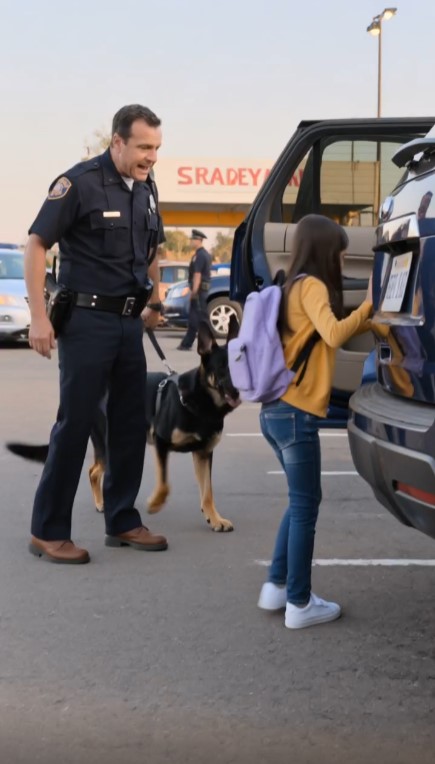
The little girl was already reaching for the car door when Atlas stepped between her and the vehicle.
“Atlas, move.”
He refused.
Her father gave a nervous laugh.
“Officer, she’s my daughter.”
I knew that.
We had just spent nearly an hour helping reunite them after the girl wandered away from a crowded county fair.
She looked exhausted.
Her father looked relieved.
Everything should have been over.
But Atlas stood beside the rear passenger door with his body rigid and his ears forward.
He was not looking at the father.
He was looking at the car.
A low growl came from his chest.
I shortened the leash.
“Atlas. Leave it.”
Nothing.
Then he lowered his head, pushed his nose beneath the rear bumper, scratched once, and looked directly at me.
That was not random behavior.
That was his trained alert.
I looked at the father.
“Is there anything in the trunk?”
“Camping gear.”
The answer came too quickly.
The little girl suddenly grabbed my sleeve.
“That’s where Daddy keeps the blue suitcase.”
Her father’s expression changed.
I looked at him.
“What blue suitcase?”
He immediately stepped toward his daughter.
Atlas moved between them.
No barking.
No attack.
Just a wall.
My partner noticed the shift and came over.
I asked the father to remain where he was.
He objected.
“This is ridiculous. You found my daughter. I’m taking her home.”
“Then this should only take a minute.”
We opened the trunk.
At first, everything looked ordinary.
Blankets.
A cooler.
A folding chair.
Camping equipment.
Then I saw it.
A large blue suitcase pushed against the back.
The father pointed toward it.
“See? Clothes.”
Atlas walked straight to it.
Then sat.
Another trained alert.
The father stopped talking.
I unzipped the suitcase.
There were no clothes inside.
Instead, we found stacks of children’s drawings.
Old photographs.
Small toys.
A few hair ribbons.
And one pink bracelet.
The little girl saw it from behind me.
Her face changed instantly.
“That’s Emma’s.”
Her father snapped toward her.
“She’s confused.”
But I knew the name.
Everyone working that fair knew the name.
Emma had disappeared from the same fairgrounds six months earlier.
Her picture had been on posters across the county.
Search teams had covered drainage areas, wooded roads, abandoned buildings, and nearby towns.
Nothing had ever been found.
I picked up the bracelet.
The little girl was crying now.
“Emma wore that.”
Her father raised his voice.
“She’s nine. She says things.”
Atlas pushed his nose deeper into the suitcase.
Then he pulled something out.
A motel key card.
The logo had mostly faded, but I recognized it.
An old roadside motel less than twenty miles away.
It had been closed for years.
I had passed it dozens of times.
The father suddenly turned toward the parking lot.
My partner stepped into his path.
“Stay where you are.”
The girl whispered:
“Daddy said Emma still sleeps there.”
Everything stopped.
Even her father.
I crouched beside her.
“What did you say?”
She looked terrified.
“Daddy told me not to talk about Emma.”
Her father started shouting.
“She doesn’t know what she’s saying!”
Atlas turned toward the road.
Then began barking.
Once.
Twice.
Again.
He wanted to move.
We did not take the father with us.
He was detained while detectives were called to the fairgrounds.
The girl was moved away from the car and placed with a female officer she trusted.
Within minutes, the old motel address was being checked.
Records showed the property had officially been abandoned after a fire damaged part of the building.
But several structures behind the main office were still standing.
A search team went in.
Atlas and I joined them.
The moment we reached the motel driveway, his entire body changed.
He pulled hard.
He had a scent.
The parking lot was cracked and covered with weeds.
Most doors were boarded.
Windows were broken.
At the far end of the property stood a row of older rooms hidden behind overgrown trees.
Atlas went straight there.
He stopped outside one door.
Scratched.
Then whined.
An officer forced it open.
The room was empty.
At least, that is what it looked like.
Old mattress.
Dust.
Broken lamp.
Water stains.
Then Atlas walked to the rear wall.
He sat.
Another alert.
Behind a warped panel, officers found a narrow opening.
A second room had been hidden behind the first.
There were blankets inside.
Children’s books.
Bottled water.
More drawings.
And several photographs matching the ones found in the suitcase.
Then we heard something.
A faint sound.
Three knocks.
Everyone froze.
Knock.
Knock.
Knock.
Atlas started whining.
We followed the sound toward an interior maintenance corridor.
One section of the floor had been covered with old plywood.
When officers moved it, they found stairs leading down.
The basement should have been sealed.
It wasn’t.
We went in carefully.
Atlas stopped halfway down.
His ears lifted.
Then from the darkness came a child’s voice.
“Hello?”
One of the officers shouted back.
“Police! Keep talking!”
A girl began crying.
We found her behind a locked utility door.
Thin.
Frightened.
Alive.
Emma.
Six months after she disappeared.
The moment Atlas entered the room, she reached for him.
He lay down beside her.
She wrapped both arms around his neck.
One officer turned away because he was crying.
Emma was taken outside and rushed for medical evaluation.
The evidence recovered from the motel triggered a much larger investigation.
Detectives searched the father’s car, home, storage areas, electronic records, and financial activity.
The suitcase was not a collection of random objects.
It was a link between the missing girl, the motel, and the man who had nearly driven away with his daughter minutes earlier.
The little girl later explained that she had seen Emma at the motel before.
Her father told her Emma was “staying there.”
He warned her never to tell anyone.
She believed him.
Children often do.
But when she saw Emma’s bracelet inside the suitcase, she understood that something was wrong.
That was why she spoke.
And Atlas gave her the chance.
If he had obeyed my first command, she would have entered the car.
The suitcase would have left.
The motel key might never have been found.
Emma might have remained hidden.
I thought about that for weeks.
Police dogs are trained to detect scents, track movement, and alert to things humans miss.
But after years of working beside Atlas, I had learned something else.
Sometimes they notice the moment when a situation that looks finished is not finished at all.
Everyone believed the reunion at the fair was the end of the story.
Atlas knew better.
He stood between one little girl and a car.
Then he sat beside one blue suitcase.
That single refusal reopened a disappearance that had haunted an entire community for six months.
And by nightfall, a family who had nearly lost hope received the call they had been waiting for.
Emma was alive.