
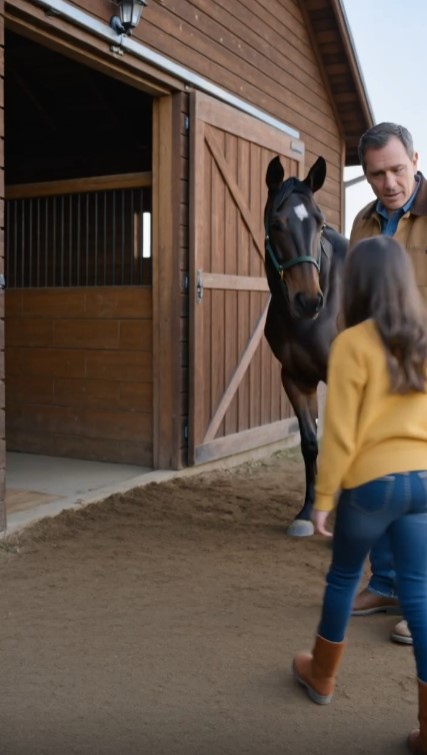
The little girl had walked into that barn every day of her life.
Then one afternoon, Duke refused to let her inside.
She stepped toward the doorway.
The old gelding moved directly in front of her.
She went left.
He moved left.
She tried the other side.
Duke blocked her again.
Her father laughed at first.
“Duke, move.”
The horse did not.
The eight-year-old girl smiled.
“He thinks it’s a game.”
But I was watching Duke’s ears.
He was not playing.
His ears were pinned backward.
His muscles were tense.
And every few seconds, he looked into the dark barn before backing closer to the child.
He was not keeping her from going somewhere.
He was protecting her from something inside.
“Don’t make him move,” I said.
Her father looked at me.
“Why?”
“Because he’s scared.”
That got his attention.
Duke had lived on the farm for nearly fifteen years.
He had been around tractors, storms, dogs, cattle, machinery, and every strange sound a working farm could make.
Very little frightened him.
Yet now he refused to place even one hoof across the barn threshold.
The girl’s father took a cautious step forward.
Duke stomped once.
Hard.
Then pushed backward against the child.
“Something’s in there,” I said.
We walked around the building and opened the opposite barn door from a safe distance.
Sunlight spilled across the floor.
Nothing moved.
No person.
No animal.
No obvious danger.
The barn looked exactly as it always had.
Hay stacked against one wall.
Tools.
Feed bins.
Old tack.
Then Duke started pawing outside the main entrance.
Once.
Again.
Again.
We looked down.
The dirt near the threshold appeared slightly different from the rest.
Smoother.
Recently disturbed.
The girl’s father went to get a shovel.
He scraped away the first inch.
Then another.
At about three inches, the shovel struck something solid.
Wood.
We cleared away the dirt.
A rectangular outline appeared beneath the barn entrance.
There was a trapdoor buried under the ground.
The father stared at it.
“I’ve owned this place for twelve years.”
He looked at me.
“I never knew this existed.”
Neither did the previous owner, as far as he knew.
Duke backed farther away.
When we lifted the door, cold air rushed upward.
Stone steps disappeared into darkness beneath the barn.
The little girl leaned forward before her father pulled her back.
Then she whispered:
“Daddy…”
Her voice had changed.
“Why is my name written down there?”
We looked.
Carved into the wood of the first stair was her first name.
LILY.
Underneath it were two more words.
AGE 8.
Her father went completely pale.
Lily was eight years old.
He slammed the trapdoor shut.
“No.”
I grabbed his arm.
“Call the police.”
He already had his phone out.
That was when Duke spun toward the pasture.
His head shot up.
At the far fence stood a man.
Gray coat.
Work boots.
One hand resting on the top rail.
Watching us.
Lily’s father stared at him.
“That’s impossible.”
“Who is he?”
His answer came almost as a whisper.
“The man who built this barn.”
I looked back toward the stranger.
“When?”
“Forty years ago.”
The man raised one hand.
Then pointed directly toward the trapdoor.
Lily’s father stepped in front of his daughter.
“The man who built this barn died before Lily was born.”
The stranger turned and walked toward the trees.
Duke immediately began neighing.
Police arrived minutes later.
By then, the man was gone.
Officers searched the pasture and surrounding woods while another team examined the trapdoor.
Nobody allowed Lily near it.
A deputy descended first.
The stairs led into a narrow underground corridor.
The walls were reinforced with old timber.
Dust covered most of the floor.
But not all of it.
There were recent footprints.
At the bottom was a small room.
A table.
A chair.
Several empty bottles of water.
And photographs.
The photographs covered one wall.
Most showed the farm over the years.
The barn.
The house.
The pasture.
Then officers found pictures of Lily.
At school.
At the county fair.
Riding Duke.
Walking beside her father.
Some had been taken only days earlier.
Her father stared at them.
“Someone’s been watching her.”
On the table sat a notebook.
Every page contained dates.
Some were decades old.
Others were recent.
Near the end, officers found Lily’s name.
Beside it:
“Eight years. Same age as Anna.”
The name meant nothing to us.
But Lily’s father suddenly remembered something.
The original builder of the barn had a daughter.
Her name had been Anna.
She disappeared when she was eight years old.
That had happened more than thirty years earlier.
The case had never been solved.
The barn builder spent the rest of his life searching for her.
Then came the photograph that changed everything.
Inside a drawer was an old family picture.
The builder stood beside a little girl.
Anna.
Behind them stood another man.
Much younger.
But unmistakable.
It was the same man we had seen at the fence.
He was not the dead barn builder.
He was his younger brother.
He had disappeared from the area shortly after Anna vanished.
Most people assumed he had moved away.
Apparently, he had returned.
Police began searching records.
The brother, now an elderly man, had been living under another name less than thirty miles away.
And according to documents found in the underground room, he had been using the hidden passage for years.
The carving on the stair had not been there for decades.
It was fresh.
Lily’s name had been added recently.
So had her age.
Her father sat down when he understood what that meant.
Whatever had happened to Anna all those years earlier, someone had started watching another eight-year-old girl.
His daughter.
The search for the man intensified.
But Duke was not finished.
While officers examined the underground room, the horse suddenly walked toward the far side of the barn.
He stopped beside an old stall wall and began striking the boards with his nose.
A deputy followed him.
Behind several pieces of loose timber was a second opening.
Much narrower.
It led from the underground room toward the pasture.
That was how someone had been entering without using the trapdoor.
Fresh boot prints led through it.
Duke had likely smelled the person beneath the barn long before any of us knew someone was there.
That was why he blocked Lily.
He had not been afraid of the barn.
He had been afraid of the person underneath it.
The prints continued across the pasture.
Into the trees.
Police followed.
About half a mile away, they found an abandoned hunting cabin.
The man from the fence was inside.
He was taken into custody without anyone being harmed.
The investigation that followed reopened Anna’s decades-old disappearance.
Evidence recovered from the cabin and underground room finally gave detectives leads that had never existed before.
For Lily’s family, though, one fact mattered more than anything else.
Duke had noticed danger before anyone else.
He had smelled something beneath the floor.
Recognized that it did not belong.
And placed his entire body between a little girl and the doorway she had walked through safely hundreds of times.
The next morning, Lily went outside to see him.
Duke was standing beside the pasture gate.
She wrapped her arms around his neck.
“You knew, didn’t you?”
The old horse lowered his head against her shoulder.
The trapdoor beneath the barn was sealed permanently.
The underground passage was turned over to investigators.
And Duke was never again treated like a stubborn old horse when he refused to move.
Because sometimes an animal is not misbehaving.
Sometimes he is the only one who knows that something familiar has suddenly become dangerous.
We should listen to our animal more. There not stupid know more than we do there senses are strong
So true about animals fuke senced danger for this girl. Who he’d bonded with.not knowing the outcome finding out about the first girl.will keep them safe.