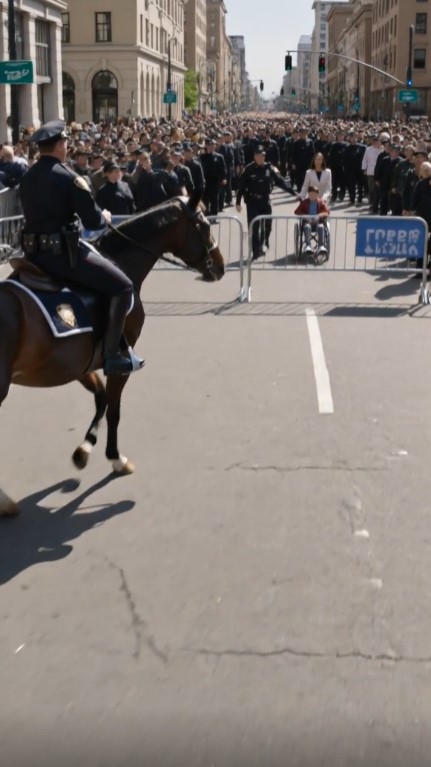
Thousands of people were watching the parade when the police horse suddenly stopped.
For several seconds, nobody understood why.
The marching band continued farther down the avenue. Children waved small flags from behind the barricades. Police motorcycles moved slowly past the reviewing stand.
But Atlas would not move.
The mounted officer gently tightened the reins.
“Atlas, forward.”
The horse ignored him.
Instead, Atlas turned completely around.
Then began walking toward the sidewalk.
Straight toward a twelve-year-old boy sitting in a wheelchair.
People immediately lifted their phones.
Noah Hayes sat beside his mother behind the metal barrier. He had not called the horse. He had not reached toward him.
Yet Atlas stared directly at the boy as though he had recognized someone in a crowd of thousands.
The officer tried again.
“Atlas.”
Nothing.
The enormous horse lowered his head.
Then gently rested his muzzle against Noah’s shoulder.
Noah started crying.
His mother covered her mouth.
The mounted officer looked confused.
“Does he know this horse?”
She shook her head.
“No.”
Noah wiped his face.
Then whispered:
“But my dad did.”
The officer froze.
Noah’s father, Sergeant Michael Hayes, had served with the mounted police unit for years.
He had died two years earlier.
Noah reached beneath his jacket and pulled out an old police badge.
Atlas saw it.
The horse immediately lifted one hoof and pawed the pavement.
Once.
Twice.
Then he made a low sound the officer said he had never heard from him before.
The officer stared at the badge.
“Where did you get that?”
“It was Dad’s.”
The officer looked from Noah to Atlas.
There was something the boy had never been told.
Atlas had once belonged to Sergeant Hayes.
For years they had worked together.
Parades.
Crowd control.
Search operations.
Community events.
They had been nearly inseparable.
After Sergeant Hayes died, Atlas changed.
The horse became difficult during ceremonies.
He resisted certain routes.
Sometimes he stood looking toward the stable entrance long after everyone else had left.
Eventually, the department transferred him to another mounted unit.
Noah’s mother had never known.
Noah reached up and touched the horse’s forehead.
“Dad talked about you every night.”
Atlas closed his eyes.
The cheering along the street slowly faded.
People nearby stopped filming.
Some simply watched.
Others wiped their eyes.
Then Atlas suddenly lifted his head.
He sniffed Noah’s wheelchair.
Once.
Again.
Then started nudging the small storage pouch attached beneath the seat.
Noah’s mother frowned.
“What is he doing?”
The mounted officer dismounted.
He opened the pouch.
Inside was something nobody recognized.
A small leather case.
Noah stared at his mother.
“That isn’t mine.”
She shook her head.
“I’ve never seen it.”
The officer opened it.
Inside was an old photograph.
Sergeant Michael Hayes stood beside Atlas outside the mounted unit’s original stable.
Michael was smiling.
One arm was around the horse’s neck.
Beside the photograph was a brass key.
The officer turned the picture over.
Four words were written on the back.
“For Noah. When ready.”
Noah’s mother went pale.
“That’s Michael’s handwriting.”
The officer looked toward Atlas.
The horse was already turning away from the parade route.
He started walking toward the park.
Not wandering.
Leading them.
Across the grass stood an old brick mounted-police stable.
It had not been used in years.
The officer watched Atlas carefully.
“That building has been locked since your father died.”
Noah looked at the key.
“Then maybe Dad left something inside.”
The officer helped move the barrier.
Noah’s mother pushed the wheelchair across the park while Atlas walked beside them.
The crowd watched from a distance.
When they reached the stable, the brass key fit the old lock perfectly.
But before the officer could turn it, Atlas moved forward.
The horse pressed one ear against the wooden door.
Then immediately stepped backward.
The officer frowned.
“What is it?”
Then everyone heard it.
Knock.
Knock.
Knock.
Three slow knocks came from inside the supposedly empty stable.
Noah’s mother grabbed the wheelchair handles.
The officer called for backup.
Nobody opened the door until two more mounted officers arrived.
Then the key turned.
The old door creaked inward.
The stable smelled of dust, leather, and old wood.
Sunlight entered through narrow windows.
At first, nothing moved.
Then another sound came from the far stall.
A soft scrape.
The officers approached carefully.
Behind the stall door sat an elderly man.
He wore an old mounted-police jacket.
Beside him was a wooden box.
Atlas immediately walked toward him.
The man looked up.
Then smiled.
“Hello, old friend.”
Atlas pushed his nose against the man’s chest.
The mounted officer stared.
“Captain Brennan?”
Noah’s mother recognized the name.
Patrick Brennan had been Michael’s commanding officer.
He had disappeared from public life shortly after Michael died.
Most people believed he had retired and moved away.
Instead, Brennan had been returning secretly to the stable.
Noah stared at him.
“Did you know my dad?”
Brennan looked toward the boy.
“I knew him for twenty-two years.”
Noah’s mother stepped forward.
“Why are you here?”
Brennan looked down at the wooden box.
“Because Michael asked me to be.”
The stable went silent.
Months before his death, Sergeant Hayes knew his health was failing.
He also knew Noah was still too young to understand everything he wanted to leave behind.
So Michael created a plan.
The brass key.
The photograph.
The leather case.
And Brennan.
Brennan had been instructed to wait until Atlas brought Noah to the stable.
No date.
No scheduled meeting.
Michael believed the horse would know when the time was right.
Noah’s mother looked at him in disbelief.
“You’ve been waiting two years?”
“Not every day.”
Brennan smiled.
“But every parade anniversary.”
Michael had known Atlas would eventually be returned for one of the department’s major ceremonial routes.
He suspected the horse might recognize Noah if they ever crossed paths.
The leather case had been hidden years earlier inside a removable lining in Michael’s old wheelchair-accessible equipment bag.
After Michael died, several of his belongings had been stored with Noah’s things.
Nobody noticed it.
Atlas did.
The horse remembered the smell.
Brennan lifted the wooden box.
“This is yours.”
Noah placed it on his lap.
Inside was his father’s mounted-unit helmet.
A stack of letters.
A small medal.
And an old video camera.
Noah picked up the first envelope.
His name was written across the front.
He opened it.
The letter began:
“Noah, if Atlas brought you here, then he remembered both of us.”
Noah stopped reading.
His mother began crying.
Brennan looked away.
Noah continued.
Michael wrote about the horse.
About fear.
About promises.
About how Noah should never believe strength meant never needing help.
Then he explained the medal.
It had been awarded after Michael and Atlas rescued a child during a storm years earlier.
Michael never displayed it.
He wanted Noah to have it instead.
The next letter was for Noah’s mother.
The third was addressed simply:
“For the day you think you can’t do something.”
Inside was a photograph of Michael helping a much younger Noah learn to ride a therapeutic horse.
Noah smiled through tears.
Then Brennan pointed toward the old video camera.
“There’s more.”
The battery was dead.
But the memory card still worked.
One of the officers brought a laptop from a patrol vehicle.
They inserted the card.
A video appeared.
Sergeant Michael Hayes sat inside the same stable.
Atlas stood behind him.
Michael looked thinner than Noah remembered.
But he was smiling.
“Hey, buddy.”
Noah immediately began crying again.
On the screen, Michael reached backward and patted Atlas.
“If you’re watching this, there’s a good chance this stubborn horse finally did what I hoped he would.”
Several officers laughed softly.
Michael continued.
“I couldn’t promise I’d always be beside you. Nobody can promise that.”
Noah listened without moving.
“But I can promise this. The people who love you leave pieces of themselves everywhere.”
Michael pointed toward Atlas.
“In memories.”
Then toward the stable.
“In places.”
Then toward the camera.
“In words.”
His voice softened.
“And sometimes in a horse who refuses to forget.”
Noah’s mother covered her face.
Then the video changed.
Michael explained something nobody expected.
The stable was scheduled to be demolished.
The department no longer needed it.
Michael had spent his final months trying to prevent that.
He wanted the building turned into a therapeutic riding center for children with disabilities.
He had started the paperwork.
Raised some money.
But died before completing the project.
Inside the wooden box were the original plans.
Letters from donors.
And one signed authorization allowing the project to continue under Noah’s name when he became old enough.
Noah looked at Brennan.
“Dad wanted me to have a stable?”
Brennan shook his head.
“He wanted you to decide what happened to it.”
The boy looked around.
Old stalls.
Dusty windows.
Cracked wood.
Then he looked toward Atlas.
“Can kids ride horses here?”
“They could.”
Noah did not hesitate.
“Then don’t tear it down.”
Word of what happened spread through the parade crowd before the event had even ended.
Within days, videos of Atlas approaching Noah were being shared everywhere.
But the story did not end with the reunion.
Donations arrived.
Former mounted officers volunteered.
Local builders offered materials.
Families of children who used therapeutic riding programs began helping.
Months later, the old stable reopened.
A new sign stood outside.
THE HAYES-ATLAS RIDING CENTER.
Noah insisted both names be included.
On opening day, Atlas stood near the entrance.
Older now.
Calmer.
No longer part of active mounted patrol.
The department officially retired him to the center.
Noah rolled toward him.
Atlas lowered his head exactly as he had during the parade.
Noah touched his forehead.
“You found it.”
Brennan stood nearby.
“Found what?”
Noah smiled.
“What Dad left.”
The old captain shook his head.
“No.”
He looked around at the children waiting to meet the horses.
“He found what your dad hoped you would build.”
For two years, Noah thought his father had left him memories.
He had.
But Michael Hayes had also left him something larger.
A purpose.
A place where other children could experience the same bond he had once shared with his son.
And the messenger was the one partner Michael trusted most.
A horse that stopped in the middle of a parade because somewhere in a crowd of thousands, he recognized the family he had never forgotten.
Awesome story animals remember better than anyone else thanks for sharing