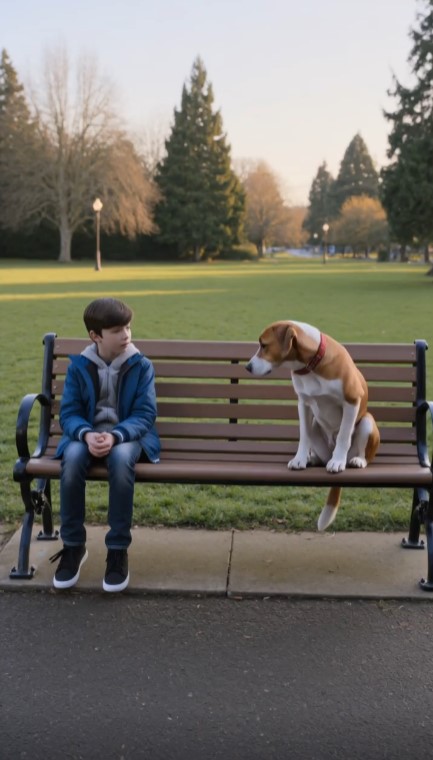
For 43 days, the little boy sat on the same park bench after school.
And every day, the same stray dog waited for him.
People assumed the boy was feeding him.
He wasn’t.
They simply sat together.
One at each end of the bench.
Until exactly 5:15.
Then the dog left.
Every day.
Same time.
Same direction.
A local police officer eventually noticed.
One afternoon, he stopped near the bench.
“Is that your dog?”
Ten-year-old Caleb shook his head.
“His name is Max.”
“How do you know?”
Caleb pointed toward the dog’s worn collar.
The name was barely visible beneath years of dirt and scratches.
The officer looked at Caleb.
“Why do you come here every day?”
Caleb stared at Max.
“Because he waits for my sister.”
The officer stopped smiling.
Caleb’s seventeen-year-old sister, Hannah, had vanished six months earlier.
This park was the last place she had been seen.
No one knew exactly what happened.
Her phone stopped working that evening.
Her backpack disappeared with her.
Police searched parks, roads, abandoned buildings, train stations, and nearby neighborhoods.
Nothing.
Then three weeks after Hannah vanished, Max appeared.
Nobody knew where the dog came from.
But every afternoon, he sat beside Caleb.
Then at exactly 5:15, he left.
The officer checked his watch.
5:14.
“Where does he go?”
Caleb shrugged.
“He never lets me follow.”
The minute changed.
5:15.
Max stood.
The officer followed.
The dog crossed the park.
Went beneath an old pedestrian bridge.
Then stopped beside a storm drain.
He didn’t bark.
He simply stared inside.
The officer shined a flashlight through the bars.
Nothing.
Then Max reached one paw into the drain.
He scraped something through the dirt.
A silver necklace.
Caleb screamed.
“That’s Hannah’s!”
The officer immediately called for assistance.
But Max wasn’t finished.
He grabbed the officer’s sleeve gently.
Then ran.
Across the grass.
Past the old playground.
Toward an abandoned railway platform.
Behind a weathered bench was a backpack.
Caleb recognized the initials stitched into the fabric.
H.H.
He started crying.
The officer carefully opened it.
Inside was a phone.
Dead for six months.
Or so everyone thought.
The screen suddenly illuminated.
One percent battery.
One unsent video.
The officer pressed PLAY.
Hannah appeared.
Alive.
Scared.
Max was sitting beside her.
She looked directly into the camera.
“Caleb, if Max finds you, follow him.”
Caleb stared at the dog.
The recording continued.
“He knows where I’m waiting.”
Then the screen died.
Max immediately ran again.
Toward an old train tunnel that had been sealed for years.
The officer shouted:
“Max!”
The dog stopped at the entrance.
Then from deep inside the darkness came a girl’s voice.
“Caleb?”
He knew that voice.
“HANNAH!”
The officer stopped him before he could run inside.
The tunnel had been closed because sections of it were unstable.
Backup arrived within minutes.
Firefighters.
Police.
Emergency crews.
Max stood at the entrance whining.
Caleb kept calling.
“Hannah!”
Then her voice came again.
Fainter this time.
“I’m here!”
Rescue crews entered carefully.
Max tried to follow.
The officer held him back.
The dog barked once.
Then again.
Almost as though he were telling them which direction to go.
The tunnel stretched much farther than most people realized.
Years earlier, trains had used it to reach a maintenance yard.
After the line closed, several side chambers were sealed.
One passage had been forgotten entirely.
That was where rescuers found Hannah.
Alive.
Weak.
But alive.
She was sitting inside an old maintenance room.
Blankets covered the floor.
Empty water bottles were stacked against one wall.
Someone had clearly been helping her survive.
Caleb ran toward her the moment rescuers brought her out.
He wrapped his arms around her.
“You came back.”
Hannah cried.
“I tried.”
Then she looked over his shoulder.
“Where’s Max?”
The dog was already pulling toward her.
The officer released him.
Max ran.
Hannah dropped to her knees.
The dog pressed his entire body against her.
She buried her face in his fur.
“He found you.”
Caleb stared at her.
“You knew him?”
Hannah nodded.
“He saved me.”
The story came slowly.
Six months earlier, Hannah had been walking through the park after meeting a friend.
She heard a dog barking near the railway bridge.
When she went to check, she found Max trapped beneath broken fencing near the old tracks.
She freed him.
Then something happened.
A section of rotting walkway collapsed.
Hannah fell into a drainage channel.
She injured her leg badly enough that she could not climb out.
Max stayed with her.
For nearly a day, he barked.
Nobody heard.
Eventually, Hannah managed to crawl toward the abandoned tunnel.
She believed she could reach the other side.
Instead, she became lost inside the old maintenance passages.
Caleb stared.
“Why didn’t you call?”
“My phone broke.”
“But you made the video.”
Hannah nodded.
“There was enough battery once.”
She recorded the message when she realized Max understood how to leave the tunnel.
She tied her necklace to his collar.
But the necklace came loose near the storm drain.
Max returned.
Again and again.
For days.
The dog began leaving the tunnel every afternoon.
Hannah noticed a pattern.
At 5:15, when nearby shops closed and foot traffic increased, Max disappeared.
Then he came back later carrying food.
Sometimes bread.
Sometimes scraps.
Sometimes small bottles people left behind.
The officer frowned.
“You survived six months like that?”
Hannah shook her head.
“No.”
There was more.
A man had found her.
An elderly former railway worker named Samuel.
He lived alone in an unofficial shelter near the far end of the tunnel.
He discovered Hannah after hearing Max barking.
Samuel brought food.
Water.
Bandages.
He wanted to call police.
But Hannah became frightened.
Not of police.
Of the man she believed had followed her into the park before the accident.
She had seen someone watching her for several days.
After she fell, she heard footsteps above the drainage channel.
Then someone searching near the tunnel entrance.
She became convinced the person who had been following her knew she was alive.
Samuel believed her.
He helped hide her while trying to find a safe way to get help.
The officer looked around.
“Where is Samuel?”
Hannah’s face changed.
“He left three days ago.”
“Why?”
“He said someone found the tunnel.”
Caleb looked at Max.
“Was that why he started waiting for me?”
Hannah nodded.
Samuel had recognized Caleb from a photograph Hannah carried.
He began sending Max toward the park at the time Caleb usually walked home from school.
At first, Max only watched.
Then one day, Caleb sat on the bench.
Max sat beside him.
That became their routine.
Samuel was teaching the dog where to find him.
The officer looked toward the tunnel.
“So why did it take 43 days?”
Hannah started crying.
“Because Max wasn’t supposed to lead Caleb here until Samuel knew the person following me was gone.”
The officer’s expression changed.
“Who was following you?”
Hannah looked toward the old railway platform.
“I don’t know his name.”
But she remembered his face.
Police showed her photographs from several recent cases.
She stopped at one.
A man who had been questioned months earlier for approaching teenagers near local parks.
He had never been charged.
Now investigators had something more.
Hannah remembered his car.
Samuel had written down part of the license plate.
The note was still inside the maintenance room.
Police found the vehicle two days later.
The man was arrested on unrelated outstanding charges while investigators examined his connection to Hannah.
But another question remained.
Where was Samuel?
Max answered that too.
The dog returned to the tunnel the next morning.
He led officers through a side passage.
At the far end, they found Samuel.
He had fallen while trying to block access to the tunnel.
He was alive.
Injured, but alive.
When Hannah visited him in the hospital, Samuel smiled.
“You finally went home.”
She held his hand.
“You made sure I could.”
He shook his head.
“No.”
Then pointed toward Max.
“He did.”
The story spread quickly.
People called Max a hero.
The town offered to adopt him.
Families lined up.
But Max had already chosen.
Caleb and Hannah’s mother completed the paperwork.
The old collar stayed.
So did the faded name.
Max.
Every afternoon after school, Caleb still walked to the park.
But he no longer sat alone on the bench waiting for 5:15.
Hannah came too.
And Max sat between them.
Months later, the city placed a small plaque near the bench.
It didn’t mention the mystery.
It didn’t mention the investigation.
It simply said:
“Sometimes waiting is another way of refusing to give up.”
For 43 days, people thought they were watching a boy and a stray dog sit silently together.
They weren’t.
They were watching a dog keep an appointment.
One he had made with a missing girl deep inside an abandoned tunnel.
And every afternoon at 5:15, Max left the bench because he was still trying to bring her home.