
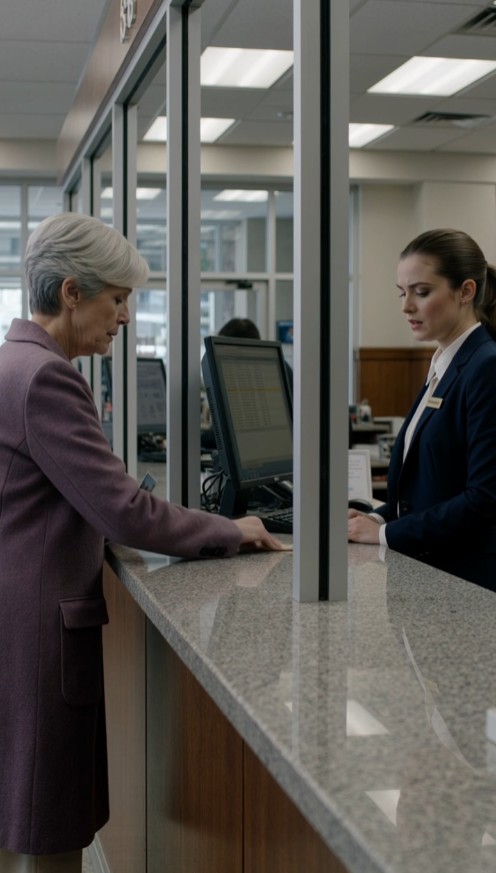
At seventy-nine, Margaret Collins had almost nothing left from the life she once knew. Her husband was gone, her little house needed repairs, and the only thing she carried everywhere was a faded photograph of a six-year-old boy standing beside a birthday cake.
But every month, she still saved one dollar.
On a rainy Thursday morning, Margaret walked into First Community Bank wearing an old brown coat and holding a bankbook nearly thirty years old.
“Please,” she whispered to the teller. “I’d like to make one more deposit.”
The young teller, Emily Parker, smiled and entered the account number.
Then she frowned.
“Ma’am, I’m sorry. This account was closed thirty years ago.”
Margaret shook her head.
“That can’t be. I’ve been saving for my son.”
Emily checked the archived records. The account had indeed been closed, but an unusual notification had appeared the previous afternoon concerning the same historical account file.
Someone named Daniel Collins had visited the branch with an old bankbook and requested assistance locating its original owner.
Emily looked up.
“Who is Daniel?”
Margaret’s face went pale.
She opened her purse and removed the photograph.
“My son,” she whispered. “I haven’t seen him in thirty years.”
The bank manager, Robert Harris, approached after Emily requested his help.
He examined the authorized account notes, then gently asked Margaret a question.
“Mrs. Collins, did Daniel have a small scar above his left eyebrow?”
Margaret began trembling.
“Yes. He fell from his bicycle when he was seven.”
Robert looked toward the entrance.
“Then I think there’s someone you should meet.”
A middle-aged man stood near the doorway holding an identical old bankbook.
His eyes filled with tears.
“Mom?”
Margaret dropped her purse.
And when Daniel explained why he had returned to the bank after thirty years, she discovered that the little savings account she refused to forget had helped bring her son home.
The Account Opened With Three Dollars
Margaret opened Daniel’s savings account in 1984, when he was just six years old.
She and her husband, Thomas, were struggling financially. Thomas worked at a furniture factory, while Margaret cleaned offices in the evenings.
They didn’t have much money, but they wanted to give their son a better future.
On Daniel’s sixth birthday, Margaret took him to the bank with three dollars she had saved from her housekeeping wages.
The teller gave Daniel a small blue bankbook.
“What’s this for?” he asked.
Margaret smiled.
“For your future, sweetheart.”
Daniel looked disappointed.
“Can I buy candy with it?”
She laughed.
“Not today.”
From then on, Margaret encouraged Daniel to save a little whenever he could.
Sometimes it was fifty cents from birthday money. Other times, a dollar earned helping a neighbor.
Margaret matched his contributions whenever possible.
They made the deposits together, and afterward she bought him a small ice cream.
The tradition became one of Daniel’s favorite childhood memories.
But as he grew older, life became more complicated.
The Argument That Separated Mother and Son
By the time Daniel turned twenty-four, he was determined to leave their small hometown.
He had been offered a job in another state and dreamed of building a successful career.
Margaret was proud of him, but frightened.
Thomas had died two years earlier, and Daniel was the only family she had left nearby.
She worried about being alone.
Daniel interpreted her concern as an attempt to control his life.
Their conversations became increasingly difficult.
One evening, they argued about his decision to move.
“You don’t understand,” Daniel said. “I need to do something with my life.”
Margaret began crying.
“You think staying here means you have no future?”
Daniel was frustrated.
He said something he regretted almost immediately.
“I can’t spend my whole life taking care of you.”
Margaret fell silent.
The following morning, Daniel left.
He promised to call once he settled into his new apartment.
But the call never came.
At first, Margaret assumed he was busy.
Then weeks passed.
She wrote letters.
Some came back unopened.
Eventually, Daniel changed addresses and telephone numbers.
Their argument turned into years of silence.
And somehow, neither knew how to repair what had happened.
Why Margaret Never Stopped Saving
Even after Daniel disappeared from her life, Margaret continued keeping small amounts of money aside.
She remembered the savings account they had opened together when he was six.
But during the years following his departure, the bank merged with another institution.
The original account was closed as part of an administrative consolidation, and its remaining balance was transferred to a replacement account managed under updated records.
Margaret received a notice, but she never fully understood what had changed.
By then, she had stopped visiting the bank regularly.
Instead, she began placing a dollar each month inside an envelope tucked into Daniel’s old bankbook.
She wrote the date beside each contribution.
Sometimes she could save more.
Often she couldn’t.
But she kept the tradition alive.
When neighbors asked why, she always gave the same answer.
“It’s for my boy.”
She didn’t know where Daniel lived.
She didn’t know whether he was married.
She didn’t even know whether he remembered the little blue bankbook.
But she continued saving.
Not because she believed a few dollars would make him wealthy.
Because it gave her something to do for the son she missed.
The Man Who Returned After Thirty Years
Daniel’s life had changed dramatically after he left home.
He found work, married, and eventually became the father of two daughters.
For years, he told himself that staying away from Margaret was easier than reopening the painful argument.
He felt ashamed of what he had said.
Every birthday and Christmas, he considered calling.
But he always postponed it.
One year became five.
Five became ten.
And eventually, thirty years had passed.
His wife, Rebecca, knew he was estranged from his mother.
She repeatedly encouraged him to reconnect, but Daniel insisted Margaret probably wanted nothing to do with him.
Then, several months before his fifty-fourth birthday, Daniel discovered something while sorting through an old box of childhood belongings.
A blue bankbook.
Inside were handwritten deposits from the 1980s.
He remembered standing beside Margaret at the teller’s counter, proudly handing over a dollar.
He remembered the ice cream afterward.
And for the first time in years, he allowed himself to think about how much his mother had loved him.
Daniel began crying.
He realized that while he had spent decades trying to forget their final argument, he had also forgotten thousands of ordinary moments when Margaret had been there for him.
He decided to find her.
The Transaction That Brought Them Together
Daniel returned to his hometown and visited First Community Bank, hoping the archived records might help him understand what happened to the childhood account.
He presented his old bankbook and identification.
The bank staff reviewed the historical records and explained that the original account had been closed during a merger.
A replacement account had been established, but accessing or changing it required proper verification from the current authorized account holder.
Daniel asked whether he could leave contact information in case Margaret inquired about the old account.
The manager agreed to document his request without disclosing protected customer information.
Daniel also asked about placing money into a new account intended as a gift for his mother.
The bank helped him arrange a separate deposit under the appropriate procedures.
He deposited thirty thousand dollars.
One thousand for every year they had been apart.
But Daniel knew the money couldn’t repair what he had done.
It was simply something he hoped might make Margaret’s life easier if she chose to accept it.
The following morning, Margaret walked into the same bank carrying one dollar.
The teller recognized the connection between the historical account inquiry and Daniel’s visit.
After the manager verified the details and obtained the necessary consent, a reunion that neither mother nor son had expected finally became possible.
The Moment Margaret Recognized Him
Margaret turned toward the doorway.
The man standing there was tall, with gray beginning to show at his temples.
He wore a dark jacket and held the small blue bankbook she remembered from Daniel’s childhood.
For a moment, she simply stared.
Then she noticed the tiny scar above his left eyebrow.
The same scar he received when he fell from his bicycle as a little boy.
Her lips trembled.
“Danny?”
Daniel nodded.
“Hi, Mom.”
Margaret covered her mouth.
“Oh, my boy.”
He stepped forward.
She reached for him.
And after thirty years, mother and son embraced in the middle of the bank.
Margaret began crying so hard she could barely speak.
“I thought I’d never see you again.”
Daniel held her tightly.
“I’m sorry, Mom.”
She shook her head.
“You came back.”
Daniel’s voice broke.
“I should have come back a long time ago.”
Around them, the bank employees quietly stepped away, giving the family privacy.
Emily wiped tears from her eyes.
Robert stood nearby, deeply moved by the reunion.
But Daniel wasn’t finished.
He had brought something else.
The Envelope Daniel Had Carried for Years
Daniel reached into his coat and removed a large brown envelope.
Inside were thirty photographs.
One from each year he had been away.
The first showed him standing beside his new apartment.
The next showed his wedding day.
Another showed him holding his first daughter.
There were school photographs, birthday celebrations, family vacations, and ordinary moments from the life Margaret had missed.
Daniel had spent several weeks collecting them from old albums and family files.
He arranged the pictures in chronological order.
Then he wrote a message on the back of each one.
“This is where I lived when I was twenty-five.”
“This is Rebecca, the woman I married.”
“This is your first granddaughter, Emily.”
“This is your second granddaughter, Sophie.”
Margaret examined the pictures with trembling hands.
She stopped at the photograph of Daniel holding a newborn baby.
“You have children?”
Daniel nodded.
“Two daughters.”
Margaret began crying again.
“I’m a grandmother?”
He smiled through tears.
“Yes, Mom.”
She pressed the photograph against her chest.
For thirty years, she had wondered whether her son was safe.
Now she was discovering that he had built an entire family.
A family she had never met.
The Gift Margaret Didn’t Want
When the reunion moved into a private meeting room, Daniel explained the money he had deposited.
“I put thirty thousand dollars aside for you,” he said.
Margaret looked confused.
“What?”
“One thousand for every year I missed.”
She stared at him.
Then she shook her head.
“No, Danny.”
Daniel frowned.
“Mom, please.”
She took his hand.
“I don’t want your money.”
“But you could use it. I know the house needs repairs.”
Margaret smiled sadly.
“Money isn’t what I’ve been waiting for.”
Daniel lowered his eyes.
She opened her old bankbook and showed him the handwritten dates.
Every month.
One dollar.
Sometimes two.
For nearly thirty years.
Daniel stared at the pages.
“You kept saving?”
Margaret nodded.
“I wanted to have something for you if you ever came home.”
He began crying.
“Mom, I don’t need the money.”
She smiled.
“Neither do I.”
Daniel looked at her.
“Then why did you keep doing it?”
Margaret touched the faded photograph inside her purse.
“Because every dollar reminded me that I still had a son.”
The Promise They Made in the Bank
Daniel sat beside Margaret for nearly two hours.
They talked about the argument that separated them.
He admitted that he had been young, angry, and frightened of feeling trapped in his hometown.
Margaret acknowledged that she had struggled to accept his independence after Thomas died.
They both regretted the things they said.
But neither tried to pretend the years apart had been harmless.
Margaret had endured decades of loneliness.
Daniel had missed opportunities to know his mother as an adult.
His daughters had grown up without their grandmother.
And both knew that no amount of money could return those lost moments.
But they could decide what happened next.
Daniel looked at Margaret.
“Would you like to meet Rebecca and the girls?”
Margaret’s eyes filled with tears.
“More than anything.”
He smiled.
“They’re nearby.”
She stared at him.
“What?”
Daniel nodded toward the entrance.
“I asked them to come with me. I didn’t know whether you’d want to see me, so they’re waiting at a café across the street.”
Margaret stood slowly.
“Then what are we doing sitting here?”
Daniel laughed through tears.
For the first time in thirty years, his mother sounded exactly as he remembered.
The Granddaughters She Never Knew
When Margaret entered the café, two young women stood near a table.
The older one, Emily, was twenty-two.
Her sister, Sophie, was nineteen.
Both had heard stories about their grandmother but had never met her.
Rebecca approached first.
“Margaret?”
The elderly woman nodded.
Rebecca embraced her.
“I’m so glad you’re here.”
Then Daniel introduced his daughters.
Margaret stared at them.
Emily had Daniel’s eyes.
Sophie had the same smile he wore as a child.
For a moment, Margaret couldn’t speak.
Then Sophie stepped forward.
“Hi, Grandma.”
Margaret covered her mouth.
“Oh, sweetheart.”
The girls hugged her.
And Margaret began crying again.
She had spent thirty years imagining whether Daniel had children.
Now she was standing between two granddaughters who were eager to know her.
During lunch, they asked questions about Daniel’s childhood.
Margaret told them about his bicycle accident, his love of chocolate cake, and the little blue bankbook.
The girls laughed.
Daniel groaned.
“Mom, not the bicycle story.”
Margaret smiled.
“Especially the bicycle story.”
For the first time in decades, the family shared a meal without silence or unanswered questions standing between them.
The One-Dollar Tradition That Continued
Over the following months, Daniel began visiting Margaret regularly.
He helped arrange repairs to her house and made sure she had the support she needed.
But Margaret insisted on keeping her independence.
She didn’t want Daniel to feel guilty forever.
And she didn’t want their relationship to revolve around money.
Instead, she suggested something simple.
“Come have lunch with me once a week.”
Daniel agreed.
Every Friday, he drove to her house.
Sometimes Rebecca and the girls joined them.
Other times, it was just Margaret and Daniel sitting at the kitchen table, sharing coffee and talking about their lives.
They gradually learned how to be mother and son again.
The conversations weren’t always easy.
There were moments when Margaret became emotional about missed birthdays.
And there were times when Daniel struggled with regret.
But they kept talking.
One afternoon, Margaret brought out the old bankbook.
“I think we should open a new account,” she said.
Daniel smiled.
“For what?”
She looked toward a photograph of Emily and Sophie.
“For the next generation.”
The Account That Became Something Bigger
Daniel helped Margaret establish a new savings account intended to support future family milestones.
They began with a symbolic deposit.
One dollar from Margaret.
One dollar from Daniel.
Then Emily and Sophie each contributed a dollar.
Margaret laughed as the teller recorded the deposit.
“Four dollars,” she said proudly.
Daniel smiled.
“Not exactly a fortune.”
Margaret shook her head.
“That’s not the point.”
She looked toward her granddaughters.
“The point is that we’re all here.”
Over time, the account became a family tradition.
On birthdays, each person contributed a small amount.
The money was eventually used to help pay for family trips, educational expenses, and special celebrations.
But Margaret always insisted that the deposits remain voluntary.
She wanted the tradition to be about connection, not obligation.
The Photograph That Finally Completed the Album
On Margaret’s eightieth birthday, Daniel organized a small gathering at her home.
Family members filled the living room.
Rebecca prepared dinner, while Emily and Sophie decorated the table with flowers.
Margaret sat in her favorite chair, smiling as everyone sang.
After the cake, Daniel handed her a wrapped gift.
Inside was a photo album.
The first page showed Daniel as a six-year-old standing beside his birthday cake.
The same photograph Margaret had carried in her purse for thirty years.
The next pages contained the pictures Daniel had brought to the bank.
His wedding.
His daughters.
His work.
His family.
But the final page was new.
It showed Margaret standing outside First Community Bank with Daniel, Rebecca, Emily, and Sophie.
The photograph had been taken shortly after their reunion.
Beneath it, Daniel had written:
“Thirty years of missing pictures. One beautiful new beginning.”
Margaret stared at the page.
Then she looked at her son.
“It’s perfect.”
Daniel smiled.
“So are you, Mom.”
Margaret laughed.
“Oh, don’t be silly.”
Then she hugged him.
The Last Deposit Margaret Made Alone
Several weeks later, Margaret returned to First Community Bank.
She wore the same brown coat she had worn on the day of the reunion.
But this time, she wasn’t carrying the old bankbook.
She had a new one.
And she wasn’t alone.
Daniel walked beside her.
Emily and Sophie followed, laughing about something they had seen on their phones.
When Margaret reached the teller’s counter, she placed a single dollar on the desk.
Emily Parker recognized her immediately.
“Good morning, Mrs. Collins.”
Margaret smiled.
“Good morning, dear.”
Emily looked toward Daniel.
“Another deposit?”
Margaret nodded.
“Yes. But this time, it’s different.”
She turned toward her son.
“Would you like to put it in?”
Daniel smiled.
He picked up the dollar and handed it to the teller.
Emily recorded the deposit.
Then she returned the bankbook.
Margaret examined the updated balance.
For a moment, she looked emotional.
Daniel noticed.
“Everything okay, Mom?”
She nodded.
“Everything is wonderful.”
The Dollar That Was Never Really About Money
For thirty years, Margaret Collins had saved one dollar at a time for a son she didn’t know how to find.
She continued the habit long after the original bank account closed.
To anyone else, the money seemed insignificant.
A dollar couldn’t buy much.
It couldn’t repair her old house.
It couldn’t erase thirty years of separation.
And it couldn’t bring back the birthdays and holidays she missed.
But Margaret wasn’t saving because she expected to become wealthy.
Each dollar represented the hope that one day she might see Daniel again.
And when he finally returned, carrying an old bankbook and photographs of the life he’d built, she understood that the most valuable thing he could give her wasn’t money.
It was time.
Time to meet her granddaughters.
Time to share meals.
Time to tell stories.
And time to build new memories with the son she had never stopped loving.
A seventy-nine-year-old woman entered a bank carrying one dollar and a bankbook nearly thirty years old.
The teller discovered that the original account had closed decades earlier, but a recent inquiry revealed that someone named Daniel had returned looking for its owner.
Moments later, Margaret was reunited with the son she hadn’t seen in thirty years — a son who had brought photographs of the family she never knew existed.
And when Daniel learned that his mother had continued saving one dollar at a time throughout their separation, he finally understood something money could never measure.
She hadn’t been saving for a future purchase. She had been saving a place for him in her life.