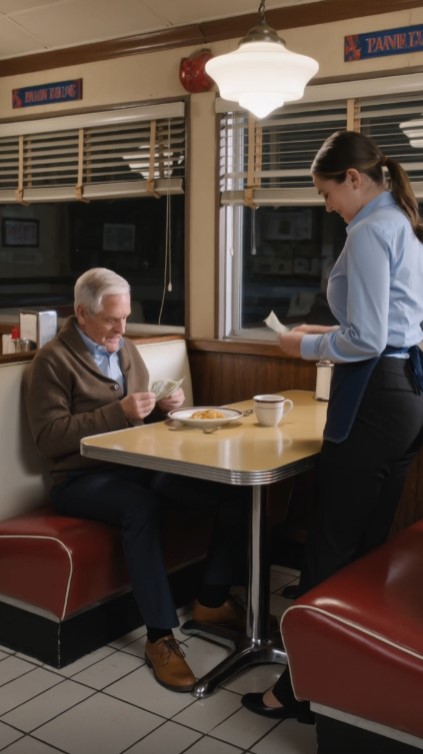
Sarah thought she was simply returning a kindness someone had once shown her father. But when the elderly stranger left behind a mysterious phone number and an old photograph, she discovered the night her father always described as their first meeting was only part of the story.
The elderly man counted his money three times.
Then quietly looked at the dessert menu.
For several seconds, he stared at the slice of apple pie he had ordered.
Finally, he called the waitress over.
“Miss?”
Sarah smiled.
“Yes?”
“I won’t need the pie.”
She glanced toward the few bills and coins beside his hand.
His entire dinner cost twelve dollars.
And he was still short.
Sarah had seen this before.
People pretending they were no longer hungry because they were embarrassed to say they couldn’t afford everything.
She picked up the dessert menu.
“Of course.”
But when the bill arrived a few minutes later, there was only one word across it.
PAID.
The elderly man immediately waved Sarah back.
“Miss, you made a mistake.”
She shook her head.
“No mistake.”
“I can’t let you do that.”
Sarah smiled.
“Someone did it for my father once.”
The old man stopped.
His coffee cup remained halfway to his mouth.
“What was your father’s name?”
“Robert.”
His expression changed.
“Robert what?”
Sarah told him.
The cup slowly returned to the table.
The elderly man’s eyes filled.
“Robert Daniels?”
Sarah stared.
“Yes.”
For several seconds, neither spoke.
Then the old man whispered:
“Thirty-two years.”
Sarah frowned.
“What?”
He introduced himself.
Henry Wilson.
Thirty-two years earlier, Henry had owned a tiny roadside diner several miles outside town.
It wasn’t fancy.
Six booths.
A counter.
A coffee machine that broke almost every week.
Henry worked nearly every shift himself.
Then one freezing winter night, shortly before closing, a young man entered carrying a sleeping little girl.
The man looked exhausted.
His coat was too thin.
The child was wrapped in an old blanket.
Henry immediately knew something was wrong.
The young father asked for hot water.
Nothing else.
Henry refused.
He brought him soup.
Bread.
Coffee.
And warm milk for the little girl when she woke.
When the bill came, the father admitted he had almost no money.
Henry tore the check in half.
“Feed your daughter. Forget about this.”
The man started crying.
Their car had broken down.
He had lost his job weeks earlier.
They had nowhere to stay until morning.
So Henry let them sleep in one of the diner booths after closing.
He gave the little girl two blankets.
Made the father another cup of coffee.
And before sunrise, helped them contact someone who could repair the car.
Before leaving, the father stood beside the door.
“One day I’ll pay you back.”
Henry told him:
“Don’t pay me. Help somebody else.”
Sarah slowly sat down across from him.
Her face had gone pale.
“That was my dad.”
Henry smiled.
“And you were the little girl.”
Sarah couldn’t speak.
Robert had told that story throughout her childhood.
Whenever Sarah complained about helping strangers, he reminded her of the diner.
Whenever money was tight but someone else needed help, Robert would say:
“We’ve been the people counting coins too.”
But he never remembered the diner owner’s name.
At least, that was what he told Sarah.
She reached across the table and took Henry’s hands.
“Then tonight is definitely on us.”
Henry laughed softly.
“I suppose arguing is pointless.”
“Completely.”
For the next twenty minutes, they talked about Robert.
Sarah explained that her father had died six years earlier.
Henry lowered his head.
“I’m sorry.”
“He talked about that night until the end.”
Henry looked surprised.
“Really?”
“He said it changed his life.”
Before leaving, Henry folded his napkin carefully.
He slipped something underneath it.
Sarah didn’t notice until he was almost at the door.
When she cleared the table, she found a phone number.
Beneath it were four words:
CALL BEFORE YOU CLOSE.
Sarah frowned.
She nearly threw it away.
It sounded strange.
Maybe Henry wanted to thank her again.
Maybe it was something about her father.
At 10:55 p.m., five minutes before closing, Sarah finally called.
A man answered.
“Law offices of Bennett and Cole.”
Sarah almost hung up.
“Sorry. I think I have the wrong number.”
“Who are you trying to reach?”
“I’m not sure. An elderly man named Henry Wilson gave me this number.”
The lawyer became quiet.
“Are you Sarah Daniels?”
Sarah straightened.
“Yes.”
“We’ve been waiting for your call.”
She laughed nervously.
“Why?”
The lawyer introduced himself as James Cole.
Then he explained that Henry Wilson had sold his roadside diner nearly thirty years earlier.
The property eventually became part of a commercial development.
Henry received much more money from the sale than anyone expected.
But he never spent most of it.
Sarah frowned.
“Okay…”
James continued.
“Mr. Wilson never married.”
“He has no children?”
“No.”
Sarah looked through the restaurant window.
Henry was still standing outside beneath the streetlight.
The lawyer continued:
“And according to the documents he gave us, your father wasn’t simply a customer that night.”
Sarah’s expression changed.
“What does that mean?”
She looked outside again.
Henry was gone.
But on the table where he had been sitting was something Sarah hadn’t noticed before.
An old photograph.
She picked it up.
Her hands began shaking.
Robert.
Henry.
And baby Sarah.
The date printed on the back was nearly two years before the freezing night Robert claimed he first met Henry.
Sarah whispered:
“That’s impossible.”
The restaurant owner looked over.
“What?”
“My dad told me they met that night.”
But clearly they hadn’t.
Sarah called the lawyer back.
“What was my father to Henry?”
James paused.
“I think Mr. Wilson should tell you himself.”
“He just left.”
“He knew you might need time.”
Sarah stared at the photograph.
“I don’t want time. I want the truth.”
James finally answered.
“Your father worked for Henry.”
Sarah sat down.
Years before the night at the diner, Robert had been a teenage dishwasher there.
He was seventeen.
No diploma.
No stable home.
Very little money.
Henry hired him when nobody else would.
Over time, Robert became more than an employee.
Henry taught him to cook.
Helped him open his first bank account.
Taught him how to fill out job applications.
And when Robert turned eighteen, Henry offered him a spare room above the diner.
Sarah listened silently.
“My dad never told me any of this.”
“There’s more.”
Robert eventually left town.
He wanted a fresh start.
He married Sarah’s mother.
Sarah was born.
Then tragedy came.
Sarah’s mother died when Sarah was still very young.
Robert struggled.
He lost work.
Bills piled up.
And eventually he found himself driving back through the town where Henry lived.
That freezing night had not been the first time Robert met Henry.
It was the first time he returned after years of silence.
Sarah stared at the photograph.
“Why would Dad lie about that?”
James answered carefully.
“He may not have wanted you to know how much help he had already received.”
Robert had been proud.
Very proud.
He didn’t want Sarah growing up thinking he survived only because someone rescued him repeatedly.
So he transformed the story.
Henry became a stranger.
The free meal became random kindness.
The night in the diner became proof that strangers could help one another.
But the truth was deeper.
Henry had been helping Robert since he was seventeen.
Sarah looked at the old photograph again.
“Then why did Henry pretend they were strangers?”
“He didn’t.”
Sarah frowned.
“Dad did.”
Henry had respected Robert’s version of the story because he understood why it mattered to him.
Then Sarah asked the question that had been bothering her.
“What does any of this have to do with Henry’s money?”
James exhaled.
“Your father tried to pay him back.”
Years after getting back on his feet, Robert began sending Henry small amounts of money.
Twenty dollars.
Fifty.
Sometimes one hundred.
Henry returned every check.
Robert kept sending them.
Eventually Henry opened a separate savings account.
Every dollar Robert sent went into it.
He never touched the money.
Then something surprising happened.
Robert started doing better financially.
His payments increased.
But Henry still refused to keep them.
The account grew.
Interest accumulated.
Then Henry added part of the money from selling the diner.
Sarah whispered:
“Why?”
“Because he said your father had already paid him back.”
“How?”
“By becoming the kind of man Henry hoped he would become.”
Sarah began crying.
Robert had spent decades helping people quietly.
He paid grocery bills for struggling coworkers.
Covered school lunches for children he barely knew.
Helped one neighbor repair a car for free.
Sarah remembered all of it.
She had always thought her father was simply generous.
Now she understood.
He had been keeping Henry’s lesson alive.
Don’t pay me.
Help somebody else.
James continued.
“Mr. Wilson recently updated his estate documents.”
Sarah went still.
“No.”
“He wants a significant portion of the money placed into a community fund.”
Sarah relaxed slightly.
“That makes sense.”
“And he wants you to administer it.”
She almost dropped the phone.
“Me?”
“Yes.”
“I’m a waitress.”
“Your father wasn’t wealthy either.”
“That doesn’t mean I know how to run a fund.”
“You wouldn’t be alone.”
Henry’s plan was simple.
Small emergency grants.
Meals.
Temporary motel rooms.
Car repairs.
School supplies.
The kinds of things that could keep one bad week from becoming a disaster.
Sarah looked toward the door.
“Why me?”
James answered:
“Because tonight you paid for Henry’s dinner without knowing who he was.”
Sarah became silent.
Henry had come to the restaurant with enough money to pay.
Far more than enough.
The counting coins had been deliberate.
The removed dessert had been deliberate.
Sarah felt a flash of anger.
“He tested me?”
James hesitated.
“In a way.”
Sarah stood.
“I don’t like that.”
“That’s understandable.”
Henry hadn’t wanted to know whether Sarah remembered her father’s story.
He wanted to know what she would do when she believed nobody important was watching.
Sarah ended the call.
Twenty minutes later, she found Henry sitting at the bus shelter down the street.
She walked toward him holding the photograph.
“You lied to me.”
Henry looked up.
“About being broke?”
“Yes.”
He nodded.
“I did.”
“I don’t appreciate being tested.”
“You shouldn’t.”
“Then why?”
Henry looked at the empty street.
“Because your father once told me something.”
Sarah waited.
“He said, ‘Sarah listens to my stories, but someday I want to know whether she understood them.’”
Sarah’s anger softened.
“Dad said that?”
Henry nodded.
Years earlier, Robert had visited Henry one final time.
By then Robert was older.
Sarah was grown.
Robert knew his health was beginning to fail.
He told Henry he didn’t want any of his repayments returned.
Henry told him again that he never wanted the money.
Robert laughed.
“Then use it on Sarah someday.”
Henry asked what he meant.
Robert answered:
“If she turns out generous, give her something bigger than money. Give her a way to keep doing it.”
Sarah sat beside him.
“You knew Dad was sick?”
“Yes.”
“Why didn’t he bring me to meet you?”
Henry smiled sadly.
“Pride dies hard.”
Sarah looked at the photograph.
“Who took this?”
“Your father.”
Henry corrected himself.
“Actually, a customer did. You were asleep five minutes later.”
Sarah smiled through tears.
Henry reached into his coat.
Another envelope.
Sarah groaned.
“Does everybody in this story carry envelopes?”
Henry laughed.
“This is the last one.”
Inside was a letter from Robert.
Sarah recognized the handwriting.
She opened it.
Sarah,
If Henry gives you this, it means he finally ignored me and found you.
She laughed.
The letter continued.
I told you the diner story a hundred times, but I left out the embarrassing parts. Henry didn’t save me once. He saved me over and over until I learned how to stand by myself.
Sarah wiped her eyes.
Robert wrote about being seventeen.
Sleeping above the diner.
Burning his first attempt at pancakes.
Getting fired by Henry twice and rehired the same afternoon.
Henry protested.
“He deserved it.”
Sarah kept reading.
Then came the line that made both of them quiet.
The best thing Henry ever did for me was eventually stop helping before I became afraid to try on my own.
Sarah looked at him.
Henry nodded.
“Your father became a good man.”
The letter ended:
If you ever meet somebody counting coins at a table, remember this: you do not need to solve their whole life. Sometimes twelve dollars is enough to change a night. And sometimes changing one night changes everything after it.
Sarah folded the letter.
For a long time, she and Henry sat silently.
Then she asked:
“Did you really sell the diner thirty years ago?”
“Yes.”
“And you kept all that money?”
“Not all.”
“What did you spend?”
Henry thought.
“Coffee.”
Sarah laughed.
“Anything else?”
“Occasionally pie.”
“You removed the pie.”
“I was committed to the performance.”
She shook her head.
“You’re terrible.”
“So was your father.”
The community fund officially began several months later.
Sarah resisted at first.
But with help from lawyers, accountants, and local volunteers, she agreed.
They named it the Brown Bag Fund.
Henry hated the name.
Sarah loved it.
The fund’s first grant was twelve dollars.
A mother at a local diner was short on breakfast for herself and her son.
Sarah paid.
No paperwork.
No photograph.
No public announcement.
Just breakfast.
Then came a car repair.
A utility bill.
Three nights in a motel for a family waiting for housing.
Winter coats.
Groceries.
Small things.
Exactly what Henry wanted.
Sarah continued working at the restaurant.
She didn’t suddenly become wealthy.
The fund’s money wasn’t hers.
That mattered to her.
Henry began eating dinner there every Thursday.
He always ordered dessert.
And every week Sarah brought him the bill.
PAID.
Henry complained every time.
“You’re ruining my budget.”
“You have a budget?”
“No.”
Years passed.
Henry became part of Sarah’s family.
Not as some mysterious benefactor.
Simply Henry.
The man who complained about weak coffee.
The man who told embarrassing stories about Robert.
The man who remembered things about her father Sarah had never known.
One evening, Sarah asked him:
“Do you regret not having children?”
Henry thought carefully.
Then pointed around the restaurant.
A young waitress he had helped with tuition.
A mechanic whose tools the fund replaced after a theft.
Sarah.
Several families laughing over dinner.
“I think family can become larger than you planned.”
Sarah smiled.
“That sounds like something Dad would say.”
“No. Your father stole most of his good lines from me.”
When Henry eventually died years later, Sarah found instructions in his documents.
No elaborate funeral.
No expensive flowers.
Instead, anyone who wanted to honor him was asked to buy a meal for someone who needed one.
Hundreds did.
Sarah kept the old photograph.
Henry.
Robert.
Baby Sarah.
She framed it beside the register at the restaurant.
Underneath, she placed Robert’s final sentence:
Sometimes twelve dollars is enough to change a night.
Customers occasionally asked about it.
Sarah never told the entire story unless she had time.
But whenever she saw someone quietly checking the prices…
counting bills…
putting something back…
she remembered.
Thirty-two years earlier, her father walked into a roadside diner believing he had nowhere else to go.
Henry gave him food.
A place to sleep.
And something more important.
Dignity.
Decades later, Henry sat at Sarah’s table and gave her the chance to make the same choice.
Sarah thought she was paying for an elderly stranger’s twelve-dollar dinner.
She had no idea she was completing a promise that began before she was old enough to remember it.
Her father had always said:
“One day I’ll pay you back.”
Henry never wanted repayment.
He wanted the kindness to keep moving.
And it did.