
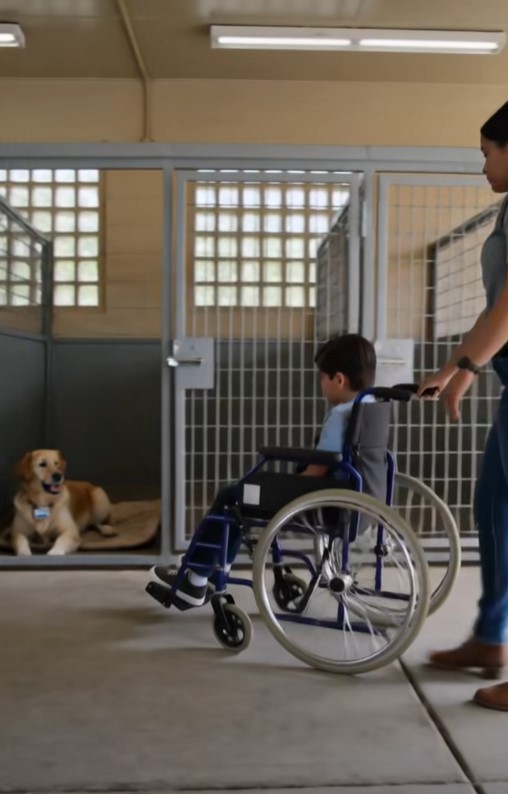
The old dog had stopped standing when people walked by.
At first, the shelter staff thought he was just tired.
Then they realized something worse.
He had given up.
His name was Max, and he had been at the shelter longer than almost any other dog there. His brown fur had faded around his face. One of his back legs dragged slightly when he walked. His eyes were gentle, but sad in a way that made volunteers look away when they passed his kennel.
He was not aggressive.
He was not loud.
He did not bark for attention like the younger dogs.
He simply lay in the corner, head resting on his paws, watching families pass him every day.
Children ran toward the puppies.
Parents smiled at the playful dogs.
Couples stopped for the ones with shiny coats and wagging tails.
But almost nobody stopped for Max.
Too old.
Too quiet.
Too broken.
That was what people seemed to think when they looked at him.
The shelter staff tried everything.
They placed a soft blanket in his kennel. They wrote a kind description on his adoption card. They posted his photo online. They told visitors he was gentle, patient, and sweet.
Still, days turned into weeks.
Weeks turned into months.
And Max remained behind the same metal bars.
Eventually, the shelter became full.
More dogs arrived.
More kennels were needed.
And one morning, the staff received the decision they had been dreading.
Max had only hours left.
No one wanted to say it out loud.
The volunteers moved quietly that day. One of them slipped an extra treat through the bars. Another sat beside his kennel and cried while pretending to clean his water bowl.
Max did not understand the words.
But he seemed to understand the sadness.
He rested his chin on the floor and closed his eyes.
By afternoon, families were still moving through the shelter.
Laughter echoed near the puppy area.
A little girl begged her father for a golden retriever mix.
Two teenagers filmed a playful dog jumping against its gate.
No one looked toward the last kennel.
No one looked at Max.
Then the front door opened again.
A woman entered slowly, pushing a little boy in a wheelchair.
The boy looked about eight years old. He wore a blue jacket, his hands resting quietly in his lap. His face was pale, but his eyes were bright as he looked around the shelter.
A staff member walked over gently.
“Are you looking for a puppy?” she asked.
The boy shook his head.
“No,” he said softly. “I want to see the dogs nobody looks at.”
The staff member paused.
His mother looked down at him with a small, emotional smile.
“He’s been saying that all morning,” she explained.
So the staff member led them past the noisy kennels.
They passed the jumping dogs.
The wagging dogs.
The dogs who pressed their noses against the bars, desperate for attention.
The boy smiled at all of them, but he did not stop.
Then they reached the final kennel.
Max’s kennel.
The old dog was lying in the corner, barely moving.
The staff member’s throat tightened.
“This is Max,” she said quietly. “He’s very gentle.”
The boy did not answer.
He stared at the dog for a long moment.
Then something changed.
His smile faded.
Not because he was afraid.
Because he looked as if he had just recognized something.
Or someone.
“Mom,” he whispered.
His mother leaned closer.
“What is it?”
The boy’s eyes stayed fixed on the old dog.
“I know him.”
The staff member frowned slightly.
Max had been a stray when he came in. No one had claimed him. No owner had called. No family had come looking.
The boy placed both hands on the wheels of his chair and pushed himself a little closer to the kennel.
Max opened his eyes.
For the first time all day, the old dog lifted his head.
The staff member froze.
Max stared at the boy.
Then, slowly, painfully, he stood.
His back leg trembled beneath him. His paws slipped slightly on the kennel floor. But he forced himself upright, his eyes locked on the child in the wheelchair.
The shelter grew quieter.
One volunteer stopped sweeping.
Another staff member looked over from the front desk.
Max took one limping step forward.
Then another.
The boy rolled closer until his knees nearly touched the kennel gate.
“Hi,” he whispered.
Max pressed his nose through the bars.
The boy reached out carefully.
The moment his fingers touched the old dog’s face, Max made a sound no one in the shelter had ever heard from him before.
Not a bark.
Not a growl.
A broken, trembling cry.
The old dog pushed his head harder against the bars, trying to reach the boy. His body shook. His tail moved weakly, then faster. Tears gathered in the corners of his eyes and rolled down the gray fur around his face.
The staff member covered her mouth.
Max was crying.
The boy began crying too.
He placed both hands on the dog’s head and whispered, “I missed you.”
His mother went completely still.
“What did you say?” she asked.
The boy looked up at her, tears running down his cheeks.
“Mom,” he whispered, “I think he remembers me.”
The entire room fell silent.
The staff member unlocked the kennel gate with shaking hands.
As soon as it opened, Max limped out and lowered his head into the boy’s lap.
Not on the floor.
Not toward the staff.
Straight into the boy’s lap.
The dog pressed himself against the wheelchair like he had found the one place in the world he had been searching for.
The boy wrapped his arms around Max’s neck.
And the old dog closed his eyes.
For several seconds, nobody spoke.
Then the mother started crying harder.
She knelt beside her son and touched Max’s fur with trembling fingers.
“It can’t be,” she whispered.
The staff member looked at her.
“What happened?”
The mother wiped her face and tried to speak, but her voice kept breaking.
Two years earlier, before the accident, her son had a dog.
A brown dog with a gray patch near one ear.
The boy and the dog had been inseparable. They slept in the same room. They played in the backyard every afternoon. When the boy was sick, the dog lay beside his bed and refused to leave.
Then came the accident.
A rainy night.
A car that lost control.
A hospital stay that changed everything.
The boy survived, but he never walked the same way again.
In the confusion after the accident, the family’s dog disappeared.
Neighbors searched.
Posters were printed.
Calls were made.
Weeks passed.
Then months.
Eventually, everyone told the family the same thing.
He was gone.
The boy never fully accepted it.
He kept saying his dog would come back.
His mother thought it was grief.
Hope.
A child holding onto the one thing he could not bear to lose.
But now, inside that shelter, the old dog lying across her son’s lap had the same gray patch.
The same scar near his shoulder.
The same way of resting his head against the boy when he was scared.
The mother looked at the staff member.
“What name did he come in with?”
The staff member checked the file.
“He didn’t have one. We named him Max.”
The boy shook his head gently.
“His name is Buddy.”
The old dog’s ears lifted.
Everyone noticed.
The boy said it again, voice shaking.
“Buddy.”
The dog lifted his head and licked the boy’s hand.
The mother broke down.
It was him.
Somehow, after all that time, after the accident, after disappearing, after surviving the streets, after ending up in the shelter unwanted and overlooked, Buddy had found his boy again.
Or maybe the boy had found him.
A volunteer rushed to check the old intake notes.
Buddy had been found months earlier wandering near a highway, thin, injured, and exhausted. No collar. No chip. No clear owner. He had been treated, fed, and placed for adoption, but nobody wanted an older dog with a limp.
So he waited.
Day after day.
Family after family.
Until the one person he had been waiting for rolled through the door.
The staff member’s hands shook as she looked at the schedule on her clipboard.
Then she turned away and wiped her eyes.
Because Buddy had been only hours away from being put down.
Hours.
If the boy and his mother had come the next day, the kennel would have been empty.
The boy held Buddy tighter, as if he understood without anyone telling him.
“You’re not staying here,” he whispered. “You’re coming home.”
His mother looked at the staff.
“We want to adopt him.”
No one argued.
No one asked if she was sure.
The paperwork was brought out immediately.
The shelter director came from the back office after hearing what happened. When she saw the dog still resting against the boy’s wheelchair, she stood silently for a moment, then signed the forms herself.
Buddy never moved far from the boy.
When the staff tried to guide him toward the exam room for one final check, Buddy looked back at the wheelchair and refused to take another step.
The boy laughed through tears.
“It’s okay,” he said. “I’m coming too.”
So they went together.
The vet checked Buddy’s leg, his heart, his old injuries, and his tired eyes. He needed care, rest, and medicine, but he was stable. More than anything, he needed a home.
And now he had one.
When they finally wheeled the boy toward the exit, Buddy walked beside him slowly.
His limp was still there.
His fur was still gray.
His body was still tired.
But something in his face had changed.
He no longer looked like a dog waiting for the end.
He looked like a dog who had remembered why he survived.
The other visitors stepped aside as they passed.
Some were crying openly.
One man who had earlier walked past Buddy’s kennel without stopping whispered, “I didn’t even notice him.”
A volunteer answered softly, “Someone did.”
Outside, the sunlight hit Buddy’s face.
He paused at the door, sniffing the air.
The boy reached down and touched his head.
“Ready to go home?”
Buddy leaned against the wheelchair.
The answer was clear.
Later, the shelter shared their story online.
People from everywhere reacted, commented, and cried over the reunion. Many said they would never look at older shelter dogs the same way again.
Because Buddy’s story was not just about a dog being adopted.
It was about being remembered.
It was about a child who looked past age, scars, and sadness.
It was about a dog who had waited in silence while the world passed him by.
Everyone else saw an old shelter dog.
The boy saw his best friend.
Everyone else saw broken.
The boy saw home.
And in the final hours, when Buddy had almost run out of time, the person he loved most found him again.
Sometimes the ones nobody wants are the ones who once meant everything to someone.
Sometimes an old dog is not waiting for a new family.
Sometimes he is waiting for the family he never forgot.
And sometimes, just when the world is ready to give up on him, a little boy in a wheelchair rolls through the door and says the one name that brings him back to life.