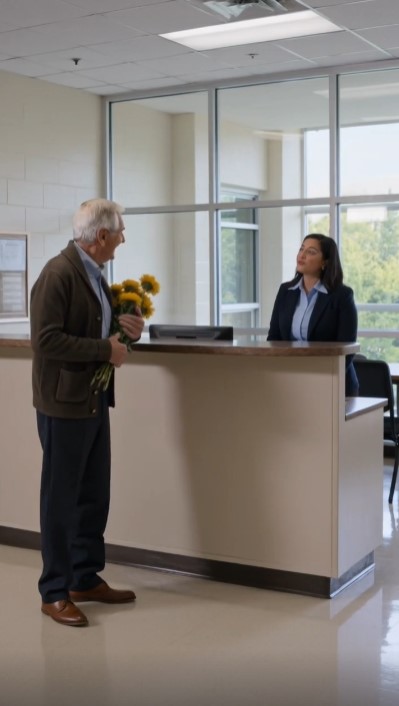
Walter thought earning his high-school equivalency at eighty-four would finally close a chapter he had carried for more than fifty years. Instead, one yellow flower, one young teacher, and a letter that had never been mailed reopened the biggest mystery of his childhood—and led him to the brother he had mourned for most of his life.
The school receptionist thought the elderly man had the wrong address.
He walked through the front doors carrying one hundred yellow flowers.
She smiled.
“Who are those for?”
Walter Bennett looked toward the hallway.
“The teachers.”
“All of them?”
“All of them.”
Walter was eighty-four.
And fifty years earlier, he had left school before graduating.
Not because he hated learning.
Not because he struggled with his classes.
Walter left because his father died suddenly.
His mother had four younger children at home.
Bills arrived.
Food became uncertain.
So Walter did what he believed he had to do.
He put away his textbooks.
Found work at a repair shop.
And became, in many ways, another parent to his brothers and sisters.
He always told himself he would return to school someday.
Someday became next year.
Next year became ten years.
Then twenty.
Marriage.
Children.
Work.
Grandchildren.
Life moved forward.
The unfinished diploma stayed behind.
But one person refused to let Walter believe leaving school meant leaving education.
His English teacher, Mrs. Eleanor Hayes.
A month after Walter dropped out, the first letter arrived.
It contained only three sentences.
Walter,
Keep reading.
Keep learning.
Leaving school does not mean you stopped being a student.
Another letter arrived the next month.
Then another.
Sometimes she recommended books.
Sometimes she enclosed newspaper articles.
Once she mailed him three vocabulary words and challenged him to use all three in a conversation.
Walter laughed about that one for years.
The letters continued long after he expected them to stop.
Mrs. Hayes never scolded him for leaving.
Never told him he had ruined his future.
She simply reminded him that his mind still belonged to him.
Walter kept every letter.
Decades later, when he learned Mrs. Hayes had died, he sat alone at his kitchen table and read them all again.
Then, at eighty-three, Walter made a decision.
He enrolled in adult education.
His children thought he was joking.
His granddaughter asked:
“Grandpa, why now?”
Walter answered:
“Because I’m running out of reasons to say later.”
He struggled with mathematics.
He hated computer-based practice tests.
He complained that passwords were “the downfall of civilization.”
But he studied.
Every morning.
Every evening.
And shortly after his eighty-fourth birthday, Walter passed his final examination.
He had finally earned the credential he once believed he would never have.
His family wanted a party.
Walter refused.
Instead, he bought one hundred yellow flowers.
Then walked into the local school.
He handed one to every teacher he could find.
“Someone like you changed my life.”
Some teachers smiled.
Some hugged him.
Several cried.
Walter reached the final classroom near the end of the hallway.
A young teacher was stacking books on her desk.
Walter entered.
“One left.”
She turned.
He held out the flower.
“This is for you.”
The teacher stared at him.
Then at the flower.
Her expression changed.
“Mr. Bennett?”
Walter froze.
“How do you know my name?”
The teacher slowly opened her desk drawer.
She removed an old bundle of letters tied with faded string.
Walter recognized the handwriting immediately.
He gripped the edge of a desk.
“Where did you get those?”
The young woman smiled.
“She was my grandmother.”
Walter stared.
“Mrs. Hayes?”
The teacher nodded.
“My name is Emily Hayes.”
Walter sat down.
For several seconds, he could say nothing.
Emily explained that after her grandmother died, the family boxed up decades of teaching materials.
Student essays.
Photographs.
Old lesson plans.
And letters.
Many were drafts Mrs. Hayes had written to former students.
Emily had recently begun going through them.
Then she found Walter’s name.
Again.
And again.
And again.
Walter smiled.
“She wrote to me every month.”
“I know.”
Emily looked at the bundle.
“She kept copies.”
Walter touched one envelope carefully.
“I thought I had every letter she ever wrote.”
Emily’s expression changed.
“You don’t.”
Walter looked up.
She removed one final envelope.
It was sealed.
His name was written across the front.
WALTER BENNETT.
No stamp.
No postmark.
Never mailed.
Walter’s hands trembled as he accepted it.
“When did she write this?”
Emily pointed to the date.
Forty-nine years earlier.
Walter opened the envelope.
The paper inside had yellowed.
Eleanor’s handwriting filled both sides.
Walter,
I saw your mother today.
She told me you are working harder than ever.
I hope you remember that being responsible does not mean forgetting yourself.
Walter smiled faintly.
That sounded exactly like her.
He kept reading.
Then his smile disappeared.
Near the bottom was one final paragraph.
Walter, your brother came looking for you.
Walter stopped breathing.
He read the sentence again.
Then looked at Emily.
“My brother died before I left school.”
Emily shook her head.
“No.”
Walter stood.
“What do you mean, no?”
She pointed toward the hallway.
An elderly man was standing outside the classroom door.
Walter dropped the flower.
The stranger looked to be in his late seventies.
Thin.
White hair.
One hand resting on a cane.
But there was something painfully familiar about his face.
The shape of his eyes.
The way his mouth tilted slightly when he was nervous.
Walter whispered:
“Samuel?”
The man’s eyes filled.
“Hello, Walt.”
Walter stepped backward.
Samuel Bennett had been Walter’s younger brother.
At least, that was what Walter remembered.
Samuel was twelve when their father died.
Months later, he disappeared during a family trip to visit relatives in another state.
The family was told Samuel had drowned after falling into a river.
There was a search.
Walter remembered his mother collapsing.
He remembered a small memorial service.
He remembered blaming himself because he hadn’t gone on the trip.
There had never been a body.
But everyone believed Samuel was dead.
Walter stared.
“You died.”
Samuel gave a sad smile.
“I was told the same thing about you.”
The room became completely silent.
Emily quietly closed the classroom door.
Walter looked from Samuel to the old letter.
“What happened?”
Samuel sat down.
The truth began almost fifty years earlier.
After their father died, Walter went to work.
Their mother, Margaret, struggled financially and emotionally.
An aunt named Clara offered to take Samuel temporarily.
Just for the summer.
She lived two states away.
Margaret agreed.
Samuel went reluctantly.
Weeks later, Clara told Margaret that Samuel had disappeared near the river.
Search teams looked.
Nothing was found.
But Clara had lied.
Walter stared.
“Why?”
Samuel lowered his head.
Clara had no children.
She had become deeply attached to Samuel.
She convinced herself he would have a better life with her.
Better school.
More food.
A stable home.
When Margaret began asking for Samuel to return, Clara panicked.
She moved.
Changed Samuel’s surname.
And told him something equally cruel.
That his mother had died.
And Walter had abandoned the family.
Samuel was thirteen.
He believed her.
Walter stood.
“She stole you?”
Samuel nodded.
“In every way that mattered.”
Walter looked sick.
“Why didn’t you run away?”
“I was a child.”
That answer stopped him.
Samuel explained that Clara controlled every letter.
Every phone call.
Every piece of information.
By the time Samuel was old enough to question the story, years had passed.
Then he found an old newspaper clipping about the supposed drowning.
His own photograph was printed beneath the word MISSING.
Samuel confronted Clara.
She admitted part of the truth.
Not everything.
Samuel left immediately.
He began searching for his family.
That was when he went back to Walter’s old school.
Walter looked at Eleanor’s letter.
“You came looking for me.”
“Yes.”
Samuel had walked into the school office asking for Walter Bennett.
Mrs. Hayes recognized the name.
She spoke to Samuel privately.
At first, she believed he might be a relative.
Then he showed her an old family photograph.
She knew immediately.
Samuel was Walter’s brother.
She tried contacting Walter.
But he had recently moved for work.
His mother had also relocated.
Phone numbers were disconnected.
Addresses changed.
Mrs. Hayes wrote the letter.
But before she could mail it, she suffered a serious medical emergency.
She was hospitalized for months.
The letter remained inside a desk drawer.
By the time she returned, Samuel had disappeared again.
Walter looked at him.
“Where did you go?”
Samuel smiled sadly.
“Looking for you.”
For years, Samuel searched.
He visited old addresses.
Former workplaces.
Relatives who barely remembered him.
But Walter had moved repeatedly.
Eventually married.
Changed jobs.
Then settled in another state for nearly twenty years.
Samuel kept missing him.
Once by only three weeks.
Another time by six months.
Finally, Samuel believed Walter might truly be dead.
Someone at an old workplace mistakenly told him Walter had died in an industrial accident.
The worker had confused Walter with another employee who shared his first name.
Samuel stopped searching.
Walter sat down slowly.
“So we both spent decades mourning someone who was alive.”
Samuel nodded.
“Yes.”
Walter looked at Emily.
“How did you find him now?”
Emily had discovered the unmailed letter six months earlier.
She became curious.
The name Samuel Bennett appeared in her grandmother’s handwritten notes.
Beside it was an old address.
Emily searched genealogy records.
Newspaper archives.
Public records.
Eventually, she found a Samuel Bennett whose age matched.
She wrote him.
At first, Samuel assumed it was a scam.
Then Emily mailed a copy of Eleanor’s letter.
Samuel called immediately.
He asked whether Walter was alive.
Emily didn’t know.
So she searched.
Walter’s recent adult-education graduation announcement had appeared in a community newsletter.
Eighty-four-year-old Walter Bennett earns high-school equivalency after five decades.
Samuel saw the photograph.
And knew.
Walter looked at Emily.
“You arranged this?”
She smiled.
“Mostly.”
“Why didn’t you call me first?”
Samuel answered.
“Because I was afraid.”
Walter looked at him.
“Afraid of what?”
“That you wouldn’t want me.”
Walter stared.
Samuel continued.
“I disappeared from your life.”
“You were twelve.”
“I know that now.”
“You were a child.”
“I still carried the guilt.”
Walter shook his head.
Then stood.
He walked toward Samuel.
For a moment, neither man knew what to do.
They had been brothers as children.
Now both were old men.
Whole lives stood between them.
Walter finally asked:
“Do you still snore?”
Samuel laughed.
“Worse.”
Walter smiled.
Then hugged him.
Emily turned away to give them privacy.
Walter held his brother tightly.
“You idiot.”
Samuel cried into his shoulder.
“I know.”
“You were alive.”
“So were you.”
For several minutes, they talked over each other.
Questions came too quickly.
Where did you live?
Did you marry?
Children?
Grandchildren?
What happened to Mom?
What happened to Clara?
Some answers brought joy.
Others hurt.
Their mother had died twenty-two years earlier.
Walter had cared for her during her final illness.
She never stopped keeping Samuel’s childhood photograph beside her bed.
Samuel covered his face when he heard that.
“She thought I was dead.”
“Yes.”
“I should’ve found her.”
Walter shook his head.
“You were looking.”
“Not hard enough.”
Walter’s voice became firm.
“You were a kid who was lied to. Then a young man trying to reconstruct a family without records, internet, or money.”
Samuel looked at him.
“You always defended everybody.”
“Not everybody.”
Walter smiled faintly.
“Clara and I are going to have problems if there’s an afterlife.”
Samuel laughed through tears.
Clara had died years earlier.
Before her death, she wrote Samuel a long apology.
He never fully forgave her.
But he kept the letter.
“She loved me.”
Samuel said.
Walter looked confused.
Samuel continued.
“That’s the hardest part.”
Clara had loved him.
She had also caused enormous harm.
Those truths could exist together.
Walter understood.
Then Samuel asked:
“Why did you leave school?”
Walter told him.
Dad died.
Money disappeared.
Their younger siblings needed food.
Samuel stared.
“You did that for us?”
Walter shrugged.
“Somebody had to.”
Samuel’s eyes filled.
“I spent years believing you walked away.”
Walter looked toward Eleanor’s old letters.
“No.”
He smiled.
“I just walked into work.”
Then Samuel noticed the yellow flower on the floor.
“What’s that?”
Walter picked it up.
“I came here giving flowers to teachers.”
Samuel laughed.
“You?”
“What’s wrong with that?”
“You used to complain about school every morning.”
“I was sixteen.”
“You hid behind the gym once to avoid a history test.”
Walter looked at Emily.
“He has been back in my life five minutes and already he’s causing problems.”
Emily laughed.
Walter handed her the final yellow flower.
“This one is definitely yours now.”
She took it.
“Thank you.”
But Walter had another question.
“Why did your grandmother never try again?”
Emily looked toward the bundle of letters.
She had.
After returning from the hospital, Eleanor wrote several more notes about Walter and Samuel.
She contacted former students.
Local businesses.
Relatives.
But privacy rules and incomplete records made searching difficult.
Eventually, she lost track.
Her final note about them read:
I hope these two boys find one another before they become old men.
Walter laughed.
“She was only off by about fifty years.”
Samuel smiled.
“Close enough.”
The reunion didn’t end inside the classroom.
Walter called his children.
Samuel called his.
Within weeks, two branches of a family that had never known the other existed met for dinner.
Walter had three children.
Samuel had two.
Together, they had eleven grandchildren.
And four great-grandchildren.
The first dinner was chaotic.
People compared photographs.
Family resemblances became a game.
Walter’s granddaughter pointed at Samuel.
“You have Grandpa’s eyebrows.”
Samuel protested.
“He has mine.”
Walter replied:
“I’m older.”
“By six years.”
“Still counts.”
Then someone brought out an old photograph.
Walter and Samuel as children.
Standing beside their mother.
Samuel wore a striped shirt.
Walter had one arm around his shoulders.
The brothers stared at it.
Walter whispered:
“I remember that day.”
Samuel nodded.
“So do I.”
For the first time in decades, they shared a memory with someone else who had actually been there.
That became more valuable than either expected.
Over the next year, they tried to fill fifty years.
They couldn’t.
Nobody could.
But they stopped treating time as something already lost.
Samuel visited Walter every month.
Walter traveled to Samuel’s home.
They argued over card games.
Compared medications.
Insulted each other’s driving.
Exactly the kinds of ordinary things brothers should have been doing all along.
Walter also kept studying.
His equivalency certificate wasn’t the end.
He enrolled in a local history class at the community college.
Samuel laughed.
“You’re eighty-five.”
Walter answered:
“And?”
“You complained about school for our entire childhood.”
“I’ve matured.”
“No evidence.”
Emily stayed in contact too.
On the anniversary of Walter receiving his diploma, the school invited him back.
This time, he didn’t bring one hundred flowers.
He brought a framed copy of Eleanor’s first letter.
Keep reading.
Keep learning.
Don’t think leaving school means you stopped being a student.
The school hung it in the teachers’ lounge.
Beneath it, Walter added another sentence:
And don’t assume an unfinished story is over.
Emily cried when she read it.
Samuel pretended not to.
Walter caught him wiping his eyes.
“You’re getting emotional.”
“Allergies.”
“In December?”
“Very aggressive allergies.”
Walter laughed.
Two years after their reunion, Walter and Samuel visited their mother’s grave together.
Samuel had never been there.
He brought one yellow flower.
Walter brought the old family photograph.
They stood quietly.
Samuel touched the headstone.
“Hi, Mom.”
His voice broke.
“I’m late.”
Walter put a hand on his shoulder.
“She’d still complain you didn’t bring a jacket.”
Samuel laughed.
“That sounds right.”
They stayed almost an hour.
Before leaving, Samuel whispered:
“I’m sorry you thought I was gone.”
Walter answered:
“I’m sorry you thought the same.”
Neither apology was really necessary.
But both needed saying.
Walter later framed the final unmailed letter.
Not because of the pain it represented.
Because of what one sentence eventually accomplished.
Walter, your brother came looking for you.
It had waited nearly fifty years to be read.
The teacher who wrote it was gone.
The boys she had tried to reconnect were now elderly men.
And yet the message still reached them.
Walter originally walked into the school carrying one hundred yellow flowers because he wanted to thank teachers for work people rarely saw.
He thought he was honoring Mrs. Hayes by honoring others like her.
Instead, her granddaughter handed him the last lesson Eleanor had ever left for him.
Walter had believed graduating at eighty-four proved it was never too late to finish something.
Then Samuel appeared in the hallway.
And Walter realized the lesson was bigger than school.
Sometimes the unfinished thing isn’t a diploma.
Sometimes it is a conversation.
A family.
A goodbye that never happened.
Or a brother you were told was gone.
Walter waited more than fifty years to finish school.
He waited almost as long to find Samuel.
And somehow, both unfinished stories ended in the same classroom…
with one yellow flower lying on the floor.