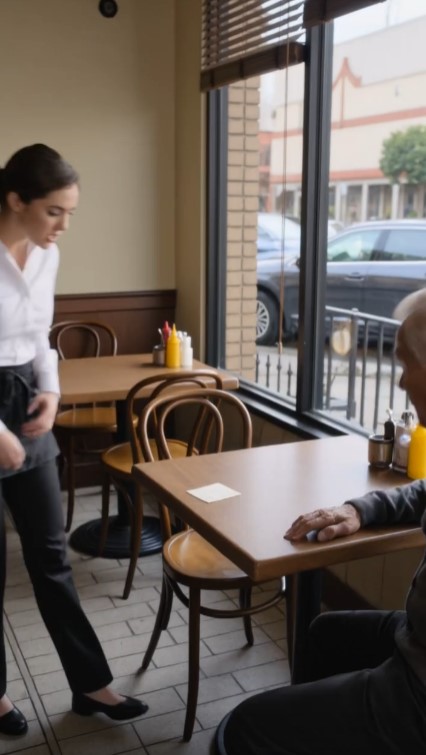
Grace had spent twenty-six years believing she knew the story of her childhood.
She knew who raised her.
She knew who loved her.
And she knew, or thought she knew, that everyone connected to the first months of her life was gone.
Then an elderly customer left a one-dollar tip.
And underneath the table, Grace found a photograph that made everything she believed begin to unravel.
The man’s bill had been eighteen dollars.
His tip was one dollar.
Grace’s coworker shook his head as they cleared the nearby tables.
“After you spent an hour helping him?”
Grace looked toward the restaurant door.
The elderly man was slowly making his way toward the bus stop.
His hands had trembled throughout dinner.
He couldn’t read the menu unless he held it inches from his face.
So Grace had sat beside him.
Read every item aloud.
Helped cut his food.
Refilled his coffee.
And listened while he talked about his late wife.
He had smiled whenever he mentioned her.
“She could make any room feel warmer,” he told Grace.
Grace had smiled.
“She sounds special.”
“She was.”
When the man left, Grace found the dollar bill folded beneath his plate.
Her coworker rolled his eyes.
“One dollar.”
Grace shrugged.
“Maybe that’s all he could afford.”
She slipped it into her apron.
Then felt something unusual.
Writing.
Grace unfolded the bill.
Across one edge, in tiny handwriting, were three words:
CHECK TABLE NINE.
Grace frowned.
That was the old man’s table.
She walked back.
Nothing sat on top.
She checked the floor.
Then crouched.
Taped beneath the table was a small envelope.
Her name was written across the front.
GRACE.
Her heart began beating faster.
She tore it open.
There was no money inside.
Only an old photograph.
Grace as a baby.
Maybe six months old.
She knew instantly because her mother still had photographs from that age.
But the woman holding Grace wasn’t her mother.
She was younger.
Dark hair.
Wide smile.
One arm wrapped protectively around baby Grace.
Grace dropped the photograph.
Her coworker picked it up.
“Grace… who is that?”
“I don’t know.”
He turned it over.
On the back:
Grace — 6 months.
Then another sentence:
Tell her when she’s ready.
Grace grabbed the photograph and ran outside.
The elderly man was still walking toward the bus stop.
“Sir!”
He stopped.
Grace caught up to him, breathless.
She held the photograph in front of him.
“Who is this?”
The man looked at it.
His expression changed immediately.
Not surprise.
Relief.
“You found it.”
“Who is she?”
He looked into Grace’s eyes.
“The woman who saved your life.”
Grace shook her head.
“My mother saved me.”
The elderly man’s face tightened.
“No, Grace.”
Then he reached into his coat.
He removed another photograph.
Same woman.
This time she stood beside Grace’s mother.
Both were much younger.
And between them was a stroller.
Grace stared.
“Who are you?”
The man answered quietly:
“I’m her husband.”
Grace stopped breathing.
“Her husband?”
“Yes.”
“Then why have I never met you?”
He looked toward the restaurant window.
Grace turned.
Her mother, Linda, was standing inside.
She had arrived unexpectedly.
And she was staring directly at the elderly man.
The color had disappeared from her face.
The man whispered:
“Ask your mother why she told you we were both dead.”
Grace felt the world tilt.
“My mother told me what?”
The elderly man looked surprised.
“She never told you?”
“Told me what?”
Before he could answer, the restaurant door opened.
Linda stepped outside.
“Grace.”
Grace turned.
“Mom, who is he?”
Linda looked at the man.
Then at the photograph in Grace’s hand.
“You shouldn’t have done this, Arthur.”
So that was his name.
Arthur.
Grace stared at her mother.
“You know him.”
Linda closed her eyes.
“Yes.”
“You told me everyone from that time was dead.”
Linda looked around.
Customers were entering and leaving the restaurant.
Cars moved through the parking lot.
“This isn’t the place.”
Grace’s voice sharpened.
“Then where is the place? Because apparently twenty-six years wasn’t enough time.”
Arthur lowered his head.
Linda looked hurt.
But she didn’t argue.
“Come home with me.”
Grace looked at Arthur.
“You too.”
Linda immediately said:
“No.”
Grace stared at her.
“He comes, or I don’t.”
For several seconds, mother and daughter stood facing each other.
Finally Linda nodded.
An hour later, the three sat around Linda’s kitchen table.
Grace placed both photographs between them.
“Start talking.”
Linda stared at the first photograph for a long time.
The woman holding Grace was named Rebecca Miller.
Arthur’s wife.
Grace asked:
“How did she save my life?”
Linda looked toward Arthur.
Arthur nodded.
“Tell her everything.”
Linda took a breath.
Twenty-six years earlier, Grace had been born nearly six weeks premature.
For the first few months, she was fragile.
Frequent respiratory infections.
Hospital visits.
Constant fear.
Linda was twenty-two.
Single.
Working whenever she could.
Grace’s father had disappeared before the birth.
Linda had almost no support.
Rebecca was Linda’s closest friend.
They had met at a community college class.
Rebecca was nearly ten years older.
Married to Arthur.
Unable to have children of her own.
“She loved you immediately,” Linda said.
Grace looked at Arthur.
He smiled faintly.
“She bought more baby clothes than your mother did.”
Linda almost smiled.
“She did.”
Rebecca began helping constantly.
Watching Grace while Linda worked.
Driving them to appointments.
Bringing groceries.
Sitting beside Grace’s crib when she was sick.
Then one winter night, everything changed.
Grace developed a severe fever.
Linda was working a late shift.
Rebecca was babysitting.
At around 11 p.m., Grace stopped breathing normally.
Rebecca called emergency services.
But a snowstorm had slowed ambulances.
Arthur was away working overnight.
Rebecca wrapped Grace in blankets.
Carried her outside.
And drove toward the hospital herself.
Grace stared.
“She drove me?”
Linda nodded.
“The roads were terrible.”
Halfway there, Rebecca’s car slid into a ditch.
She couldn’t get it out.
Grace’s breathing was getting worse.
Rebecca left the car.
Carried Grace nearly half a mile through snow to a gas station.
The attendant called emergency services again.
Paramedics finally reached them.
Grace was taken to the hospital.
Doctors later told Linda that if Rebecca had waited much longer, Grace might not have survived.
Grace looked at the photograph.
“So that’s what he meant.”
Arthur nodded.
“She saved you.”
Grace’s voice softened.
“Then why did I never know her?”
Linda looked down.
Because three months later, Rebecca disappeared.
Grace frowned.
“Disappeared?”
Arthur’s jaw tightened.
“She left.”
Linda looked at him.
“You still don’t know that.”
“I know enough.”
Grace looked between them.
“What happened?”
Rebecca had been struggling emotionally for years.
Her inability to have children hurt deeply.
Helping Linda with Grace brought joy.
But it also exposed wounds Rebecca rarely discussed.
Then she learned something that changed everything.
Grace’s biological father returned.
Not to become a parent.
To ask Linda for money.
Grace’s father, Michael, had gambling debts.
He learned Rebecca and Arthur had savings.
He approached Rebecca privately.
Told her Linda intended to give Grace up.
Said he could “arrange” for Rebecca and Arthur to take custody if they paid him.
Grace stared.
“That sounds insane.”
“It was,” Arthur said.
But Rebecca desperately wanted a child.
For a short time, she believed him.
She gave Michael money.
Thousands.
Then discovered the truth.
Linda had never planned to give Grace away.
Michael had manipulated her.
Rebecca was devastated.
Ashamed.
She confessed everything to Linda.
Linda exploded.
“You tried to buy my daughter.”
Arthur interrupted.
“She didn’t see it that way.”
Linda looked at him.
“I was twenty-two and terrified.”
“I know.”
Grace asked:
“What happened next?”
Linda told Rebecca never to come near them again.
Arthur defended his wife.
The friendship collapsed overnight.
Rebecca became increasingly depressed.
Then one morning, Arthur woke and found a note.
Rebecca was gone.
Her car was later found at a bus station.
No confirmed sighting after that.
No bank activity.
No calls.
Nothing.
Grace looked at Arthur.
“You never found her?”
“No.”
“Was she declared dead?”
Arthur nodded slowly.
“After seven years.”
Grace turned toward Linda.
“So technically, she was presumed dead.”
“Yes.”
“What about Arthur?”
Linda said nothing.
Grace stared.
“You told me he was dead too?”
Linda finally answered.
“When you were twelve, you found one of Rebecca’s old photographs.”
Grace vaguely remembered.
A box.
An unfamiliar woman.
She had asked questions.
Linda panicked.
She said Rebecca and Arthur had both died years earlier.
“Why?”
“Because I didn’t want you looking for them.”
“Why not?”
Linda’s voice broke.
“Because I was afraid.”
“Of what?”
“That you’d learn Rebecca wanted you.”
Grace stared.
“She saved my life.”
“I know.”
“She cared for me.”
“I know.”
“And you were afraid I’d love her?”
Linda began crying.
“Yes.”
The answer was painfully simple.
Grace sat back.
For years, Linda had been ashamed of that fear.
She had been a young mother abandoned by Grace’s father.
Rebecca had money.
A stable marriage.
A home.
Patience.
Everything Linda thought she lacked.
After Rebecca disappeared, Linda told herself she had protected Grace from confusion.
But underneath that explanation was something less noble.
Jealousy.
Fear.
Possessiveness.
Grace asked Arthur:
“Why did you come today?”
Arthur looked at the table.
“Because I’m sick.”
Grace’s anger paused.
“What?”
“Heart failure.”
Linda looked at him sharply.
Arthur shrugged.
“Doctors say I have time. They just won’t say how much.”
Grace swallowed.
“So you decided to find me.”
“I decided to stop respecting a promise that had outlived the people who made it.”
“What promise?”
Arthur reached into his coat again.
He placed another envelope on the table.
This one was old.
The paper yellowed.
Rebecca’s handwriting.
Grace recognized it from the back of the photograph.
Arthur explained.
One week before Rebecca disappeared, she wrote him a letter.
He had kept it for twenty-six years.
Inside, she admitted what she had done with Michael.
She apologized.
She wrote that Linda had every right to be furious.
Then came one sentence:
If Grace ever grows up and asks about me, tell her only if Linda agrees. She is Grace’s mother. I will not take another choice away from her.
Grace looked toward Linda.
“You knew about this?”
“No.”
Arthur nodded.
“I never showed her.”
Grace opened the letter.
Rebecca wrote about Grace.
About the night in the snow.
About feeding her at 2 a.m.
About the way Grace grabbed her finger when she slept.
Then:
I loved that little girl. Maybe too much. Maybe in the wrong way sometimes. But I never wanted to replace Linda. I wanted to matter to someone.
Grace stopped reading.
There were tears on the page.
Or stains that looked like them.
Then she reached the bottom.
One final line:
Arthur, if I cannot find my way back, please forgive me.
Grace closed the letter.
“Did she kill herself?”
Arthur shook his head.
“I don’t know.”
That uncertainty had haunted him for twenty-six years.
He searched hospitals.
Shelters.
Public records.
Private investigators.
Every few years, another possible lead.
Nothing definitive.
Grace looked at Linda.
“Did you ever search?”
Linda’s face filled with shame.
“At first.”
“How hard?”
“Not hard enough.”
Arthur said nothing.
Linda continued.
She had convinced herself Rebecca leaving was proof she was unstable.
Dangerous to keep in Grace’s life.
Then years passed.
The story became easier to leave buried.
Grace stood from the table.
“I need air.”
She walked outside.
Ten minutes later, Arthur joined her.
He stood quietly beside the porch railing.
Grace finally asked:
“Why did you leave the photo under the restaurant table instead of just telling me?”
Arthur smiled sadly.
“Because I was afraid you’d ask me to leave.”
“So you manipulated me.”
“Yes.”
“At least you admit it.”
“I’m too old to get creative with excuses.”
Grace almost laughed.
Then she looked at him.
“You knew where I worked?”
“I found you six months ago.”
“Six months?”
“I came into the restaurant three times.”
Grace stared.
“I never noticed you.”
“You’re busy.”
“Why wait?”
Arthur looked embarrassed.
“I wanted to know what kind of person you became.”
Grace frowned.
“You were watching me?”
“Not like that.”
He smiled.
“I watched you give an elderly man a free coffee because he counted his change three times.”
Grace remembered.
“I saw you sit with a child whose mother was late picking him up.”
That was a coworker’s son.
“You reminded me of Rebecca.”
Grace looked away.
“That’s a strange thing to hear about someone I never knew.”
Arthur nodded.
“I know.”
Then Grace asked:
“Why today?”
“Your kindness.”
“What?”
Arthur pointed toward the restaurant.
“You sat with me for almost an hour.”
Grace shrugged.
“You needed help.”
“You didn’t know who I was.”
“No.”
“That’s why.”
Arthur had planned to leave without revealing himself if Grace seemed uncomfortable.
But when she read the menu aloud without impatience, cut his food without making him feel embarrassed, and listened to him talk about Rebecca…
he decided she deserved the truth.
Grace looked at the one-dollar bill still in her pocket.
“You could’ve tipped more.”
Arthur laughed.
“I needed the dollar to carry the message.”
“That’s your excuse?”
“I’m retired.”
For the first time that day, Grace genuinely smiled.
Then Linda came outside.
She stood several feet away.
“Grace?”
Grace turned.
Her mother looked terrified.
Not that Grace would yell.
That she might leave.
Grace understood.
“I’m angry.”
Linda nodded.
“You should be.”
“You lied to me.”
“Yes.”
“For years.”
“Yes.”
“But I’m not disappearing.”
Linda began crying.
Grace walked over.
“I need time.”
“I understand.”
“And I need you to stop choosing what truths I can handle.”
Linda nodded.
“I will.”
Grace looked toward Arthur.
“Same rule for you.”
Arthur raised both hands.
“Understood.”
Over the following weeks, Grace learned everything she could about Rebecca.
Arthur brought photographs.
Letters.
Old home videos.
Linda contributed what she had kept hidden.
There were pictures of Rebecca holding baby Grace.
Rebecca feeding her.
Rebecca asleep on a sofa while Grace slept on her chest.
One photograph showed Linda and Rebecca laughing together in a kitchen.
Grace stared at it for a long time.
“You really loved each other.”
Linda nodded.
“She was my best friend.”
“Do you hate her?”
Linda looked surprised.
“No.”
“Did you?”
“For a while.”
Then Linda admitted something.
Anger had been easier than grief.
If Rebecca was simply the woman who crossed a boundary, Linda didn’t have to mourn the friend who had carried her baby through snow.
Grace and Arthur also began spending time together.
Coffee once a week.
Sometimes dinner.
He told stories about Rebecca.
But Grace set a boundary.
“I don’t want you turning her into a saint.”
Arthur nodded.
“She wasn’t.”
Rebecca could be stubborn.
Moody.
Terrible with money.
She once drove ninety miles in the wrong direction and refused to admit she was lost.
Grace laughed.
“That sounds better.”
“What?”
“Real.”
Months later, Grace asked Arthur whether he would undergo one more search for Rebecca.
Not because she expected a miracle.
Because she wanted certainty if any certainty remained possible.
They hired a professional genealogical researcher and investigator.
Most leads went nowhere.
Then one record appeared.
A woman named Rebecca Miller had used the same birth date at a women’s shelter two states away—three weeks after Rebecca disappeared.
Arthur stared at the record.
“It’s her.”
The shelter no longer had full files.
But one archived note listed a forwarding name:
Rebecca Lane.
That surname led somewhere.
A marriage record.
Eleven years after Rebecca disappeared.
Grace stopped breathing.
“She remarried?”
Arthur sat silently.
The record meant one thing.
Rebecca had survived.
For at least eleven years.
Arthur looked devastated.
“She was alive.”
Grace touched his arm.
That discovery was not purely good news.
Rebecca had chosen not to return.
They followed the records further.
Rebecca Lane had lived in Oregon.
Worked as a library assistant.
No children.
Her second husband died several years earlier.
Then came another record.
Rebecca herself had died four years ago.
Grace stared at the screen.
“She was alive until four years ago.”
Arthur cried.
Not loudly.
Just quietly, with both hands covering his face.
For twenty-six years, part of him had imagined Rebecca dead shortly after leaving.
Now he knew she had built another life.
Grace worried he would become angry.
Instead, he said:
“I hope she was happy.”
The investigator found one more thing.
Rebecca had left personal papers to a small library archive because she volunteered there.
Among them was a sealed envelope.
The outside read:
FOR GRACE, IF SHE EVER FINDS ME.
Grace flew to Oregon with Arthur.
Linda came too.
The three stood inside a quiet library office while an archivist handed Grace the envelope.
Her hands shook.
Inside was a letter written six years earlier.
Grace,
If you are reading this, then somehow the story found you.
Rebecca explained everything.
After leaving, she entered a mental-health crisis.
She stayed in a shelter.
Then treatment.
For months, she considered returning.
But shame stopped her.
She believed Linda would never forgive her.
She believed Arthur deserved someone less broken.
So she made the same mistake again and again.
She stayed away.
Then:
I followed your life from a distance only once. I found a college announcement with your name. You looked happy. I decided not to disturb that happiness.
Grace started crying.
Rebecca knew she became a waitress?
No.
The letter was written before that.
But Rebecca knew Grace survived.
Grew up.
And apparently chose not to contact her.
The final paragraph read:
I saved your life once, but your existence saved part of mine too. Loving you showed me I was capable of love even when I did not know how to live with myself.
Please do not remember me as your second mother.
You had a mother.
Remember me as someone who loved you for a little while and hoped that was enough.
Grace pressed the letter against her chest.
Linda began sobbing.
Arthur turned away.
For years, all three had carried different versions of the same story.
Linda carried betrayal.
Arthur carried abandonment.
Grace carried nothing because the truth had been hidden from her.
Now they finally had the whole thing.
Not a perfect ending.
Rebecca would never walk through a door.
Never explain herself in person.
Never meet adult Grace.
But the unanswered space had a shape now.
Grace visited Rebecca’s grave.
She brought one thing.
A photograph.
The copy Sophie—no, there was no Sophie in this story—Grace herself chose was the old baby picture.
She placed it against the headstone.
Then changed her mind.
“That’s mine.”
Arthur smiled through tears.
Grace kept the photograph.
Instead, she left a small note.
Thank you for carrying me through the snow.
Months later, Arthur’s health declined.
Grace visited him frequently.
One afternoon, he apologized.
“For what?”
“The one-dollar tip.”
Grace laughed.
“You should be sorry.”
“I’ve been thinking about it.”
“Dangerous.”
“I owe you twenty percent.”
Grace held out her hand.
“Three-sixty.”
Arthur laughed so hard he started coughing.
When he recovered, he reached into his drawer.
Inside was another dollar bill.
Writing across the edge.
Grace unfolded it.
CHECK YOUR POCKET.
She frowned.
Then reached into her coat pocket.
There was a small brass key.
“What does this open?”
Arthur smiled.
“A box in my closet.”
Inside the box were every photograph of Rebecca and Grace that Arthur owned.
He had decided they belonged to Grace.
There was also a note.
Not from Rebecca.
From Arthur.
You don’t owe us anything.
Grace looked at him.
“I know.”
“Good.”
He smiled.
“That took your mother twenty-six years to learn.”
Linda, sitting nearby, threw a tissue at him.
Arthur lived another two years.
Long enough to attend Grace’s wedding.
Linda sat beside him.
People asked how they knew each other.
Grace gave the simplest answer:
“They’re part of the same old story.”
She didn’t explain everything.
Some stories belong more to the people who lived them than to the people curious about them.
Years later, Grace still kept the original one-dollar bill.
Not because of its value.
Because three words written along its edge changed her understanding of her entire childhood.
CHECK TABLE NINE.
At that table, an elderly stranger had eaten an eighteen-dollar meal.
Grace had read the menu to him.
Cut his food.
Listened to him talk about his late wife.
She thought she was helping someone lonely.
She had no idea he was deciding whether to tell her that the woman he loved had once carried Grace through a snowstorm to save her life.
Grace also never forgot what Rebecca wrote.
Do not remember me as your second mother.
You had a mother.
That sentence eventually helped Grace forgive Linda.
Because the truth did not erase who had raised her.
Learning that Rebecca loved her did not reduce Linda’s love.
Families were not measuring cups.
One person’s place did not have to shrink because another person mattered too.
Linda had spent decades afraid of exactly that.
Grace finally understood.
And one afternoon, while the two were looking through Rebecca’s photographs, Grace said:
“You know what your biggest mistake was?”
Linda braced herself.
“What?”
“Thinking I couldn’t love you both.”
Linda began crying.
Grace hugged her.
Twenty-six years earlier, Rebecca saved a six-month-old baby.
Then fear, shame, anger, and silence separated everyone connected to that night.
Decades later, the truth returned in the smallest possible way.
Not through a lawyer.
Not through an inheritance.
Not through some dramatic announcement.
Through a one-dollar tip.
And three handwritten words.
Grace had spent her entire shift believing she was the person helping the elderly stranger.
Only later did she understand that he had walked into the restaurant carrying something she had been missing her entire life.
The truth.
And this time…
nobody hid it from her.