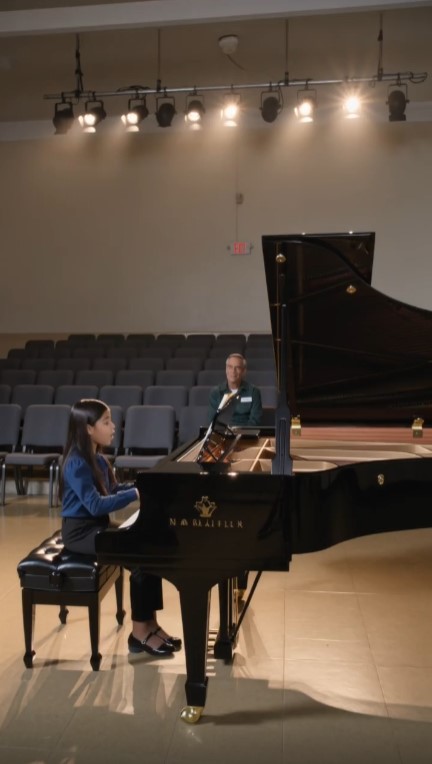
The famous pianist had already left.
The audience was gone.
The lights were being switched off one row at a time.
But sixteen-year-old Maya was still onstage.
She had an important scholarship audition the next morning, and she wanted one final rehearsal before going home.
Then she noticed someone sitting alone in the last row.
Mr. Harris.
The school janitor.
He was staring at the grand piano.
Maya smiled.
“Want to hear one more?”
Mr. Harris laughed softly.
“You should go home.”
“Just one.”
She turned back toward the keys.
The piece began quietly.
Then built.
Maya had played it hundreds of times.
Her teachers said she was ready.
Her mother said she was ready.
Maya herself wasn’t sure.
Halfway through the piece, Mr. Harris suddenly stood.
Maya stopped.
“Was it that bad?”
He shook his head.
“No.”
Then he walked slowly toward the stage.
“Your left hand is rushing.”
Maya frowned.
“What?”
“Measure twelve.”
She stared at him.
Mr. Harris pointed toward the score.
“You’re anticipating the phrase. It makes the right hand sound late even though it isn’t.”
Maya blinked.
“How do you know that?”
He didn’t answer.
“Play it again.”
She did.
This time he counted quietly.
“Wait.”
“Now.”
“Hold that.”
Maya played the passage again.
It sounded different.
Cleaner.
Balanced.
Exactly right.
She turned toward him.
“How did you know?”
Mr. Harris looked at the piano.
For a moment, something changed in his face.
Then he stepped onto the stage.
He sat down.
Placed both hands above the keys.
And hesitated.
Maya noticed his fingers trembling.
“You don’t have to.”
Mr. Harris smiled sadly.
“Yes, I do.”
For the first time in twenty-five years…
Samuel Harris played.
The first notes were quiet.
Then the sound filled the auditorium.
Maya stopped breathing.
This wasn’t someone who had taken a few lessons.
This wasn’t a hobby.
Mr. Harris played with the precision of someone who had once lived inside music.
His hands moved effortlessly.
The empty hall seemed to wake up around him.
When he finished, Maya stood frozen beside the piano.
“Who are you?”
Mr. Harris kept looking at the keys.
“Someone who stopped playing.”
“Why?”
He stood.
“That’s a long story.”
Maya looked at the scholarship folder sitting beside her music.
“Tomorrow?”
Mr. Harris glanced at it.
His expression changed.
“Tomorrow matters to you.”
“Yes.”
“Then tonight isn’t the time for my story.”
He picked up his mop.
“Go home, Maya.”
She stared at him.
“You’re coming tomorrow.”
“That wasn’t an invitation.”
“It is now.”
He smiled.
“I’ll think about it.”
The next morning, Maya arrived early.
Three judges sat at a long table.
Her hands were cold.
Her stomach hurt.
Then she saw Mr. Harris near the back wall.
Clean shirt.
Old jacket.
Hands folded in front of him.
He had come.
Maya smiled.
Then one of the judges noticed him.
The man slowly stood.
“Samuel?”
Mr. Harris’s face changed.
He immediately turned toward the door.
The judge followed.
“You disappeared.”
Mr. Harris kept walking.
“Samuel.”
Maya stepped away from the piano.
“You know each other?”
The judge laughed in disbelief.
“Know him?”
He pointed toward Mr. Harris.
“This man was supposed to become one of the greatest pianists of his generation.”
The room went silent.
Maya stared.
Mr. Harris stopped at the doorway.
She whispered:
“Why did you stop?”
He looked at her.
Then at the scholarship paperwork.
“Because of that scholarship.”
One of the judges went pale.
The oldest judge.
Dr. Leonard Vale.
Mr. Harris slowly reached inside his jacket.
He removed an old envelope.
The paper was yellowed.
Across the front was the same seal printed on Maya’s scholarship application.
Maya looked between them.
“What happened?”
Mr. Harris stared directly at Dr. Vale.
“Ask him why the winner disappeared twenty-five years ago.”
Nobody moved.
Dr. Vale lowered his eyes.
The second judge leaned forward.
“What is he talking about?”
Mr. Harris walked back into the room.
He placed the old envelope on the judges’ table.
Inside was a letter.
Twenty-five years earlier, Samuel Harris had been nineteen.
Poor.
Brilliant.
And almost unknown.
His mother cleaned offices at night.
His father had died when Samuel was twelve.
They couldn’t afford conservatory tuition.
So Samuel practiced anywhere he could.
Church basements.
School auditoriums.
Community centers.
Anywhere someone let him use a piano.
Then he heard about the scholarship.
Full tuition.
Private instruction.
Housing.
A path into one of the country’s best music programs.
Samuel auditioned.
Dr. Vale had been a young faculty member then.
He was also one of the judges.
Samuel won.
Unanimously.
At least, that was what he had been told.
But three days later…
the scholarship was given to someone else.
Maya frowned.
“Why?”
Samuel looked at Vale.
“Because the other student’s father was one of the program’s biggest donors.”
Dr. Vale closed his eyes.
The room became completely still.
Samuel continued.
The official explanation was that there had been an administrative review.
Scores were “reconsidered.”
Suddenly Samuel was placed second.
No tuition.
No housing.
No way to attend.
He appealed.
Nothing changed.
He wrote letters.
No answer.
Then he confronted Dr. Vale privately.
Maya looked toward the judge.
“What did you tell him?”
Vale sat down slowly.
“I told him to let it go.”
Samuel laughed once.
“You told me careers were built on relationships, not fairness.”
Vale looked ashamed.
“I was twenty-eight.”
“You were old enough.”
“Yes.”
Samuel’s mother was already ill.
Without the scholarship, he took a warehouse job.
Then a second job.
He practiced less.
His mother’s medical bills grew.
A year later she died.
Samuel stopped playing altogether.
Maya whispered:
“Because of the scholarship?”
Samuel shook his head.
“No.”
Then looked at her.
“The scholarship broke the door.”
“My mother’s death made me stop looking for another one.”
That distinction mattered.
Samuel had spent years blaming the program.
The judges.
Vale.
But somewhere along the way, pain became an excuse to abandon the thing he loved.
He moved through jobs.
Delivery driver.
Building maintenance.
School janitor.
Every time he heard a piano, he walked away.
Until the night before Maya’s audition.
Maya asked:
“Why keep the letter?”
Samuel looked at the envelope.
“To remind myself I had been cheated.”
He paused.
“Eventually it became something worse.”
“What?”
“Proof I could use whenever I wanted to explain why I never tried again.”
Vale looked at him.
“I’m sorry.”
Samuel said nothing.
Vale continued.
“I should have fought harder.”
Samuel’s expression tightened.
“You didn’t fight at all.”
“You’re right.”
The other judges looked stunned.
One asked Vale:
“Did the committee know?”
“Some did.”
“And nobody reported it?”
Vale shook his head.
“No.”
Maya stared at the scholarship paperwork.
“Is this still happening?”
The judges immediately answered no.
The program had changed completely.
Independent scoring.
Recorded auditions.
External review.
Conflict-of-interest rules.
The donor structure was different.
But none of that changed what had happened to Samuel.
Maya looked at him.
“You should expose them.”
Samuel smiled faintly.
“That’s not why I came.”
“Then why did you bring the envelope?”
He looked toward the piano.
“Because last night I touched those keys for the first time in twenty-five years.”
Then he looked at Maya.
“And I realized I was tired of carrying this.”
He picked up the envelope.
Then tore it in half.
Vale flinched.
Samuel tore it again.
Maya stared.
“You kept that for twenty-five years.”
“Yes.”
“Why destroy it now?”
“Because it already took enough.”
The room stayed silent.
Then Samuel pointed toward the piano.
“You have an audition.”
Maya suddenly remembered why she was there.
Her hands began shaking.
“I can’t play after that.”
Samuel smiled.
“Yes, you can.”
“No.”
“You can.”
He walked over.
“Sit.”
Maya sat.
He leaned toward her.
“Measure twelve.”
She almost laughed.
“My left hand.”
“Exactly.”
Maya placed her hands on the keys.
Then stopped.
“What if I lose?”
Samuel looked at her for a long moment.
Then said:
“Losing is not the same as being finished.”
She looked up at him.
Samuel continued.
“I spent twenty-five years confusing those two things.”
Maya nodded.
Then she played.
At first, her hands trembled.
Then the music settled.
Measure twelve came.
Her left hand waited.
Perfectly.
Samuel smiled from the back of the room.
When Maya finished, nobody spoke for several seconds.
Then the judges thanked her.
She walked outside with Samuel.
“Was I good?”
“You know better than to ask me that.”
“Samuel.”
“You rushed measure thirty-six.”
Maya stared.
He smiled.
“Everything else was beautiful.”
She punched his arm lightly.
“You’re horrible.”
“I’ve been told.”
Two hours later, the results were posted.
Maya won.
She stared at the paper.
Full scholarship.
She turned.
Samuel was standing behind her.
“I got it.”
“I see that.”
She hugged him.
He froze.
Then slowly hugged her back.
“Thank you.”
Samuel shook his head.
“You earned it.”
“You helped.”
“That’s different.”
Dr. Vale approached.
Samuel immediately became guarded.
Vale held out a folder.
“What’s this?” Samuel asked.
“A copy of your original audition records.”
Samuel didn’t take it.
Vale continued.
“I found them in the archive.”
The scores showed Samuel had indeed ranked first.
By a wide margin.
Vale said quietly:
“I can’t give you twenty-five years back.”
“No.”
“But I can tell the truth publicly.”
Samuel looked at him.
“Why now?”
“Because I should have then.”
Samuel stared for several seconds.
Then took the folder.
“Do it.”
The conservatory opened an internal historical review.
The findings were published months later.
Samuel’s name was formally restored as the rightful winner of the 25-year-old competition.
The institution apologized.
Samuel read the statement once.
Then folded it.
Maya asked:
“Does it feel better?”
He thought for a moment.
“A little.”
“Only a little?”
“An apology can correct a record.”
He looked toward the piano.
“It can’t play the years you lost.”
But something else had begun.
Samuel started staying after school.
At first, only when Maya practiced.
He corrected phrasing.
Finger position.
Tempo.
Then another student asked for help.
Then another.
The principal noticed.
“You know we could pay you to teach.”
Samuel laughed.
“I’m the janitor.”
“You’re also apparently terrifyingly overqualified.”
Samuel resisted.
Eventually he agreed to one afternoon a week.
Then two.
The music teacher handed him a set of keys to the practice rooms.
Samuel stared at them.
“What?”
“You’re allowed to use the pianos.”
He smiled.
“I know.”
“Then why are you staring?”
“Because twenty-five years ago I spent half my life asking permission.”
The first time Samuel performed publicly again was at the school’s winter concert.
He refused at first.
Maya insisted.
“Just one piece.”
Samuel stared at her.
“That line sounds familiar.”
“Good.”
He played after the students finished.
No announcement about his past.
No dramatic introduction.
He simply sat down.
And played.
By the end, the auditorium was standing.
Samuel stayed seated for several seconds.
Then looked toward Maya.
She was crying.
He mouthed:
Measure twelve.
She laughed.
A year later, Maya left for conservatory.
Samuel drove her to the station.
Before she boarded, he gave her an envelope.
She groaned.
“Please tell me this one doesn’t contain a twenty-five-year scandal.”
“No.”
Inside was one dollar.
Maya frowned.
“Why?”
Samuel smiled.
“My first piano teacher charged me one dollar for my first lesson because my mother couldn’t afford more.”
On the bill he had written:
DON’T LET ONE CLOSED DOOR BECOME YOUR WHOLE HALLWAY.
Maya folded it carefully.
“You’re getting sentimental.”
“I’m getting old.”
“You were already old.”
“Get on the train.”
She hugged him.
Years passed.
Maya became a professional pianist.
Not famous overnight.
Not instantly successful.
She lost competitions.
Missed opportunities.
Made mistakes.
Every time something went wrong, she kept that dollar bill nearby.
And whenever she returned home, she visited Samuel.
He eventually stopped working maintenance.
The school created a small music mentorship position for him.
The irony was not lost on anyone.
One afternoon, Maya arrived and found him teaching a boy who kept stopping after every mistake.
Samuel tapped the music stand.
“Again.”
The boy sighed.
“I’m bad at this.”
“No.”
Samuel shook his head.
“You’re unfinished.”
Maya smiled from the doorway.
Samuel noticed.
“You’re late.”
“I’m famous now.”
“Not in this room.”
She laughed.
Then looked toward the piano.
“You still play?”
“Sometimes.”
“Play with me.”
Samuel hesitated.
Old habit.
Then sat down.
Maya joined him.
Four hands.
One piano.
The janitor who had stopped playing for twenty-five years.
And the teenager whose scholarship audition had forced him to confront why.
They began.
Samuel missed one note.
Maya stopped.
“Your left hand is rushing.”
He stared at her.
She smiled.
“Measure twelve.”
Samuel laughed so loudly he ruined the piece.
They started again.
Years later, people would tell Samuel’s story as if Maya had rescued him.
He always corrected them.
“She didn’t rescue me.”
“What did she do?”
Samuel would smile.
“She gave me one reason to sit at the piano.”
That was all.
One reason.
After twenty-five years of refusing every reason.
The scholarship had been stolen from him.
That was true.
People with power had failed him.
That was true too.
But the part Samuel eventually understood was harder.
The people who hurt him took one opportunity.
He had accidentally handed them the next twenty-five years.
So when he tore up the old letter, he wasn’t forgiving the corruption.
He wasn’t pretending the injustice didn’t matter.
He was simply refusing to let it choose another day for him.
Maya won the scholarship Samuel should have received decades earlier.
But that wasn’t the most important thing that happened inside the audition room.
The most important thing happened before Maya played a single note.
A quiet school janitor walked toward a piano.
Sat down.
And after twenty-five years of silence…
began again.