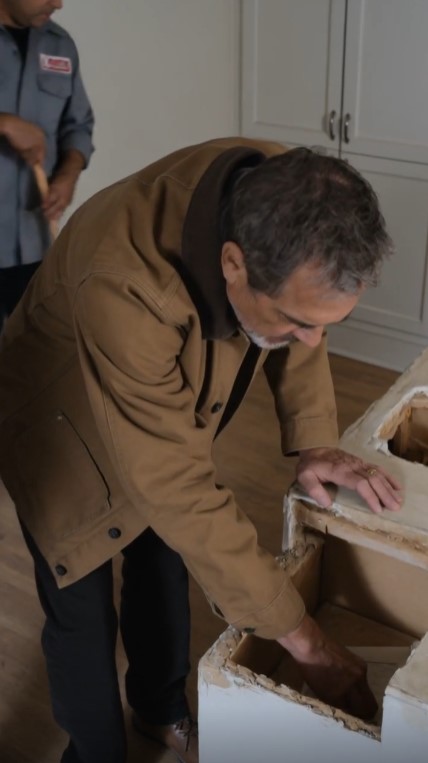
The demolition crew had already cleared most of the old house.
Walls were open.
Floorboards had been removed.
Dust covered nearly everything.
Then Thomas, a homeless man who had been helping the crew clean debris for a few days, noticed something shining inside a broken section of plaster.
He reached into the wall.
And pulled out a wedding ring.
The contractor looked over.
“Lucky find.”
But Thomas wasn’t smiling.
He turned the ring slowly in his hand.
Then read the engraving inside.
His face changed.
“This was my wife’s.”
The entire crew stopped.
Thomas had been homeless for almost nine years.
Before that, he had been married to a woman named Rebecca.
They had not been wealthy.
But they had been happy.
At least Thomas had believed they were.
Then everything collapsed.
Thomas lost his job.
Their savings disappeared into bills.
They fell behind on rent.
Eventually they lost their apartment.
For several months, they moved between cheap motels and friends’ couches.
The pressure changed them.
Arguments became more frequent.
Thomas became ashamed of how little he could provide.
Rebecca became quieter.
Then one morning…
she was gone.
No note.
No call.
Nothing.
Thomas searched.
He contacted old friends.
Hospitals.
Shelters.
Police.
Nobody knew where she had gone.
Eventually, Thomas came to believe the simplest explanation.
Rebecca had left him.
Maybe she had found someone else.
Maybe she was tired of struggling.
Maybe she simply wanted a life without him.
That belief hurt.
But over time, it became easier than uncertainty.
Now Thomas was standing inside a house he had never seen before…
holding the ring he personally bought for Rebecca.
He knew the tiny scratch near the edge.
He knew the engraving.
T + R.
FOREVER.
The contractor called the property owner.
An elderly woman arrived twenty minutes later.
Her name was Margaret.
She walked through the damaged house slowly.
Then she saw Thomas.
Then the ring.
She stopped.
“You’re Thomas?”
He stared at her.
“How do you know my name?”
Margaret looked suddenly tired.
“Come with me.”
She led him toward the only room not yet demolished.
The old dining room.
A cabinet stood against one wall.
Margaret asked the workers to move it.
Behind it was a small cavity.
Inside were several objects.
A photograph.
A bus ticket.
And a bundle of unopened letters.
Every envelope had one name written across the front.
THOMAS.
His hands started shaking.
“They were never sent.”
Margaret nodded.
“No.”
Thomas turned toward her.
“Who wrote them?”
“You know.”
He picked up the first envelope.
Rebecca’s handwriting.
He opened it.
The first line read:
Tom, if you ever find these, I didn’t leave you.
Thomas sat down.
For several seconds, he couldn’t continue.
Then he looked at Margaret.
“Rebecca lived here?”
“Yes.”
“For how long?”
“Almost five years.”
Thomas stared at her.
“Why didn’t she come home?”
Margaret reached into the cavity.
She handed him another photograph.
Rebecca.
Older.
Thin.
But unmistakably alive.
Standing beside Margaret.
Thomas looked at the date.
Three months earlier.
His breath caught.
“She’s alive.”
Margaret nodded.
Thomas stood so quickly the chair moved backward.
“Where is she?”
Margaret looked toward the driveway.
A car had just stopped outside.
Then she said quietly:
“That depends on whether you’re ready to hear why she disappeared.”
Thomas turned toward the window.
A woman sat inside the car.
He could see only part of her face.
But he knew.
Rebecca.
Nine years disappeared in an instant.
Thomas moved toward the door.
Margaret caught his arm.
“Wait.”
He turned.
“I’ve waited nine years.”
“I know.”
“Then let me go.”
“Not before you understand.”
Thomas looked at the letters.
Then slowly sat down again.
Margaret began.
The night Rebecca disappeared, she had not planned to leave Thomas forever.
She planned to leave for one night.
Nothing more.
She had been frightened.
Not of Thomas.
Of herself.
For months, Rebecca had been hiding something.
She had been experiencing severe panic attacks.
Sometimes she couldn’t breathe.
Sometimes she became convinced something terrible was about to happen.
She stopped sleeping.
Stopped eating properly.
But she told Thomas almost none of it.
Why?
Because he was already struggling.
He had lost work.
He blamed himself for losing their home.
Rebecca didn’t want to become another problem he had to solve.
Thomas stared at the floor.
“She could’ve told me.”
Margaret nodded.
“She should have.”
That final night, Thomas and Rebecca argued in a motel room.
Not about anything important.
Money.
Food.
Where they would stay next.
Thomas said something he regretted.
“I can’t keep carrying everything.”
Rebecca heard something different.
She heard:
I can’t keep carrying you.
Thomas closed his eyes.
“I didn’t mean that.”
“I know.”
“Did she?”
“Not then.”
Rebecca left the motel.
She walked for hours.
Eventually, she reached a bus station.
She had almost no money.
She bought the cheapest ticket she could.
The bus brought her to the town where Margaret lived.
Margaret had been running a small rooming house at the time.
Rebecca arrived looking exhausted.
She asked for a room.
Couldn’t afford it.
Margaret let her stay anyway.
Thomas frowned.
“Why?”
Margaret smiled sadly.
“Because someone once did the same for me.”
Rebecca stayed one night.
Then two.
Then a week.
She intended to call Thomas.
She even wrote the first letter.
But before she sent it, something happened.
Rebecca collapsed.
Margaret took her to the hospital.
Doctors discovered a serious heart condition.
Not immediately fatal.
But dangerous.
Rebecca needed treatment.
Medication.
Monitoring.
She was terrified.
Thomas stared.
“She was sick?”
“Yes.”
“For years?”
“Yes.”
“Why didn’t anyone tell me?”
Margaret looked toward the letters.
“She tried.”
Rebecca wrote.
Again and again.
But she never mailed them.
Thomas shook his head.
“That makes no sense.”
Margaret sighed.
“At first she was afraid you’d blame yourself.”
Then time passed.
One week became one month.
One month became six.
Thomas’s situation worsened.
Rebecca occasionally searched public records and old addresses.
Then she learned he had lost contact with nearly everyone they knew.
She found one shelter where he had stayed.
By the time she called, he was gone.
She wrote another letter.
Didn’t send it.
Then another.
“What stopped her?”
“Shame.”
Thomas laughed bitterly.
“Shame kept her away nine years?”
“Partly.”
Margaret continued.
Rebecca had always believed she would contact Thomas once she was stable.
Once she had a job.
Once she had somewhere to live.
Once she could explain everything without sounding broken.
But each improvement made the silence harder to justify.
Eventually, she became convinced Thomas hated her.
Thomas looked at the first letter again.
“I thought she hated me.”
Margaret nodded.
“That was the tragedy.”
Two people.
Each ashamed.
Each waiting to become “better” before reaching for the other.
Neither knew the other was still waiting.
Thomas looked toward the driveway.
“Why now?”
Margaret hesitated.
Then told him the part Rebecca had asked her not to reveal until today.
Three months earlier, Rebecca had finally found Thomas.
Not in person.
Through a local outreach program.
A photograph had been posted online showing volunteers serving meals to unhoused residents.
Thomas was in the background.
Rebecca recognized him instantly.
Thomas stared.
“She knew where I was?”
“She knew the program.”
“Then why didn’t she come?”
“She did.”
Thomas froze.
Rebecca came twice.
Both times, she remained across the street.
She watched Thomas help another homeless man carry boxes.
Saw him share part of his meal.
Saw him laugh with volunteers.
Then she panicked.
“She thought you had built a life without her.”
Thomas laughed painfully.
“A life?”
Margaret lowered her eyes.
“She didn’t understand.”
Then Rebecca did something unexpected.
She returned to this old house.
The one Margaret had once rented to her.
Years earlier, after Margaret stopped operating it as a rooming house, she kept the property.
Rebecca still had access.
She hid the ring inside the wall.
Along with the letters.
Thomas stared.
“Why?”
“Because she couldn’t throw them away.”
“And burying them in a wall was better?”
Margaret smiled faintly.
“Rebecca was never especially logical when emotional.”
Thomas almost smiled.
That sounded like her.
Then he looked again at the bus ticket.
The date was the night Rebecca disappeared.
Proof that she had left town exactly as Margaret described.
Thomas opened another letter.
Tom,
I keep telling myself I’ll send this when I know what to say.
The truth is, I don’t.
I left because I thought you’d be better without one more person depending on you.
I know now that leaving was its own kind of cruelty.
He opened another.
Tom,
Today I got a job.
You would laugh because I still hate mornings.
I wanted to call you.
I didn’t.
I’m sorry.
Another.
Tom,
I saw a man on the street today wearing your old jacket.
For three seconds I thought it was you.
I almost ran after him.
Thomas stopped reading.
He wiped his face.
“Where is she now?”
Margaret looked toward the car.
“Waiting.”
“For what?”
“For you to decide if you want to see her.”
Thomas stood.
“That isn’t a decision.”
He walked outside.
The car door opened.
Rebecca stepped out.
She looked older.
So did he.
Gray in her hair.
Lines around her eyes.
But it was her.
Thomas stopped several feet away.
Rebecca covered her mouth.
“Tom.”
He stared.
Nine years of imagined conversations disappeared.
He had planned anger.
Questions.
Accusations.
Instead he said:
“You’re alive.”
Rebecca started crying.
“So are you.”
Thomas laughed once.
Then cried too.
Neither moved.
Finally Rebecca whispered:
“I’m sorry.”
Thomas shook his head.
“Don’t start with that.”
She looked frightened.
“Why?”
“Because if you start apologizing, I’m going to start too, and we’ll be standing in this driveway until dark.”
Rebecca laughed through tears.
That sound broke the distance.
Thomas walked toward her.
Then stopped.
“Can I hug you?”
Rebecca nodded.
They held each other.
Not like people magically restored to who they were nine years earlier.
Like two people meeting again after becoming strangers to parts of each other.
When they separated, Thomas asked the first question that mattered.
“Why didn’t you tell me you were sick?”
Rebecca looked down.
“Because you already thought you failed me.”
“You disappearing made that worse.”
“I know.”
“You should’ve called.”
“I know.”
“You should’ve sent one letter.”
“I know.”
Thomas looked at the house.
“Forty letters.”
“Forty-three.”
He stared.
“You wrote forty-three letters and sent zero?”
Rebecca gave a small embarrassed nod.
“That might be the most infuriating thing you’ve ever done.”
“I know.”
“Stop saying that.”
She smiled.
“Sorry.”
Thomas almost laughed again.
Then Rebecca asked:
“Why are you here?”
Thomas explained.
The demolition contractor had been hiring temporary workers through a local outreach program.
Thomas had taken the job because he wanted to save enough for a room.
He had no idea this house had anything to do with Rebecca.
Margaret looked between them.
“That’s the part neither of you is going to believe.”
The house was being demolished because Margaret had sold the lot.
If the crew had started one section of wall slightly differently…
the ring might have disappeared into debris.
If Thomas had been assigned to another part of the property…
someone else might have found it.
If he hadn’t noticed the glint…
the letters could have been destroyed.
Thomas looked at Rebecca.
“You hid this here.”
“Yes.”
“And I was the one who found it.”
“Yes.”
Neither tried to explain the coincidence.
Then Thomas asked:
“Why the ring?”
Rebecca looked at his hand.
He no longer wore his own.
Thomas noticed.
“I sold mine.”
Rebecca’s face fell.
“For food.”
“I understand.”
“No, you don’t.”
He wasn’t angry.
Just factual.
There had been nights when twenty dollars mattered more than symbolism.
Rebecca nodded slowly.
Then she said:
“I kept mine until three months ago.”
“Why put it in the wall?”
“Because I thought I was finally going to let you go.”
Thomas looked at her.
“And did you?”
She shook her head.
“No.”
They spent the rest of the afternoon talking.
Not privately at first.
Margaret stayed nearby.
The demolition crew quietly moved to another part of the property.
Thomas read more letters.
Rebecca explained the missing years.
After treatment, she worked in a grocery store.
Then a library.
Eventually, she became a receptionist at a medical clinic.
Her heart condition stabilized.
She rented a small apartment.
She volunteered twice a month at a food pantry.
Thomas stared at her.
“You were okay.”
“Eventually.”
“And I was sleeping behind a warehouse.”
Rebecca began crying.
“I didn’t know.”
“That’s the point.”
His voice sharpened.
“You didn’t know because you didn’t ask.”
She nodded.
“You’re right.”
Thomas immediately regretted the harshness.
But Rebecca didn’t defend herself.
“No. Say it.”
“What?”
“All of it.”
So Thomas did.
He told her about the first year.
How he searched every shelter.
How he checked hospitals.
How every time a woman with dark hair walked past, he looked twice.
How he eventually convinced himself she had left because he had failed as a husband.
How that belief contributed to him giving up.
Rebecca listened.
She didn’t interrupt.
Then she said:
“I thought leaving would remove a burden from your life.”
Thomas looked at her.
“You weren’t a burden.”
“I know that now.”
“You were my wife.”
“I know.”
He closed his eyes.
“There it is again.”
She smiled weakly.
“I don’t know what else to say.”
Thomas softened.
“Neither do I.”
They did not decide to reunite that day.
That would have been too easy.
Thomas had changed.
Rebecca had changed.
Love surviving didn’t automatically mean a marriage could resume.
Instead, Rebecca asked:
“Can I see you tomorrow?”
Thomas thought.
Then nodded.
“Tomorrow.”
They met at a coffee shop.
Then again two days later.
Rebecca helped Thomas connect with a housing program.
He resisted.
“I don’t want you fixing me.”
“I’m not.”
“It feels like it.”
“Then I’ll stop if you want.”
Thomas thought.
“No.”
“But?”
“But let me do part of it myself.”
Rebecca nodded.
“Okay.”
That became the pattern.
Help without control.
Closeness without pretending nothing happened.
Thomas moved into temporary housing.
Then found steady work with the demolition contractor.
He was good at it.
Reliable.
Careful.
The contractor who had first joked “Lucky find” eventually offered him a permanent position.
Thomas accepted.
Six months later, he rented a small apartment.
Rebecca helped him carry in one chair.
Thomas laughed.
“One chair?”
“You said you wanted to do it yourself.”
“Not literally everything.”
She brought another the next day.
Their relationship rebuilt slowly.
Some evenings felt almost like the old marriage.
Others reminded them how much time had passed.
Rebecca had habits Thomas didn’t recognize.
Thomas had stories Rebecca hadn’t lived.
They sometimes argued.
The difference now was that neither disappeared.
One night, after an argument about money, Rebecca grabbed her coat.
Thomas went pale.
She noticed immediately.
“I’m going for a walk.”
He said nothing.
“I’m coming back.”
Thomas looked at her.
“Promise?”
Rebecca nodded.
“Promise.”
Twenty minutes later, she returned.
That small act mattered more than either admitted.
A year after finding the ring, Thomas asked Rebecca to meet him at the demolition site.
The old house was gone.
A community garden had been created on part of the property while construction plans were delayed.
Thomas stood beside the spot where the wall once had been.
Rebecca arrived.
“What are we doing here?”
Thomas held out a small box.
Her face changed.
“Tom.”
“Relax.”
Inside was not a new ring.
It was her old wedding ring.
Cleaned.
Repaired.
The engraving polished but preserved.
T + R.
FOREVER.
Rebecca stared.
“I thought the police still had it.”
“They gave it back months ago.”
“Why didn’t you tell me?”
Thomas smiled.
“Apparently we both enjoy hiding things.”
She laughed.
Then became serious.
“Are you asking me to marry you again?”
“No.”
She blinked.
Thomas continued.
“Not yet.”
He placed the ring in her hand.
“This belongs to you.”
Rebecca looked confused.
“What am I supposed to do with it?”
“Whatever you want.”
“Wear it?”
“If you want.”
“Put it in another wall?”
“Absolutely not.”
She laughed.
Thomas smiled.
“For years, that ring meant the marriage I thought I lost.”
He looked at her.
“Now I want it to mean that we found the truth.”
Rebecca slipped it onto a chain around her neck.
Not her finger.
Not yet.
Two years later, they did marry again.
Small ceremony.
Margaret attended.
So did the demolition crew.
The contractor gave Thomas a one-dollar “finder’s fee” as a joke.
Thomas framed it.
Their second wedding vows were different from their first.
They didn’t promise they would never hurt one another.
They already knew better.
Instead, Rebecca promised:
“I will not disappear when I’m afraid.”
Thomas promised:
“I will not decide what you feel without asking.”
When the officiant asked for the rings, Rebecca removed the old ring from the chain.
Thomas had bought another inexpensive band.
Nothing fancy.
They didn’t need fancy.
Afterward, Margaret gave them the old box containing copies of all forty-three letters.
Rebecca groaned.
“Please burn those.”
Thomas shook his head.
“Absolutely not.”
“They’re humiliating.”
“They’re historical documents.”
“Thomas.”
He smiled.
“I’ll keep them somewhere safer than a wall.”
Years later, Thomas would sometimes tell people how he found his wife again.
Most assumed it was a romantic story.
A wedding ring.
Hidden letters.
A miraculous reunion.
Thomas always corrected them.
“The finding was the easy part.”
The hard part came afterward.
Learning how to trust.
Learning how to ask instead of assume.
Learning that shame becomes more dangerous the longer it stays silent.
For nine years, Thomas believed Rebecca left because she stopped loving him.
Rebecca believed Thomas would be better without her.
Both were wrong.
And neither knew because neither had spoken.
All those years, forty-three letters existed.
Words that could have changed everything.
But they remained sealed.
Hidden behind a wall.
Thomas often thought about that.
The letters had contained the truth the entire time.
But truth that never reaches someone can’t repair anything.
That was what they eventually understood.
The ring didn’t save their marriage.
The letters didn’t erase nine years.
The coincidence didn’t heal them.
What saved them was what happened after Thomas walked into the driveway and saw Rebecca alive.
They finally stopped hiding.
And started talking.
Nine years after she disappeared, Thomas found Rebecca’s wedding ring inside a wall of a house he had never known she lived in.
At first, he thought he had found proof of everything he lost.
Instead…
he found the first clue leading him back to the woman he had never truly stopped loving.