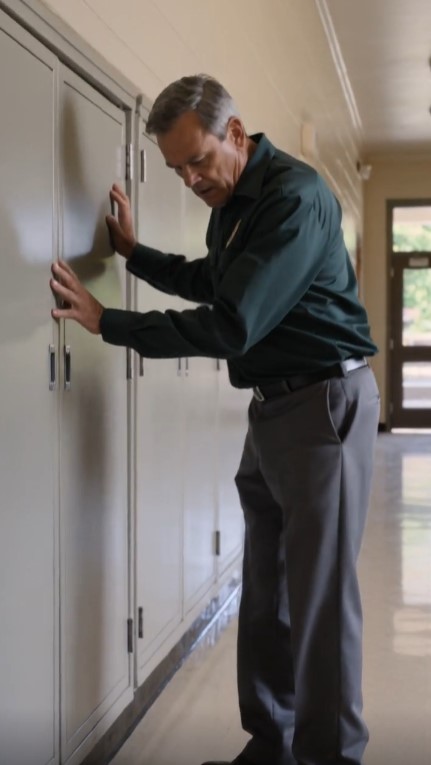
The school janitor was replacing a broken wall panel when something fell out.
A tiny red backpack.
Covered in dust.
At first, he assumed it belonged to a student.
He picked it up and started toward lost-and-found.
Then he saw the name written inside.
EMILY PARKER.
The screwdriver slipped from his hand.
Emily Parker had been a student at that school eighteen years earlier.
And one afternoon…
she never came home.
The entire town had searched.
Police questioned teachers.
Staff.
Parents.
Students.
Volunteers walked nearby streets and woods for weeks.
Emily’s photograph remained on the school notice board for years.
But she was never found.
Until now, nobody even knew her backpack had remained inside the building.
The janitor, Samuel Harris, immediately called the principal.
Within minutes, the hallway was closed.
Authorities arrived.
The backpack was photographed before anyone touched the contents.
Then it was carefully opened.
Inside were only three things.
A library book.
A silver bracelet.
And a disposable camera.
The bracelet mattered immediately.
Emily’s mother had described one exactly like it during the original investigation.
But the camera changed everything.
Technicians developed the film.
Most photographs were ordinary.
Emily laughing with friends.
A classroom.
The playground.
A teacher writing on the board.
Then they reached the final photograph.
Everyone stopped talking.
Emily had photographed a door beneath the school staircase.
Small.
Dark.
Almost hidden.
The current principal stared at the image.
“There’s no door there.”
Samuel looked at the photograph again.
Then walked toward the staircase.
He tapped the wall.
Solid.
Moved several feet.
Tapped again.
Hollow.
Workers carefully removed a newer wall panel.
Behind it…
was the same door.
Still locked.
Emily’s mother, Laura Parker, arrived shortly afterward.
The moment she saw the red backpack, she began crying.
Then she noticed the library book.
“Wait.”
She picked it up carefully after investigators cleared it.
A folded piece of paper slipped from between the pages.
One sentence was written on it:
MR. HARRIS SAID THIS ROOM DOESN’T EXIST.
Samuel went completely still.
The principal slowly looked at him.
“Your name is Harris.”
Samuel shook his head.
“Not me.”
Then he pointed toward an old staff photograph hanging in the hallway.
One man stood in the back row.
A younger version of Samuel’s face.
“That was my father.”
His name had been Robert Harris.
He had worked maintenance at the school for nearly thirty years.
And he had died twelve years earlier.
Before anyone could say more…
something clicked behind the hidden door.
The handle slowly moved.
Everyone stepped back.
An officer raised a hand.
“Stay behind me.”
The handle turned again.
The door opened several inches.
A man stood on the other side.
He appeared to be in his late fifties.
Thin.
Gray-haired.
Holding an old flashlight.
He stared at the police.
Then at Samuel.
And whispered:
“You’re Robert’s boy.”
Samuel froze.
“Who are you?”
The man lowered the flashlight.
“My name is Peter Collins.”
The principal recognized the surname.
Peter had been a substitute music teacher at the school almost twenty years earlier.
He disappeared from school records shortly after Emily vanished.
Not because police suspected him.
He simply stopped working there.
Samuel looked toward the hidden room.
“What are you doing inside?”
Peter’s expression changed.
“I came back for something.”
Laura pushed forward.
“My daughter.”
Peter looked at her.
His face collapsed.
“Mrs. Parker.”
Laura stopped.
“You knew Emily?”
Peter nodded.
“Very well.”
An officer separated everyone and escorted Peter outside.
The hidden room was secured.
Investigators entered.
It was much larger than anyone expected.
A narrow staircase led down beneath the school.
Old shelves lined the walls.
Music stands.
Broken chairs.
Boxes of archived paperwork.
It appeared to have once been a storage room.
But at the far end…
there was another door.
And beside it stood a small wooden desk.
On the desk was a second red backpack.
Laura saw it.
“That isn’t Emily’s.”
Samuel shook his head.
“No.”
Inside were old notebooks.
A cassette recorder.
And a stack of letters tied together with string.
All addressed to:
EMILY.
Laura stared.
“Who wrote those?”
Peter sat inside a police interview room several hours later.
The truth came slowly.
Eighteen years earlier, Emily Parker had been twelve.
Bright.
Curious.
Constantly asking questions.
Her favorite place in the school was the library.
Her second favorite was the music room.
Peter Collins had been working there temporarily while the regular music teacher recovered from surgery.
Emily often stayed after class.
Not because she was exceptionally musical.
Because she liked the old piano.
Peter taught her simple melodies.
Robert Harris—the janitor—sometimes passed through during those sessions.
The three became familiar with one another.
Then Emily discovered something.
The hidden room beneath the staircase.
It had originally been part of a maintenance tunnel built decades earlier.
Robert used it to store equipment the school no longer needed.
The room wasn’t dangerous then.
But it wasn’t officially listed on current building plans.
Robert told Emily:
“This room doesn’t exist.”
He meant it jokingly.
Emily loved the idea.
A secret room.
She began hiding little things there.
Drawings.
Books.
Notes.
Peter knew.
So did Robert.
Then, one afternoon, Emily entered the room and found something she wasn’t supposed to see.
A box of documents.
Old school financial records.
Invoices.
Receipts.
Payment authorizations.
Emily didn’t understand them.
But she noticed one name appearing repeatedly.
Thomas Parker.
Her father.
Laura looked stunned when investigators told her.
“My husband?”
Emily’s father had died six years after her disappearance.
He spent those years believing his daughter had been abducted.
But before Emily vanished, Thomas Parker had been serving as the school district’s assistant financial manager.
The records showed unusual payments.
Money transferred to companies that barely existed.
At first, investigators thought Thomas had been stealing.
But Peter said:
“No.”
Robert Harris had discovered the same documents.
And he believed someone was using Thomas’s authorization without permission.
Someone inside the district.
Robert showed Peter.
Peter urged him to report it.
Robert hesitated.
Why?
Because the person involved was the school board treasurer.
A powerful man named Charles Vance.
Charles had connections throughout the town.
Robert feared losing his job.
Peter feared the same.
Emily accidentally overheard part of their conversation.
Then she took the disposable camera.
She photographed the hidden room.
The documents.
A file bearing Charles Vance’s name.
And one other thing.
A meeting.
Peter looked toward the detectives.
“Emily saw Charles give Robert an envelope.”
The investigator asked:
“Money?”
“No.”
“What?”
“A threat.”
Inside the envelope were photographs of Samuel.
Robert’s son.
Samuel had been seventeen then.
Charles knew where he went to school.
Where he worked.
Where he spent time with friends.
The message was clear.
Stop asking questions.
Samuel sat outside the interview room when he learned this.
“My father never told me.”
Peter nodded.
“He was terrified.”
Samuel remembered that year.
His father suddenly became stricter.
He stopped letting Samuel walk home alone.
Insisted on picking him up from work.
Samuel thought Robert was simply being controlling.
Now he understood.
But none of this explained Emily’s disappearance.
Laura asked the question directly.
“What happened to my daughter?”
Peter lowered his eyes.
“The day she vanished, Emily came to the school after classes ended.”
She was carrying the red backpack.
She had taken photographs.
She told Peter:
“I know who’s stealing.”
Peter panicked.
He told her she had misunderstood.
Then she showed him the camera.
One of the undeveloped photographs showed Charles Vance entering the hidden room.
Peter told her to go home.
Emily refused.
She wanted to tell her father.
But she was afraid Charles would destroy the evidence first.
So Peter made a terrible decision.
He told Emily to hide the backpack inside the wall.
The hallway panel was loose at the time.
Robert knew how to remove it.
The plan was simple.
Hide the camera.
Tell Thomas Parker privately.
Retrieve the evidence later.
But Charles arrived before they could.
Peter heard him arguing with Robert.
Then Emily disappeared.
Peter assumed she had gone home.
She hadn’t.
Laura whispered:
“So what happened?”
Peter took a long breath.
“Robert took her.”
Samuel stood.
“My father?”
Peter nodded.
But not to hurt her.
Robert believed Charles had realized Emily knew too much.
He put Emily in his truck.
Drove her away from school.
He planned to take her to a relative’s home temporarily.
Then contact Thomas.
But Charles followed them.
There was a confrontation near an old railway service road.
Robert managed to get Emily away.
Then called Peter.
“Take her somewhere Charles can’t find her.”
Peter drove there.
He found Emily frightened but unharmed.
Robert stayed behind to distract Charles.
Peter drove Emily to his sister’s home three towns away.
He planned to bring her back the next morning.
But that night, everything changed.
Thomas Parker was publicly named as a suspect in the missing school funds.
Police began looking for Emily.
Charles told investigators that Thomas might have taken his own daughter and fled.
Peter panicked.
He believed Charles controlled enough people locally that bringing Emily back immediately could put her in danger.
Laura stared.
“You kept her hidden?”
“For three days.”
“And then?”
Peter’s sister insisted they contact authorities outside the county.
They did.
But Emily refused to give her real name.
She was twelve.
Terrified.
Convinced Charles would hurt her family.
Peter told her:
“Your parents are safe.”
He didn’t know whether that was true.
Then Robert called.
He told Peter something shocking.
“Don’t bring Emily back.”
Charles had discovered where Peter’s sister lived.
Robert believed someone was watching the house.
He arranged for Emily to go temporarily to another family.
Friends of his in another state.
Laura covered her face.
“You sent my child away.”
Peter whispered:
“Yes.”
Samuel asked:
“Did my father know where she was?”
“At first.”
Then Robert stopped hearing from the family.
Phone disconnected.
Address abandoned.
They had moved.
Without telling anyone.
Peter searched.
Robert searched.
Nothing.
The entire plan that was supposed to protect Emily had turned into another disappearance.
Laura stared.
“So everyone was looking for her while you two already knew she had survived.”
“For a while.”
“You should have told police.”
“Yes.”
“You should have told me.”
“Yes.”
“You stole eighteen years from us.”
Peter began crying.
“I know.”
Samuel asked:
“Why did my father stay silent until he died?”
Peter looked at him.
“Because Charles still had power.”
Charles Vance remained on the school board for another nine years.
By the time he retired, Robert’s health had deteriorated.
And there was another problem.
The records in the hidden room had disappeared.
Without proof, Robert feared confessing would make him look responsible for Emily’s disappearance.
So he kept waiting.
Then suffered a stroke.
Then died.
Samuel sat silently.
He had spent years believing his father had simply been a quiet school janitor.
Now he was learning that Robert carried a secret that destroyed him.
Investigators searched the hidden room.
Behind the second door was another narrow corridor.
It led beneath the stage.
And there they found something Peter had returned for.
A metal lockbox.
Inside were copies of the original financial records.
Robert had hidden them.
There was also another disposable camera.
This one belonged to Robert.
The photographs showed Charles Vance removing files.
Meeting privately with vendors.
And handing cash to another district employee.
The evidence was old.
But clear.
One photograph showed Charles entering the hidden room on the exact afternoon Emily disappeared.
The case changed immediately.
Charles Vance was still alive.
Eighty-two.
Living in a retirement community.
Investigators questioned him.
At first, he denied everything.
Then they showed him the photographs.
He said:
“I never touched that girl.”
That statement mattered.
Nobody had accused him directly yet.
The detective asked:
“Then why mention her?”
Charles stopped talking.
Eventually, under further investigation, the truth about the money emerged.
Charles had been running a fraud scheme through false maintenance contracts.
Thomas Parker discovered inconsistencies.
Charles framed him.
When Emily photographed documents in the hidden room, Charles panicked.
He threatened Robert.
But Charles insisted he never abducted Emily.
Evidence supported that.
Robert and Peter had moved her themselves.
Charles’s crime had set everything in motion.
But the disappearance itself became a chain of terrible decisions made by frightened adults.
The next challenge was finding Emily.
Investigators returned to Peter’s old records.
His sister had died years earlier.
But one address remained.
The family who had taken Emily temporarily was named Turner.
They had moved across state lines soon afterward.
Police traced them.
Both parents were dead.
But their adult son remembered something.
“A girl named Emma.”
Not Emily.
Emma.
She stayed with them for almost a year.
Then entered a youth-support program because the Turners could no longer care for her.
The name change had not been official.
It began because Emily was afraid to use her own name.
That made searching much harder.
Eventually investigators traced Emma Turner through school records.
High school.
College.
Employment.
Then a current address.
Laura sat beside Samuel when the detective called.
“We found someone who matches.”
Laura couldn’t breathe.
“Alive?”
“Yes.”
“Is it her?”
“We believe so.”
Emily Parker was thirty now.
She worked as an occupational therapist.
She lived four hours away.
She had spent most of her adult life believing her parents had died.
Laura stared.
“Who told her that?”
The Turners.
Not maliciously.
They believed it themselves.
Peter had told them Emily’s family was “in danger.”
Robert later stopped contacting them.
Then a local newspaper article appeared reporting Thomas Parker’s arrest in the financial investigation.
The Turners misunderstood.
They thought the family had completely collapsed.
Later, someone told them Thomas had died.
That part eventually became true.
Nobody ever corrected the rest.
Emily grew up carrying fragments.
A school.
A red backpack.
A mother named Laura.
A father named Thomas.
A secret room.
But by adulthood, she doubted some of her own memories.
Then police knocked on her door.
They showed her the red backpack.
Emily sat down.
“I thought that was gone.”
The detective asked:
“Do you remember hiding it?”
“Yes.”
“Do you remember your mother?”
Emily started crying.
“Of course.”
The reunion happened two days later.
Laura stood outside Emily’s home.
Samuel came too.
Not because he was family.
Because Emily had asked whether Robert Harris’s son could be there.
The door opened.
Emily stepped outside.
Laura stared.
She saw the twelve-year-old immediately.
In the eyes.
In the shape of the smile.
In the way Emily held her hands together when nervous.
“Mom?”
Laura ran.
They held each other.
Neither said anything for a long time.
Then Emily whispered:
“I thought you were dead.”
Laura cried harder.
“I thought you were gone.”
Samuel stayed back.
Eventually Emily looked toward him.
“You’re Mr. Harris’s son?”
“Yes.”
Emily smiled sadly.
“He talked about you.”
Samuel’s eyes filled.
“My father?”
“Yes.”
“He said you were the reason he was scared.”
Samuel frowned.
Emily explained.
Robert told her:
“Being brave is easier when only your own life is at risk.”
He feared Charles because Charles had threatened Samuel.
But Robert still helped Emily escape.
Samuel looked away.
For years, he had thought his father was emotionally distant.
Now he realized some of that distance had been fear.
Emily asked:
“Did he ever tell you about me?”
“No.”
She nodded.
“I think he wanted to.”
Laura’s reunion with Emily was not simple.
Eighteen years could not be repaired in one embrace.
Emily had built an entire life.
Friends.
A career.
People she considered family.
Laura had to learn not to treat her like a missing twelve-year-old.
Emily had to learn her mother had never stopped searching.
They started slowly.
Phone calls.
Visits.
Photographs.
Stories.
Laura showed Emily the bedroom she had never changed for years.
Emily showed Laura her college graduation picture.
Then Emily asked about her father.
Thomas had died believing his daughter was still missing.
That was the hardest truth.
Emily sat silently for a long time.
“He never knew?”
“No.”
“Did he blame himself?”
“Every day.”
Emily cried.
Then Laura gave her something.
Thomas’s old wallet.
Inside was a photograph of Emily at twelve.
Behind it, Thomas had written:
Still looking.
Emily held it against her chest.
The financial case also changed Thomas’s legacy.
The old records proved he had not stolen from the district.
His name was formally cleared.
The school board issued a public apology.
Charles Vance faced legal consequences connected to the financial fraud, though many charges were complicated by the decades that had passed.
For Laura, the apology mattered less than the record.
She wanted one sentence preserved somewhere official:
THOMAS PARKER DID NOT STEAL THE MONEY.
Samuel wanted something similar for his father.
Robert Harris had lied.
Hidden evidence.
Helped move Emily without involving authorities.
Those choices caused enormous harm.
But he had also been trying to protect a child and his own son from a man he believed was dangerous.
The final report did not call Robert a hero.
It didn’t call him a villain either.
It told the truth.
That mattered more.
Peter Collins apologized to Emily personally.
She agreed to meet him.
He expected anger.
He got it.
“You should have taken me to police.”
“Yes.”
“You should have taken me home.”
“Yes.”
“You were an adult.”
“Yes.”
Peter cried.
“I thought I was saving you.”
Emily answered:
“You were trying to.”
She paused.
“But trying and doing aren’t always the same thing.”
Peter nodded.
“I know.”
Emily did not immediately forgive him.
She didn’t need to.
But months later, she wrote him a short letter.
It said:
I understand why you were afraid.
I wish you had trusted the truth more than the fear.
Peter kept it.
The school eventually renovated the hidden room.
The principal initially suggested sealing it permanently.
Emily disagreed.
“No.”
She stood inside the room where her childhood backpack had remained hidden for eighteen years.
“Open it.”
So they did.
The room became a small student archive and music practice space.
No secret doors.
No hidden walls.
No forgotten rooms.
A plaque near the entrance said only:
TRUTH SHOULD NEVER NEED A HIDING PLACE.
Emily approved that.
Samuel continued working at the school.
One afternoon, while repairing a cabinet, he found a small folded note behind a shelf.
His heart nearly stopped.
Then he opened it.
A student had written:
MR. HARRIS, THANK YOU FOR FIXING MY DESK.
Samuel laughed.
Not every hidden note needed to contain a family mystery.
Years later, Emily visited the school with Laura.
Children ran through the hallways.
Nobody knew that the woman walking beside them had once been the missing girl whose photograph hung on the notice board.
Emily stopped beneath the staircase.
The old hidden door was now painted bright white.
Unlocked.
She opened it.
Inside, a student practiced piano.
Emily smiled.
Her mother asked:
“Do you hate this place?”
Emily thought about it.
“No.”
“This is where everything went wrong.”
“Yes.”
“But it’s also where the truth waited.”
Laura took her hand.
The red backpack was eventually returned to Emily.
She kept the bracelet.
The library book went back to the school, eighteen years overdue.
The librarian waived the fine.
Emily laughed when she heard.
The disposable camera remained part of the investigation for years.
But one developed photograph was copied for her.
The hidden door.
Emily framed it.
People sometimes asked why.
She would answer:
“Because doors aren’t always dangerous.”
Sometimes the dangerous part is pretending they don’t exist.
Eighteen years earlier, Emily wrote:
MR. HARRIS SAID THIS ROOM DOESN’T EXIST.
She had meant it as a clue.
But years later, Samuel realized it described the entire tragedy.
Too many people pretended things didn’t exist.
The fraud.
The threats.
The fear.
The hidden room.
The truth about Emily.
And every secret grew larger in the dark.
It took a janitor removing one broken wall panel eighteen years later to finally let the light in.
A red backpack fell onto the floor.
And an entire missing life came back with it.