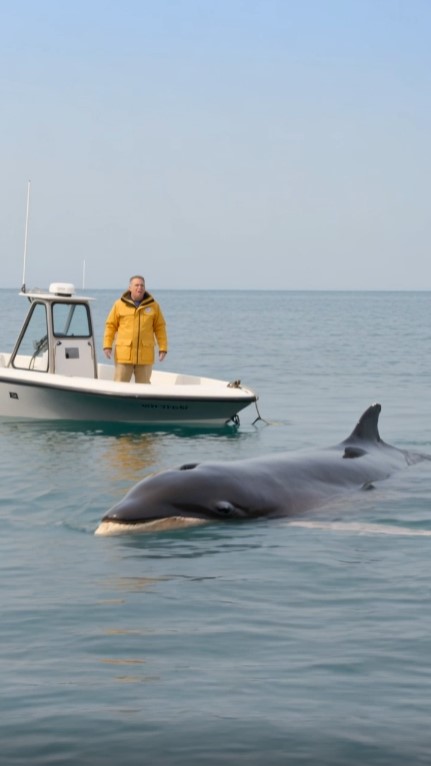
The fisherman had been at sea for thirty years.
He had never seen a whale behave like this.
She surfaced beside his boat…
and stayed there.
He moved away.
She followed.
He stopped.
The whale slapped the water.
Then disappeared.
Seconds later…
she surfaced again.
But this time she was pushing something.
The fisherman, Daniel Morris, grabbed his radio.
“I think she’s asking for help.”
He looked over the side.
Then understood.
A young whale was tangled in discarded rope.
Several thick loops had wrapped around its body and tail.
The adult whale was staying beside it…
occasionally nudging the calf toward the surface.
Daniel immediately contacted the regional marine rescue team.
A vessel arrived less than half an hour later.
The rescuers approached slowly.
Nobody wanted to frighten the animals.
For almost an hour, they worked carefully around the calf.
One rope.
Then another.
The adult whale remained nearby.
Sometimes disappearing beneath the surface.
Then returning.
Finally, the last section came free.
The young whale immediately swam toward the larger one.
The two touched gently.
The crew cheered.
Daniel smiled.
“That’s one lucky calf.”
They expected the whales to leave.
They didn’t.
The mother swam beneath the rescue boat.
Surfaced on the opposite side…
then pushed something floating in the water toward them.
An orange bag.
Daniel reached down with a boat hook.
“Where did this come from?”
It was a waterproof emergency bag.
Inside was a camera.
A handheld radio.
And a wallet.
Daniel opened it.
His expression changed.
“I know him.”
The identification belonged to Aaron Blake.
A local marine photographer.
Aaron had disappeared four days earlier during a sudden coastal storm.
His small boat had been found damaged and empty.
Search crews had spent two days looking.
Nothing.
The official search had recently been reduced.
The rescue captain immediately radioed shore.
“We may have recovered equipment belonging to Aaron Blake.”
Then the whale slapped the surface again.
Once.
Hard.
She began swimming away.
Stopped.
Turned.
Waited.
Daniel stared.
“She wants us to follow.”
The captain hesitated.
The whale moved again.
Then stopped.
Finally he said:
“Let’s see where she goes.”
They followed her toward a chain of rocky islands several miles from the normal fishing route.
Then the radio inside Aaron’s bag suddenly crackled.
Static.
Everyone stared at it.
Then a man’s voice:
“Can anyone hear me?”
The captain grabbed the radio.
“Aaron? This is marine rescue. Where are you?”
Silence.
Then:
“Follow the whale.”
Everyone on the boat froze.
Daniel looked toward the animal ahead.
The captain pressed the radio again.
“Aaron, repeat your location.”
Static.
Then the voice returned.
“I can see her.”
“Who?”
“The female whale.”
The signal disappeared.
The rescue boat accelerated carefully.
The whale stayed ahead.
She moved between two rocky islands and entered a narrow channel.
Daniel frowned.
“I’ve never taken a boat through here.”
The captain slowed.
Rock formations rose sharply on both sides.
Then Aaron’s voice returned.
“Keep coming.”
The captain shouted into the radio:
“Can you see us?”
“Yes.”
“Where are you?”
“Above you.”
Everyone looked up.
Nothing.
Then Daniel saw movement.
Far above the water, on a narrow rocky ledge…
a man was waving a piece of fabric.
“There!”
Aaron Blake was alive.
The crew erupted.
But reaching him would not be simple.
The cliff below Aaron was almost vertical.
Waves crashed against the rocks.
There was no safe place to land the larger rescue vessel.
The team launched a small inflatable boat.
Two rescuers approached with climbing equipment.
Aaron looked exhausted.
His clothes were torn.
One leg was heavily bandaged with strips from his own shirt.
But he was standing.
Alive.
The rescuers climbed toward him.
When they reached the ledge, Aaron immediately asked:
“Did you find the calf?”
One rescuer stared.
“What?”
“The young whale.”
“Yes. We freed it.”
Aaron closed his eyes.
“Good.”
Only after hearing that did he let them examine him.
His ankle was badly injured.
He was dehydrated.
He had several cuts and bruises.
But there were no immediately life-threatening injuries.
While they prepared him for extraction, the rescuer asked:
“How did your bag end up with that whale?”
Aaron laughed weakly.
“That’s a long story.”
Four days earlier, Aaron had been photographing a familiar group of whales offshore.
He knew several individuals by distinctive markings.
The adult female the rescuers had followed was one he had photographed regularly for almost five years.
Aaron called her Luna in his research notes.
The younger whale was her newest calf.
Then the weather changed.
Fast.
Winds increased.
Aaron tried returning to harbor.
A large wave struck his boat.
Equipment flew.
The engine failed.
Another wave pushed the vessel toward the rocky islands.
Aaron managed to send one distress message.
Then his radio went into the water.
His boat struck rock.
He jumped.
The current carried him toward the island.
Somehow, he reached the narrow ledge.
His ankle was injured during the climb.
His boat drifted away.
Most of his supplies disappeared.
He spent the first night exposed to rain and wind.
The next morning, he saw Luna and her calf.
The calf was already tangled.
Aaron didn’t know whether it became trapped before or after his accident.
He could only watch helplessly from the cliff.
For hours, Luna stayed with the calf.
Aaron shouted whenever boats appeared in the distance.
None came close enough.
On the second day, something orange floated near the rocks below him.
His emergency bag.
It must have washed from the damaged boat.
Aaron climbed down as far as he safely could.
He couldn’t reach it.
Then Luna appeared.
The whale moved unusually close to the floating bag.
A wave pushed it away.
Luna surfaced beside it.
The bag shifted again.
Aaron watched in disbelief.
Over the next several hours, the bag drifted away from the island.
Sometimes near Luna.
Sometimes not.
Aaron assumed it was gone forever.
Daniel interrupted when Aaron later told the story aboard the rescue vessel.
“So the whale carried it to us?”
Aaron shook his head.
“I don’t know.”
He was careful.
He was a photographer, not someone interested in turning wild animals into fairy tales.
“The current could have moved it. Luna may have nudged it. Maybe she was just investigating it.”
Daniel smiled.
“She pushed it against our boat.”
Aaron looked toward the water.
“Then I’m glad she was curious.”
But there was still the strangest part.
How did Aaron know to say:
“Follow the whale”?
On the third day, Aaron noticed Luna repeatedly leaving the calf.
She would swim toward the open sea.
Disappear.
Then return.
At first, Aaron thought nothing of it.
Then he began wondering.
Was she searching for other whales?
Was she responding to boats?
He had no way to know.
Then, on the fourth afternoon, he saw a rescue boat in the distance.
Luna moved toward it.
Aaron stood despite the pain.
He waved.
Shouted.
Nothing.
The vessel was too far away.
Then Luna disappeared from Aaron’s view.
Minutes later…
the rescue boat changed direction.
Toward the islands.
Aaron couldn’t believe it.
“That’s when I knew you were following her.”
The captain asked:
“How did you get the radio?”
Aaron smiled.
“I didn’t.”
Everyone stared.
“You spoke to us.”
“Yes.”
“But the radio was in the orange bag.”
Aaron shook his head.
“That wasn’t the only radio.”
His main handheld radio had fallen overboard during the wreck.
But he had a tiny emergency unit clipped inside his jacket.
Its battery had been nearly dead.
For days, he kept it switched off.
He turned it on only for brief intervals to conserve power.
Its range was limited.
That was why nobody heard him earlier.
When the rescue boat entered the narrow channel…
it finally came close enough.
Aaron saw Luna ahead of them.
Then his emergency radio crackled.
He transmitted:
“Can anyone hear me?”
When the captain answered, Aaron knew they were coming toward him.
He didn’t know their exact position.
He couldn’t describe the hidden channel clearly.
But Luna was swimming straight through it.
So he said the simplest thing possible.
“Follow the whale.”
The rescuers carried Aaron carefully down to the inflatable craft.
As they approached the main boat, Luna surfaced nearby.
Her calf was with her.
Free.
Aaron looked toward them.
For several seconds, he didn’t say anything.
Then:
“Hello, girl.”
Luna surfaced again.
The calf remained close to her side.
Daniel watched Aaron.
“You think she knew you were trapped?”
Aaron smiled.
“I think she knew her calf was trapped.”
“And us?”
“I think she noticed your boat.”
“And the bag?”
“I think she noticed that too.”
Daniel laughed.
“You’re determined to ruin a good story.”
Aaron shook his head.
“No.”
He looked toward Luna.
“The real story is already good enough.”
A wild whale had a calf in distress.
She repeatedly approached a vessel.
The vessel followed.
The calf was freed.
An orange emergency bag was recovered.
Then the whale moved toward the islands where Aaron was stranded.
Whatever she understood…
those events happened.
Nobody needed to invent more.
Aaron was transported to the hospital.
His ankle was fractured.
He had severe dehydration.
Doctors told him another day on the ledge could have become dangerous.
His family arrived that evening.
His sister hugged him so hard he complained about the ribs she was supposedly trying to save.
Then she hit his shoulder.
“You’re never going alone again.”
Aaron laughed.
“I knew that was coming.”
The photographs recovered from the orange bag survived.
Most of the camera equipment had remained waterproof.
When Aaron looked through the images several days later, he stopped at one.
It had been taken only hours before the storm.
Luna and her calf.
The calf was swimming beneath its mother.
Completely free.
Aaron stared for a long time.
“That may be the last photograph before the rope.”
The rescue organization later used the image in a campaign about marine debris.
The discarded rope that nearly trapped the calf permanently had likely been floating at sea for months.
Nobody knew where it came from.
The story became less about one dramatic rescue and more about what people left behind in the ocean.
Fishing gear.
Rope.
Plastic.
Things that disappeared from human sight but remained dangerous to wildlife.
Aaron became involved in cleanup projects after he recovered.
Daniel joined several.
The fisherman joked:
“I spent thirty years pulling things out of the ocean. Now you’ve got me putting trash in bags.”
Aaron smiled.
“Character development.”
Months later, Aaron returned to the water.
Not alone.
His sister made sure of that.
Daniel took him on his fishing boat.
They traveled near the rocky islands.
For hours, they saw nothing.
Then Daniel pointed.
A whale surfaced.
Another smaller one beside it.
Aaron lifted his camera.
Then stopped.
Daniel asked:
“You’re not taking the picture?”
Aaron smiled.
“In a second.”
He watched first.
Luna surfaced again.
The calf was larger.
Healthy.
Moving normally.
No rope.
Aaron finally raised the camera.
Click.
He later placed that photograph beside the one taken before the accident.
Two images.
Same mother.
Same calf.
Before.
And after.
Daniel asked him once:
“Do you think she remembered you?”
Aaron shrugged.
“Maybe my boat. Maybe my voice. Maybe nothing at all.”
“You’re impossible.”
“I’m a photographer. I’m supposed to show what happened, not pretend I know what she was thinking.”
Then Aaron added:
“But I know I remembered her.”
Years passed.
The story continued to follow him.
People frequently introduced Aaron as:
“The photographer a whale rescued.”
He corrected them.
“Marine rescue rescued me.”
Then someone would ask:
“But didn’t the whale lead them there?”
Aaron usually smiled.
“She certainly didn’t make their job harder.”
The orange waterproof bag remained in his office.
So did the radio.
And the wallet Daniel opened aboard the boat.
Aaron framed one unusual photograph too.
It had been taken by a rescuer moments after Aaron was brought aboard.
Aaron sat wrapped in a blanket.
Daniel stood nearby.
Behind them, two whale backs broke the surface.
Luna and her calf.
On the back, Daniel had written:
WE FOLLOWED HER.
Aaron never corrected that.
Years later, the fisherman still described the moment differently from Aaron.
Daniel remembered trying to return to shore.
A whale appeared.
Blocked them.
Disappeared.
Returned.
Then led them to a trapped calf.
After the calf was free, she pushed an orange bag toward their boat.
Then started swimming.
Daniel had been at sea for thirty years.
He trusted patterns.
Weather patterns.
Fish movements.
Currents.
And sometimes…
behavior that didn’t fit any familiar pattern.
That day, the whale’s behavior was unusual enough that he paid attention.
The rescue captain paid attention too.
They could have turned toward shore after freeing the calf.
Instead, they followed.
And deep between the rocky islands…
a radio crackled.
“Can anyone hear me?”
They answered.
Then the voice of a man everyone had been searching for said four words:
“Follow the whale.”
So they did.
And minutes later…
they looked toward a cliff and found Aaron Blake standing above them.
Alive.
Aaron never claimed Luna understood that a human needed rescuing.
Daniel never stopped believing she knew more than they could prove.
They eventually agreed on one thing.
It didn’t matter.
A fisherman noticed.
A rescue crew followed.
A calf was freed.
A missing man came home.
And sometimes…
the difference between sailing away and finding someone who is still waiting…
is simply deciding to follow.