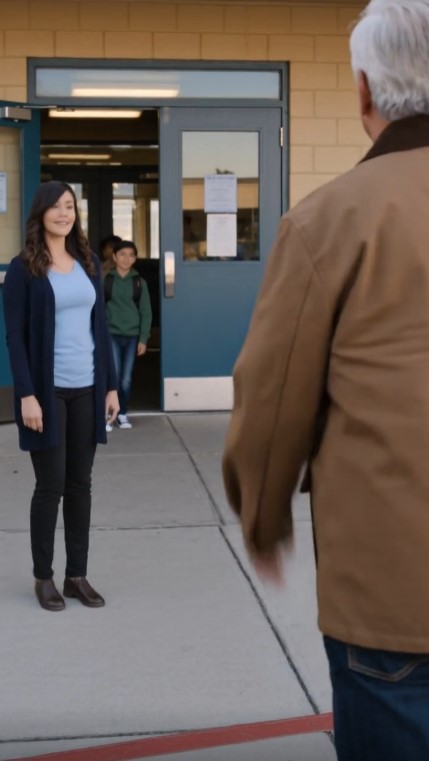
Every afternoon at exactly 3:15…
the same elderly man stood across from the elementary school.
He never entered.
Never spoke to anyone.
He simply waited.
Then when ten-year-old Lucas walked out…
the old man waved.
Lucas waved back.
That was it.
Every day.
For months.
At first, nobody paid much attention.
Parents waited in cars.
Teachers hurried children toward buses.
Crossing guards watched the street.
The old man always stayed on the opposite sidewalk.
Always kept his distance.
Always left after Lucas disappeared into his mother’s car.
Finally, Lucas’s teacher, Mrs. Taylor, asked him:
“Is that your grandfather?”
Lucas looked across the street.
The man was there again.
Hands in the pockets of an old gray coat.
Waiting.
Lucas shook his head.
“I don’t know him.”
Mrs. Taylor’s expression changed immediately.
“You don’t?”
“No.”
“Does your mom know him?”
Lucas shrugged.
“I never asked.”
That afternoon, Mrs. Taylor spoke to Lucas’s mother.
Her name was Anna.
“There’s a man watching Lucas after school.”
Anna frowned.
“What man?”
“Older gentleman. Gray coat. Usually across the street.”
Anna looked toward the sidewalk.
The old man had already gone.
The following afternoon, she arrived early.
At 3:13, nothing.
At 3:14…
an elderly man came around the corner.
Anna saw him.
And went pale.
“Lucas, get in the car.”
Lucas had just walked through the gate.
He looked confused.
“But Mom—”
“Now.”
Lucas climbed inside.
Anna locked the doors.
He stared through the window.
The old man had stopped across the street.
He did not approach.
He simply lowered his hand.
Lucas frowned.
“Why are we leaving?”
Anna started the car.
“Because I said so.”
“Who is he?”
She didn’t answer.
The next afternoon…
the old man wasn’t there.
Lucas walked out at 3:15.
Looked across the street.
Empty sidewalk.
He waited.
His mother called from the car.
“Lucas.”
He climbed in quietly.
Another day passed.
Still nothing.
By Thursday, Lucas stopped smiling after school.
He didn’t understand why the stranger mattered.
He only knew that for months, someone had been there every afternoon.
And now he wasn’t.
Then Friday came.
At 3:15…
the old man returned.
But this time, he was carrying something.
A small wooden airplane.
Lucas stopped.
The airplane was painted blue.
One wing had a tiny red stripe.
The old man held it up.
Lucas immediately moved toward the gate.
Anna caught his shoulder.
“No.”
“But Mom—”
The old man stayed safely across the street.
He didn’t call Lucas over.
Instead, he walked toward a bench.
Placed the wooden airplane on it.
Then stepped back several yards.
Anna stared at it.
Her eyes filled.
Lucas looked at her.
“What?”
She didn’t answer.
Finally, Anna crossed the street herself.
The old man remained where he was.
She picked up the airplane.
Her hands were already shaking.
Lucas followed only as far as the school gate.
Anna turned the airplane over.
Something had been carved underneath.
A date.
Ten years earlier.
And one word.
SON.
Anna closed her eyes.
Lucas called:
“Mom?”
She brought the airplane back.
He took it.
“It’s mine?”
Anna nodded slowly.
“When you were a baby, your father built you an airplane exactly like that.”
Lucas stared at her.
“My dad died before I was born.”
Anna looked toward the elderly man.
“Yes.”
Then whispered:
“That’s what I told you.”
Lucas froze.
The old man rolled up his sleeve.
On his forearm was a small tattoo.
A circle with two lines crossing beneath it.
Lucas recognized it immediately.
He had seen the same symbol in every photograph of his father.
“Mom…”
Anna nodded.
“That symbol belonged to your dad’s family.”
Lucas looked back at the man.
“Who is he?”
Anna’s face crumpled.
Then she finally said the sentence she had feared for ten years.
“Lucas… that’s your grandfather.”
Lucas stared.
“My grandpa?”
“Yes.”
“But you said Grandpa was dead too.”
Anna began crying.
The old man lowered his head.
Lucas asked again:
“Why did you tell me he was dead?”
Anna didn’t answer at first.
Then the old man spoke from across the sidewalk.
His voice was gentle.
“Because she had a reason.”
Anna looked at him sharply.
“You don’t get to explain it for me.”
He nodded.
“You’re right.”
Lucas looked between them.
“Can somebody please tell me what happened?”
Anna took a breath.
“His name is Henry.”
Henry.
Lucas had never heard that name before.
Not once.
Yet Henry was his grandfather.
His father’s father.
Anna led Lucas toward a nearby bench.
Henry stayed several feet away.
Anna noticed.
“You can sit.”
Henry hesitated.
Then sat at the far end.
Lucas held the wooden airplane in his lap.
Anna began.
Lucas’s father was named Daniel.
Daniel and Anna met when they were nineteen.
They married young.
Daniel loved building things.
Furniture.
Model cars.
Wooden toys.
The little airplane had been one of the first things he made after learning Anna was pregnant.
“He was excited about you,” Anna said.
Lucas stared at the airplane.
“But he died.”
Anna nodded.
“Yes.”
That part had always been true.
Daniel died in a car accident two months before Lucas was born.
Lucas had grown up knowing photographs.
Stories.
A few videos.
But never his father.
What Anna had never told him…
was what happened before the accident.
Daniel and Henry had stopped speaking.
Lucas looked toward his grandfather.
“Why?”
Henry answered quietly:
“Because I was stubborn.”
Anna added:
“And because your dad was stubborn too.”
The argument began over something that now seemed almost impossibly small.
Daniel wanted to leave the family construction business.
Henry expected him to take it over.
Daniel wanted to become a teacher.
Henry called it foolish.
Daniel accused Henry of caring more about the business than about him.
Henry accused Daniel of throwing away everything the family built.
The argument became ugly.
Words were said.
Daniel left.
For months, they barely spoke.
Then Anna became pregnant.
Daniel wanted to repair the relationship.
He started building the wooden airplane.
He told Anna:
“When Dad sees this, he’ll understand.”
Lucas frowned.
“Understand what?”
“That he wanted Henry in your life.”
Daniel planned to visit his father.
He never made it.
The accident happened that morning.
Henry closed his eyes.
“He was coming to see me.”
Anna nodded.
Police found the airplane in Daniel’s damaged car.
Broken into three pieces.
Henry repaired it.
That was the airplane Lucas now held.
Lucas stared at it differently.
“My dad touched this?”
“Yes.”
Henry’s voice broke.
“He made it for you.”
Lucas looked at his mother.
“Then why didn’t Grandpa give it to me?”
Anna became quiet.
Because after Daniel died…
grief turned into blame.
Henry blamed Anna.
Anna blamed Henry.
Neither said it directly at first.
Then, during the funeral, everything exploded.
Henry told Anna:
“If Daniel hadn’t spent months fighting with me, he wouldn’t have been on that road.”
Anna was devastated.
She answered:
“If you had just supported him, there wouldn’t have been a fight.”
Both knew those statements were unfair.
The accident had been caused by a drunk driver.
But grief doesn’t always care about fairness.
Henry wanted to be part of Lucas’s life.
Anna refused.
She told him:
“You already lost your son. You’re not using my child to fix that.”
Henry shouted back.
Anna left.
Then she made a decision.
A terrible one.
When Lucas eventually became old enough to ask about his father’s family, Anna told him Henry had died years earlier.
Lucas stared.
“You lied.”
“Yes.”
“Why?”
“Because I was angry.”
Anna didn’t try to make it sound better.
“I told myself I was protecting you.”
“From Grandpa?”
“From all of it.”
Henry looked down.
Anna continued.
“At first, I thought I would tell you when you were older.”
“How old?”
“I don’t know.”
“Ten?”
She started crying.
“Maybe.”
“But I’m ten.”
“I know.”
Every year made the lie harder to correct.
When Lucas was three, Anna thought:
Next year.
At five:
When he understands death better.
At seven:
When school is less stressful.
At nine:
After his birthday.
There was always another reason.
Then Henry appeared outside the school.
Lucas turned to him.
“Why didn’t you just come to our house?”
Henry looked at Anna.
“Because she asked me not to.”
Anna stared.
“You never listened before.”
“I learned.”
For ten years, Henry had stayed away.
Mostly.
He sent birthday cards.
Anna returned the first few.
Then he stopped putting his return address.
Anna threw them away unopened.
He sent money once.
She mailed it back.
He attended one school concert from the back row without speaking to Lucas.
Anna never knew.
Then six months earlier, Henry became seriously ill.
Not terminal.
But frightening enough.
He underwent heart surgery.
During recovery, one thought kept repeating:
Lucas does not even know I exist.
So Henry came to the school.
He didn’t approach.
Didn’t call.
Didn’t interfere.
He simply wanted to see his grandson.
The first afternoon, Lucas came out and noticed him.
Henry waved instinctively.
Lucas waved back.
Then again the next day.
And the next.
Henry started returning at 3:15.
Lucas asked:
“Why every day?”
Henry smiled sadly.
“Because once I saw you wave back, I couldn’t stop coming.”
Anna wiped her face.
“You should have told me.”
“I was afraid you’d make me leave.”
“I did make you leave.”
“Yes.”
Lucas looked at the airplane.
“Why did you come back Friday?”
Henry reached inside his coat.
He removed an envelope.
“Because I decided hiding was wrong.”
He handed it to Anna.
She immediately recognized Daniel’s handwriting.
Her hands froze.
“What is this?”
“I found it inside the airplane.”
Anna stared.
Henry explained.
When he repaired the broken toy after Daniel’s accident, he heard something inside the hollow body.
But one section was sealed tightly.
Henry had been too grief-stricken to open it.
Years passed.
Recently, while cleaning his workshop, he found the airplane again.
He repaired a crack.
A folded piece of paper slipped out.
Daniel had hidden a letter inside.
For Henry.
Anna whispered:
“You had this?”
“For three weeks.”
“And you didn’t open it?”
“It wasn’t addressed to me alone.”
Henry handed it to Lucas.
The front read:
FOR DAD — AND FOR MY SON WHEN HE’S OLD ENOUGH.
Lucas looked at his mother.
“Can I?”
Anna nodded.
He opened it.
Daniel had written the letter shortly before the accident.
Dad,
I’m still angry at you.
I’m guessing you’re still angry at me too.
But I don’t want my son growing up thinking anger is the same thing as family.
Lucas stopped.
His lips moved silently over the words.
Then he continued.
I’m bringing you the airplane tomorrow.
If you hate it, pretend you don’t.
I spent six hours on the wings.
Henry laughed through tears.
“That sounds like him.”
Daniel continued.
I want my boy to know you.
Not because we agree.
Not because everything is fixed.
Because you’re his grandfather.
And because I’m tired of wasting time.
Lucas’s voice broke.
The final paragraph read:
If anything ever happens to me, don’t let him inherit our argument.
Teach him the good parts.
Tell him I was stubborn.
Tell him you were worse.
And tell him I loved him before I ever saw his face.
Nobody spoke.
Cars passed.
Children laughed in the distance.
Lucas stared at the letter.
Then looked at his mother.
“You knew Dad wanted me to know Grandpa?”
Anna was crying.
“No.”
“But you knew they wanted to fix things?”
She nodded.
“Your dad told me he was going to see Henry.”
“And you still told me Grandpa was dead.”
“Yes.”
Lucas stood.
For one moment, Anna thought he might run toward Henry.
Instead, he walked several feet away and sat alone.
Neither adult followed.
He needed space.
Ten years old.
In one afternoon, he had learned that his grandfather was alive.
That his mother had lied.
That his father had left him a letter.
And that a wooden airplane he thought was just a toy had survived the same accident his father did not.
Finally, Lucas asked:
“Do I have to forgive you?”
Anna answered immediately.
“No.”
Henry looked at him.
“Me neither.”
Lucas frowned.
“What did you do to me?”
“Nothing directly.”
Henry looked ashamed.
“But I hurt your father. And I spent too many years letting pride decide what came next.”
Lucas thought.
Then asked:
“Can I see your workshop?”
Henry’s face changed.
“My workshop?”
“Dad built things with you, right?”
“Yes.”
“Then I want to see.”
Anna stared.
“Lucas…”
He looked at her.
“I’m not saying everything’s okay.”
Anna nodded slowly.
“I know.”
The following Saturday, Anna drove Lucas to Henry’s house.
She had not been there since Daniel’s funeral.
Very little had changed.
Same porch.
Same maple tree.
Same garage.
Inside the workshop, tools covered one wall.
Wood scraps filled bins.
Photographs stood on shelves.
Lucas noticed one immediately.
Daniel at twelve, holding a badly made wooden boat.
Henry smiled.
“He insisted it was a speedboat.”
Lucas laughed.
“It looks like a shoe.”
“That’s what I told him.”
Another photo showed Daniel at seventeen.
Another at twenty.
Then one photograph showed Daniel and Anna together.
Pregnant.
Lucas stared.
“You had this?”
Henry nodded.
“Your dad mailed it.”
Anna had never known.
Henry opened a drawer.
Inside were cards.
Birthday cards.
One for Lucas at age one.
Two.
Three.
Four.
All the way to ten.
“You wrote every year?”
“Yes.”
“Why didn’t you send them?”
“Some I did.”
Lucas looked toward his mother.
Anna lowered her eyes.
“I returned them.”
The room became quiet.
Anna expected anger.
Lucas simply said:
“That was wrong.”
“Yes.”
She didn’t defend herself.
“I’m sorry.”
Henry handed Lucas the tenth birthday card.
This one was still sealed.
Lucas opened it.
Inside was twenty dollars.
He smiled.
“Now we’re getting somewhere.”
Henry laughed so hard he had to sit down.
Anna laughed too.
It was the first normal moment between them.
Then Henry showed Lucas something covered beneath a cloth.
Another wooden airplane.
Unfinished.
Daniel had started it years earlier.
It was larger than Lucas’s.
Henry had kept it untouched.
Lucas ran his fingers along the wood.
“Can we finish it?”
Henry looked stunned.
“Together?”
“Yes.”
They began that afternoon.
At first, Anna stayed nearby.
Then, gradually, she stopped watching every second.
Henry taught Lucas how to sand the wings.
Lucas asked endless questions about Daniel.
Not about the accident.
About life.
Did Dad like sports?
Badly.
Was he good at school?
Only when he liked the teacher.
Did he ever get in trouble?
Constantly.
Was he scared of anything?
Spiders.
Lucas laughed.
“My dad was scared of spiders?”
“Terrified.”
That was what Daniel meant by:
Teach him the good parts.
Not perfection.
Not tragedy.
The ordinary things.
Over the next months, Henry became part of Lucas’s life.
Carefully.
Slowly.
Anna established rules.
Henry respected them.
That surprised her more than anything.
No unannounced school visits.
No decisions without Anna.
No pretending the past never happened.
Henry agreed.
He apologized to Anna.
Not once.
Repeatedly.
But he also eventually asked her something difficult.
“Why did you hate me so much?”
Anna answered honestly.
“Because every time I saw you, I saw Daniel.”
Henry nodded.
“Same.”
They both realized they had avoided each other for the same reason.
Each represented the person they lost.
Avoidance had become easier than grief.
Until Lucas.
Lucas refused to carry that burden politely.
One evening he asked:
“Why couldn’t you two just be sad together?”
Anna and Henry stared at him.
Neither had a good answer.
A year later, Lucas finished the wooden airplane with Henry.
They painted it blue.
A red stripe across the wing.
Just like Daniel’s original.
Underneath, Lucas carved:
DAD.
GRANDPA.
ME.
Henry saw it.
His eyes filled.
“You sure?”
Lucas nodded.
“Yeah.”
The original airplane stayed in Lucas’s bedroom.
The repaired one.
The one Daniel built before he died.
Daniel’s letter was framed beside it.
Lucas read it often.
Especially one sentence:
Don’t let him inherit our argument.
That became important.
Because Lucas learned something many adults take decades to understand.
Family stories are often handed down like property.
Love.
Traditions.
Photographs.
But so are grudges.
Silences.
Lies.
Sometimes children inherit fights that began before they were born.
Lucas decided he didn’t want that part.
That didn’t mean Anna’s lie stopped mattering.
For a long time, he struggled to trust stories she told him about his father.
Sometimes he asked:
“Is that true?”
The question hurt Anna.
But she answered every time.
Sometimes she showed proof.
Photographs.
Letters.
Videos.
Gradually trust returned.
Not because Lucas forgot.
Because Anna stopped hiding.
Henry changed too.
For decades, he had described the argument with Daniel as:
“My son abandoned the family business.”
Eventually he learned to say:
“I was afraid my son would choose a life that didn’t include me.”
That was more truthful.
Daniel had wanted to teach.
Henry viewed it as rejection.
It wasn’t.
Years later, Henry attended Lucas’s middle-school career day.
The teacher asked students what they wanted to become.
Doctor.
Pilot.
Engineer.
Athlete.
Lucas said:
“Teacher.”
Henry stared at him.
Then smiled.
After school, Lucas asked:
“You mad?”
Henry laughed.
“Absolutely furious.”
Lucas grinned.
Then Henry hugged him.
“No.”
He whispered:
“I think your dad would be proud.”
Every afternoon at 3:15, Henry no longer stood across the street.
Some days, with Anna’s permission, he stood directly outside the school gate.
Lucas walked toward him.
Sometimes they went to the workshop.
Sometimes for ice cream.
Sometimes Henry simply drove him home.
The ritual changed.
But Lucas never forgot how it began.
A stranger across the road.
A wave.
Nothing more.
For months.
Then a wooden airplane.
A tattoo.
A truth his mother had been afraid to tell.
And a letter written by a father who never lived long enough to meet his son.
Daniel had died before Lucas was born.
For ten years, Lucas believed that meant the entire paternal side of his family was gone too.
Then one afternoon…
he learned grief had hidden someone in plain sight.
His grandfather had been alive the whole time.
Waiting across the street.
Not brave enough to approach.
Not willing to disappear completely.
Just waving.
And waiting for someone to finally tell the truth.