
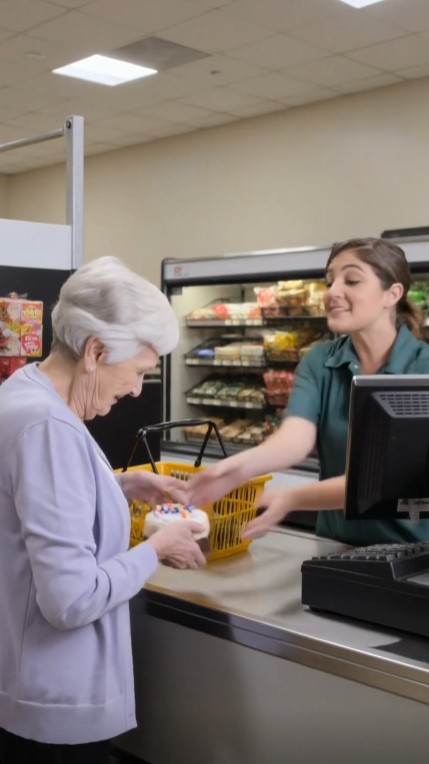
The line behind her was getting longer.
An elderly woman stood at the register…
removing groceries one by one.
Bread.
Milk.
Eggs.
Fruit.
She was $18 short.
“Take the milk off.”
Still not enough.
“The eggs too.”
The young cashier watched silently.
Then the woman reached for the small birthday cake.
The cashier stopped her.
“Keep that one.”
“I can’t afford it.”
The cashier took $20 from her own wallet.
“Now you can.”
The elderly woman stared at her.
“You shouldn’t do that.”
The cashier smiled.
“Whoever’s birthday it is deserves cake.”
The woman started crying.
“My husband’s.”
“He’ll love it.”
The woman looked down.
“He passed away last year.”
The cashier’s smile softened.
“Then celebrate him anyway.”
The woman squeezed her hand…
and left.
The cashier thought that was the end.
It wasn’t.
The following morning…
the store manager called her into his office.
A man in an expensive suit was waiting.
The cashier immediately became nervous.
“Did I do something wrong?”
The stranger placed a grocery receipt on the desk.
It was yesterday’s receipt.
“You paid for my mother’s groceries.”
The cashier swallowed.
“I didn’t know she was your mother.”
“That’s exactly why I’m here.”
He asked why she had done it.
The cashier shrugged.
“My mom used to say you never let someone put back a birthday cake.”
The man’s expression changed.
“What was your mother’s name?”
She told him.
“Laura Bennett.”
He stopped moving.
Then removed his wallet.
Inside was an old photograph.
He placed it on the desk.
The cashier stared.
Her mother was in the picture.
Twenty years younger.
Standing beside this man.
She whispered:
“How did you know my mom?”
The man answered:
“Because when I had nothing… she did the same thing for me.”
Then he placed an envelope beside the photograph.
“Your mother made me promise that if I ever found you…”
The cashier stared at the envelope.
“…I’d give you this.”
Her mother had been gone for nine years.
The cashier’s name was Emily.
She was twenty-four.
She had been working at the grocery store for nearly three years while finishing community college.
Her mother, Laura, had raised her alone.
Money had always been tight.
But Laura had one rule.
If somebody was short a few dollars for food…
and you could help…
you helped.
Especially if there was cake.
Emily used to laugh at that part.
“Why cake?”
Laura always answered:
“Because people can survive without cake.”
Then she would smile.
“But sometimes they shouldn’t have to.”
Now Emily stared at the envelope.
Her hands shook.
“What is this?”
The man sat down.
“My name is Daniel.”
Emily looked at the photograph again.
Daniel was much younger in it.
Thin.
Wearing a work jacket.
Laura stood beside him.
There was a grocery store behind them.
Not the same one Emily worked in.
Another store.
Far older.
Daniel continued.
Twenty-two years earlier, he had been nineteen.
His father had died.
His mother was sick.
Daniel had dropped out of college to work.
Then he lost his job.
For several months, he survived by doing odd jobs.
One night, he entered a grocery store with exactly fourteen dollars.
He needed bread.
Milk.
Canned soup.
And one small cake.
It was his mother’s birthday.
At the register, he discovered he was nearly ten dollars short.
He started removing items.
First the milk.
Then the soup.
Then the cake.
Laura was the cashier.
Emily looked up.
“My mom?”
Daniel nodded.
“She stopped me.”
Laura asked who the cake was for.
Daniel said:
“My mother.”
Laura pulled money from her own pocket.
Paid the difference.
Then told him:
“You never let someone put back a birthday cake.”
Emily covered her mouth.
“That’s where she got it.”
Daniel smiled.
“I think so.”
Emily had assumed the sentence came from Laura’s mother.
Or some old family saying.
It didn’t.
It came from one ordinary night.
One struggling young man.
One grocery register.
Daniel continued.
He never forgot Laura.
At first, he wanted to repay her.
He returned the following week.
She refused.
“Help somebody else someday.”
So Daniel did.
Years later, he built a successful construction company.
Then several businesses.
He became wealthy.
But he kept Laura’s sentence with him.
Whenever he saw someone struggling at a checkout counter…
he remembered.
Sometimes he paid anonymously.
Sometimes he funded grocery cards through local charities.
Sometimes he simply gave someone twenty dollars.
Emily stared at him.
“You did all that because Mom bought your groceries?”
“No.”
Daniel shook his head.
“Because she treated me like I wasn’t embarrassing.”
That mattered more.
Daniel had been humiliated that night.
He was nineteen.
Trying to care for his mother.
Standing in front of strangers while removing food from a cart.
Laura didn’t make a speech.
Didn’t call attention to him.
Didn’t make him feel like a charity case.
She simply covered the difference.
Then moved on.
Daniel said:
“I remember walking outside thinking maybe being poor didn’t mean being invisible.”
Emily looked toward the envelope.
“But why did Mom have something for me?”
Daniel’s face became serious.
“Because I met her again.”
“When?”
“About ten years ago.”
Emily froze.
One year before Laura died.
Daniel had returned to the neighborhood where the old grocery store once stood.
It had closed years earlier.
He was there for a business meeting.
By coincidence, he saw Laura leaving a pharmacy.
He recognized her immediately.
She didn’t recognize him.
Not at first.
Then he said:
“Birthday cake.”
Laura stopped.
Then smiled.
“You paid me back yet?”
Daniel laughed.
“A few times.”
They went for coffee.
Daniel told her what had happened to his life.
His mother recovered enough to live another eleven years.
She died knowing her son had built something stable.
Daniel eventually married.
Had children.
Created a company.
Laura listened.
Then she said:
“Good.”
That was it.
No demand for gratitude.
No pride.
Just:
“Good.”
Daniel later asked if there was anything he could do for her.
Laura refused.
Then he asked about Emily.
Laura smiled.
“My daughter is going to do better than I did.”
Emily started crying.
“She said that?”
“Yes.”
Daniel continued.
Laura told him about Emily’s plans.
College.
Work.
How responsible she was.
How stubborn.
How she once gave her lunch money to another child and then lied about forgetting lunch.
Emily laughed through tears.
“I did that.”
“Your mother knew.”
“She always knew.”
Then Laura’s expression changed during that coffee meeting.
She told Daniel she had been diagnosed with cancer.
Emily looked down.
Laura had hidden the seriousness of her illness for months.
She wanted Emily to finish school without carrying all her fear.
Daniel offered help again.
Medical bills.
Anything.
Laura refused.
But before they left, she handed him an envelope.
“What’s this?” Daniel asked.
“If something happens to me…”
“Laura—”
“Just listen.”
She told him:
“If Emily ever ends up needing help, don’t rescue her.”
Daniel frowned.
“What does that mean?”
“Don’t hand her money just because you can.”
Then:
“But if you ever find her doing for someone else what I did for you…”
She smiled.
“Give her this.”
Daniel looked toward Emily.
“That was the condition.”
Emily stared at the envelope.
“So you knew where I was?”
“Not exactly.”
Daniel had tried finding her after Laura died.
But Emily moved.
Changed jobs.
Then began college.
He lost track.
Laura had not given him permission to intrude into her life.
Only to deliver the envelope if their paths crossed under the right circumstances.
Daniel kept it.
For nine years.
Then his mother, Margaret, came home from the grocery store with a birthday cake.
She told him about the cashier.
A young woman who paid twenty dollars from her own wallet.
Daniel asked which store.
Then:
“What was her name?”
Margaret had looked at the receipt.
“Emily.”
Daniel’s heart stopped.
He came the next morning.
Emily whispered:
“So your mother was the woman yesterday.”
“Yes.”
“And she didn’t know who I was?”
“No.”
“Did you send her?”
“No.”
Daniel smiled.
“That’s why I knew it was time.”
Emily finally touched the envelope.
“Can I open it?”
“It’s yours.”
She carefully tore the edge.
Inside was a handwritten letter.
Laura’s handwriting.
Emily recognized it immediately.
Her vision blurred before she even read the first line.
Em,
If you’re reading this, then apparently you inherited my worst habit.
Emily laughed through tears.
The letter continued.
I hope you’re not angry that I left this with a stranger.
Technically he isn’t a stranger.
I bought him groceries once.
So obviously that makes him legally trustworthy.
Emily covered her mouth.
“That sounds exactly like her.”
Daniel smiled.
Laura continued.
If Daniel gave you this, it means he saw you helping somebody when you didn’t know anyone important was watching.
Good.
That means I raised you right.
Emily stopped.
Her manager quietly left the office and closed the door behind him.
Laura wrote:
There may be times when you feel like small things don’t matter.
They do.
You won’t always know what happens after you help somebody.
Most of the time, you won’t.
That’s the point.
Kindness is not an investment you track.
You give it away.
Then let it go.
Emily read slower.
Years ago, I paid for Daniel’s groceries.
I forgot about it.
He didn’t.
He carried that moment for years.
And apparently he carried me too.
Emily looked at Daniel.
He wiped his eyes.
The next paragraph changed everything.
There’s something else I never told you.
Daniel helped us too.
Emily looked up.
“What?”
Daniel lowered his eyes.
“Keep reading.”
After Laura became sick, she refused direct financial help.
But Daniel found another way.
He anonymously paid several months of rent through a community assistance program.
He also covered part of one hospital bill.
Laura discovered it later.
She was furious.
Then grateful.
Then furious again.
Emily stared at Daniel.
“You paid our rent?”
“Some of it.”
“I thought Mom got assistance from the hospital.”
“She did.”
Daniel smiled.
“Some of it came from me.”
Emily shook her head.
“We almost lost that apartment.”
“I know.”
“How?”
“Your mom told me.”
Emily remembered.
She was fifteen.
Laura had been sick.
Bills were piling up.
Then suddenly the landlord told them part of the balance had been covered by a local relief fund.
Emily never knew who arranged it.
Daniel whispered:
“Your mother helped me when she had twenty dollars.”
“When I had money, I helped her.”
Emily looked back at the letter.
Laura had written:
I spent years telling you never to let somebody put back a birthday cake.
But there’s a second rule.
When somebody helps you…
don’t spend your life trying to repay the same person.
Pass it forward.
Emily started crying harder.
The final section read:
If I’m gone when you read this, don’t make sadness the most important thing I left you.
I hope you remember me laughing.
I hope you remember burned pancakes.
I hope you remember singing in the car even when I forgot the words.
And if you ever see someone counting coins at a register…
look at them like a person.
Not a problem holding up the line.
Love you forever,
Mom
Emily pressed the letter against her chest.
For several minutes, nobody spoke.
Finally, Daniel said:
“There’s something else in the envelope.”
Emily checked.
A smaller piece of paper was tucked behind the letter.
It was an old grocery receipt.
Twenty-two years old.
Most of the ink had faded.
But several items remained visible.
BREAD.
MILK.
SOUP.
CHOCOLATE CAKE.
At the bottom, someone had written by hand:
$9.43 — LAURA.
Emily stared.
“You kept this?”
Daniel nodded.
“All these years.”
“Why?”
“Because I was afraid I’d forget what it felt like.”
“What?”
“To need nine dollars.”
That answer stayed with Emily.
Daniel had become wealthy.
But he kept an old grocery receipt in his wallet for two decades.
Not as a trophy.
As a reminder.
Emily asked:
“What happened to your mother’s birthday cake yesterday?”
Daniel laughed.
“She ate two pieces.”
“Good.”
“She wants to meet you again.”
“Again?”
“You met her yesterday.”
Emily smiled.
“I mean properly.”
Margaret returned to the store that afternoon.
This time, she carried a small container.
Inside was one slice of the birthday cake.
She placed it on Emily’s counter.
“My husband’s birthday.”
Emily nodded.
“How long were you married?”
“Forty-six years.”
Margaret smiled.
“His name was Robert.”
“He liked chocolate?”
“Hated it.”
Emily laughed.
“Then why chocolate cake?”
“Because I like chocolate.”
Margaret shrugged.
“He’s dead. He can’t complain.”
Emily laughed so hard another cashier looked over.
Then Margaret became serious.
“My son told me who you are.”
Emily nodded.
“Your son told me who you are too.”
Margaret reached across the counter.
“Your mother must have been special.”
Emily smiled.
“She was.”
Margaret answered:
“So are you.”
Emily looked away.
“Yesterday was just twenty dollars.”
Margaret shook her head.
“No.”
“It was groceries.”
“That’s what your mother probably thought too.”
That evening, Emily read Laura’s letter again.
Then again.
She placed the old receipt inside the same box where she kept her mother’s photographs.
But the story didn’t end with one emotional meeting.
Daniel asked Emily what she planned to do after college.
She wanted to become a social worker.
But tuition was difficult.
He offered to pay.
Emily immediately refused.
Daniel laughed.
“Exactly like your mother.”
“I can’t take that.”
“Good.”
“What?”
“Laura told me not to rescue you.”
Emily frowned.
“So why offer?”
“To see what you’d say.”
“You’re annoying.”
“Also like your mother.”
Instead of paying Emily’s tuition directly, Daniel helped establish something larger.
A community grocery fund.
Not in Emily’s name.
Not in Laura’s.
At first.
The program partnered with local stores.
Cashiers could discreetly use small emergency credits when customers were short for basic food.
No public embarrassment.
No complicated application while standing at the register.
Just enough help to get through the moment.
Emily agreed to help design it.
She had one condition.
“Birthday cakes count.”
Daniel laughed.
“Your mother would insist.”
The first year, the fund helped hundreds of families.
Most received less than thirty dollars.
Bread.
Formula.
Milk.
Fruit.
Medicine.
Occasionally…
cake.
Daniel wanted to name it after Laura.
Emily resisted.
Then she found something in her mother’s old notebook.
One line written in the margin:
Leave people with their dignity whenever you can.
Emily changed her mind.
The program became:
LAURA’S TABLE.
Years later, Emily became a social worker.
She continued working with families who were one emergency away from missing rent or food.
She learned how often hardship looked ordinary.
People wearing work uniforms.
Parents with jobs.
Older adults with small pensions.
Students.
People standing at cash registers calculating whether milk or eggs mattered more that week.
Whenever she saw someone embarrassed to ask for help, Emily remembered Laura’s letter.
Look at them like a person.
Not a problem holding up the line.
Daniel remained part of her life.
Not as a replacement parent.
Nothing that simple.
He became a friend.
A connection to a version of Laura Emily had never known.
Sometimes he told stories.
How Laura teased him about his haircut.
How she refused every attempt to repay $9.43.
How she once told him:
“If you become rich, please don’t become boring.”
Emily laughed.
“He definitely didn’t follow that one.”
Daniel pretended to be offended.
Margaret became close to Emily too.
Every year on Robert’s birthday, she bought a chocolate cake.
Emily often joined her.
One year she asked:
“Did Robert really hate chocolate?”
Margaret smiled.
“Absolutely.”
“Then this is getting disrespectful.”
“He had forty-six years to stop me.”
They laughed.
Years passed.
The original twenty-dollar moment at the register became something Emily rarely talked about.
Not because it stopped mattering.
Because she understood her mother’s point.
You didn’t perform kindness so people would tell your story.
Most good moments disappeared quietly.
That was okay.
But on the ninth anniversary of Laura’s Table, Daniel brought something to Emily’s office.
A framed photograph.
The old one.
Laura and nineteen-year-old Daniel outside the grocery store.
Beside it was another photograph.
Emily and Margaret.
Taken the day after Emily paid for her groceries.
Daniel had placed them side by side.
Underneath, he wrote:
TWENTY-TWO YEARS APART.
SAME CAKE RULE.
Emily stared at it.
Then laughed.
“You’re getting sentimental.”
“I’m old.”
“You wear expensive suits.”
“Old people can own suits.”
She hugged him.
Then Daniel handed her one final item.
The original faded receipt.
Emily frowned.
“You gave this to me already.”
“A copy.”
He removed another paper from his wallet.
This one was yesterday’s receipt.
Margaret’s groceries.
The one Emily had paid twenty dollars toward.
Daniel placed both beside each other.
On one, Laura’s name.
On the other, Emily’s employee number.
Two small moments.
Separated by more than two decades.
Neither woman knew who they were helping.
Neither expected anything back.
That was what Daniel loved most.
Years later, when people asked Emily why Laura’s Table existed, she never began with the wealthy businessman.
Or the old photograph.
Or the envelope hidden for nine years.
She started with an elderly woman standing at a register.
Eighteen dollars short.
Removing milk.
Then eggs.
Then reaching for a birthday cake.
And one cashier saying:
“Keep that one.”
Because twenty-two years earlier, another cashier had said almost the same thing to a frightened nineteen-year-old boy.
Laura never knew where that small kindness would travel.
It reached Daniel’s mother.
Then Daniel.
Then back to Laura during her illness.
Then to Emily.
Then hundreds of strangers after them.
All from a few groceries…
and one simple rule passed from mother to daughter:
You never let someone put back a birthday cake.