
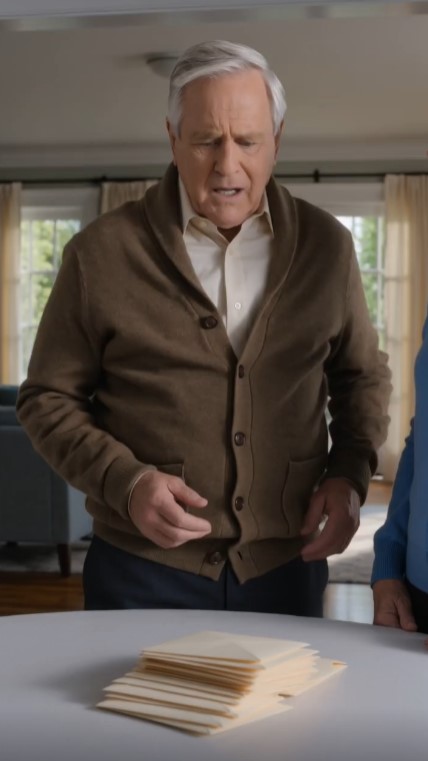
Mr. Harris had taught for forty-one years.
Then he retired quietly.
No big party.
No speeches.
No former students waiting outside.
He went home carrying one cardboard box.
Inside:
A coffee mug.
Three books.
And an old class photograph.
That night, he told his wife:
“I don’t think they’ll remember me.”
The next morning…
the doorbell rang.
A delivery driver handed him one envelope.
Then another.
Then another.
By noon…
there were twenty-seven.
Every envelope had the same sentence written on the front:
“Open on your last day.”
Mr. Harris stared at them.
His wife whispered:
“Who sent these?”
He opened the first.
Inside was a photograph of a firefighter.
The letter said:
“You were the first person who told me I wasn’t stupid.”
The second came from a surgeon.
The third from a mechanic.
Then a mother of four.
A musician.
A police officer.
A small-business owner.
Every one had been his student.
Mr. Harris couldn’t stop crying.
Then he opened envelope number 27.
It contained no letter.
Only a train ticket.
And a photograph of one former student.
A boy named Daniel.
Daniel had disappeared from school after his parents died.
Mr. Harris spent months trying to find him.
He never did.
The train ticket was for that afternoon.
His wife looked at him.
“You’re going?”
Mr. Harris was already putting on his coat.
At the station…
he found exactly one man waiting on the platform.
The man held Mr. Harris’s old red grading pen.
Daniel.
Now forty-three.
They stared at each other.
Then Daniel said:
“You looked for me.”
Mr. Harris nodded.
“For a long time.”
Daniel handed him the pen.
“I kept this because it was the last thing anyone gave me before I left.”
Mr. Harris smiled.
Then Daniel said:
“But that’s not why I brought you here.”
A train arrived.
Dozens of people began stepping off.
Every one of them was carrying the same kind of envelope.
Mr. Harris stared.
The first person to step toward him was the firefighter from envelope number one.
Then the surgeon.
Then the mechanic.
Then the mother of four.
Then faces he hadn’t seen in decades.
Some he recognized instantly.
Some had changed so much he only knew them after they smiled.
One woman walked up holding an old algebra workbook.
“Still hate fractions,” she said.
Mr. Harris laughed through tears.
Another man handed him a folded detention slip.
“You gave me this in 1998.”
Mr. Harris looked at it.
“You kept a detention slip?”
The man grinned.
“It was the first piece of paper where a teacher wrote, ‘You can do better than this.’”
Mr. Harris sat down on a bench.
He couldn’t take it in.
Daniel stood beside him.
“You really thought nobody remembered?”
Mr. Harris looked at the crowd.
“I didn’t know.”
Daniel smiled.
“That’s the thing about teachers.”
“What?”
“You usually don’t get to see the ending.”
Mr. Harris lowered his head.
That sentence stayed with him.
For forty-one years, he had watched students leave classrooms before their stories were finished.
Some graduated.
Some transferred.
Some disappeared.
Some came back years later with children of their own.
Most never returned.
Mr. Harris had always assumed that was normal.
Teach the lesson.
Grade the paper.
Move on.
He never imagined what happened afterward.
Daniel sat beside him.
“Do you remember the day I left?”
Mr. Harris’s expression changed.
“Yes.”
Daniel had been thirteen.
Quiet.
Thin.
Too serious for his age.
His parents died within months of each other.
First his mother.
Then his father.
Afterward, Daniel stopped doing homework.
Stopped speaking to classmates.
Then one Monday…
his desk was empty.
Mr. Harris asked the office.
They said Daniel had been placed with relatives.
No forwarding information.
No new school.
Nothing.
Mr. Harris called every number in the file.
Disconnected.
He sent letters.
Returned.
He even drove to Daniel’s old house.
Empty.
Months passed.
Eventually, Mr. Harris was told to stop.
“You’ve done what you can.”
But he never forgot Daniel.
Especially because of the red pen.
The day before Daniel vanished, Mr. Harris had returned one of his essays.
The grade wasn’t good.
But at the bottom, Mr. Harris had written:
You are better than what is happening to you.
Then he accidentally left the red pen on Daniel’s desk.
Daniel took it.
Mr. Harris assumed it was lost.
Daniel held it up now.
“This was all I had from school.”
Mr. Harris looked at him.
“Where did you go?”
Daniel took a breath.
“To my uncle’s.”
“Was he good to you?”
Daniel paused.
“He tried.”
That was enough to tell Mr. Harris the years had not been easy.
Daniel’s uncle lived several states away.
He worked nights.
Money was tight.
Daniel changed schools twice.
Then dropped out at seventeen.
For a while, he drifted.
Warehouse work.
Construction.
Restaurant kitchens.
Anywhere that paid.
Then one evening, he found the old red pen in a box.
The ink had dried years earlier.
But the message attached to it was still alive in his head.
You are better than what is happening to you.
Daniel went back to school.
First a GED.
Then community college.
Then university.
Mr. Harris stared.
“What did you become?”
Daniel smiled.
“A teacher.”
Mr. Harris covered his face.
“You became a teacher?”
“Middle school.”
“God help you.”
Daniel laughed.
“Exactly.”
Then he handed Mr. Harris another envelope.
This one wasn’t numbered.
Inside was a photograph of Daniel standing beside a classroom whiteboard.
Written across it:
MR. DANIEL CARTER
Mr. Harris stared at it.
“I wish I had known.”
Daniel nodded.
“I wish I had told you.”
Then the firefighter stepped forward.
His name was Marcus.
He handed Mr. Harris his envelope again.
“You wrote something on my science test when I was fourteen.”
Mr. Harris squinted.
“What?”
Marcus opened the letter.
“You wrote, ‘Stop pretending you don’t care. You care too much.’”
Mr. Harris started laughing.
“That sounds rude.”
“It was.”
Marcus smiled.
“It was also true.”
The surgeon came next.
Her name was Dr. Elena Brooks.
She said Mr. Harris had once stayed after school for three weeks helping her prepare for a scholarship exam.
“I didn’t get the scholarship.”
Mr. Harris frowned.
“That’s a terrible story.”
Elena laughed.
“I got another one the next year.”
Then the mechanic stepped forward.
He said Mr. Harris had been the first teacher who let him repair a broken projector instead of punishing him for refusing to do a worksheet.
“You told my mother, ‘He isn’t lazy. He needs something to build.’”
Mr. Harris whispered:
“I remember that.”
The mechanic smiled.
“I own three repair shops now.”
One by one, they told him.
Not grand miracles.
Small moments.
A recommendation letter.
A lunch paid quietly.
A detention that turned into a conversation.
A phone call home that wasn’t about trouble.
A second chance on an assignment.
A book lent and never returned.
A ride after school.
One sentence written in red ink.
Mr. Harris cried more than he spoke.
Then he asked Daniel:
“How did you find all these people?”
Daniel smiled.
“I didn’t.”
The firefighter raised his hand.
“I found some.”
The surgeon said:
“I found others.”
Then another former student laughed.
“It became a group project.”
Someone had learned Mr. Harris was retiring.
A former student posted about it.
Then someone else added a memory.
Then another.
Within days, hundreds of former students were sharing stories.
Daniel saw the post.
At first, he didn’t respond.
He simply stared at Mr. Harris’s name on the screen.
Then he opened an old box.
Found the red pen.
And wrote:
I think I owe this man a train ticket.
The idea grew from there.
The twenty-seven envelopes delivered to Mr. Harris’s house were only the beginning.
They represented twenty-seven people chosen because each had a story that could fit into one letter.
But dozens more wanted to come in person.
That was the train.
Mr. Harris looked around.
“How many of you are there?”
Daniel smiled.
“Enough.”
Another train pulled in.
More former students stepped off.
Mr. Harris stood.
“No.”
His wife laughed.
“Oh yes.”
She had known.
He turned toward her.
“You knew?”
“Since last week.”
“And you let me sit at home saying nobody remembered me?”
She smiled.
“You were being dramatic.”
“I was retired for twelve hours.”
“Very dramatic twelve hours.”
Mr. Harris laughed.
Then another former student appeared carrying a large cardboard sign.
He unfolded it.
Mr. Harris groaned.
The sign read:
MR. HARRIS WAS RIGHT SOMETIMES.
Everyone laughed.
Then the man flipped it over.
The other side said:
WE REMEMBER.
That broke him again.
The group walked from the station to the old school.
Mr. Harris thought the building would be closed.
It wasn’t.
The principal was waiting.
So were several current teachers.
They led him into the gymnasium.
This time…
there was the retirement party he thought never existed.
But it wasn’t organized by the school.
It was organized by students.
Former ones.
There were no fancy decorations.
Just photographs.
Hundreds.
Class pictures.
Yearbook pages.
Old report cards.
Sports teams.
Graduations.
Weddings.
Families.
Lives.
One entire wall was covered with copies of comments Mr. Harris had written on student work.
Some made him proud.
Some embarrassed him.
One simply said:
PLEASE STOP USING GLITTER.
A woman nearby yelled:
“You ruined my artistic vision!”
Mr. Harris pointed at her.
“You were seventeen and glitter was inside the photocopier.”
She laughed.
“It was worth it.”
At the center of the wall was a large old class photograph.
The same one Mr. Harris had carried home in his cardboard box.
Except this copy had names written underneath.
And arrows.
Each arrow connected a student to another photograph showing where they ended up.
A nurse.
A teacher.
A carpenter.
A chef.
A father.
A mother.
A musician.
A firefighter.
A mechanic.
Some careers looked impressive.
Others ordinary.
Mr. Harris liked those best.
The wall wasn’t about achievement.
It was about continuation.
Proof that the children who walked out of his classroom had kept going.
Then Daniel led him toward one final display.
An old school desk.
On top sat a red pen.
Not the original.
A new one.
Beside it was a plaque.
FOR THE NEXT STUDENT WHO NEEDS ONE MORE SENTENCE.
Mr. Harris stared.
“What is this?”
Daniel explained.
Former students had created a small fund in Mr. Harris’s name.
Not a giant scholarship.
Something more practical.
Emergency support for students.
Bus fare.
Lunch money.
Books.
Exam fees.
Supplies.
The kinds of small barriers Mr. Harris had quietly helped students overcome for decades.
Mr. Harris immediately protested.
“You shouldn’t have used my name.”
Daniel smiled.
“Too late.”
“How much money did you raise?”
Daniel hesitated.
“Enough for a while.”
Mr. Harris gave him the teacher look.
Daniel sighed.
“Forty-eight thousand.”
Mr. Harris nearly sat down.
“What?”
The surgeon smiled.
“Turns out some of us have jobs.”
Mr. Harris looked furious and emotional at the same time.
“You people are ridiculous.”
Marcus the firefighter answered:
“You trained us.”
The room laughed.
Then the principal handed Mr. Harris a microphone.
He shook his head.
“No speeches.”
Everyone booed.
Daniel shouted:
“Forty-one years. You owe us one.”
Mr. Harris took the microphone.
He looked at the room.
For once, the teacher had no prepared lesson.
He started simply.
“I thought retirement would feel bigger.”
The room went quiet.
“I spent forty-one years waking up before sunrise.”
“Forty-one years saying the same things.”
“Write your name on the paper.”
“Stop talking.”
“Please read the instructions.”
“You cannot submit a blank page and call it minimalist.”
People laughed.
Mr. Harris smiled.
“Then yesterday, I packed a box.”
“A mug.”
“Three books.”
“One photograph.”
“And I thought…”
He stopped.
“I thought maybe that was it.”
His voice broke.
Daniel looked down.
Mr. Harris continued.
“Teachers are strange.”
“We spend years planting things in people who leave before we know whether anything grew.”
The room became completely silent.
“Sometimes a student disappears.”
“Sometimes they fail.”
“Sometimes they hate us.”
“Sometimes we say the wrong thing.”
“Sometimes we go home wondering whether anything we did mattered.”
He looked at Daniel.
“And apparently sometimes…”
“…a red pen survives thirty years.”
Daniel laughed through tears.
Mr. Harris continued.
“I don’t remember every lesson I taught.”
“I don’t remember every test.”
“I definitely don’t remember every grade.”
He looked around.
“But I remember you.”
That was when the applause started.
Not loud at first.
Then everyone stood.
Mr. Harris lowered the microphone.
He tried to wave them down.
Nobody stopped.
The applause lasted longer than he wanted.
And not nearly as long as everyone else did.
After the gathering, Daniel and Mr. Harris walked alone through the old hallway.
The building had changed.
New paint.
New computers.
Different lockers.
But Mr. Harris’s old classroom was still there.
Daniel stopped outside.
“Can we go in?”
The room was empty.
Mr. Harris sat at his old desk.
Daniel sat where he remembered sitting as a boy.
Third row.
Near the window.
For a moment, forty-one years disappeared.
Daniel asked:
“Do you know why I really brought the pen?”
Mr. Harris smiled.
“I assumed symbolism.”
“Partly.”
Daniel placed it on the desk.
“The day I left school, I thought nobody would notice.”
Mr. Harris looked at him.
“I noticed.”
“I know that now.”
Daniel’s uncle had found an unopened letter years later.
Sent by Mr. Harris.
It said:
Daniel,
I don’t know where you are, but if this reaches you, school still has a place for you.
Daniel never received it as a child.
His uncle found it after moving houses.
By then Daniel was twenty-six.
Already studying to become a teacher.
He kept the letter with the pen.
“That’s when I knew you really looked for me.”
Mr. Harris’s eyes filled.
“I wish I had found you.”
Daniel shook his head.
“You did.”
Mr. Harris frowned.
“Twenty years late.”
“Still counts.”
Then Daniel handed him one final envelope.
Number 28.
Mr. Harris laughed.
“You said there were twenty-seven.”
“I lied.”
“That’s an automatic detention.”
“Open it.”
Inside was a photograph.
Daniel standing in his own classroom.
Around him were twenty-eight students.
Every student held a red pen.
Mr. Harris turned it over.
On the back Daniel had written:
THEY’VE HEARD ABOUT YOU.
Mr. Harris stared.
Then smiled.
“Poor kids.”
Daniel laughed.
Before leaving the classroom, Mr. Harris placed the original red pen in Daniel’s hand.
Daniel shook his head.
“No. That’s yours.”
“It hasn’t been mine for thirty years.”
“You gave it to me accidentally.”
Mr. Harris smiled.
“Teachers like to pretend accidents were lessons.”
Daniel looked at the pen.
Then put it back in his pocket.
The following September, Mr. Harris did something his wife had specifically told him not to do.
He went back to school.
Not full-time.
He volunteered one morning a week.
Tutoring.
Mostly students who hated reading.
Or math.
Or school.
Or adults.
He liked those best.
One afternoon, a boy shoved a blank worksheet across the table.
“I’m stupid.”
Mr. Harris looked at him.
Then reached into his pocket.
No red pen.
He had given that away.
So he picked up a blue one.
At the top of the paper, he wrote:
You are better than what is happening to you.
The boy read it.
“What does that mean?”
Mr. Harris smiled.
“It means we start again.”
Years later, when Mr. Harris eventually stopped volunteering, the emergency student fund still existed.
Daniel helped manage it.
The red pen remained in his desk.
He used it rarely.
Only when a student needed more than a grade.
And whenever someone asked why he kept an ancient dried-out pen in a glass case beside his computer…
Daniel told them about a teacher who once thought nobody would remember him.
A teacher who retired with one cardboard box.
Then woke the next morning to twenty-seven envelopes.
And followed the final one to a railway station.
There, dozens of people stepped off a train carrying proof of something teachers almost never get to see.
The ending.
Not of every story.
But enough.
Enough to show that a sentence written on a bad essay could survive decades.
That a student who vanished could return as a teacher.
And that forty-one years of ordinary school days had quietly traveled much farther than one classroom.
Mr. Harris had been wrong about one thing.
His students did remember him.
Some of them had been remembering him their entire lives.