
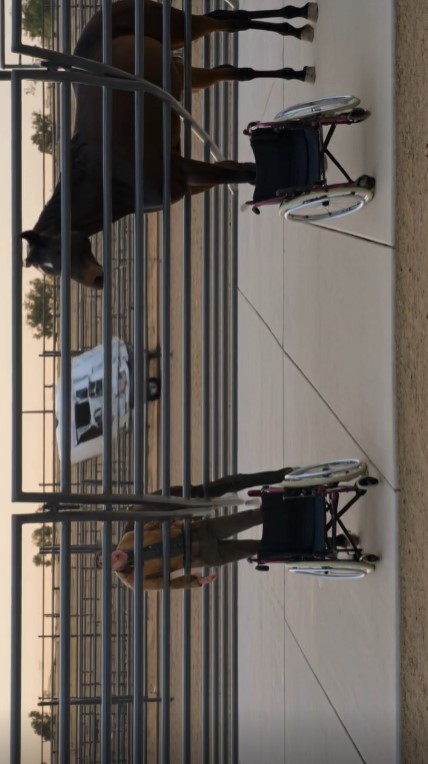
When everyone left the ranch…
Shadow stayed.
The black horse stood beside an empty wheelchair.
Wouldn’t eat.
Wouldn’t return to the stable.
Wouldn’t move.
The ranch owner finally asked:
“Why does he keep standing there?”
The wheelchair belonged to sixteen-year-old Maya.
For two years, Maya came to the ranch every Saturday.
She couldn’t ride Shadow.
So she sat beside him.
Read books.
Talked to him.
Sometimes for hours.
Then Maya suddenly stopped coming.
Nobody at the ranch knew why.
Shadow kept waiting.
Saturday after Saturday.
Then one afternoon…
a van pulled into the ranch.
Shadow lifted his head.
The side door opened.
A woman stepped out.
Then Maya appeared.
Older.
Smiling.
Using a new wheelchair.
The moment Shadow saw her…
he ran safely to the fence.
Maya started crying.
“You waited.”
Shadow pressed his muzzle gently against her hand.
The ranch staff watched silently.
Then Maya’s mother handed the owner a folded letter.
“Maya wanted you to have this.”
The letter explained why she’d disappeared.
Her family had been forced to move away unexpectedly.
Maya believed she’d never see Shadow again.
But there was something else.
Maya had been saving money.
Birthday money.
Holiday money.
Every dollar.
The ranch owner looked confused.
“For what?”
Maya pointed at Shadow.
“For him.”
She wanted to sponsor his care permanently so he would never be moved.
The owner started crying.
Then he walked to the stable and returned with a small envelope.
“Maya… this was supposed to be given to you if you ever came back.”
Inside was a photograph.
Maya and Shadow.
Taken during her very first visit.
But behind them in the photograph stood a man.
Maya stared.
“Mom… that’s Grandpa.”
Her grandfather had died before Maya ever visited the ranch.
The ranch owner shook his head.
“That’s not your grandfather.”
Maya’s mother went pale.
Because the man in the photograph looked exactly like him.
His name was Samuel.
At least that was what the ranch owner knew him as.
Samuel had arrived at the ranch nearly three years before Maya’s first visit.
He never spoke much about his past.
He volunteered twice a week.
Fixed fences.
Carried feed.
Brushed the older horses.
And spent an unusual amount of time with Shadow.
Maya’s mother, Elena, stared at the picture.
“When was this taken?”
The ranch owner checked the date on the back.
“April 14.”
Elena sat down.
“That’s impossible.”
Maya looked at her.
“Why?”
Elena’s voice shook.
“Your grandfather died on April 2.”
Twelve days earlier.
Everyone went quiet.
The ranch owner frowned.
“I met Samuel months before that.”
Elena looked at him.
“What was his last name?”
“I never knew.”
“Where did he live?”
“About an hour north, I think.”
“Did he have family?”
“He never said.”
Maya kept staring at the photograph.
The man had the same narrow face.
Same silver hair.
Same heavy eyebrows.
Even the same crooked smile.
She had seen that face in family photographs all her life.
Her grandfather’s name had been Thomas Reed.
He died when Maya was thirteen.
They had been close.
Very close.
He was the one who taught her to love horses.
Before Maya’s mobility changed, Thomas used to take her to watch them from outside local pastures.
He always told her:
“You don’t have to sit on a horse to know one.”
After Thomas died, Maya’s world became smaller.
Grief.
Medical appointments.
A new wheelchair.
A move to a different school.
Then her mother found the ranch.
Shadow became the first place Maya felt normal again.
Not because he ignored the wheelchair.
Because he didn’t seem to care.
Maya would sit beside him for hours.
Sometimes reading.
Sometimes talking about Thomas.
Shadow simply stayed.
Now Maya wondered whether there had always been more to it.
She looked at the owner.
“Where is Samuel now?”
The owner’s expression changed.
“I don’t know.”
“What do you mean?”
“He stopped coming.”
“When?”
“About six months after this photo.”
“Did he say why?”
“No.”
Then the owner remembered something.
Samuel had left a box.
Small.
Wooden.
He said:
“If the girl who reads to Shadow ever stops coming, keep this until she returns.”
Maya’s mother looked at him.
“He knew she might leave?”
“I thought he was just being strange.”
The owner went into the office.
He returned carrying an old wooden box.
There was a brass latch.
No lock.
Maya opened it.
Inside was a worn leather bracelet.
A folded ranch map.
A photograph of Shadow as a young horse.
And a letter.
The handwriting made Elena gasp.
Maya looked at her.
“What?”
Elena reached for the letter.
“That’s my father’s handwriting.”
Maya’s heart started pounding.
“No.”
“Yes.”
Elena had boxes of Thomas’s birthday cards at home.
She knew the handwriting.
The tall T.
The strange way he wrote the letter R.
The long slash through his sevens.
It was his.
Maya unfolded the letter.
At the top, it said:
For Maya.
She froze.
Then began reading.
Maya,
If you’re reading this, then you came back.
That means Shadow did too.
Maya stopped.
Her mother was crying already.
The letter continued.
There’s something your mother never knew.
And something I should have told both of you before I ran out of time.
Maya whispered:
“Grandpa wrote this?”
Elena nodded.
“I think so.”
Thomas explained that Shadow had once belonged to him.
Not officially.
Years earlier, before Maya was born, Thomas volunteered at a rehabilitation farm.
Shadow had been rescued young.
Nervous.
Difficult to approach.
Thomas spent months working around him.
Not riding.
Just sitting nearby.
Reading newspapers.
Talking.
Waiting.
Exactly what Maya later did.
Maya covered her mouth.
“He did the same thing.”
The ranch owner nodded slowly.
“That explains a lot.”
Thomas eventually helped transfer Shadow to the ranch when the rehabilitation farm closed.
But nobody at the current ranch knew Thomas by his real name.
He used Samuel.
His middle name.
Elena looked angry now.
“Why would Dad hide his name?”
The letter answered.
Thomas had been diagnosed with a serious illness.
He knew his time was limited.
He didn’t tell Elena immediately.
He hated being treated differently.
At the ranch, he wanted one place where nobody knew him as “the sick man.”
So he introduced himself as Samuel.
Then something unexpected happened.
He learned Maya had started visiting.
Thomas knew the ranch had programs for young people with disabilities.
But he did not know Elena had found this exact place.
One Saturday, he saw Maya from across the yard.
He nearly walked toward her.
Then stopped.
Maya looked at her mother.
“He saw me?”
“Yes.”
The letter continued.
I wanted to come over.
But then I watched you sit beside Shadow.
You didn’t try to make him do anything.
You just opened a book.
And he stayed.
That was the moment I knew he had chosen you.
Maya cried.
Thomas did not reveal himself that day.
He stood in the background.
That was when the photograph had been taken.
The ranch owner remembered now.
“I thought Samuel was watching Shadow.”
“He was watching me,” Maya whispered.
Elena looked hurt.
“Why wouldn’t he tell us?”
The next paragraph answered that too.
Because Thomas was scared.
He had already begun pulling away from people.
He thought it would make losing him easier.
It didn’t.
He wrote:
Your mother will be angry at me for this.
She should be.
I thought disappearing in pieces would hurt less than leaving all at once.
I was wrong.
Elena covered her face.
“That sounds exactly like him.”
Thomas had continued visiting the ranch under the name Samuel even after his health worsened.
But here was the mystery.
How could he have been in the photograph twelve days after his recorded date of death?
The answer came several pages later.
Thomas had not died on April 2.
Not technically.
That was the date Elena had been told he died.
Maya stared at her mother.
“What?”
Elena looked stunned too.
Thomas explained that his condition became critical.
He was moved into hospice care under a private arrangement organized by his older brother, David.
Thomas did not want Maya seeing him decline.
He asked Elena to tell Maya he had died when doctors believed he had only hours left.
Elena refused at first.
But after Thomas lost consciousness, doctors believed death was imminent.
The family prepared for the worst.
Then Thomas briefly stabilized.
For nearly three weeks.
Elena stared at the page.
“They never told me.”
The letter said Thomas regained enough strength for two short outings.
One was to the ranch.
He asked David to drive him.
That was April 14.
The day of the photograph.
Thomas stood far away.
He did not approach Maya.
He watched her read to Shadow.
Then returned to hospice.
He died for real nine days later.
April 23.
Maya’s hands trembled.
“Mom… you thought he was already gone?”
“Yes.”
Elena was crying hard now.
“I thought April 2 was the day.”
The ranch owner looked horrified.
“Why would the family tell you that?”
Elena’s expression hardened.
“My uncle.”
David.
Thomas’s older brother.
The man Elena had not spoken to in years.
That changed everything.
Elena remembered Thomas and David fighting near the end.
She never knew why.
Now the letter explained.
David believed Elena should know Thomas had stabilized.
Thomas begged him not to tell her.
He insisted the family had already started grieving.
He believed appearing again only to die days later would make everything worse.
David disagreed.
They argued.
In the end, David kept Thomas’s secret.
After Thomas actually died, the official arrangements were handled quietly.
The family never corrected the date they had given Maya.
Elena whispered:
“That’s why Uncle David disappeared after the funeral.”
He had carried guilt too.
Maya kept reading.
Thomas wrote:
I am sorry.
I thought I was protecting you both.
Old men are very talented at confusing fear with wisdom.
Maya laughed through tears.
Then came the part about Shadow.
Thomas had asked the ranch owner to keep the wooden box.
But not to give it to Maya unless she returned after being gone for a long time.
Why?
Because Thomas knew Elena’s job was unstable.
He knew they might move.
And he feared Maya would lose the ranch just as she lost him.
So Thomas had done one final thing.
He created a small fund.
Enough to help cover Shadow’s basic care.
Maya stopped reading.
“What?”
The ranch owner looked surprised.
“I didn’t know that.”
The paperwork was inside the box.
An old bank document.
A trust.
Not enormous.
But enough to cover feed and veterinary costs for years.
Maya looked at the money she had saved herself.
Birthday money.
Holiday money.
Every dollar.
She laughed.
“He already did it.”
The ranch owner smiled.
“Looks like it.”
But Thomas had included a condition.
The fund belonged to Shadow’s care only as long as he remained at the ranch and continued participating in quiet-companion sessions with visitors who could not or did not ride.
Maya read the sentence twice.
Thomas had understood Shadow.
He knew the horse’s value was not in riding.
It was in staying.
Sitting beside someone.
Waiting.
Listening.
The exact thing Maya needed.
The ranch owner looked toward the pasture.
“That horse has helped dozens of kids since you left.”
Maya smiled.
“Grandpa knew.”
Then she found the last page.
Thomas had written:
Maya,
I don’t know how long Shadow will be here.
I don’t know how long any of us get.
But I know this:
Not every friendship has to look the way other people expect.
You don’t need to ride him.
You don’t need to stand beside him.
You don’t need to do anything except show up.
He’ll understand.
You always did.
Maya could no longer read aloud.
Her mother finished.
And if you ever think he forgot you because you had to leave…
remember that some hearts are better at waiting than people are.
Maya looked toward Shadow.
The horse was still standing at the fence.
Waiting.
She wheeled toward him.
Shadow lowered his head.
Maya pressed her forehead against his muzzle.
“You knew Grandpa.”
The horse stood quietly.
No miracle.
No magical answer.
Just the same stillness he had always given her.
Elena stood behind Maya.
“I’m sorry.”
Maya looked back.
“For what?”
“For not knowing.”
Maya shook her head.
“You didn’t know either.”
Elena looked at the photograph again.
“I should’ve.”
Maya frowned.
“How?”
“Because Dad used to disappear on Tuesdays.”
“The ranch?”
“Probably.”
For years, Elena assumed Thomas had medical appointments.
Sometimes he did.
Sometimes he came here.
The ranch had been his private refuge.
Now it had become Maya’s too.
A week later, Elena called Uncle David.
He answered on the second ring.
Neither spoke at first.
Then Elena said:
“You let me believe Dad died three weeks before he actually did.”
David began crying immediately.
“I know.”
“Why?”
“Because he made me promise.”
“You could’ve broken it.”
“I should have.”
Elena’s anger lasted through the entire call.
David accepted it.
Then he told her something Thomas had not included in the letter.
On his final visit to the ranch, Thomas had wanted to approach Maya.
He took three steps toward her.
Then stopped.
David asked:
“Why aren’t you going over?”
Thomas said:
“Because look at her.”
Maya was beside Shadow.
Reading.
Smiling.
Calm.
Thomas whispered:
“She isn’t thinking about me right now.”
David didn’t understand.
Thomas smiled.
“That’s good.”
He had spent months watching Maya worry about him.
Hospitals.
Illness.
Adults whispering.
At the ranch, she had one place untouched by his sickness.
Thomas refused to take that away.
So he stayed in the background.
The camera happened to catch him.
That accidental photograph became the only picture of Maya and her grandfather together after the day she had been told he was gone.
Elena eventually met David again.
It was uncomfortable.
But necessary.
Maya asked him questions.
A lot of them.
Especially about the missing three weeks.
David told her Thomas had good days.
Bad days.
One afternoon he demanded chocolate ice cream.
Another day he insisted on wearing a clean shirt to visit “an old friend.”
The old friend was Shadow.
Maya smiled.
“That sounds like Grandpa.”
David handed her one more item.
Thomas’s old paperback copy of Black Beauty.
Inside the front cover, he had written:
For Maya someday.
She had no idea he planned to give it to her.
From then on, Maya read that book to Shadow every April.
When her family moved back permanently, she resumed her Saturday visits.
Shadow was older now.
Slower.
He rested more.
Maya didn’t care.
Neither did he.
She still couldn’t ride him.
That was never the point.
Sometimes children at the ranch asked:
“Why don’t you ride?”
Maya smiled.
“Because Shadow and I do something else.”
“What?”
“We sit.”
They usually looked confused.
Then some of them tried it.
One child with severe anxiety sat beside Shadow for forty minutes without speaking.
Another read him comic books.
A veteran sat in silence.
An elderly woman brushed his mane.
The ranch eventually created a formal program built around the idea.
No riding required.
No performance.
No pressure.
They called it the Shadow Sessions.
Maya hated the name at first.
“Sounds like a spy movie.”
The owner laughed.
“You have a better one?”
She didn’t.
So it stayed.
Maya used the money she had saved for Shadow differently.
She paid for new adaptive pathways around the ranch.
Smooth enough for wheelchairs.
Wide enough for mobility devices.
Then others donated.
A local contractor volunteered.
Former visitors contributed.
Within a year, the ranch was more accessible than ever.
At the entrance, they installed a small plaque.
Not about Thomas.
Maya refused.
“He hated attention.”
Instead, the plaque said:
YOU DON’T HAVE TO RIDE TO BELONG HERE.
Years passed.
Shadow lived to an old age.
By then, Maya was studying counseling.
She returned whenever she could.
On one of her final visits, Shadow walked more slowly than usual.
Maya knew.
Everyone did.
She sat beside him with the same old book.
Opened to the first page.
And read.
Shadow lowered his head beside her wheelchair.
Just like he had the first time.
The ranch owner stood at a distance.
He remembered Samuel.
Thomas.
Whatever name the old man used.
He remembered another quiet figure sitting beside Shadow years earlier.
Reading.
Talking.
Waiting.
The similarity no longer surprised him.
Shadow died peacefully months later.
Maya was devastated.
But this time, she understood something she had not understood at thirteen.
Leaving was not the same as erasing.
Waiting was not always pointless.
And love didn’t disappear simply because someone could no longer show up on Saturday.
The ranch kept Shadow’s stall empty for one week.
Then Maya asked them to use it again.
“He wouldn’t want an empty stall.”
They converted part of it into a small reading corner.
A shelf held donated books.
In the center sat the photograph from Maya’s first visit.
Maya beside Shadow.
Thomas standing quietly in the background.
Underneath it, Maya placed one sentence from his letter:
SOME HEARTS ARE BETTER AT WAITING THAN PEOPLE ARE.
Visitors often asked about the man in the photograph.
Maya told them.
“He was my grandfather.”
Then, depending on the day, she added:
“And for a little while, he was Samuel.”
Years later, people would remember the story as the one about the horse who waited beside an empty wheelchair.
But Maya remembered something else.
Shadow had not only waited for her.
He had connected two versions of the same family.
A grandfather who found peace sitting quietly beside a horse.
And a granddaughter who, without knowing it, found peace the exact same way.
Maya had returned believing she was saving money to make sure Shadow would never be moved.
Instead, she discovered her grandfather had already thought of him.
Already planned for him.
Already understood what Shadow would become in Maya’s life.
And the photograph that seemed impossible was not a ghost.
Not a miracle.
Not proof of anything supernatural.
It was something more human.
A grandfather with only days left…
standing quietly in the background…
watching his granddaughter smile…
and choosing, one last time, not to interrupt.