
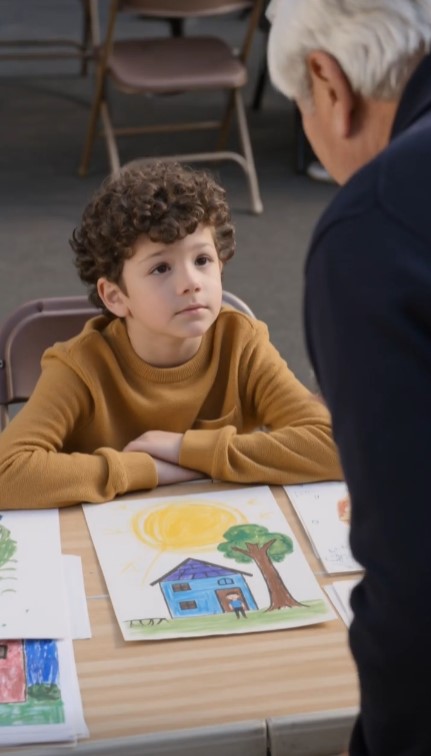
Nobody stopped at Leo’s tiny art table.
The ten-year-old had spent all morning displaying his paintings at the community fair.
People walked past.
Some smiled.
Nobody bought one.
Then an elderly man stopped.
He pointed to Leo’s simplest painting.
A small blue house beneath a huge yellow sun.
“How much?”
Leo looked surprised.
“One dollar.”
The man handed him a dollar.
Then carefully held the painting against his chest.
Leo smiled for the first time all day.
Before leaving, the man asked:
“Why did you paint this house?”
Leo shrugged.
“I dream about it.”
The old man stopped.
“What?”
“I’ve never been there. But I keep seeing it when I sleep.”
The man slowly turned the painting around.
Blue door.
Two upstairs windows.
A crooked apple tree.
His hands started trembling.
He sat down.
Leo’s mother rushed over.
“Are you okay?”
The elderly man looked at her.
Then at Leo.
“Who taught him to paint this?”
“Nobody.”
The man opened his wallet.
He removed a photograph taken almost fifty years earlier.
It showed the exact same blue house.
The same apple tree.
And standing outside…
was a little boy who looked almost exactly like Leo.
Leo pointed.
“Who’s that?”
The elderly man couldn’t answer.
Leo’s mother saw the photograph…
and turned pale.
Because she recognized the little boy too.
There was an identical photograph hidden inside her late mother’s belongings.
The elderly man looked at Leo’s mother.
“What was your mother’s name?”
She told him.
He closed his eyes.
Then whispered:
“She was my sister.”
Leo’s mother shook her head.
“My mother didn’t have a brother.”
The elderly man reached into his coat.
He removed half of an old photograph.
Leo’s mother had the other half at home.
Then he looked at Leo’s painting again.
“That house is still standing.”
Leo stared at him.
“Where?”
The elderly man answered:
“Where your grandmother told everyone never to look.”
The man’s name was Samuel.
Leo’s mother, Anna, stared at him.
“My mother’s name was Margaret.”
Samuel nodded.
“I know.”
Anna’s voice sharpened.
“How?”
“Because I called her Maggie.”
Anna went completely still.
Nobody had called her mother Maggie.
At least, not during Anna’s lifetime.
Margaret hated nicknames.
If someone shortened her name, she corrected them immediately.
Yet Samuel said it naturally.
As though he had said it thousands of times.
Anna looked at Leo.
Then at the photograph.
“We’re going home.”
Samuel started to speak.
Anna raised a hand.
“No.”
Leo frowned.
“Mom…”
“Not now.”
But Samuel didn’t argue.
Instead, he took a pen from his pocket.
He wrote an address on the back of Leo’s one-dollar bill.
Then handed the bill back.
Leo looked confused.
“You paid me with this.”
Samuel smiled sadly.
“Keep the painting.”
“No.”
Leo hugged his little cash box.
“You bought it.”
Samuel looked at the blue house again.
Then carefully took the painting.
“Fair enough.”
He handed Leo the dollar.
“Then keep the address.”
Anna took Leo home.
She barely spoke during the drive.
Leo kept asking questions.
“Who was he?”
“Was he really Grandma’s brother?”
“Why did he have the same picture?”
“What did he mean about the house?”
Finally Anna said:
“I don’t know.”
That was the truth.
Her mother Margaret had died four years earlier.
She had been seventy-two.
Quiet.
Private.
The kind of woman who remembered every birthday but rarely talked about childhood.
Whenever Anna asked about grandparents or cousins, Margaret changed the subject.
She said her parents had died young.
Said she was an only child.
Said there was nobody left to look for.
Anna believed her.
Then after Margaret died, Anna found an old wooden box in the back of a closet.
Inside were photographs.
Most were ordinary.
School pictures.
A young Margaret standing beside a lake.
A wedding picture.
Anna as a baby.
But one photograph was strange.
It had been torn in half.
The remaining side showed Margaret as a little girl standing outside a blue house.
Beside her was half of another child.
Just one shoulder.
One hand.
And the edge of a face missing because the photograph had been ripped.
Anna had asked her father once.
He said:
“Your mother didn’t like talking about that house.”
“Why?”
“I never knew.”
She forgot about it.
Until now.
That evening, Anna opened the wooden box again.
Leo sat beside her.
She found the torn photograph.
Then looked at the picture Samuel had shown at the fair in her memory.
Same house.
Same tree.
Same clothes.
Anna whispered:
“He really has the other half.”
Leo stared.
“So he is Grandma’s brother?”
“Maybe.”
“Can we go see the house?”
Anna immediately said:
“No.”
Leo looked disappointed.
Then he asked:
“Why do I dream about it?”
Anna had no answer.
She told herself it was coincidence.
Maybe Leo had seen the old photograph years earlier and forgotten.
Maybe Margaret once showed it to him when he was very young.
Children absorbed images.
Memory worked strangely.
That explanation was reasonable.
But Anna remembered something else.
When Leo was six, he drew the same apple tree.
Bent trunk.
One low branch.
When he was eight, he painted a blue door in art class.
Then, several months earlier, he started painting the whole house.
Always from the same angle.
Anna had assumed imagination.
Now she wasn’t sure.
Two days passed.
Samuel did not contact them.
He had no number.
No address.
Just the hope Anna might use his.
On the third day, Leo placed the one-dollar bill on the breakfast table.
“You said Grandma always told you family questions mattered.”
Anna looked at him.
“She also told me not to talk to strangers.”
“He’s not a stranger if he’s family.”
“We don’t know that yet.”
Leo thought.
“Then let’s find out.”
Anna hated how sensible that sounded.
So that afternoon, she called.
Samuel answered after one ring.
“Anna?”
She froze.
“How did you know?”
“I hoped.”
She said:
“I want proof.”
Samuel answered:
“I have it.”
They met at a café.
Public place.
Daylight.
Anna insisted.
Samuel brought a folder.
Inside were documents.
Old birth certificates.
School records.
A newspaper clipping.
And photographs.
One showed two children.
Margaret and Samuel.
Together.
Not torn.
Anna stared.
Her mother looked about seven.
Samuel maybe five.
They were sitting on the front steps of the blue house.
The crooked apple tree behind them.
Anna whispered:
“Oh my God.”
Samuel said:
“She was two years older.”
Anna looked at him.
“Why did she tell me she was an only child?”
Samuel’s eyes filled.
“That’s the part she never forgave.”
“Forgave who?”
“Our father.”
Samuel began telling the story.
Their father’s name had been Robert.
Their mother, Helen.
The family lived in the blue house in a small town about four hours away.
Samuel remembered very little of the early years.
Margaret remembered everything.
Their father drank too much.
Worked inconsistently.
Disappeared for days.
Their mother held the family together.
Then Helen became ill.
Not suddenly.
Slowly.
By the time the children understood something was wrong, she was already very sick.
Helen died when Margaret was eleven and Samuel was nine.
Afterward, everything collapsed.
Robert could not manage.
Bills went unpaid.
Food disappeared.
The house deteriorated.
Then one winter, Robert made a decision.
He sent Samuel to live temporarily with an aunt.
Margaret was supposed to follow two weeks later.
She never did.
Anna frowned.
“Why?”
Samuel looked down.
“Because Dad disappeared.”
Robert left the house.
Nobody knew where he went.
Margaret stayed behind with a neighbor for several days.
Then child welfare stepped in.
But there was confusion.
Different counties.
Different relatives.
Paper records.
Margaret was eventually placed with another family.
Samuel remained with the aunt.
The siblings were separated.
At first, they wrote letters.
Then the letters stopped.
Samuel believed Margaret no longer wanted contact.
Margaret believed Samuel had been taken away and forgotten her.
Neither knew the truth.
Anna whispered:
“Who stopped the letters?”
Samuel said:
“My aunt.”
Anna’s expression hardened.
“Why?”
“She thought Maggie’s situation was unstable.”
“She wanted me to adjust.”
“So she hid them?”
Samuel nodded.
Years later, he found three unopened letters Margaret had written.
By then, Margaret had been adopted.
Her surname changed.
The address no longer worked.
Samuel tried finding her.
No internet then.
No easy records.
He searched.
Failed.
Then life moved.
College.
Marriage.
Children.
Years.
He never stopped wondering.
Anna looked at the documents.
“You could have found her eventually.”
“I did.”
“When?”
Samuel’s voice broke.
“Twenty-three years ago.”
Anna froze.
“What?”
Samuel found Margaret through a newspaper wedding announcement for Anna.
Margaret’s name appeared as mother of the bride.
He recognized the town.
He called.
Margaret answered.
For the first time in nearly thirty years…
brother and sister spoke.
Anna stared at him.
“Then why didn’t I know?”
Samuel took a long breath.
“Because she told me not to contact her again.”
Anna looked stunned.
“Why?”
Samuel opened another envelope.
Inside was a photocopy of a letter.
Margaret’s handwriting.
Samuel,
I am glad you are alive.
But please do not come here.
I built a life by telling myself the old one was gone.
I cannot open that house again.
Anna covered her mouth.
Samuel continued.
They spoke for almost an hour.
Margaret cried.
Samuel cried.
He wanted to visit.
She refused.
He asked about Anna.
Margaret said she had a daughter and a husband who knew very little about the past.
She didn’t want to explain.
Samuel begged.
Margaret said:
“I survived by becoming someone else.”
Then she gave him one condition.
Never come to her home.
Never contact Anna.
Never bring the old house back into her life.
Samuel kept the promise.
For twenty-three years.
Anna stared.
“You knew where we were?”
“Mostly.”
“You knew I existed?”
“Yes.”
“And you stayed away?”
“She asked me to.”
Anna’s eyes filled.
“That was her choice. Not mine.”
Samuel nodded.
“I know that now.”
The sentence sounded familiar.
Families repeated mistakes even when circumstances changed.
Anna thought of all the stories where adults made decisions “for” children.
Margaret had hated that her own family controlled who she could know.
Then she had done something similar to Anna.
Not cruelly.
Fearfully.
But still.
Anna asked:
“Why did you come to the fair?”
“I didn’t know you’d be there.”
Samuel had moved nearby six months earlier to live closer to his daughter.
He attended the community fair because his granddaughter had a dance performance.
Then he saw Leo’s painting.
The blue house.
The yellow sun.
The apple tree.
He nearly walked away.
Then Leo said he dreamed about it.
Samuel couldn’t.
Anna looked toward Leo, who was drawing quietly at the next table.
“He really does dream about it.”
Samuel smiled.
“Margaret did too.”
Anna froze.
“What?”
Samuel reached into the folder.
Another paper.
A childhood drawing.
Blue crayon house.
Huge yellow sun.
Crooked tree.
At the bottom:
MAGGIE — AGE 10.
Anna stared.
The similarity to Leo’s painting was unnerving.
Samuel said:
“She painted that house constantly.”
“Why the yellow sun?”
“I don’t know.”
“The sun wasn’t special.”
Anna called Leo over.
He looked at Margaret’s drawing.
His eyes widened.
“She paints like me.”
Anna corrected gently:
“She did.”
Leo looked at Samuel.
“Did Grandma dream about the house?”
Samuel nodded.
“After we left, yes.”
“Did she go back?”
Samuel’s face changed.
“No.”
“Never?”
“Not that I know.”
Then Leo asked:
“Can we?”
Anna looked at him.
Samuel remained silent.
That decision belonged to her.
Not him.
Two weeks later…
they went.
The drive took four hours.
Samuel sat in the passenger seat.
Anna drove.
Leo watched the scenery.
Nobody spoke much during the final twenty miles.
The town was smaller than Anna expected.
Older houses.
A church.
A closed pharmacy.
A narrow road leading toward the edge.
Samuel said:
“Turn here.”
Anna’s chest tightened.
Then they saw it.
Blue.
Faded now.
But blue.
Two upstairs windows.
The crooked apple tree still alive.
Leo whispered:
“That’s it.”
Anna parked.
Nobody moved.
Leo looked almost frightened.
Not because the house was scary.
Because it was familiar.
He had never been there.
At least not physically.
Samuel stepped out first.
He touched the fence.
“Smaller than I remember.”
Anna stared at the house.
“Who owns it?”
Samuel smiled.
“We do.”
Anna turned.
“What?”
Samuel held up an old key.
“The deed was never properly transferred.”
After Robert disappeared, debts should have taken the property.
But Helen’s parents had quietly paid the remaining mortgage.
They hoped one day the children might return.
The house sat empty for years.
Then Samuel’s aunt managed it.
Later Samuel inherited her share.
Margaret technically retained part ownership too.
When she died…
that share passed to Anna.
Anna stared at him.
“You mean I own this?”
“Half.”
She laughed nervously.
“This is insane.”
Samuel nodded.
“I’ve been paying taxes on half a house for decades.”
They walked inside.
Dust.
Covered furniture.
Old wallpaper.
The smell of wood and age.
Samuel stood in the hallway.
For a moment he looked nine again.
Leo moved slowly from room to room.
Then stopped at the staircase.
“There should be a red mark here.”
Anna froze.
“What?”
Leo pointed to the wall beside the stairs.
Samuel walked over.
Under peeling wallpaper was a tiny strip of red paint.
He stared.
“How did you know?”
Leo shrugged.
“It’s in the dream.”
Anna felt cold.
But Samuel didn’t call it supernatural.
He looked at Anna.
“Margaret may have told him things when he was little.”
Anna nodded quickly.
“Maybe.”
Leo had spent time alone with Margaret before she died.
He had been six.
Could she have described the house?
Could she have shown him photographs?
Maybe.
That explanation remained possible.
Then Leo walked toward the kitchen.
“The apple tree should be outside that window.”
It was.
Samuel sat down.
He looked overwhelmed.
Leo noticed.
“Are you okay?”
Samuel smiled.
“Just remembering.”
They found more photographs in an upstairs cupboard.
Not hidden deliberately.
Just forgotten.
Margaret and Samuel.
Helen.
Robert.
Birthdays.
Christmas.
Ordinary life before everything went wrong.
Anna had never seen her mother as a child smiling freely.
Margaret’s adult photographs always showed restraint.
A polite smile.
Straight posture.
Here she was barefoot.
Laughing.
Hair messy.
Holding a frog.
Anna cried.
“This is who she was.”
Samuel nodded.
“Before she had to become someone else.”
Then Leo shouted from another room.
“Mom!”
Anna ran.
He was standing in a small bedroom.
One wall had drawings beneath old wallpaper.
Crayon houses.
Horses.
Trees.
And one repeated image.
A huge yellow sun.
Samuel whispered:
“Maggie.”
She had drawn them directly on the wall.
One picture showed two children standing beneath the sun.
Above them, in childish handwriting:
MAGGIE + SAM ALWAYS.
Samuel sat on the floor.
Anna watched him cry.
For decades, he had believed Margaret chose to stop writing.
Then learned the truth.
Then found her.
Then lost her again by respecting her fear.
Now she was gone.
No reunion remained possible.
Except this.
The wall.
The photographs.
Her daughter.
Her grandson.
Leo sat beside him.
“Why did Grandma tell everyone not to look here?”
Samuel wiped his eyes.
“Because some places hurt.”
Leo considered that.
“Can they stop hurting?”
Samuel looked around.
“Maybe differently.”
In the attic, Anna found a locked box.
The key Samuel had did not fit.
Leo spotted a tiny brass key taped beneath an old desk drawer.
It opened the box.
Inside was a stack of letters.
Margaret’s letters.
Dozens.
Most never sent.
Addressed to Samuel.
Written across decades.
Anna’s hands shook.
Samuel stared.
“She kept writing?”
The first was from age nineteen.
Sam,
I don’t know where you are.
Sometimes I’m angry at you for disappearing.
Sometimes I think maybe you believe I disappeared.
Another from age thirty-two.
I had a daughter.
Her name is Anna.
I wish you could meet her.
Samuel covered his mouth.
Another.
Anna is getting married.
I saw your name in an old school record today and almost tried again.
I didn’t.
I’m afraid if I find you, I’ll become eleven years old again.
Anna cried.
Margaret had wanted him.
Feared him.
Missed him.
All at once.
Then they found the final letter.
Dated only months before Margaret died.
Samuel,
I know where you live.
Samuel stared.
“What?”
Margaret had found him again.
She had searched online.
She knew he had children.
Grandchildren.
She even knew he had retired.
But she never called.
The letter continued.
I keep thinking about the blue house.
Leo draws houses now.
Sometimes his trees look like ours.
I have never shown him that place.
Anna froze.
There it was.
Confirmation.
Margaret claimed she had never shown Leo.
Maybe she had described it without realizing.
Maybe Leo had glimpsed the torn photograph.
Maybe memory had traveled through tiny details.
Nobody could know.
Margaret wrote:
He asked me yesterday why I never talk about being a little girl.
I told him some memories are boxes you keep closed.
He said boxes are for opening.
Leo smiled when Anna read that aloud.
“Sounds like me.”
Samuel laughed.
Margaret’s final lines broke them.
I think I was wrong to keep you away.
I thought silence would protect Anna from my pain.
Instead I gave her a family story with missing pages.
If I lose my nerve again, I hope someday one of them finds you.
Maybe Leo.
He notices things.
Samuel cried openly.
Anna couldn’t speak.
Leo looked between them.
“Grandma wanted us to find you?”
Anna nodded.
“I think she did.”
The final line read:
If he ever paints the blue house, take him there.
Samuel looked at Leo’s painting.
The one he had bought for one dollar.
He had brought it with him.
He slowly turned it around.
Blue house.
Crooked tree.
Huge yellow sun.
Then he placed it beside Margaret’s childhood drawing.
The two paintings were not identical.
But they felt like the same memory seen by two children decades apart.
Anna spent the rest of the day reading letters.
She learned things about her mother she never knew.
Margaret loved apple pie but hated peeling apples.
She once broke Samuel’s bicycle and blamed a neighbor.
She wanted to become a teacher.
She was terrified of thunderstorms.
She slept with the hallway light on for years after Helen died.
Small things.
Human things.
Not secrets exactly.
Pieces.
Anna realized her mother had spent adulthood trying to erase the frightened child she once was.
But erasing pain had also erased connection.
The family began restoring the blue house.
Slowly.
Not as a permanent home.
As a shared place.
Samuel repaired the porch.
Anna cleaned photographs.
Leo insisted the blue door remain blue.
The apple tree was treated by an arborist and survived.
One upstairs room became a small art space.
They kept part of Margaret’s wall untouched.
Huge yellow sun.
Two children.
MAGGIE + SAM ALWAYS.
Samuel’s children visited.
Then his grandchildren.
For the first time, Anna met cousins she never knew existed.
Nobody pretended the lost decades didn’t matter.
They did.
Margaret and Samuel should have had more time.
Anna should have known the truth earlier.
But the family refused to waste the time that remained arguing about what could no longer be changed.
A year later, Leo held another tiny art sale.
This time at the blue house during a family gathering.
He painted six pictures.
Samuel bought the first.
Again.
“How much?”
Leo smiled.
“Inflation.”
Samuel laughed.
“Two dollars?”
“Five.”
“Robbery.”
He paid.
The painting showed the blue house.
But something had changed.
There were people standing outside.
A woman.
An elderly man.
A boy.
Several children.
Family.
And above them…
the enormous yellow sun.
Samuel looked at it.
“Why is the sun always so big?”
Leo shrugged.
“Because Grandma made it big first.”
Anna stared at him.
“What?”
Leo pointed toward Margaret’s childhood drawing.
That was all he meant.
A simple answer.
The mystery didn’t need more.
Years later, Leo barely remembered the dreams.
They faded after visiting the house.
He grew up.
His paintings changed.
Landscapes.
Portraits.
Cities.
But he always kept one-dollar painting number one.
The original blue house.
Samuel eventually gave it back.
Leo protested.
“You bought it.”
Samuel smiled.
“I borrowed it.”
On the back, Samuel had written:
THIS PAINTING FOUND A FAMILY.
The blue house remained standing.
Not because it was magical.
Not because Leo somehow inherited a perfect memory of a place he had never visited.
There were plenty of ordinary explanations for what he painted.
A childhood glimpse of a photograph.
A forgotten story from his grandmother.
Coincidence.
Imagination.
But the painting still accomplished something real.
It stopped an old man at a community fair.
It made him ask one question.
It connected two halves of a photograph.
And it opened a family story that had been closed for nearly fifty years.
Anna had spent her entire life believing her mother had no brother.
Samuel had spent most of his believing his sister wanted to forget him.
Both were wrong.
Margaret had remembered everything.
The house.
The apple tree.
The letters.
Samuel.
She had simply been too afraid to go back.
In the end, she never did.
But her grandson did.
And when ten-year-old Leo stood in front of the blue house for the first time…
he looked up at the windows he had painted again and again.
Then smiled and said:
“It looks smaller in real life.”
Samuel laughed.
“That’s exactly what I said.”
And for the first time in almost fifty years…
someone opened the blue door.
Not to live in the past.
Just to let the missing family back inside.