
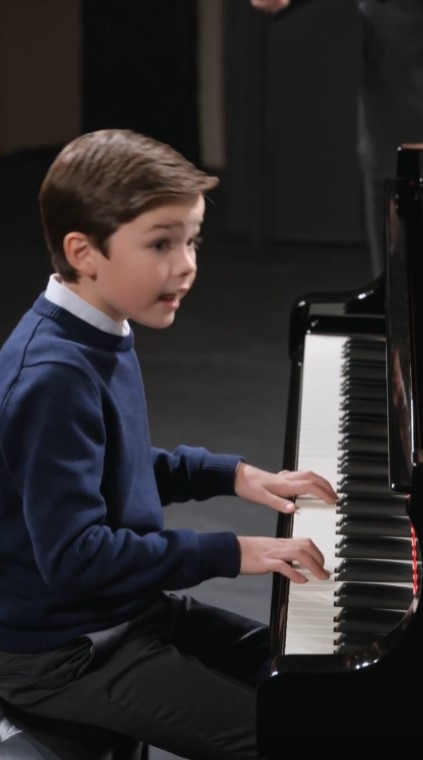
The orchestra was performing in front of two thousand people.
Then a ten-year-old boy walked onto the stage.
No one knew who he was.
The conductor stopped.
Security moved forward.
The boy ignored everyone.
He walked directly toward the piano.
Then pressed…
one single key.
The conductor went pale.
“Where did you learn that?”
The boy didn’t answer.
He pressed another.
Then another.
Four notes.
The pianist suddenly stood up.
“That melody…”
Nobody understood.
The boy’s mother rushed toward the stage.
“Eli! Come back!”
But the conductor stared at her.
Then at the boy.
“What’s his last name?”
The mother hesitated.
“Taylor.”
The conductor dropped his baton.
Thirty years earlier…
he had written an unfinished lullaby with his younger brother.
Only the two of them knew those four notes.
His brother disappeared before the song was ever completed.
The conductor walked toward Eli.
“Who taught you that?”
Eli pointed toward the audience.
“That man.”
Everyone turned.
An empty seat.
Just a black coat.
The conductor ran into the aisle.
Nobody was there.
Under the seat…
he found an old music notebook.
His brother’s notebook.
Same torn cover.
Same handwriting.
The conductor’s hands began shaking.
Then Eli said:
“He told me you’d know the ending.”
The conductor looked at him.
“What ending?”
Eli sat at the piano.
Played the four notes again.
Then continued.
Five.
Six.
Seven.
The conductor began crying.
His missing brother had finished their song.
But then Eli’s mother whispered:
“That’s impossible.”
The conductor turned.
She was staring at the notebook.
“Why?”
She answered:
“Because I buried that notebook with my father.”
The conductor looked at her.
“Your father?”
She nodded.
Then said his brother’s name.
“David.”
The conductor, whose name was Samuel Reed, seemed to stop breathing.
“What did you say?”
The woman’s voice trembled.
“My father’s name was David Reed.”
Samuel stared at her.
“No.”
She took a step closer.
“Did your brother have a scar on his left hand?”
Samuel’s face changed.
“Yes.”
“From broken glass?”
“Yes.”
The woman covered her mouth.
“My father had that scar.”
The auditorium was silent.
Two thousand people were now watching a family secret unfold onstage.
Samuel looked at Eli.
Then back at his mother.
“What’s your name?”
“Anna.”
Samuel whispered:
“David had a daughter?”
Anna shook her head.
“He never told me he had a brother.”
Samuel sat down hard in the nearest chair.
For thirty years, he believed David had vanished.
No phone call.
No letter.
No goodbye.
Nothing.
Their parents died without knowing what happened.
Samuel had searched.
Police reports.
Hospitals.
Old friends.
Missing-person notices.
Every trail ended.
And now a woman he had never met was standing in front of him saying David had lived long enough to raise a daughter.
Samuel asked:
“When did he die?”
“Six years ago.”
Samuel closed his eyes.
He had been alive.
For twenty-four years after disappearing.
Alive.
And never came home.
Anna looked ashamed even though none of it was her fault.
“He didn’t talk much about his past.”
“Did he ever mention me?”
“Not by name.”
Samuel looked hurt.
Anna continued quickly.
“But he talked about music.”
That got Samuel’s attention.
“What did he say?”
“He said he once wrote a song with someone he loved more than anyone.”
Samuel looked toward the piano.
“The lullaby.”
Anna nodded.
“He never finished playing it for me.”
Eli interrupted.
“He finished it for me.”
Anna turned sharply.
“What?”
Eli looked confused by all the attention.
“Grandpa taught me.”
“When?”
“Before he died.”
Anna stared.
“You were four.”
Eli nodded.
“I remember.”
Anna looked doubtful.
But Eli continued.
Grandpa David would sit at an old keyboard in the basement.
He rarely played full songs.
Mostly fragments.
The same seven notes.
Over and over.
Eli said:
“He told me the first four belonged to somebody else.”
Samuel started crying again.
“What exactly did he say?”
Eli thought.
“He said, ‘One day, if you meet the man who knows the first four, give him the rest.’”
Anna looked stunned.
She had never heard this.
Samuel asked:
“Why didn’t you tell your mother?”
Eli shrugged.
“I thought it was just Grandpa being weird.”
A few people in the audience laughed softly.
The tension eased for a second.
Then Samuel lifted the notebook.
“Why did you say this was buried with him?”
Anna explained.
After David died, she placed several personal objects in his casket.
His watch.
A photograph.
And the old music notebook.
She remembered it clearly because David had protected that notebook for years.
He never let anyone touch it.
She had personally placed it beside him.
Samuel looked at the notebook in his hands.
Same tear across the corner.
Same faded ink.
Same initials.
D.R.
The impossible part remained.
How could it be here?
Samuel opened it.
Inside the front cover was something Anna had never seen.
A small note.
Samuel read it.
Then went pale.
“Anna.”
“What?”
“This isn’t the notebook you buried.”
She frowned.
“It is.”
“No.”
He turned the page toward her.
Written inside:
COPY FOR SAMUEL. ORIGINAL STAYS WITH ME.
Anna stared.
Samuel gave a strange laugh.
“David made two.”
The mystery suddenly became simpler.
David had copied the notebook years earlier.
The one Anna buried was the original.
This was the copy.
But another question replaced it.
Who brought it to the concert?
Eli pointed toward the empty seat again.
“The man.”
Anna crouched beside him.
“What man?”
“The old man in the black coat.”
“What did he look like?”
Eli described him.
Gray hair.
Thin face.
Round glasses.
Samuel reacted immediately.
“Mr. Carter.”
Anna looked at him.
“Who?”
Samuel’s old piano teacher.
The man who taught both brothers.
Samuel had not seen him in decades.
He would be over ninety now, if still alive.
Samuel looked at the black coat left on the seat.
Inside the pocket was an envelope.
On the front:
SAMUEL
Samuel opened it.
The handwriting was not David’s.
It belonged to another man.
The letter began:
Samuel,
If you’re reading this, then Eli found you.
My name is Henry Carter.
Samuel sat down again.
The letter explained everything.
David had contacted Henry Carter twenty-five years earlier.
Not Samuel.
Not their parents.
Only Henry.
David asked him to keep something.
The copied notebook.
And one promise.
If David ever died without reconciling with Samuel…
Henry was to find Samuel.
But there was a condition.
Only after David’s daughter was old enough to know the truth.
Samuel’s hands shook.
“Why would David do this?”
The answer was in the next paragraph.
David had not disappeared because he stopped loving his family.
He disappeared because of what happened the night he left.
Samuel remembered it.
They had argued.
A terrible fight.
Their father wanted David to join the family business.
David wanted to become a musician.
Samuel, already studying conducting, sided with their father.
He told David:
“You’re not good enough to throw your whole life away on this.”
David left that night.
Samuel assumed he would return.
He didn’t.
For years, Samuel believed his words had driven him away.
But the letter revealed something else.
David had already decided to leave town before the argument.
He was frightened.
He had borrowed money from people he should never have borrowed from.
Not criminals in some dramatic sense.
Just dangerous lenders who threatened him.
David believed the safest thing was to disappear until he could repay everything.
He moved.
Changed jobs.
Cut contact.
Then pride took over.
One month became one year.
One year became ten.
By the time his life stabilized, he felt ashamed.
Too ashamed to return.
Henry wrote:
Your brother spent the rest of his life regretting that silence.
Samuel stared at the letter.
Anna whispered:
“He regretted it?”
Samuel nodded.
Henry had visited David only twice.
Both times, David asked about Samuel.
Had he become a conductor?
Was he married?
Did he still play their melody?
Henry brought newspaper clippings.
Programs.
Recordings.
David kept them.
Anna began crying.
“My father had boxes of concert programs.”
Samuel looked at her.
“What?”
“I never understood why.”
Now she did.
They were Samuel’s.
David had followed his brother’s career from a distance.
Every award.
Every orchestra.
Every major concert.
He knew.
He just never reached out.
Then Samuel reached the final page.
There was a second letter.
This one was David’s.
Samuel recognized the handwriting instantly.
Sam,
I don’t know if you’ll ever read this.
If you do, then I’m probably gone.
Samuel stopped.
He couldn’t continue.
Anna sat beside him.
Eli stayed at the piano.
The audience remained completely silent.
Samuel finally read on.
David wrote that the argument had hurt.
But it was never the real reason he left.
He wrote:
You said I wasn’t good enough.
For years I used that sentence as an excuse to stay angry.
The truth is, I was scared you might have been right.
Samuel wiped his eyes.
David admitted he gave up music professionally.
He found another life.
He married.
Had Anna.
Later became a widower.
He raised Anna alone.
Music became something private.
Something he played only at night.
And eventually for Eli.
Then came the line Samuel never expected:
You were always the better musician.
But I finished our song.
Samuel looked toward Eli.
The boy placed his fingers on the keys.
Samuel said softly:
“Play it.”
Eli did.
Four notes.
The old opening.
Then three new ones.
But this time he continued.
There was more.
A second phrase.
Then a third.
Samuel stood.
“Wait.”
He walked toward the conductor’s podium.
He turned to the orchestra.
“From the beginning.”
The musicians looked confused.
The pianist asked:
“You have the score?”
Samuel looked at David’s notebook.
Pages of notation filled the back half.
A completed arrangement.
Strings.
Piano.
Woodwinds.
David had not merely finished the lullaby.
He had orchestrated it.
For Samuel.
The audience realized what was happening.
Samuel lifted his baton.
Then stopped.
He looked at Anna.
“May I?”
She nodded through tears.
Samuel turned to Eli.
“You start us.”
The boy pressed the first note.
Then the second.
Third.
Fourth.
The orchestra entered softly.
For the first time in thirty years…
Samuel heard the song he had started with his brother.
Completed.
Not in a bedroom.
Not on an old piano.
But in front of two thousand people.
Halfway through, Samuel had to lower his head.
The musicians kept playing.
Anna cried openly.
Eli smiled.
At the final chord, nobody moved.
Then the entire audience stood.
The applause lasted several minutes.
But Samuel barely heard it.
He was staring at the empty chair.
The black coat was still there.
He looked around.
“Where’s Henry?”
Security searched the lobby.
Then found an elderly man sitting quietly near the exit.
Samuel ran toward him.
“Mr. Carter?”
The man looked up.
Very old.
But unmistakable.
“Hello, Samuel.”
Samuel hugged him.
“You could have told me.”
Henry nodded.
“I should have.”
“Why didn’t you?”
“Because I promised David.”
Samuel pulled away.
“That promise cost us thirty years.”
Henry looked ashamed.
“I know.”
There was no easy forgiveness.
Henry had honored David’s request.
But perhaps too literally.
He believed David had the right to choose when his story was revealed.
Samuel disagreed.
Still, anger felt small compared with the truth he had finally received.
Then Samuel asked:
“Why tonight?”
Henry smiled.
“Because I found Eli.”
Anna looked surprised.
Henry had contacted her months earlier.
But he never told her exactly who Samuel was.
He only said an old family friend wanted to attend the concert.
Anna had brought Eli.
When Henry realized Eli knew the melody, he gave him simple instructions.
“If you see the conductor after the performance, play the first four notes.”
Eli, being ten, interpreted that as:
Walk directly onto the stage in the middle of the concert.
Samuel laughed.
“That sounds like David.”
Henry smiled.
“Exactly.”
Anna suddenly remembered something.
“The dreams.”
Samuel looked at her.
“What?”
There were no dreams.
No supernatural mystery.
Only memories.
Eli had heard David’s melody so young that for years Anna thought he was inventing it.
Sometimes he hummed it in his sleep.
Sometimes while drawing.
The tune remained when almost everything else about his grandfather faded.
That was how music survived.
Not magically.
Through repetition.
Memory.
Family.
Samuel asked Anna if she wanted to know more about David’s childhood.
She said:
“Everything.”
So after the concert, they stayed in the empty auditorium for nearly three hours.
Samuel told stories.
David stealing cookies.
David getting suspended for putting soap in a fountain.
David learning piano with one hand because the other was injured.
David always changing the endings of songs.
Anna laughed.
“That sounds like him.”
Then she told Samuel about the man David became.
A quiet father.
A terrible cook.
A good listener.
A grandfather who bought Eli too many toys.
Someone who played piano only when he thought nobody was listening.
Samuel absorbed every detail.
He had missed David’s adulthood.
But he could still know part of it.
Then Anna showed him a photograph on her phone.
David at sixty.
Gray hair.
Same smile.
Samuel touched the screen.
“That’s my brother.”
Anna nodded.
“And my dad.”
The sentence connected them.
Samuel looked at Eli.
“And apparently my great-nephew.”
Eli corrected him.
“Grand-nephew.”
Samuel laughed.
“Already annoying. Definitely family.”
The notebook became something they shared.
Anna kept the original buried with David.
Samuel kept the copy.
But before taking it home, he scanned every page.
One copy for Anna.
One for Eli.
One for the orchestra archive.
David’s completed lullaby was performed again the following year.
This time its title appeared in the program.
THE SEVEN NOTES
Composed by:
David Reed and Samuel Reed.
Samuel insisted David’s name come first.
When asked why, he answered:
“He finished it.”
Eli later began piano lessons seriously.
Not because anyone expected him to continue a family legacy.
Samuel made that clear.
“You can quit tomorrow if you hate it.”
Eli said:
“I don’t hate it.”
“Good.”
“But I hate scales.”
“Also family.”
Years passed.
Samuel and Anna became close.
Not instantly.
There were awkward moments.
Questions nobody could answer.
Anger toward David.
Anger toward Henry.
Grief for years that could not be recovered.
But they kept meeting.
Birthdays.
Concerts.
Sunday dinners.
Samuel showed Anna where David grew up.
She showed Samuel David’s old house.
In the basement, they found the keyboard Eli remembered.
One key was chipped.
Samuel sat down.
Played the first four notes.
Eli finished the remaining three.
Anna watched.
For the first time, the melody no longer felt like a secret.
It belonged to all of them.
Henry Carter died two years later.
He left Samuel one final note.
It said:
Some promises should be kept.
Some should be broken sooner.
I’m sorry I learned the difference too late.
Samuel framed that one.
Not because Henry had been right.
Because he had finally admitted he wasn’t.
Samuel eventually retired from conducting.
At his final concert, the orchestra asked what piece he wanted to close with.
Everyone expected Beethoven.
Mahler.
Maybe one of the great symphonies that defined his career.
Samuel chose seven notes written by two brothers when they were young.
The arrangement had become fuller over the years.
But the opening stayed unchanged.
Four notes from Samuel.
Three from David.
Eli, now grown, sat at the piano.
Anna sat in the front row.
Samuel lifted his baton.
Before the first note, he looked at the empty chair beside Anna.
Not because anyone was expected to appear.
The chair held David’s old black music notebook.
That was enough.
Eli began.
One note.
Then another.
Then another.
Then the fourth.
Samuel smiled.
Thirty years earlier, those notes belonged to a song that never had an ending.
For decades, Samuel believed his brother had disappeared and taken the ending with him.
He was wrong.
David had finished it.
He had taught it to his grandson.
He had saved the score.
And through one very confused ten-year-old who ignored security and walked onto a stage in front of two thousand people…
the song finally found its way home.