
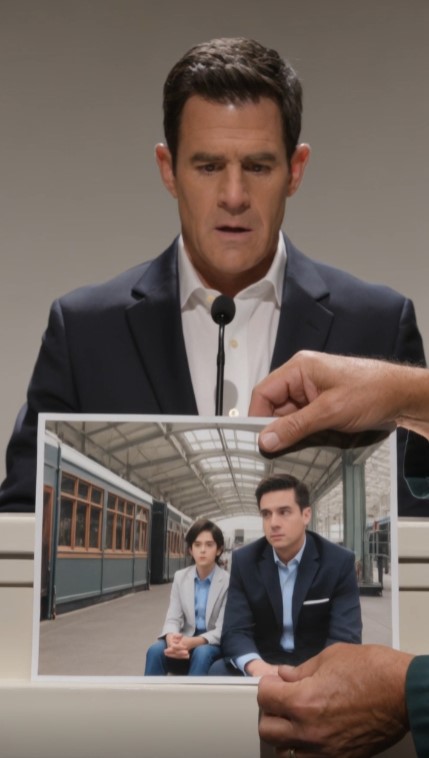
The CEO was announcing the biggest promotion in company history.
Hundreds of employees filled the auditorium.
Then an elderly janitor walked onto the stage.
Security immediately moved toward him.
The CEO raised his hand.
“Don’t touch him.”
The room went silent.
The janitor, Mr. Carter, looked embarrassed.
“I just need thirty seconds.”
He reached into his pocket…
and placed an old photograph on the podium.
The CEO looked down.
And froze.
It showed a homeless teenage boy asleep inside a train station.
Beside him…
was a much younger Mr. Carter.
The CEO whispered:
“Where did you get this?”
Mr. Carter smiled.
“You don’t remember?”
Twenty-eight years earlier, the CEO had been that homeless boy.
He slept at the station after running away from an abusive situation.
Mr. Carter worked nights nearby.
Every morning…
he brought the boy breakfast.
Then one winter evening, he disappeared.
The CEO spent years trying to find him.
Now Mr. Carter was standing in front of him.
Working as the janitor…
inside his own company.
The CEO stepped away from the podium.
“You knew I was here?”
Mr. Carter nodded.
“For eleven years.”
“Why didn’t you tell me?”
Mr. Carter looked around the enormous auditorium.
“I wanted to see what you became when you thought nobody was watching.”
Nobody moved.
Then the CEO asked:
“And?”
Mr. Carter smiled.
“You became the man I hoped you would.”
The CEO hugged him.
The entire room stood.
But Mr. Carter whispered:
“I’m not actually here because of you.”
The CEO pulled back.
Mr. Carter pointed toward a nervous young employee sitting in the last row.
“I’m here because you’re about to fire him.”
The CEO stared.
“How do you know that?”
Mr. Carter handed him another photograph.
The CEO looked at it…
then immediately stopped the ceremony.
The photograph showed the same young employee.
His name was Daniel.
But he wasn’t sitting behind a desk.
He was kneeling beside a sleeping man beneath an overpass.
Daniel was handing him a coat.
The CEO looked closer.
The coat was unmistakable.
It carried the company logo.
He stared at Mr. Carter.
“What is this?”
Mr. Carter answered quietly.
“Something your reports don’t show.”
Daniel looked terrified.
He had no idea why his photograph was being shown to hundreds of people.
The CEO, Michael Reed, looked down at the folder waiting on the podium.
Daniel’s termination paperwork was inside.
Three warnings.
Repeated tardiness.
Missed deadlines.
An unauthorized absence.
Michael had reviewed the file that morning.
The decision seemed obvious.
Daniel was going to be dismissed immediately after the promotion ceremony.
Michael looked toward him.
“Daniel, come here.”
The young man stood slowly.
He walked toward the stage with the expression of someone who already knew what was coming.
When he reached the microphone, Michael held up the photograph.
“Explain this.”
Daniel’s face went pale.
“I can.”
“Please do.”
Daniel looked at Mr. Carter.
Then at the audience.
Finally he said:
“That man is my father.”
A murmur moved through the auditorium.
Michael frowned.
“Your father?”
Daniel nodded.
His father, Robert, had lost his job eight months earlier.
Then his apartment.
Then nearly everything else.
Daniel had tried to help.
But he was only twenty-three.
Entry-level salary.
Student debt.
Small apartment with three roommates.
He couldn’t move Robert in.
So every morning before work, Daniel checked the shelters and streets near the station.
Sometimes he brought food.
Sometimes clothes.
Sometimes he simply sat with him.
Michael looked at the photograph again.
“That explains the lateness?”
Daniel nodded.
“Some of it.”
“Some?”
Daniel swallowed.
His father wasn’t the only person he had been helping.
Once Daniel began visiting the shelter district, he met others.
An elderly veteran.
A mother waiting for housing assistance.
A teenager who had aged out of foster care.
Daniel started bringing extra meals.
Then blankets.
Then helping people fill out job applications.
He never told the company.
He assumed nobody cared.
Michael stared.
“Why didn’t you speak to your manager?”
Daniel gave a bitter little laugh.
“I tried.”
That changed the room.
Michael looked toward the department director, Karen Blake, seated near the front.
Karen shifted uncomfortably.
Michael asked:
“You tried?”
Daniel nodded.
Three times.
The first time, he asked to shift his start time by thirty minutes for one month.
Denied.
The second time, he requested two personal days.
Denied.
The third time, he explained that his father was homeless and he was trying to get him into transitional housing.
Karen told him personal problems could not affect professional standards.
Michael looked at her.
“Is that accurate?”
Karen stood.
“The policy is clear.”
“That wasn’t my question.”
She hesitated.
“Yes.”
Michael’s expression hardened.
Mr. Carter stepped toward him.
“This is why I came.”
Michael looked confused.
Mr. Carter explained.
For eleven years, he had cleaned offices.
Conference rooms.
Hallways.
He heard things.
Not because he tried to.
Because people often forgot janitors were there.
He had watched managers stay late.
Watched executives treat assistants kindly or cruelly.
Watched employees cry in stairwells.
Watched people celebrate promotions.
Watched others pack boxes.
And for months, he had watched Daniel.
Every morning, Daniel arrived rushed and apologetic.
Every evening, he stayed late.
Sometimes two hours.
Sometimes three.
Mr. Carter checked the time sheets himself after noticing the pattern.
Daniel was technically late often.
But he regularly worked more hours than required.
The system counted one.
Not the other.
Michael turned toward HR.
“Is that true?”
The HR director looked at her laptop.
Then slowly nodded.
“Yes.”
Daniel’s badge records showed it.
He was late eighteen times in three months.
But on fourteen of those days, he stayed well past closing.
His total hours exceeded his requirement.
Michael stared at Karen again.
“Why isn’t that in the termination file?”
Karen replied:
“Because attendance is based on start time.”
Mr. Carter shook his head.
“That’s not the whole story.”
He reached into his pocket again.
This time, he pulled out a folded piece of paper.
It was a performance report.
Daniel’s work quality ranked second-highest in his department.
Michael looked at the score.
Then at the termination file.
The score had been omitted.
Daniel whispered:
“I didn’t know that.”
Michael did.
Now the ceremony stopped being about one employee.
It became about the company.
Michael had spent years telling people the business rewarded performance, character, and effort.
But the system in front of him had reduced a complicated human being to a series of red marks.
He turned toward Mr. Carter.
“How did you get all this?”
Mr. Carter smiled.
“I clean the copier room.”
A few people laughed.
Even Michael.
Then Mr. Carter became serious again.
“I didn’t steal anything.”
“Daniel threw that report away.”
“He thought it wasn’t good enough.”
Daniel looked embarrassed.
Mr. Carter continued.
“And I took the photograph myself.”
Michael stared at him.
“You followed him?”
“No.”
“I live near the station.”
One morning, Mr. Carter saw Daniel beneath the overpass.
He watched him remove his own coat and place it over Robert.
Then he recognized the company badge hanging from Daniel’s pocket.
Mr. Carter began paying attention.
That was when he realized Daniel’s story looked strangely familiar.
A young man trying to survive.
A father lost in the cracks.
A job that might disappear because nobody knew what happened before he clocked in.
Mr. Carter looked at Michael.
“Twenty-eight years ago, you needed someone to see more than what you looked like sleeping on a station bench.”
Michael lowered his eyes.
He remembered.
At sixteen, people saw a runaway.
A problem.
A kid who smelled like old clothes and slept where he shouldn’t.
Mr. Carter saw a hungry teenager.
Brought him eggs.
Coffee.
A newspaper.
Eventually helped him find a community shelter.
Then a part-time job.
Michael never forgot.
Mr. Carter continued.
“I’m asking you to look at Daniel the same way.”
Silence.
Michael closed the termination folder.
Then tore the top page in half.
The auditorium erupted.
Daniel stared.
“Sir…”
Michael raised a hand.
“This isn’t charity.”
The room quieted.
“You still have responsibilities.”
Daniel nodded.
“I know.”
“You should have communicated better.”
“I know.”
“But the company should have listened better.”
Michael looked toward HR.
“That part is on us.”
Then he turned toward Karen.
“And if an employee tells you his father is homeless, the answer cannot be a policy quote and a closed door.”
Karen looked down.
Michael didn’t fire her on the spot.
He wasn’t interested in theatrical punishment.
Instead, he said:
“We’ll review this properly.”
Then he looked at Daniel.
“You’re not being terminated today.”
Daniel exhaled.
His shoulders dropped.
Mr. Carter smiled.
But Michael still looked troubled.
He picked up the first photograph.
The one from the train station.
“Now we need to talk about you.”
Mr. Carter laughed.
“I was hoping you’d forget.”
“No chance.”
Michael looked at the audience.
“Twenty-eight years ago, this man kept me alive.”
Mr. Carter immediately shook his head.
“No.”
Michael continued.
“He fed me.”
“Found me shelter.”
“Got me my first clean shirt for a job interview.”
Mr. Carter pointed at him.
“You got yourself the job.”
Michael smiled.
“Fine.”
“He also argued with me constantly.”
“That part is true.”
The auditorium laughed again.
Michael asked the question everyone was wondering.
“Why did you disappear?”
Mr. Carter’s smile faded.
He had not disappeared willingly.
His wife became seriously ill.
He moved across the country to care for her.
He assumed Michael had entered a youth program and would be fine.
By the time he returned years later…
the station had been renovated.
The shelter had closed.
He had no idea where Michael went.
Then, eleven years ago, Mr. Carter applied for a janitorial job at Reed Technologies.
On his second week, he saw the CEO’s photograph in the lobby.
He stopped cold.
The homeless boy from the train station had become Michael Reed.
Founder.
CEO.
Thousands of employees.
Mr. Carter could have walked upstairs.
He almost did.
Then he changed his mind.
Michael asked:
“Why?”
Mr. Carter looked embarrassed.
“Pride.”
He didn’t want Michael to think he had come looking for money.
Or recognition.
So he stayed quiet.
He cleaned the same building.
Passed Michael occasionally in hallways.
Never said a word.
Michael looked stunned.
“You saw me?”
“Many times.”
“You never thought maybe I wanted to see you?”
Mr. Carter nodded.
“I was wrong.”
Michael walked closer.
“You were.”
Then he hugged him again.
This time longer.
When he finally stepped back, Michael asked:
“Do you remember what you told me the first morning at the station?”
Mr. Carter thought.
“Probably something brilliant.”
Michael smiled.
“You said, ‘Everybody deserves one person who notices.’”
Mr. Carter’s face softened.
“I remember.”
Michael looked toward Daniel.
Then toward the hundreds of employees.
“Apparently I forgot.”
That afternoon, the company announced no giant promotion.
Not yet.
Michael postponed it.
Instead, he spent two hours with department managers reviewing employee support policies.
Flexible start times.
Emergency leave.
Caregiver accommodations.
Mental-health resources.
Anonymous HR escalation.
And something Michael insisted on personally:
Before any employee with solid performance was terminated for attendance problems, somebody had to speak to them.
Actually speak.
Not email.
Not automated warning.
A conversation.
Mr. Carter watched the changes with amusement.
“You don’t have to rebuild the company because of one photograph.”
Michael answered:
“I’m not.”
“I’m rebuilding one part because it was stupid.”
“Fair.”
Daniel kept his job.
But his story didn’t end there.
Michael asked about Robert.
“Is your father safe tonight?”
Daniel hesitated.
“He’s at the shelter.”
Michael nodded.
“What kind of work did he do?”
“Electrical maintenance.”
Mr. Carter suddenly laughed.
Michael looked at him.
“What?”
“We need an electrician.”
Daniel stared.
“No.”
Michael smiled.
“Why not?”
“My dad doesn’t need pity.”
“Good.”
“Neither do I.”
“I said we need an electrician.”
A facilities manager interviewed Robert normally.
No shortcuts.
No special test.
Robert had twenty-two years of experience.
He passed everything.
Three weeks later, he started work.
Not because he was Daniel’s father.
Because the company genuinely needed the skill.
The first morning Robert entered the building, he saw Mr. Carter polishing the lobby floor.
He stopped.
“You’re the man from the photograph.”
Mr. Carter smiled.
“And you’re the man who stole Daniel’s coat.”
Robert laughed.
“He gave it to me.”
“Still looked better on you.”
They became friends quickly.
Daniel’s attendance improved once Robert entered transitional housing and later moved into a small apartment.
But the biggest surprise came months later.
Mr. Carter stopped showing up.
Michael noticed by noon.
For eleven years, he had apparently walked past the man without realizing he was there.
Now one empty maintenance cart bothered him immediately.
He asked facilities.
Mr. Carter was in the hospital.
Michael left the office.
No announcement.
No entourage.
He drove there alone.
Mr. Carter was recovering from pneumonia.
Nothing immediately life-threatening.
When Michael entered, the old man frowned.
“You have a company to run.”
Michael pulled up a chair.
“You missed breakfast once twenty-eight years ago.”
Mr. Carter stared.
Michael smiled.
“I’ve been waiting to complain.”
Mr. Carter laughed until he coughed.
Michael stayed for three hours.
They talked about the years they had lost.
Mr. Carter’s wife.
She had died nine years earlier.
Michael’s mother.
He had eventually reconciled with her before she died.
His childhood.
The train station.
The day Mr. Carter gave him twenty dollars for a bus ticket.
Michael had always thought it was charity.
Mr. Carter corrected him.
“That was a loan.”
Michael laughed.
“I owe you?”
“With interest.”
“How much?”
Mr. Carter pretended to calculate.
“Couple million.”
Michael nearly fell out of the chair laughing.
Then Mr. Carter said:
“I don’t want your money.”
“I know.”
“I mean it.”
“I know.”
“What I want is for you to stop thinking everything good that happened in your life came from me.”
Michael went quiet.
Mr. Carter continued.
“I fed you breakfast.”
“You did the next twenty-eight years.”
That sentence stayed with Michael.
When Mr. Carter recovered, he returned to work.
Michael offered retirement with full benefits.
Mr. Carter refused.
“I like working.”
Michael offered him a different position.
He refused that too.
“I like cleaning.”
Finally they compromised.
Mr. Carter reduced his hours.
He also became part of a voluntary employee support committee.
Not an executive role.
No fancy title.
Just someone workers could talk to confidentially before small problems became disasters.
Daniel joined the committee too.
A year later, Michael finally held the promotion ceremony he had postponed.
Same auditorium.
Hundreds of employees.
Mr. Carter sat in the front row this time.
Not working.
Watching.
Daniel was there too.
Michael reached the podium.
He announced the promotions.
Then before leaving, he showed two photographs on the screen.
The first:
A homeless sixteen-year-old Michael asleep at a train station beside young Mr. Carter.
The second:
Daniel kneeling beside his homeless father.
Michael said:
“These pictures were taken twenty-eight years apart.”
“Different people.”
“Same lesson.”
He paused.
“A résumé tells you what someone has done.”
“A time sheet tells you when they arrived.”
“A performance review tells you how they scored.”
“None of them tell you the whole person.”
Mr. Carter shook his head from the front row.
“You’re getting dramatic.”
The room laughed.
Michael smiled.
“I learned from you.”
Afterward, Daniel approached Mr. Carter.
“Can I ask you something?”
“Sure.”
“Why me?”
Mr. Carter looked confused.
“Why did you risk embarrassing the CEO in front of everyone for me?”
Mr. Carter smiled.
“Because somebody did that for him once.”
Daniel frowned.
“You?”
“No.”
Mr. Carter shook his head.
“Life.”
Daniel laughed.
Then Mr. Carter became serious.
“I saw someone who needed one person to notice.”
Daniel looked down.
Those words again.
The same ones Michael remembered from the station.
Everybody deserves one person who notices.
Years later, Mr. Carter finally retired.
The company threw a party.
He hated every second of the attention.
Michael gave him no expensive watch.
No car.
No giant check.
He knew better.
Instead, he handed him a framed photograph.
It showed Mr. Carter standing on the auditorium stage beside Michael and Daniel.
Three generations of one small act continuing forward.
On the bottom, a plaque read:
HE NOTICED.
Mr. Carter stared at it for a long time.
Then turned it over.
Michael had written something on the back.
Breakfast debt paid in full.
Mr. Carter laughed.
“Not even close.”
The photograph went home with him.
The old train-station picture stayed in Michael’s office.
Not because he wanted visitors to see where he started.
Most never did.
He kept it inside a desk drawer.
Whenever he became too busy…
too certain…
too impressed with policies, reports, and numbers…
he opened the drawer.
There he was.
Sixteen years old.
Cold.
Exhausted.
Invisible to almost everyone.
And beside him…
one ordinary man who had stopped long enough to notice.
Twenty-eight years later, that same man walked onto a corporate stage.
Not to ask for money.
Not to collect gratitude.
Not even to tell Michael who he was.
He came because another young man was about to disappear inside a file full of warnings.
And Mr. Carter knew better than anyone…
sometimes a person’s entire future can change when somebody decides to look beyond the page.