
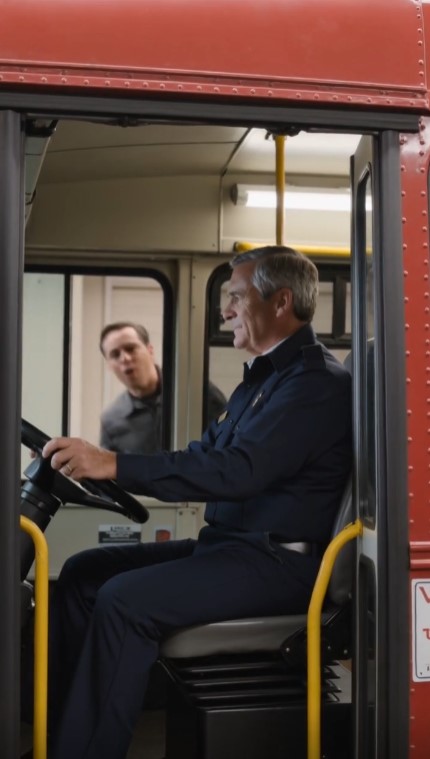
The last bus of the night was already twenty minutes late.
Passengers were angry.
But driver Frank wouldn’t leave.
He kept staring at one empty bus stop.
A passenger shouted:
“What are we waiting for?”
Frank answered:
“A woman.”
Everyone looked outside.
Nobody was there.
Frank had driven the same route for thirty-two years.
Every night at 10:15…
an elderly woman named Helen boarded at that stop.
She always sat directly behind him.
And every night she said:
“See you tomorrow, Frank.”
But tonight…
10:15 passed.
Then 10:20.
Then 10:30.
Still no Helen.
Finally, Frank opened the doors.
Stepped safely onto the sidewalk…
and noticed something beneath the bench.
Helen’s red scarf.
He picked it up.
Then heard:
“Frank?”
He turned.
Helen was standing across the plaza with a suitcase.
She wasn’t hurt.
She was crying.
Frank hurried over.
“Helen, what happened?”
She smiled.
“I’m leaving.”
Her daughter had finally convinced her to move across the country.
Frank tried to smile.
“So this is goodbye?”
Helen nodded.
Then hugged him.
“You were the last person who spoke to me every night after my husband died.”
Frank couldn’t answer.
The passengers inside had gone completely silent.
Then something extraordinary happened.
One passenger stepped off the bus.
Then another.
Then everyone.
They formed a line.
Each person hugged Helen goodbye.
A woman who had been a stranger to them five minutes earlier.
Helen started crying harder.
But then a young man at the end of the line saw Frank.
His expression changed.
He removed an old bus ticket from his wallet.
“Are you Frank?”
Frank nodded.
The young man stared at him.
“My father told me to find you.”
Frank froze.
“Who’s your father?”
The young man pointed toward the bus.
“The boy you drove home for free every night in 1998.”
Then he handed Frank a key.
Frank stared at it.
Small.
Brass.
Worn around the edges.
A number was stamped into the metal.
Frank looked at the young man.
“What is this?”
“My name is Daniel.”
The young man swallowed.
“My father’s name is Michael Turner.”
Frank’s face changed.
He remembered immediately.
Michael had been fourteen years old in 1998.
Thin.
Quiet.
Always carrying the same green backpack.
For almost four months, Michael boarded Frank’s bus near the old industrial district.
Most nights he didn’t have enough money.
Frank noticed.
The first time, Michael emptied his pockets.
Three coins.
Still short.
Frank waved him through.
“Sit down.”
The next night, the same thing happened.
Then again.
Eventually Frank stopped asking.
Michael would step onto the bus.
Frank would nod.
Michael would sit directly behind him.
Exactly where Helen later sat years afterward.
Daniel smiled faintly.
“Dad told me you used to pretend the fare machine was broken.”
Frank laughed.
“I did that?”
“He said you’d hit it and say, ‘Thing’s acting up again.’”
Frank remembered now.
Michael hated charity.
If Frank said the ride was free, the boy refused.
So Frank blamed the machine.
Night after night.
One evening, Michael finally asked:
“Why are you doing this?”
Frank answered:
“Because you’re going home.”
That was all.
Daniel looked at the old bus ticket in his hand.
“My father kept this for twenty-eight years.”
Frank stared.
“Why?”
Daniel shrugged.
“He said it reminded him that one person noticing you can change everything.”
Frank looked down.
Helen stood beside them listening.
The passengers did too.
Then Frank asked:
“Where is Michael now?”
Daniel’s expression softened.
“He died six months ago.”
Frank’s smile disappeared.
“I’m sorry.”
Daniel nodded.
“Cancer.”
“He knew he didn’t have much time.”
“Before he died, he gave me three things.”
“The old bus ticket.”
“A letter.”
“And this key.”
Frank held it up.
“What does it open?”
Daniel looked toward the far side of the plaza.
“Come with me.”
Frank glanced at the bus.
One passenger laughed.
“We’re already late.”
Another said:
“At this point, we’re committed.”
Frank looked at his route clock.
Then at Helen.
Then at Daniel.
He called dispatch.
Explained he had a delay involving a longtime passenger.
Dispatch told him another bus was nearby and could take over the remaining route.
Twenty minutes later, Frank’s passengers transferred.
But almost half of them chose to stay.
Nobody wanted to leave now.
Daniel led them across the plaza.
Behind an old row of closed storefronts stood a narrow brick building.
Frank recognized it.
Years ago, it had been a laundromat.
Then a grocery store.
Now the windows were covered from inside.
Daniel stopped at the front door.
“Try the key.”
Frank frowned.
“You want me to open this?”
Daniel nodded.
“It’s yours.”
Frank stared.
“What?”
“Just open it.”
Frank inserted the key.
It turned.
Inside, the lights were off.
Daniel switched them on.
Frank stopped.
The room had been completely renovated.
Along one wall were shelves of canned food.
Blankets.
Hygiene supplies.
Winter coats.
A small desk sat near the entrance.
Above it was a sign:
LAST STOP
Frank whispered:
“What is this?”
Daniel handed him the letter.
“My father built it.”
Frank opened the envelope.
The handwriting was shaky but clear.
Frank,
You probably won’t remember me.
Frank stopped reading.
He looked at Daniel.
“I remember.”
Then continued.
My name is Michael Turner.
In 1998 I was the kid who boarded your bus every night without enough money.
What you didn’t know was that my mother and I had lost our apartment.
We were staying in a church basement across town.
Every night I worked washing dishes.
Then I took your bus back.
Frank’s throat tightened.
Michael had always told him he was coming home from “practice.”
Frank never questioned it.
The letter continued.
I was embarrassed.
I thought everyone could tell.
Maybe you could.
But you never asked questions in front of people.
You never made me explain.
You just let me ride.
Frank wiped his eyes.
Michael wrote that those bus rides mattered because the church shelter had a strict curfew.
Missing the bus meant walking nearly six miles.
In winter.
Sometimes after midnight.
Frank had unknowingly gotten him back safely every night.
Then Michael wrote:
The best thing you did wasn’t letting me ride free.
It was pretending you weren’t doing me a favor.
You let me keep my dignity.
Frank sat down.
Helen placed a hand on his shoulder.
The letter continued.
Michael eventually finished school.
Then college.
Then started a small delivery company.
The business grew.
Years later, he sold it.
He had enough money to live comfortably.
But he never forgot the bus.
So when he became ill, he created Last Stop.
A small emergency center near Frank’s old route.
Not a shelter.
Not exactly.
A place for people caught between places.
Someone who missed the last shelter intake.
A teenager who needed a safe ride.
An elderly person who couldn’t afford groceries that week.
A worker who needed a bus pass.
Nothing huge.
Just help before a bad night became something worse.
Frank whispered:
“He did all this?”
Daniel nodded.
“For years.”
“Why didn’t I know?”
“Dad didn’t want you to.”
Frank frowned.
“Why?”
Daniel smiled.
“He said if you knew, you’d refuse to take credit.”
Frank almost laughed.
“He was right.”
The final part of the letter explained the key.
Michael had transferred ownership of the building into a small charitable trust.
Frank wasn’t expected to run it.
Professionals already did that.
The key was symbolic.
But Michael had written:
If Frank wants it, give him access.
If he doesn’t, leave him alone.
He has already done enough.
Frank folded the letter.
For several seconds he couldn’t speak.
Then Helen said:
“You kept waiting for me every night.”
Frank looked at her.
She continued:
“Maybe you’ve been doing this your whole life.”
Frank shook his head.
“No.”
“I drove a bus.”
Daniel replied:
“Exactly.”
Frank looked confused.
Daniel smiled.
“You think small things don’t count because they were ordinary to you.”
Frank looked at the shelves.
Food.
Blankets.
Bus passes.
A whole building created because one teenager remembered a bus driver pretending the fare machine was broken.
Then one of Frank’s passengers stepped forward.
He was the man who had complained first.
The one who shouted:
“What are we waiting for?”
He looked embarrassed.
“My name’s George.”
Frank nodded.
George reached into his wallet.
Pulled out some cash.
“Can I donate?”
Daniel smiled.
“Yes.”
Another passenger did the same.
Then another.
Helen laughed.
“This is becoming an expensive bus delay.”
Everyone laughed.
Frank finally did too.
But something still bothered him.
He looked at Daniel.
“Why tonight?”
“You could have found me any time.”
Daniel glanced at Helen.
“Because of her.”
Helen looked surprised.
“Me?”
Daniel nodded.
“My father knew about you.”
Frank stared.
“How?”
Daniel explained.
Michael had occasionally ridden Frank’s route again as an adult.
Not often.
Once or twice a year.
Sometimes deliberately.
He never introduced himself.
He just sat quietly.
Several years earlier, he noticed Helen boarding every night.
He noticed Frank greeting her by name.
Then waiting when she was late.
Michael asked another driver about them.
The driver said:
“Oh, that’s Helen. Frank never leaves without her.”
Michael laughed when he heard it.
He told Daniel:
“He’s still doing it.”
Frank shook his head.
“This is ridiculous.”
Daniel smiled.
“Dad loved it.”
When Michael’s health declined, he asked Daniel to watch the route.
He wanted the key delivered on the night Frank would understand it best.
Daniel didn’t know exactly when that would be.
Then he learned Helen was leaving.
Her daughter had posted a goodbye message in a neighborhood group.
Daniel saw it.
He realized this was the night.
Frank looked at Helen.
“So you knew?”
She shook her head.
“Not a thing.”
Daniel laughed.
“Neither did Dad. He just gave me too much responsibility.”
They stayed inside Last Stop nearly an hour.
Then Helen checked the time.
“My train.”
Everyone froze.
Frank stood.
“You’re going to miss it.”
Helen smiled.
“Seems appropriate.”
Daniel offered to drive.
Frank insisted on going too.
So did George.
Eventually a strange little convoy headed toward the train station.
Daniel drove Helen.
Frank sat beside her.
The red scarf was folded in her lap.
At the station entrance, Helen hugged him one last time.
“Thirty-two years.”
Frank smiled.
“Not all with you.”
“Enough.”
She handed him the red scarf.
“You left this.”
Helen shook her head.
“No.”
“I left it for you.”
Frank frowned.
“Why?”
“So you’d stop.”
“Stop what?”
“The bus.”
Frank laughed.
“You planned that?”
“I knew if you saw the scarf, you’d wait.”
“You could’ve just called.”
“Less dramatic.”
Frank shook his head.
“You’re trouble.”
Helen smiled.
“See you tomorrow, Frank.”
Frank’s face changed.
She had said the same thing every night for years.
But this time she was moving across the country.
He whispered:
“You won’t be here tomorrow.”
“I know.”
“Then why say it?”
Helen hugged him.
“Because goodbye sounds too permanent.”
Then she boarded the train.
Frank stood on the platform until it disappeared.
For the first time in years, the 10:15 stop would be empty the next night.
He dreaded it.
But when he drove the route the following evening…
someone was waiting there.
Daniel.
Frank opened the doors.
“You again?”
Daniel climbed aboard.
“I paid this time.”
Frank smiled.
Daniel sat behind him.
Helen’s seat.
Frank glanced in the mirror.
For a second, he saw the green backpack from 1998.
Then it was gone.
Just Daniel.
A grown man.
A different generation.
At the end of the route, Daniel asked:
“Do you want to visit Last Stop tomorrow?”
Frank hesitated.
Then nodded.
He began volunteering there once a week.
Nothing complicated.
Mostly sitting at the front desk.
Talking to people.
Handing out transit cards.
Occasionally making coffee.
The staff quickly discovered Frank was good at one thing.
Knowing when not to ask questions.
A teenager once came in needing a bus pass.
Frank handed one over.
The boy said:
“I can pay you next week.”
Frank shook his head.
“No.”
The teenager looked uncomfortable.
Frank smiled.
“Machine’s acting up.”
The boy stared.
Frank laughed.
“Old joke.”
Years passed.
Last Stop expanded.
Not into some giant organization.
Michael had never wanted that.
It stayed small.
Local.
Practical.
One emergency motel night.
One grocery card.
One bus ticket.
One safe ride.
Frank liked it that way.
When he finally retired from driving at seventy-one, dozens of people gathered at his final stop.
Former passengers.
Coworkers.
Daniel.
Staff from Last Stop.
And one person Frank wasn’t expecting.
Helen.
She had flown back.
Frank stepped off the bus.
“You said you were moving.”
“I did.”
“You lied.”
“I came back for the day.”
She held out a new red scarf.
Frank laughed.
“You still have the old one?”
“At home.”
He hugged her.
Then Daniel handed Frank another old object.
Michael’s bus ticket.
The original one.
Frank shook his head.
“No.”
Daniel insisted.
“Dad wanted you to have it eventually.”
Frank looked at the date.
Almost three decades earlier.
One ordinary night.
One ordinary bus ride.
One boy without enough fare.
Frank had almost forgotten the details.
Michael had remembered every one.
After retirement, Frank framed the ticket beside the key to Last Stop.
Underneath he wrote:
THE LAST BUS IS NEVER JUST A BUS TO THE PERSON WHO NEEDS IT.
Helen hated the wording.
“Too sentimental.”
Frank laughed.
“You made thirty strangers hug you in a parking lot.”
“That was different.”
Daniel sided with Helen.
Frank ignored both of them.
When Frank eventually became too old to volunteer regularly, Last Stop created a small transportation fund in Michael’s name.
Not Frank’s.
Frank insisted.
The Michael Turner Ride Home Fund paid for late-night transportation for people who otherwise had no safe way home.
The first year, it helped forty-seven people.
Frank asked Daniel:
“Would your father like this?”
Daniel smiled.
“He’d complain the name is too long.”
“That sounds right.”
Helen and Frank continued speaking every week.
She never moved back.
But every phone call ended the same way.
“See you tomorrow, Frank.”
Even when tomorrow meant next Tuesday.
Even when they both knew better.
It became less about an actual meeting.
More about refusing to make every goodbye final.
Years later, Daniel found Frank’s red scarf folded inside a drawer at Last Stop.
Beside it was the brass key.
And Michael’s old bus ticket.
Three ordinary objects.
A scarf.
A key.
A ticket.
None worth much money.
But together they told the story.
A bus driver waited twenty minutes for an elderly woman because she was never late.
A passenger complained.
A scarf was found.
A goodbye became something much larger.
Then a young man stepped forward carrying a twenty-eight-year-old bus ticket.
He reminded Frank of a teenager who once boarded the last bus without enough money.
And Frank discovered something he had never understood.
He thought he had given that boy a few free rides.
Michael thought Frank had given him something else.
A safe way home.
A little dignity.
And proof that someone had noticed.
Frank never considered himself extraordinary.
He drove a bus.
He waited for people.
He learned their names.
Sometimes he bent a rule when someone needed help.
But perhaps that was the point.
The moments that change somebody’s life rarely look important while they’re happening.
Sometimes they look like a driver glancing at an empty stop and saying:
“Not yet.”
Sometimes they look like pretending a fare machine is broken.
And sometimes…
twenty-eight years later…
they come back as a brass key in the hand of a stranger who says:
“My father told me to find you.”