
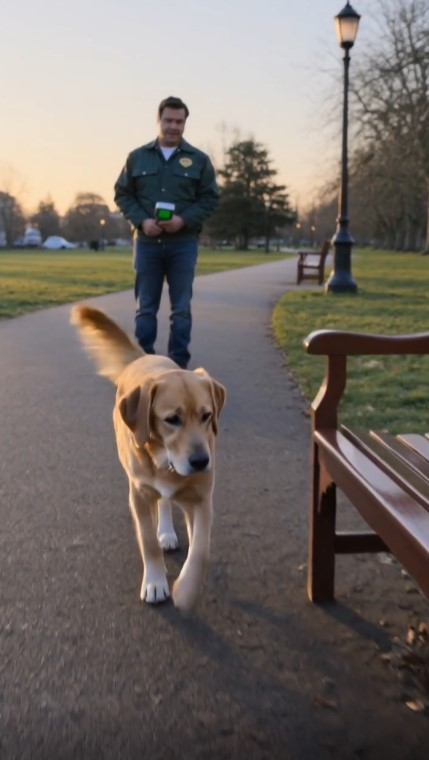
Every evening at exactly 6:10…
an old dog named Rusty walked into the same park.
He ignored the other dogs.
Ignored the people.
Then climbed beside one empty bench…
and waited.
Rain.
Cold.
Wind.
Rusty always came back.
A park worker named Daniel finally became curious.
One evening he sat beside him.
“Who are you waiting for, buddy?”
Rusty stared toward the path.
Then placed one paw on the empty seat.
The next evening…
Daniel returned.
This time carrying a scanner from a nearby rescue center.
Rusty had a microchip.
The registered owner was an elderly man named Walter.
But Walter had died nearly two years earlier.
Daniel looked at Rusty.
“You’re still waiting for him?”
Rusty rested his head on the bench.
Daniel’s eyes filled with tears.
Then something happened.
A woman walking through the park stopped suddenly.
She stared at Rusty.
Then at the bench.
“Rusty?”
The dog instantly jumped down.
The woman knelt.
Rusty ran into her arms.
She began crying.
Daniel asked:
“You know him?”
The woman nodded.
“My father was Walter.”
She had lived overseas for years.
Her father had written that Rusty disappeared shortly before he died.
She never knew what happened to him.
Then Rusty pulled gently at her sleeve.
He led them behind the bench.
Started digging beneath some loose leaves.
Daniel found a small waterproof box.
Inside was an old photograph…
Walter sitting on that exact bench beside Rusty.
And one sealed envelope.
The woman recognized her father’s handwriting.
But the envelope wasn’t addressed to her.
It was addressed to:
The person who finally finds Rusty.
The woman stared at those words.
Her name was Claire.
For a moment, she didn’t open the letter.
Daniel asked softly:
“Do you want some privacy?”
Claire shook her head.
“No.”
“If Dad left this here, I think he wanted someone to read it.”
She opened the envelope.
Inside was a single folded page.
The first line said:
If you found Rusty here, then he remembered.
Claire stopped.
Her hands began trembling.
Daniel looked at Rusty.
The old dog sat beside the bench.
Quiet.
Watching them.
Claire continued reading.
Walter explained that every evening at 6:10, he and Rusty had walked to that exact bench.
Not 6:00.
Not 6:30.
Exactly 6:10.
It had started years earlier when Claire’s mother, Margaret, was still alive.
Margaret finished work at six.
She took the same path home.
Walter would sit on the bench with Rusty and wait for her.
Every evening.
At 6:10, Margaret usually appeared around the corner.
Rusty would see her first.
Stand.
Wag his tail.
Then run toward her.
Claire looked down at the old photograph.
There was her father.
Walter.
Rusty beside him.
And far in the background…
almost out of frame…
a woman walking toward them.
Her mother.
Claire whispered:
“I never knew this.”
Walter’s letter continued.
After Margaret died, he kept taking Rusty to the bench.
Same time.
Same place.
For years.
At first, he told himself it was for the dog.
Then he admitted it was for him.
The bench was the last place where waiting had once ended happily.
Claire sat down.
Daniel looked away.
Some grief was too private to stare at.
Walter wrote:
Rusty still watches the path.
I do too.
Then came the part that made Claire stop breathing.
And one day, I think he may have to wait without me.
Claire whispered:
“He knew.”
Walter’s health had been failing.
Claire had known that much.
But because she lived overseas, most of their conversations happened by phone.
Walter always said:
“I’m fine.”
Just like fathers often do.
He never told her how sick he had become until very late.
The letter said that if Walter died before Rusty…
he had arranged for a neighbor to care for him.
But Walter worried.
Rusty was old.
Attached to routine.
And sometimes prone to slipping through gates when he became anxious.
Walter wrote:
If he gets out, he’ll probably come here.
This bench is the closest thing he has to a compass.
Daniel looked at Claire.
“So that’s what happened.”
Maybe.
After Walter died, Rusty had stayed with a neighbor named Susan.
According to Claire, Susan wrote several weeks later saying Rusty had escaped during a storm.
They searched.
Nothing.
Claire was devastated.
But she was also dealing with her father’s estate from another country.
Flights.
Paperwork.
Grief.
Eventually the search faded.
Rusty remained missing.
Claire assumed the worst.
But somehow…
he had survived.
And eventually found his way back to the park.
Daniel frowned.
“How long has he been coming here?”
“Months.”
Claire looked shocked.
“Months?”
“Every evening.”
“Exactly 6:10?”
“Yes.”
Claire began crying again.
“He remembered.”
Daniel didn’t say anything.
He didn’t need to turn it into something supernatural.
Dogs remember routines.
Places.
Scents.
People.
Walter had repeated the same walk for years.
Rusty returning to that bench made sense.
But that didn’t make it less moving.
Claire returned to the letter.
Walter wrote:
If you found him, please don’t take him somewhere completely unfamiliar if you can avoid it.
He has spent enough of his life learning how to wait.
Then:
And if Claire finds this, tell her I wasn’t angry.
Claire froze.
Daniel looked at her.
Walter had written her name.
She read the line again.
Tell her I wasn’t angry.
Her face changed completely.
Daniel asked:
“Angry about what?”
Claire folded the letter slightly.
Then stared toward the path.
“My last conversation with him.”
Six months before Walter died, Claire and her father had argued.
Not over anything dramatic.
At least it hadn’t seemed dramatic at the time.
Walter wanted her to come home.
Claire had just accepted a new job overseas.
She promised she would visit later.
Walter said:
“You always say later.”
Claire became defensive.
She accused him of trying to make her feel guilty.
He accused her of forgetting where home was.
Claire hung up.
They spoke again afterward.
But never properly addressed the argument.
Walter’s health worsened.
Then everything moved too quickly.
Claire returned during his final week.
Walter was exhausted.
They talked.
Held hands.
But he never mentioned the argument.
Claire assumed he still carried some hurt.
She had carried the guilt ever since.
Now Walter’s letter said:
I wasn’t angry.
The next lines were harder.
I was lonely.
There’s a difference.
Claire covered her mouth.
Walter continued:
I should have told you that instead of making it sound like you owed me your life because I missed you.
Claire whispered:
“Dad…”
Then:
You were supposed to leave.
That’s what children do when parents do their job right.
Daniel stared toward the trees.
Claire cried openly now.
Walter wrote:
I was proud of you.
I just wasn’t very good at saying proud and lonely in the same sentence.
Claire laughed through tears.
“That sounds exactly like him.”
Then came the final paragraph.
If Rusty is still around, give him the life I couldn’t finish giving him.
And if you can’t, find someone patient.
He likes soft blankets, chicken, and pretending he can’t hear when he absolutely can.
Daniel looked at Rusty.
“You hear everything, don’t you?”
Rusty didn’t react.
Claire laughed.
The last line said:
Don’t spend too long waiting at this bench.
Some people are meant to come back.
Some memories are meant to go home with you.
Claire folded the letter carefully.
For a long time, nobody spoke.
Then Daniel asked:
“What happens now?”
Claire looked at Rusty.
That question was more complicated than it sounded.
She still lived overseas.
Her apartment didn’t allow pets.
Her work schedule was demanding.
Taking an elderly dog across countries would involve paperwork, travel stress, and uncertainty.
Claire wanted him.
That wasn’t the same as being able to care for him well.
Daniel saw the hesitation.
“You don’t have to decide tonight.”
Claire looked relieved.
“Thank you.”
Then Rusty placed his head in her lap.
That didn’t help.
She laughed.
“You’re manipulative.”
Daniel smiled.
“He has experience.”
For the next week, Claire delayed her flight.
She stayed in a hotel near the park.
Every morning, she visited Rusty.
Daniel helped arrange a veterinary examination through the local rescue center.
Rusty was older than anyone first guessed.
Around twelve.
Arthritis.
Some hearing loss.
Otherwise surprisingly healthy.
The rescue volunteer asked where he had been living while missing.
Nobody knew.
Then Daniel remembered something.
A groundskeeper had occasionally seen an elderly woman leaving food near the park’s maintenance shed.
They found her.
Her name was Helen.
She lived two streets away.
When Daniel described Rusty, she smiled.
“That old gentleman.”
She had been feeding him for nearly a year.
Not every day.
Rusty came and went.
Sometimes he disappeared for days.
But almost every evening…
before sunset…
he walked toward the bench.
Helen had assumed he belonged to someone nearby.
Claire stared at her.
“You kept him alive.”
Helen shook her head.
“He kept himself alive.”
“I just fed him.”
Claire hugged her anyway.
Then Helen said something surprising.
“He slept in my garage when it was cold.”
Claire looked at Rusty.
“So you did have a home.”
Helen smiled.
“Part-time.”
That explained how Rusty survived the winter.
He wasn’t completely alone.
He had built a loose routine.
Helen’s garage.
The park.
The bench.
Perhaps other places nobody knew about.
Claire began thinking differently.
Maybe bringing him overseas wasn’t the only answer.
Maybe home could remain here.
Near the bench.
Near familiar streets.
Near Helen.
But Claire didn’t want to abandon him again.
So they found another solution.
Claire arranged to work remotely for several months.
She rented a small ground-floor apartment near the park.
Pet-friendly.
Temporary.
She wanted time.
Time with Rusty.
Time in her father’s neighborhood.
Time she had spent years telling herself she didn’t have.
The first night Rusty entered the apartment, he walked through every room.
Sniffed.
Then lay beside the front door.
Claire spread a blanket near him.
Walter’s letter had been correct.
Rusty immediately took the softest one.
Claire sat beside him.
“I guess we live together now.”
Rusty sighed.
That was apparently agreement.
The next evening, at 6:05, Rusty stood.
Went to the door.
Claire looked at the clock.
“Seriously?”
He waited.
So she clipped on his leash.
They walked to the park.
At exactly 6:10, Rusty climbed beside the bench.
Claire sat next to him.
He stared toward the path.
Claire did too.
For several minutes, nobody appeared.
Then Claire whispered:
“Mom isn’t coming.”
Rusty kept watching.
“Dad isn’t either.”
The dog rested his head on the seat.
Claire touched his back.
“But I’m here.”
They sat until sunset.
Then went home.
That became their evening routine.
But slowly…
something changed.
At first Rusty stayed forty minutes.
Then thirty.
Then twenty.
Some evenings he reached the bench, sniffed it, and kept walking.
Claire noticed.
“You’re getting bored?”
Maybe.
Or maybe old habits simply changed when new ones formed.
One evening Rusty ignored the bench entirely.
He headed toward a small food stand.
Claire laughed.
“Dad would be offended.”
Rusty sat near the smell of roasted chicken.
“Okay. Your priorities have evolved.”
Months passed.
Claire returned to the life she had left years earlier.
She visited Walter’s old house.
Sorted through boxes she had rushed through after his death.
This time, she actually looked.
She found dozens of photographs of the park bench.
Walter and Margaret.
Margaret and Rusty.
Walter alone.
Rusty alone.
And one photo of Claire at seventeen.
Sitting on the bench rolling her eyes at the camera.
She had forgotten it.
Behind the photograph Walter had written:
She’ll leave someday. Good.
Claire smiled.
Then cried.
Her father had always known.
He wanted her to build a life.
He simply missed her once she did.
Both things could be true.
Claire found another box labeled:
RUSTY
Inside were vet records.
Old collars.
Toys.
And a notebook.
Walter had kept brief notes during Rusty’s first year.
Chewed shoe. Denied involvement.
Afraid of vacuum. Pretends not to be.
Waited by door for Claire even though she hasn’t visited in months.
Claire laughed.
Then found one dated shortly before Walter died:
Took Rusty to bench. He still watches for Margaret. Maybe I do too.
She closed the notebook.
That line explained everything.
The bench had never only belonged to Rusty.
Walter had been waiting too.
Different kind of waiting.
For a wife who was gone.
For a daughter living far away.
For a life that once felt fuller.
Rusty simply gave him a reason to sit there.
Claire kept the notebook.
Then did something she had avoided.
She called Susan.
The neighbor who had cared for Rusty after Walter died.
Susan answered cautiously.
Claire introduced herself.
There was silence.
Then Susan started apologizing.
“I lost him.”
Claire stopped her.
“You didn’t.”
“The gate blew open.”
“I know.”
“I searched for months.”
“I know.”
“I should have done more.”
Claire looked at Rusty sleeping nearby.
“He survived.”
Susan began crying.
Claire sent her a photograph.
Rusty on the couch.
Wrapped in a blanket.
Susan replied:
Thank God.
A week later, she visited.
Rusty recognized her.
Not dramatically.
No running.
He simply walked over and leaned against her.
Susan cried anyway.
Claire realized Rusty had more people than she knew.
Walter.
Margaret.
Susan.
Helen.
Daniel.
Now Claire.
He wasn’t an abandoned dog moving through the world alone.
He had been passed quietly from one act of care to another.
Some official.
Some accidental.
Some temporary.
But enough.
When Claire’s remote-work period ended, she faced the decision she had avoided.
Return overseas.
Stay.
Or bring Rusty with her.
Her company offered her a permanent remote position.
Claire stared at the email for a long time.
Then laughed.
Walter would have called it fate.
Claire didn’t.
She called it convenient timing.
She stayed.
Not only because of Rusty.
But he was part of it.
She had spent years believing returning home meant admitting she had failed to build a life elsewhere.
Now she understood something.
Coming back wasn’t the same as going backward.
She kept her career.
Her friendships overseas.
Her independence.
She simply changed where she slept.
And at 6:10 most evenings…
she walked with an old dog.
Rusty lived another three years.
His walks became shorter.
The bench became harder for him to climb beside.
Daniel installed a small lower platform near it with the park department’s approval.
Claire teased:
“Private seating now?”
Daniel said:
“He’s our longest-serving visitor.”
Rusty still occasionally placed one paw on the bench.
Just as Daniel had seen years earlier.
But eventually he stopped watching the path.
Instead, he watched Claire.
When she stood…
he stood.
When she walked…
he followed.
The waiting had shifted.
On Rusty’s final summer, Claire brought Walter’s old photograph to the park.
She sat beside him.
The picture showed Walter and Rusty on the same bench.
Margaret approaching in the distance.
Claire placed it on her lap.
“You waited for both of them.”
Rusty slept beside her.
Then she smiled.
“And apparently for me too.”
When Rusty’s health declined, Claire arranged for the veterinarian to visit at home.
Helen came.
Susan came.
Daniel came after his shift.
Rusty lay on his favorite blanket.
Claire held him.
“You found everybody, didn’t you?”
Rusty breathed slowly.
She whispered:
“Dad said not to spend too long waiting.”
Then smiled through tears.
“So you can stop now.”
Rusty died peacefully.
Claire kept Walter’s waterproof box.
But she didn’t bury it again.
She gave the photograph to the local historical society after making a copy.
The letter stayed with her.
The park bench remained.
Daniel asked whether she wanted a memorial plaque.
Claire thought about it.
Then shook her head.
“Dad would hate that.”
“What about Rusty?”
“He’d probably chew it.”
Daniel laughed.
So they did something simpler.
Beside the bench, they placed a small water bowl for dogs.
Nothing engraved.
Nothing dramatic.
People used it every day without knowing why it was there.
Claire liked that.
Years later, she still walked through the park at 6:10 sometimes.
Not every day.
She had listened to Walter.
Don’t spend too long waiting at this bench.
But occasionally she sat.
Not because she expected anyone to appear.
Because the place reminded her of something she had learned too late.
Walter had believed Margaret might never truly leave that path.
Rusty had learned the same route.
Claire had spent years thinking distance erased belonging.
None of them were completely right.
People leave.
Animals get lost.
Lives move.
Routines break.
But care leaves tracks.
A dog can remember a park.
A father can leave a letter beneath a bench.
A stranger can feed a lost animal through winter.
And a daughter can come home years after believing home had disappeared.
Every evening at exactly 6:10, Rusty had returned to one empty bench.
Everyone assumed he was waiting for Walter.
Maybe he was.
Maybe he was waiting for Margaret too.
Maybe it was simply the strongest routine he had left.
But eventually…
someone did come down the path.
Claire.
Walter’s daughter.
And when Rusty ran into her arms, he ended a search she hadn’t even known was still happening.
Then he led her to the box.
To Walter’s letter.
And to the words she had needed for nearly two years:
I wasn’t angry.
I was lonely.
In the end, Rusty didn’t just find his way back to Walter’s bench.
He helped Claire find her way back to her father.
And this time…
nobody had to keep waiting.