
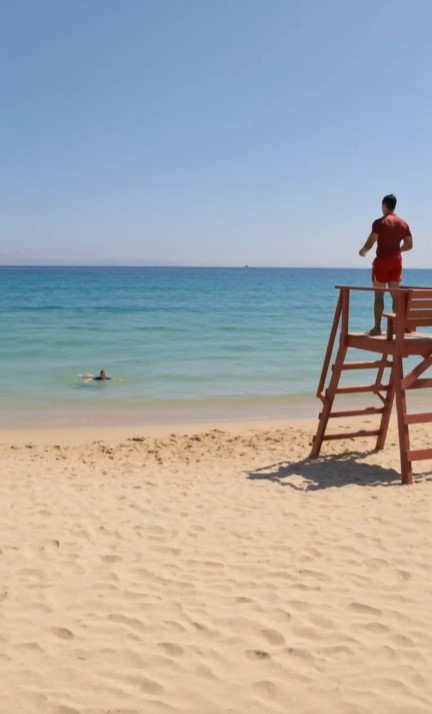
The first whistle cut through the beach like a warning.
It was a bright summer afternoon, the kind of day when the sand was crowded with umbrellas, coolers, children, and families trying to escape the heat. Waves rolled gently toward the shore, and most people were too busy laughing, swimming, or taking photos to notice the little boy drifting farther and farther from the beach.
But lifeguard Caleb Turner noticed.
He always noticed.
From his tower, Caleb saw the boy’s small head bobbing beyond the safe swim markers. The child looked no older than nine. He was not splashing wildly. He was not calling for help. But he was too far out, and every wave was carrying him farther.
Caleb stood, lifted his whistle, and blew hard.
The sharp sound made people turn.
A few parents looked up from their towels.
Children stopped playing near the water.
The boy heard it too, but he did not swim back.
Instead, he turned in the water and pointed down.
Caleb frowned.
He blew the whistle again.
“Come back!” he shouted.
The boy pointed harder.
Desperately.
Then he disappeared behind a small swell and came up coughing, still pointing beneath the surface.
Caleb did not wait another second.
He grabbed the rescue buoy, jumped from the tower, and sprinted across the sand.
People moved out of his way as he ran into the surf. The water hit his waist, then his chest. He dove forward and began swimming fast, cutting through the waves with practiced strength.
By the time he reached the boy, the child was exhausted.
Caleb wrapped one arm around him.
“Hey, I’ve got you,” he said. “You’re okay.”
But the boy grabbed Caleb’s wrist and shook his head.
“No,” he gasped.
Caleb tried to turn him toward shore.
The boy resisted with the little strength he had left.
He pointed again into the water.
Caleb looked down.
The ocean was dark beneath them, shifting with sand and sunlight. From above, he could not see anything clearly.
“What are you doing out here?” Caleb asked. “Where are your parents?”
The boy’s lips trembled.
He tried to speak, but only swallowed seawater and coughed.
Then he pointed again.
This time, Caleb understood something was wrong.
Not with the boy.
Below him.
Caleb pushed the rescue buoy into the child’s arms.
“Hold this. Do not let go.”
The boy clung to it, eyes wide with fear.
Caleb took one deep breath and dove.
The world changed instantly.
Sound vanished.
The bright noise of the beach became a distant murmur beneath the heavy silence of the ocean. Caleb kicked downward, eyes open, searching through cloudy water.
At first, he saw nothing.
Only sand.
Bubbles.
A flash of seaweed moving with the current.
Then he saw a shape.
A hand.
Caleb’s chest tightened.
He swam closer.
There were two people beneath the surface.
A woman and a younger child.
The woman’s arm was wrapped around the smaller child, holding him against her chest. A tangled piece of fishing line or loose rope had caught around part of the submerged rocks near the bottom, trapping them just long enough to turn panic into danger.
Caleb’s lungs burned.
He grabbed the woman first, trying to pull her free.
The line held.
He yanked harder.
Nothing.
Above him, the boy floated with the rescue buoy, staring down at the spot where Caleb had vanished.
On the beach, people began to realize this was not a simple rescue.
Ten seconds passed.
Then twenty.
Then thirty.
The crowd went silent.
A woman near the shoreline whispered, “Where is he?”
Caleb kicked upward, bursting through the surface with a gasp.
He waved both arms toward the rescue boat.
“There are two of them!” he shouted. “I need help now!”
The beach froze.
Then everything moved at once.
Another lifeguard launched the rescue boat. A third ran for the emergency kit. People rushed to the shoreline, shielding their eyes against the sun.
The little boy on the buoy was crying now, but quietly, like he did not have enough strength left to sob.
Caleb grabbed him again.
“Who’s down there?” he asked.
The boy’s voice was barely a whisper.
“My mom…”
Caleb’s face went pale.
“And my little sister.”
For a split second, Caleb looked back at the water.
Then he dove again.
This time, he knew where to go.
He reached the woman and child faster. The mother was barely moving, but even underwater, even fighting for her own life, her arms were still locked around the little girl.
Caleb pulled at the line around her leg.
It was tight, twisted around a piece of broken metal or old debris hidden beneath the rocks. He worked his fingers under it, ignoring the scrape against his skin.
His lungs screamed for air.
He tugged once.
Twice.
The line loosened.
He kicked hard, pulling the mother upward, but the little girl slipped in her arms.
Caleb caught the child by the back of her shirt and pushed both of them toward the surface.
The rescue boat reached them just as they broke through the water.
“Take the girl!” Caleb shouted.
The second lifeguard leaned over and lifted the little girl into the boat.
Another grabbed the mother.
Caleb stayed in the water, holding them steady until both were aboard.
The little boy cried out from the buoy.
“Mama!”
Caleb swam to him and pushed him toward the boat.
“You did it,” Caleb said, breathless. “You stayed with them.”
The boy shook his head.
“I couldn’t get them up.”
“You got me,” Caleb said. “That saved them.”
On shore, paramedics were already waiting.
The boat raced back through the surf. People stepped aside as the rescuers carried the mother and little girl onto the sand. For several terrifying moments, nobody knew if they were too late.
The beach became completely silent.
No music.
No laughter.
No waves noticed.
Only the sound of paramedics working.
The little boy sat wrapped in a towel, shaking uncontrollably, eyes fixed on his mother.
Caleb knelt beside him.
“What’s your name?” he asked softly.
“Evan.”
“Evan, listen to me. You were very brave.”
Evan did not look away from the paramedics.
“She told me to swim,” he whispered. “She pushed me up and told me to find help.”
Caleb swallowed hard.
“What happened?”
Evan’s voice shook as he explained.
His mother had been swimming with him and his little sister near the shallow rocks when the girl’s foot slipped into a hidden tangle beneath the water. Their mother dove to free her, but a loose line wrapped around her leg too.
She pushed Evan toward the surface.
She told him to swim.
But Evan could not leave them.
He had tried to pull them.
Tried to dive.
Tried to scream.
But the waves were too loud, and from shore, he looked like just another child swimming too far out.
So he did the only thing he could.
He stayed above them.
Pointing.
Waiting for someone to understand.
Caleb looked at the boy, and something inside him broke.
Everyone had thought Evan was the one who needed saving.
But Evan had been trying to save his family.
Then, suddenly, a paramedic shouted.
The little girl coughed.
A second later, the mother gasped for air.
A sound rose from the beach.
Not a cheer at first.
More like one huge breath released by hundreds of people at the same time.
Then came the crying.
The applause.
The relief.
Evan jumped up, but Caleb held him gently until the paramedic nodded.
Only then did the boy run forward.
His mother, weak and wrapped in a silver emergency blanket, reached for him with trembling arms.
Evan collapsed against her.
“I tried,” he sobbed. “I tried to get you.”
His mother held him as tightly as she could.
“You did,” she whispered. “You got help.”
His little sister lay beside her, crying softly but alive.
Caleb stood a few steps away, soaked and exhausted, watching the family cling to one another on the sand.
A man in the crowd lowered his phone, ashamed.
“I thought the kid was just messing around,” he murmured.
Another person said nothing. She simply wiped her eyes.
The rescue changed the mood of the entire beach.
Minutes earlier, people had been annoyed by the whistle. Some had complained when Caleb ran into the water. Others had assumed the boy was careless, disobedient, or dramatic.
But now everyone understood.
The little boy had not ignored the lifeguard because he was being stubborn.
He had stayed out there because leaving would have meant abandoning his mother and sister beneath the waves.
Later, at the hospital, doctors said all three would recover. The mother had swallowed water and suffered exhaustion, but she had survived. The little girl was frightened and weak, but stable. Evan was treated for fatigue and shock.
When Caleb visited the next day, Evan was sitting beside his mother’s bed.
The boy looked smaller indoors.
Quieter.
Still carrying the weight of what had happened.
When he saw Caleb, he stood up.
For a moment, neither of them knew what to say.
Then Evan walked over and wrapped his arms around the lifeguard’s waist.
“Thank you for believing me,” he whispered.
Caleb closed his eyes.
“I’m sorry I didn’t understand faster.”
Evan shook his head.
“You came.”
Those two words stayed with Caleb longer than any medal ever could.
The city later praised the lifeguard team for the rescue. The beach posted new warning signs near the rocky section. Divers removed the abandoned fishing line and debris from the area. Safety rules were changed, and lifeguards were trained to pay closer attention when a swimmer pointed repeatedly instead of waving for help.
But Caleb never called himself the only hero of that day.
Whenever reporters asked about the rescue, he always said the same thing.
“The boy saved them first. I just followed where he was pointing.”
Evan became known around town as the child who refused to leave.
But his mother never liked that phrase.
“He didn’t refuse to leave,” she said quietly. “He refused to give up.”
Weeks later, the family returned to the beach.
Not to swim.
Just to stand near the water together.
Evan held his little sister’s hand while their mother placed a small bouquet of white flowers near the rocks. Caleb watched from his lifeguard tower, keeping his eyes on the waves like always.
Before leaving, Evan looked up at the tower and raised his hand.
Not waving for help this time.
Just waving.
Caleb smiled and lifted his whistle in return.
The ocean looked peaceful that afternoon.
But Caleb knew better than anyone that danger does not always shout. Sometimes it hides beneath the surface. Sometimes the person everyone thinks is in trouble is actually the only one trying to show where the real emergency is.
And sometimes a little boy far from shore is not swimming away.
He is staying close to the people he loves, pointing with all the strength he has left, hoping someone will finally see what he sees.
That day, a lifeguard blew his whistle because he thought a child needed saving.
But the truth was much bigger.
The boy was never trying to save himself.
He was trying to save his whole world.