
Mrs. Collins thought her daughter was taking her to a quiet retirement dinner.
She had spent forty-three years teaching children.
No fame.
No awards.
No television cameras.
Just thousands of ordinary school days.
Then her daughter stopped outside the school where Mrs. Collins had once taught.
“Why are we here?”
Her daughter smiled.
“Just come inside.”
Mrs. Collins walked down the familiar hallway.
Her old classroom door was closed.
She opened it.
And froze.
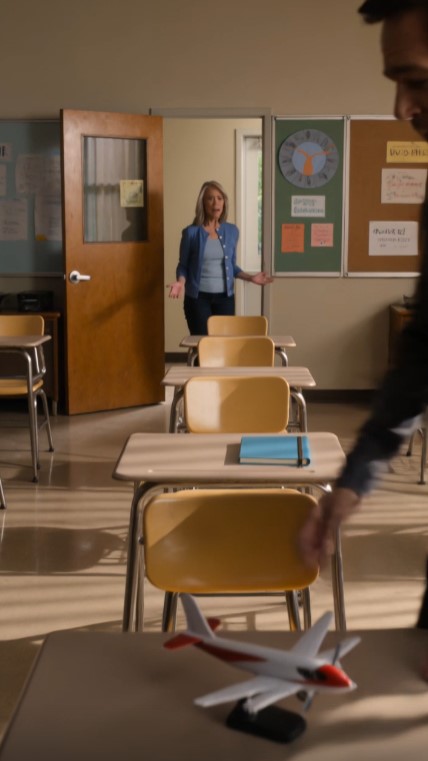
Inside were 31 empty desks.
On each desk sat one object.
A toy airplane.
A stethoscope.
A cookbook.
A firefighter helmet.
A camera.
A ruler.
A children’s book.
Mrs. Collins looked at her daughter.
“What is this?”
Before she could answer…
the classroom door opened.
A man in his forties entered.
He walked toward the toy airplane and sat down.
Mrs. Collins stared at him.
Then recognized his eyes.
“Michael?”
He smiled.
“You told me I could become a pilot.”
Mrs. Collins covered her mouth.
Another former student entered.
A woman.
She sat beside the stethoscope.
“You stayed after school every Tuesday because I couldn’t understand science.”
Another entered.
Then another.
A chef.
A firefighter.
A carpenter.
A nurse.
A photographer.
A teacher.
One by one…
the empty desks filled with adults.
Every one of them had once been a child sitting in Mrs. Collins’s classroom.
Some had traveled hundreds of miles to be there.
Mrs. Collins started crying.
“I was only your teacher.”
Michael shook his head.
“You were the first person who made some of us believe we could become something.”
Mrs. Collins looked around the room.
Thirty former students were smiling back at her.
Then she noticed something.
One desk was still empty.
Desk 31.
On top of it sat an old red notebook.
Mrs. Collins’s smile disappeared.
She walked toward it.
Her hands began trembling.
“I know this notebook.”
The room became quiet.
Forty years earlier…
she had given it to a student named Samuel.
Samuel was brilliant.
Quiet.
And struggling at home.
Then one Monday…
he simply stopped coming to school.
His family moved without saying goodbye.
Mrs. Collins never saw him again.
She had always wondered what happened to him.
Then a voice came from behind her.
“Sorry I’m late, Mrs. Collins.”
She turned.
A man in his fifties stood in the doorway.
In his hand…
was another red notebook.
Mrs. Collins whispered:
“Samuel?”
He smiled.
“You told me to bring this back when I finally made something of myself.”
Mrs. Collins walked toward him crying.
Samuel hugged her.
Then he whispered something into her ear.
Mrs. Collins suddenly pulled back.
“What did you say?”
Samuel looked toward the 31 former students.
Then placed a small key on the final desk.
“They don’t know the real reason I brought everyone here.”
The entire classroom went silent.
Mrs. Collins stared at the key.
Samuel pointed toward the old storage room at the back of her classroom.
A room that had been locked for decades.
Mrs. Collins looked at him.
“That room?”
Samuel nodded.
“You remember it?”
“Of course I remember it.”
The little room had once been used for old textbooks, art supplies, and broken desks.
By the time Mrs. Collins retired, the lock was rusted and nobody used it anymore.
Samuel picked up the key.
“You gave this to me.”
Mrs. Collins frowned.
“I did?”
“Not exactly.”
He smiled.
“You hid it inside my notebook.”
Now she remembered.
Forty years earlier, Samuel had been eleven years old.
He rarely spoke in class.
His clothes were often too large.
His lunch was usually missing.
And when other children went home talking about television, bicycles, or weekend plans…
Samuel packed his schoolwork slowly.
As if he didn’t particularly want to leave.
Mrs. Collins noticed.
She never embarrassed him by asking questions in front of anyone.
Instead, she gave him small jobs after school.
Erase the board.
Sort books.
Help carry papers.
Nothing that sounded like pity.
One rainy afternoon, Samuel remained after everyone else had gone.
Mrs. Collins found him sitting alone with his head down.
“What’s wrong?”
“Nothing.”
“Samuel.”
He finally whispered:
“We’re leaving.”
“Where?”
“I don’t know.”
His mother had lost their apartment.
They were staying with relatives temporarily.
Then leaving town.
Samuel didn’t know where they would end up.
He was terrified he would never finish school.
Mrs. Collins went to her desk.
She pulled out a red notebook.
Blank pages.
She handed it to him.
Samuel looked confused.
“What’s this for?”
“Your future.”
He laughed nervously.
“I don’t have one.”
Mrs. Collins sat beside him.
“Then write one.”
On the first page she wrote:
Things Samuel Will Do Someday.
Samuel stared.
“That’s stupid.”
“Probably.”
She handed him the pencil.
“Write anyway.”
His first entry was tiny.
Finish school.
The second:
Have my own room.
Then:
Get a job where I wear clean clothes.
Mrs. Collins had to look away for a moment.
Finally Samuel wrote something bigger.
Build something that stays.
She smiled.
“I like that one.”
The next Monday…
Samuel’s desk was empty.
No goodbye.
No forwarding address.
Nothing.
Mrs. Collins kept wondering.
Had he finished school?
Was he safe?
Did he still have the notebook?
Now the same boy stood before her four decades later.
Samuel opened the original notebook.
The pages were worn.
Filled.
Every one.
Mrs. Collins whispered:
“You kept it?”
“All forty years.”
She turned the first page.
There was her handwriting.
Things Samuel Will Do Someday.
Below it, the childish list.
Each item had eventually been checked.
Finish school.
Check.
Have my own room.
Check.
Get a job.
Check.
Then the final one:
Build something that stays.
Beside it Samuel had written only:
Not finished yet.
Mrs. Collins looked up.
“What did you build?”
Samuel smiled.
“A few things.”
He became an architect.
Then started a construction company.
Later, he designed schools and affordable housing.
But he hadn’t gathered everyone merely to tell her about his career.
He pointed toward the key.
“Open the room.”
Mrs. Collins walked toward the storage door.
The key turned.
The door creaked open.
Dust floated through the air.
Inside were old shelves.
Boxes.
Stacks of forgotten classroom materials.
Nothing extraordinary.
Then Samuel walked to the back wall.
He moved an old cabinet.
Behind it was a second narrow door.
Mrs. Collins stared.
“I never knew that was there.”
Samuel smiled.
“I did.”
“How?”
“I hid in there once.”
The former students laughed.
Mrs. Collins gave him her old teacher look.
“You did what?”
“I was eleven.”
“That is not a defense.”
Samuel opened the second door.
Behind it was a tiny supply closet.
And inside…
dozens of cardboard boxes.
New boxes.
Recently placed.
Mrs. Collins looked confused.
Samuel pulled one out.
Inside were red notebooks.
Hundreds of them.
Every notebook had a blank first page.
At the top:
Things I Will Do Someday.
Mrs. Collins stared.
“What is this?”
Samuel looked toward the classroom.
“This is why I brought everyone.”
He explained.
Months earlier, he learned the district planned to convert part of the old school into a student support center.
Not simply tutoring.
A place for children dealing with housing instability, food insecurity, family emergencies, or other difficulties that made school harder.
Samuel’s company had quietly funded the renovation.
He wanted no building named after him.
No plaque.
No press release.
But he wanted one room named for someone.
Mrs. Collins shook her head immediately.
“No.”
Samuel laughed.
“I knew you’d say that.”
“I don’t need a room.”
“I know.”
“Then don’t.”
“That’s why it isn’t named after you.”
Mrs. Collins looked confused.
Samuel handed her one of the red notebooks.
The cover said:
THE SOMEDAY ROOM
Mrs. Collins stopped.
Samuel continued.
The room would contain books.
Computers.
Emergency school supplies.
Free snacks.
A quiet study space.
And notebooks.
Any child who felt as if their future had disappeared could take one.
No speeches.
No forced sharing.
Just a blank page.
Mrs. Collins ran one hand over the cover.
Samuel said:
“I’ve spent forty years thinking about the day you handed me that notebook.”
“You didn’t fix my family.”
“You couldn’t.”
“You didn’t know where I went.”
“You couldn’t follow me.”
“But you gave an eleven-year-old kid one reason to think there might be something after that week.”
Mrs. Collins whispered:
“I just gave you paper.”
Samuel smiled.
“No.”
“You gave me permission to imagine surviving.”
The classroom was completely quiet.
Then Michael—the pilot—stood.
“This is where we come in.”
Mrs. Collins turned.
The thirty other former students had known there would be a new support center.
They just hadn’t known Samuel’s full story.
Each had brought an object representing what their life became.
The pilot brought the airplane.
The doctor brought the stethoscope.
The chef brought a cookbook.
The firefighter brought his old helmet.
But those objects weren’t gifts for Mrs. Collins.
They were going into the Someday Room.
Each would include a short note.
Not bragging.
Not saying:
Look how successful I became.
Instead:
I once sat in this classroom too.
And one sentence about something Mrs. Collins had told them.
The firefighter’s note read:
Mrs. Collins told me being scared and being brave can happen at the same time.
The photographer’s:
She told me noticing things other people miss could become a strength.
The nurse’s:
She told me struggling with a subject did not mean I was stupid.
The carpenter’s:
She was the first teacher who stopped asking why I couldn’t sit still and gave me something useful to do with my hands.
Mrs. Collins began crying again.
“You all remember these things?”
Michael laughed.
“You don’t?”
“No.”
That surprised them.
Mrs. Collins explained.
Teachers say thousands of things.
Most disappear from their own memory almost immediately.
A sentence that becomes important to a child might have been spoken while the teacher was thinking about attendance sheets, lunch duty, or tomorrow’s lesson.
Samuel nodded.
“That’s exactly why we wanted you to see this.”
Teachers often never know which words survive.
Mrs. Collins sat at the final desk.
Samuel placed the key beside her.
Then opened his second red notebook.
She frowned.
“What’s that one?”
“The next list.”
“You’re fifty-two.”
“So?”
“You need another future?”
Samuel smiled.
“Everybody does.”
He opened it.
The first line said:
Build something that stays.
This time…
it had a check mark.
Mrs. Collins looked toward the hidden room.
Then back at him.
“You think this is what stays?”
“No.”
Samuel pointed toward the people in the classroom.
“This is.”
Mrs. Collins looked around.
The thirty-one children she remembered were gone.
In their places sat adults.
Some gray-haired now.
Some parents.
One a grandmother.
Some visibly successful.
Others living ordinary lives.
And Mrs. Collins suddenly realized something.
The evening wasn’t about careers.
Nobody had been invited because they became impressive.
One former student drove a city bus.
Another ran a small bakery.
One cared full-time for her disabled husband.
Another had recently lost his job.
One had never finished college.
Mrs. Collins had mattered to them too.
Samuel said:
“I told everyone one rule before tonight.”
“What?”
“No pretending your life became perfect.”
The chef laughed.
“Mine definitely didn’t.”
The room relaxed.
Samuel explained.
He didn’t want the Someday Room filled only with stories that made struggling children believe success meant becoming wealthy or famous.
So every former student wrote two things.
Something they achieved.
And something that had been hard.
The pilot wrote that he failed his first flight exam.
The nurse wrote that she had once dropped out of college.
The photographer wrote that his first business closed.
The teacher wrote that she nearly quit during her second year.
Michael said:
“Kids need to know becoming something doesn’t mean everything becomes easy.”
Mrs. Collins smiled.
“Now that sounds like something I’d say.”
“It is.”
“Did I?”
“Yes.”
“Good.”
They laughed.
Then Samuel handed Mrs. Collins another notebook.
Blue this time.
On the front:
Mrs. Collins — Things I Will Do Someday
She shook her head.
“I’m retiring.”
“Not dying.”
Michael added:
“Please don’t write ‘grade papers.’”
Mrs. Collins laughed harder than she had all evening.
Then she opened the notebook.
Thirty-one students had already written one line each.
Not suggestions for her.
Thank-yous.
Michael:
Someday I hope you understand how many people carried your words farther than your classroom.
The nurse:
Someday I hope you stop saying you were only a teacher.
The firefighter:
Someday I hope someone waits after school for you the way you waited for us.
Mrs. Collins stopped reading.
“I hate all of you.”
Samuel smiled.
“We know.”
Her daughter, Emma, finally walked forward.
She had been quiet most of the evening.
Mrs. Collins pointed at her.
“You knew about this.”
“For six months.”
“You lied to me.”
“I said we were going to dinner.”
“We are not eating.”
Emma smiled.
“There’s food in the cafeteria.”
Mrs. Collins wiped her eyes.
“That is technically a retirement dinner.”
Exactly.
Later, they ate from long cafeteria tables.
Nothing fancy.
Sandwiches.
Cake.
Coffee.
Mrs. Collins walked from person to person hearing what happened after they left her classroom.
She remembered some immediately.
Others only after a story or two.
She apologized once for not remembering enough.
A former student named Lisa stopped her.
“You had hundreds of us.”
“We had one of you.”
Mrs. Collins had no answer.
Weeks later, the Someday Room opened.
Mrs. Collins insisted there be no ceremony.
Samuel compromised.
A tiny one.
No media.
Students were invited in.
The red notebooks sat neatly on one shelf.
Nobody was required to take one.
By the end of the first week, twelve were gone.
Mrs. Collins began volunteering there every Tuesday.
Retirement lasted exactly eleven days.
Emma complained.
“You were supposed to rest.”
“I am resting.”
“You are tutoring.”
“Very relaxing.”
One afternoon, Mrs. Collins noticed a boy sitting alone.
About eleven.
His backpack was torn.
He hadn’t touched the snack in front of him.
A red notebook lay closed on the table.
Mrs. Collins sat across from him.
She didn’t ask what was wrong.
She remembered enough to know that sometimes the question makes children retreat.
Instead she said:
“That notebook is terribly boring while it’s blank.”
The boy looked at her.
“What am I supposed to write?”
“Something you want to do someday.”
“I don’t know.”
“That’s fine.”
He stared at the page.
Then wrote:
Have my own dog.
Mrs. Collins smiled.
“Excellent.”
He added:
Finish school.
Mrs. Collins looked at the words.
For a moment, she was back forty years earlier.
Samuel.
Eleven years old.
Red notebook.
Same line.
She did not cry.
Not until the boy left.
Then she found Samuel’s number and called.
He answered:
“Everything okay?”
“One disappeared.”
“What?”
“A notebook.”
Samuel laughed.
“That’s the point.”
“I know.”
She told him about the boy.
Silence.
Then Samuel whispered:
“Good.”
Over the years, hundreds of notebooks left the room.
Most never returned.
That was expected.
A few did.
A college student returned one five years later.
A young mother brought hers back after earning her nursing qualification.
One teenager returned his after simply graduating high school.
He apologized.
“I didn’t do anything huge.”
Mrs. Collins looked at him.
“You finished.”
“That was on your list.”
“Yes.”
“Then why are you apologizing?”
The notebook went into a small cabinet.
Not a trophy case.
Mrs. Collins refused that.
“The list isn’t a competition.”
Samuel agreed.
One day he brought his own original notebook and placed it there.
Mrs. Collins immediately objected.
“That belongs to you.”
He shook his head.
“I don’t need it anymore.”
“You kept it forty years.”
“Exactly.”
He opened to the first page.
Finish school.
Have my own room.
Get a job where I wear clean clothes.
Build something that stays.
Every line checked.
He smiled.
“Maybe someone needs to see where a future can start.”
The notebook stayed.
Years later, Mrs. Collins turned eighty.
She no longer volunteered every week.
But she still visited.
The Someday Room had expanded.
More computers.
More shelves.
More red notebooks.
Samuel’s company continued funding it, but most people never knew his name.
That was how he wanted it.
One afternoon, Mrs. Collins found him standing before the old cabinet.
“You’re getting gray.”
Samuel looked offended.
“You are literally eighty.”
“Don’t change the subject.”
They sat together.
Mrs. Collins asked:
“Did I really say you could become anything?”
Samuel smiled.
“No.”
She looked surprised.
“You said something better.”
“What?”
“You said I didn’t have to know what I’d become yet.”
Mrs. Collins nodded slowly.
“That does sound more realistic.”
“It was.”
He had spent decades telling people Mrs. Collins believed in him.
But what she actually did was smaller.
She allowed uncertainty.
An eleven-year-old boy with no stable home didn’t need someone promising he would become an architect.
He needed someone telling him his story had not ended.
Samuel looked around the room.
“That was enough.”
Mrs. Collins died peacefully many years after retiring.
Samuel was at the funeral.
So were dozens of former students.
There was no giant speech about changing thousands of lives.
She would have hated it.
Instead, Emma placed one red notebook beside a photograph of her mother.
The notebook was Mrs. Collins’s own.
The one her former students gave her at retirement.
On its first blank page, Mrs. Collins had eventually written:
Things I Will Do Someday
- Learn to sleep past 6:00.
Beside it:
Failed.
- Stop correcting people’s grammar.
Impossible.
- Keep teaching if somebody still needs me.
Beside that line was a check mark.
Then, at the very bottom:
Figure out whether forty-three years made a difference.
Samuel read it.
He took out a pen.
For a moment, he hesitated.
Then he wrote beneath it:
Yes.
One by one, the former students added their names.
Thirty-one signatures from that first reunion.
Then hundreds more from students who had passed through the Someday Room.
The notebook eventually became too full to close properly.
Emma donated it to the school archive.
The old classroom remained mostly unchanged.
Desk 31 stayed near the back.
A red notebook rested on top.
Not Samuel’s original.
Just a new blank one.
Every year, another student took it.
And another replaced it.
Mrs. Collins had spent forty-three years believing she had lived an ordinary working life.
Lessons.
Attendance.
Homework.
Parent conferences.
Thousands of days that seemed to disappear as soon as they ended.
Then on the night of her retirement, she opened her classroom door and saw thirty-one empty desks.
One by one…
the children who once sat there returned as adults.
At the final desk sat a red notebook belonging to the student she had wondered about for forty years.
Samuel had come back.
Not to prove that he became successful.
Not simply to say thank you.
He came back because one teacher had once handed a frightened child a blank notebook and told him to imagine there might still be a tomorrow worth writing down.
Forty years later…
Samuel had filled every page.
Then he returned to make sure another child would get a blank one.