
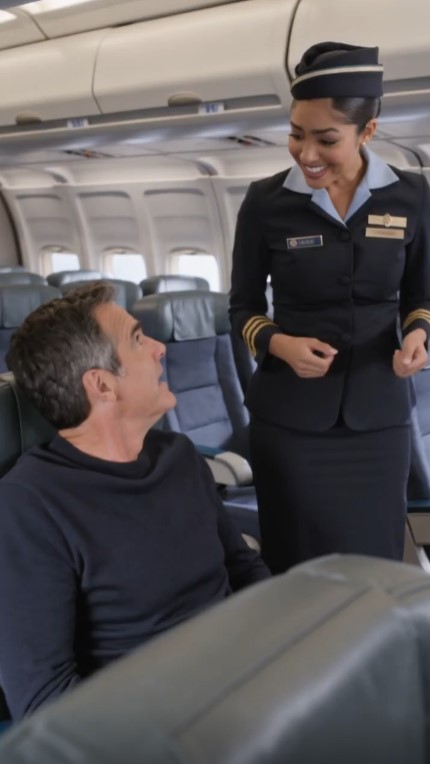
For eleven years…
David bought two airplane tickets every time he traveled.
One for himself.
And one for an empty seat beside him.
Flight attendants noticed.
Passengers asked questions.
David always gave the same answer:
“Someone belongs there.”
Nobody knew what he meant.
Then one evening, a young flight attendant named Sarah finally asked:
“Who?”
David looked at the empty seat.
“My daughter.”
Sarah immediately apologized.
But David shook his head.
“She’s alive.”
That confused her even more.
David explained.
Eleven years earlier, after a bitter divorce, his former wife moved overseas with their daughter Emma.
David lost contact.
Phone numbers changed.
Letters came back.
Every birthday card he mailed was returned.
But when Emma was little, she had loved airplanes.
She always demanded the window seat.
So every year on Emma’s birthday…
David took the same route they had once flown together.
And bought her seat.
Sarah looked toward the empty window.
“How old would she be now?”
“Twenty-two.”
Sarah’s face suddenly changed.
“What’s her full name?”
David told her.
Sarah stopped moving.
Then whispered:
“Wait here.”
She disappeared toward the front of the plane.
A few minutes later…
someone walked down the aisle.
A young woman.
She stopped beside David’s row.
David looked up.
The woman was crying.
“Dad?”
David couldn’t breathe.
Emma had become a flight attendant.
She had recently transferred to that exact airline.
Sarah had recognized her name.
David slowly stood.
Emma threw her arms around him.
People nearby began applauding.
Then Emma sat in the empty seat beside him.
David whispered:
“I kept buying it.”
Emma looked at him.
“I know.”
David froze.
“What?”
Emma opened her bag…
and pulled out eleven unopened birthday cards.
Every single card David thought had been returned.
Then she said:
“Mom never sent these back to you.”
David stared at the envelopes.
Emma continued:
“Someone else did.”
David’s face changed.
“Who?”
Emma looked down at the cards.
“My grandmother.”
David went completely still.
Emma’s grandmother, Margaret, was his former mother-in-law.
David had not spoken to her since the divorce.
For years, he had assumed Margaret hated him.
Apparently, that wasn’t the full story.
Emma placed the cards on the tray table between them.
“Mom never knew you kept writing.”
David frowned.
“What do you mean?”
Emma explained.
After the divorce, her mother, Laura, had moved overseas to live near Margaret.
The separation had been ugly.
Arguments about money.
Custody.
Work.
Everything that should have stayed between two adults somehow became mixed with hurt, pride, and family loyalty.
At first, David was allowed to call Emma.
Then the calls became less frequent.
Then stopped.
David sent letters.
Birthday cards.
Christmas cards.
Some disappeared.
Others came back marked:
RETURN TO SENDER.
David assumed Laura was rejecting them.
She wasn’t.
Margaret was intercepting the mail.
Emma whispered:
“She thought she was protecting Mom.”
David stared.
“From me?”
Emma nodded.
Margaret believed every letter reopened old wounds.
Laura had been struggling after the divorce.
So Margaret began returning David’s mail before Laura or Emma could see it.
At first, she told herself it would only be temporary.
Then one year passed.
Then another.
Eventually admitting what she had done became harder than continuing.
David looked at the eleven envelopes.
“Then how did you get these?”
Emma took a breath.
“Grandma gave them to me before she died.”
David closed his eyes.
Margaret had passed away six months earlier.
Near the end of her life, she called Emma into her room.
She handed her a small box.
Inside were David’s cards.
Some unopened.
Some returned.
Some never mailed back at all.
Margaret finally confessed.
Emma said:
“She cried when she told me.”
David looked out the window.
For eleven years, he had imagined Emma seeing his name and refusing him.
The truth was almost worse.
She hadn’t known.
Emma touched one envelope.
“I thought you stopped trying.”
David looked at her.
“No.”
His voice broke.
“I never stopped.”
Emma started crying again.
She reached into her bag and pulled out something else.
A tiny plastic airplane.
Blue wings.
One wheel missing.
David stared.
“You still have that?”
Emma nodded.
He had bought it for her when she was six.
On their first flight together.
She had held it the entire trip and insisted they count clouds from the window.
David laughed through tears.
“You made me switch seats because you said I was blocking your clouds.”
Emma smiled.
“You were.”
For a moment, the eleven lost years disappeared.
Then came back.
David asked:
“Why didn’t you contact me after your grandmother told you?”
Emma looked ashamed.
“I tried.”
She searched his old number.
Disconnected.
His old address.
Sold.
Social media accounts.
Inactive.
David had deliberately stayed mostly offline.
Emma eventually found a record showing he still lived in the same city.
But no current contact information.
Then she remembered something.
The annual flight.
Her mother had once mentioned that David always loved the route they used to take together.
Emma started checking passenger manifests where she could legally see crew-related scheduling information, but she never had access to private passenger history.
She couldn’t simply search for him.
So she did the next thing she could.
She transferred to that airline.
David stared.
“You changed jobs because of me?”
Emma shook her head.
“Not exactly.”
She already worked as cabin crew elsewhere.
The transfer gave her better routes.
But part of her hoped that someday…
somehow…
she might see him.
Then Sarah heard David say his daughter’s name.
That was the missing connection.
David laughed weakly.
“Eleven years of buying a seat, and apparently I just needed a talkative flight attendant.”
Emma smiled.
“Pretty much.”
Then David asked the question he had been afraid to ask.
“Your mother.”
Emma became quiet.
“Does she know you’re here?”
“Yes.”
David looked surprised.
“And?”
“She told me to come.”
That hurt in a different way.
David stared at the cards.
“Why didn’t she?”
Emma answered carefully.
“Because she’s ashamed.”
Laura eventually learned what Margaret had done.
Not until after Margaret’s confession.
Laura had spent years believing David simply lost interest.
She never questioned why no new letters arrived.
She was angry enough to accept the silence as proof.
Then Margaret revealed everything.
Emma said:
“Mom realized she had built half her anger on something that wasn’t true.”
David shook his head.
“She could’ve called.”
Emma nodded.
“You could’ve kept looking in other ways too.”
David looked at her.
She wasn’t accusing him.
Just telling the truth.
He had written.
He had called.
He had tried through lawyers early on.
Then after years of rejection…
he stopped pushing.
The annual flights became his substitute.
A ritual that felt like doing something.
But it wasn’t the same as actually finding Emma.
David nodded slowly.
“You’re right.”
Emma whispered:
“Everybody waited for someone else to move first.”
The plane began boarding more passengers.
Sarah returned.
She looked embarrassed.
“I’m sorry, but Emma technically has duties.”
David stood.
“Of course.”
Emma took his hand.
“Sit in your seat.”
David looked at the empty window seat.
“Our seat.”
Emma smiled.
“I’ll be back.”
Throughout the flight, Emma worked.
But whenever she passed David’s row, she looked at him.
Sometimes smiled.
Sometimes touched the seat beside him.
After the meal service, another crew member covered for her for a few minutes.
Emma finally sat down.
David handed her the window seat.
She laughed.
“You still remember?”
“Some things are permanent.”
She opened the first birthday card.
Age twelve.
David had written:
Happy birthday, Em.
I hope you still hate aisle seats.
Emma smiled.
The second:
Thirteen sounds very grown-up. It isn’t.
The third:
If you’re angry with me, that’s okay. Just know I’m still here.
Emma stopped.
David looked down.
She opened another.
Age sixteen.
I don’t know what music you like anymore.
I don’t know what you want to study.
I don’t know if you still bite your nails when you’re nervous.
I hate not knowing.
Emma cried silently.
Then age eighteen:
You’re an adult today.
I wish I had been there for the years that got you here.
She closed the card.
“Dad.”
David looked at her.
“I need you to know something too.”
“What?”
“I was angry at you.”
“I know.”
“No.”
Emma shook her head.
“I mean really angry.”
She had spent years believing David abandoned her.
When classmates talked about fathers, Emma pretended she didn’t care.
When birthdays passed without contact she knew about, she told herself:
“He has another life.”
She even stopped asking Laura questions because every conversation ended the same way.
“He chose distance.”
David whispered:
“I didn’t.”
“I know now.”
But knowing now did not erase how it felt then.
David understood.
“I’m sorry you carried that.”
Emma nodded.
“And I’m sorry I believed it so easily.”
“You were a child.”
“So were you, emotionally.”
David laughed.
“That sounds like your mother.”
Emma smiled.
“She said it.”
For the first time, Laura’s name did not feel like a wound.
Then Emma pulled out one last envelope.
Different from the others.
Not addressed to her.
To David.
Margaret had written it.
David hesitated.
“Do I want to read this?”
Emma shrugged.
“Probably not.”
He opened it anyway.
Margaret’s letter was short.
David,
I returned your letters.
No excuse.
No soft beginning.
I told myself I was protecting Laura.
Then I told myself Emma was better without confusion.
Eventually I was only protecting myself from admitting I had done something cruel.
David stared.
The letter continued:
You were not a perfect husband.
David muttered:
“Fair.”
Emma smiled.
But whatever happened between you and Laura, you loved your daughter.
I knew that.
I interfered anyway.
Then:
I cannot give you the years back.
I can only tell the truth before I run out of time.
David closed his eyes.
At the end Margaret had written:
If Emma finds you, please do not make her choose which adult to forgive.
That line stayed with him.
He folded the letter carefully.
Emma asked:
“Are you angry?”
“Yes.”
“At Grandma?”
“Yes.”
“At Mom?”
“Yes.”
“At yourself?”
David looked at her.
“Very.”
Emma nodded.
“Me too.”
Then she smiled slightly.
“Good start.”
The flight landed three hours later.
David had taken that route every year intending to return home the next morning.
This time, he cancelled his return ticket.
Emma had two days off after the flight.
They spent them together.
Not doing anything dramatic.
Coffee.
Walking.
Talking.
David learned she hated tomatoes.
Loved documentaries.
Had changed university majors twice before becoming cabin crew.
She had once been engaged.
It ended.
She collected postcards.
Still bit her nails when nervous.
David noticed.
“You still do it.”
Emma looked at her hand.
“What?”
He smiled.
“The nail thing.”
She stared.
“You remembered?”
“Of course.”
That night, Emma asked:
“Do you want to talk to Mom?”
David’s first instinct was no.
Then he remembered Margaret’s line.
Do not make Emma choose.
He nodded.
“Call her.”
Laura answered by video.
For a long moment, nobody spoke.
David saw gray in her hair.
Laura saw age in his face.
Eleven years.
Then Laura said:
“Hello, David.”
“Hello.”
Emma stayed nearby.
Neither parent wanted her mediating.
Laura apologized first.
Not for the divorce.
That had reasons.
Not for every argument.
But for assuming silence meant David stopped caring.
For not investigating further.
For letting anger fill gaps where facts should have been.
David apologized too.
For giving up.
For turning annual flights into a symbol instead of continuing to search in practical ways.
For telling himself that respecting distance meant doing nothing.
They did not reconcile romantically.
Nobody wanted that.
They did something harder.
They corrected the story.
Emma finally heard both versions.
Not to decide who had been right.
To understand.
When the call ended, Emma looked exhausted.
David said:
“That was awful.”
“Yep.”
“Worth it?”
She thought.
“Yes.”
Over the next year, David and Emma rebuilt slowly.
Calls every Sunday.
Messages.
Visits when schedules allowed.
Sometimes they argued.
That surprised David.
Part of him had imagined reunion would create endless gratitude.
Instead, it created a real relationship.
Emma got annoyed when he called too often.
David became irritated when she disappeared for three days without replying.
They disagreed about money.
Jobs.
Travel.
Normal things.
David loved it.
One day Emma shouted:
“You’re acting like my father.”
David smiled.
“That is technically the job.”
She threw a pillow at him.
The annual birthday flight changed too.
On Emma’s twenty-third birthday, David bought two tickets again.
This time, he sent her one.
Emma called.
“You already know airline employees can fly differently, right?”
“Yes.”
“So why did you buy this?”
“Tradition.”
“Wasteful tradition.”
“Window seat.”
She sighed.
Then came.
For the first time in twelve years, both seats were occupied.
David sat in the aisle.
Emma took the window.
Obviously.
Sarah happened to be working that flight too.
When she saw them, she stopped.
“No way.”
Emma grinned.
“Your fault.”
Sarah laughed.
David handed her a small gift bag.
Inside was a travel mug.
It read:
ASK ONE MORE QUESTION
Sarah stared.
“What is this?”
David smiled.
“If you hadn’t asked who the empty seat belonged to, we wouldn’t be here.”
Sarah looked embarrassed.
“I just made conversation.”
“Exactly.”
Sometimes lives change because someone asks the next question.
Years passed.
Emma eventually left cabin crew and trained in aviation operations.
She still loved airplanes.
David joked that he had financially supported that interest one unused ticket at a time.
Laura eventually visited too.
Not to become part of David’s life again.
For Emma.
The three had dinner.
It was awkward.
Then less awkward.
Margaret’s actions were discussed openly.
Emma refused to let her grandmother become a villain.
“She loved us.”
David answered:
“She also hurt us.”
Both could be true.
Emma nodded.
That became one of the lessons she carried from the whole experience.
People could love you and still make terrible choices.
Forgiveness didn’t require pretending otherwise.
David kept the returned birthday cards.
Eventually Emma asked for them.
“All eleven?”
“Yes.”
“What are you going to do with them?”
“Open them on the birthdays I missed.”
So every year, Emma reread one.
Not because she wanted to relive pain.
Because the cards showed something she had once believed didn’t exist.
Continuity.
Her father had been thinking about her.
Age twelve.
Thirteen.
Fourteen.
All the way to twenty-two.
On her thirty-second birthday, she opened the final old card again.
Then called David.
“That’s all of them.”
David said:
“Good.”
“Now what?”
“I write new ones.”
“You’re very sentimental.”
“I had practice.”
By then David no longer bought an empty seat annually.
The first year he stopped felt strange.
At 6:00 that morning, he almost opened the airline website out of habit.
Then Emma texted him a photograph.
She was sitting in an airport lounge.
Window behind her.
Coffee in hand.
Caption:
Seat occupied. Stop wasting money.
David laughed.
He saved the picture.
Years later, when David’s health declined, Emma came home more often.
One afternoon, they sat looking through old photographs.
She found one from her first childhood flight.
Six-year-old Emma at the window.
Plastic blue airplane in her hand.
David beside her looking exhausted.
She laughed.
“You look miserable.”
“You asked the same question for three hours.”
“What question?”
“Are we there yet?”
Emma smiled.
Then she placed another picture beside it.
The reunion flight.
Emma at twenty-two.
Same route.
Same window seat.
Older David beside her.
Two photographs.
Eleven years apart.
A missing middle.
David whispered:
“I wish I had those years.”
Emma nodded.
“Me too.”
Then:
“But we got these.”
She pointed at the years after.
Photos of birthdays.
Trips.
Christmas.
Ordinary dinners.
Nothing could restore the missing years.
But regret did not deserve the remaining ones too.
That was what David finally learned.
He had spent eleven years buying an empty airplane seat because he wanted to prove that Emma still had a place beside him.
He thought the gesture meant he had never given up.
In some ways, it did.
In other ways, it allowed him to stay frozen.
Waiting.
Repeating.
Remembering.
Then one young flight attendant asked one simple question:
“Who?”
And eleven years of assumptions began collapsing.
Emma had not rejected his cards.
Laura had not returned them.
Margaret had.
Emma had not forgotten him.
She believed he had forgotten her.
And the empty seat David kept buying was not proof that someone was gone forever.
It was simply a place that had been waiting to be filled.
On that final reunion flight, Emma sat beside him.
Window seat.
Exactly where she had always belonged.
David looked at the eleven returned birthday cards.
Then at his daughter.
For years, he had been buying two tickets because he believed someone belonged there.
At last…
she did.