
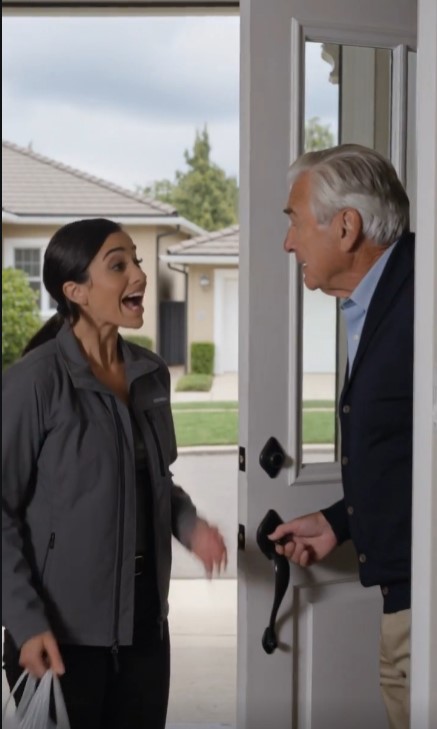
Every Friday for two years, Elena delivered groceries to the same elderly man.
Then one Friday…
his order disappeared.
Elena became worried.
So she bought the groceries herself and drove to his house.
Mr. Carter opened the door.
“I canceled it. I’m moving tomorrow.”
Before Elena left, he handed her a small wooden box.
Inside was a photograph.
Elena stared at it.
The young woman looked almost exactly like her.
“Who is she?”
“My sister.”
Then Mr. Carter told Elena her name.
Elena froze.
That was the name of her biological grandmother.
A woman Elena had never met.
The elderly customer she had visited every Friday for two years…
might be her great-uncle.
Elena asked why he had never told her.
Mr. Carter removed another photograph.
Then said:
“That’s why I chose your delivery route.”
Elena stared at him.
“What do you mean?”
Mr. Carter slowly sat down.
His real name was Thomas Carter.
His sister had been named Margaret.
Elena knew that name.
She had seen it once on an old adoption record.
Her mother had been adopted as a baby.
She spent years knowing almost nothing about her biological family.
Only one name.
Margaret Carter.
Thomas opened the box again.
Inside were photographs spanning decades.
Margaret as a child.
Margaret at seventeen.
Margaret holding a baby.
Elena’s hands began trembling.
“Is that my mother?”
Thomas nodded.
“As a baby.”
Elena sat down.
“Then you knew who I was this whole time?”
Thomas looked ashamed.
“Not the whole time.”
The first time Elena delivered groceries, Thomas only noticed her surname.
It was different from Margaret’s.
Nothing unusual.
Then Elena smiled.
Thomas froze.
The resemblance was immediate.
Margaret had smiled the same way.
Same eyes.
Same slight tilt of the head.
Thomas started asking harmless questions over the following weeks.
Where did Elena grow up?
Was her mother from the area?
Did she know much about her grandparents?
Elena thought he was simply lonely.
Then one Friday she casually mentioned that her mother had been adopted.
Thomas nearly dropped his coffee.
He asked:
“Do you know her birth mother’s name?”
Elena answered:
“Margaret Carter.”
Thomas knew.
But he said nothing.
Elena stared at him now.
“Why?”
“Why didn’t you tell me?”
Thomas looked down.
“Because I wasn’t sure you wanted to be found.”
Elena frowned.
Thomas explained.
Margaret became pregnant at nineteen.
The father disappeared.
Their parents were furious.
They insisted the baby be adopted.
Margaret fought them.
For months.
But she had no money.
No stable home.
No support except Thomas.
Then Thomas made a mistake he regretted for the rest of his life.
He left town for work.
He thought he would be gone only a few months.
While he was away…
Margaret gave birth.
By the time Thomas returned, the baby was gone.
Adopted.
Margaret was devastated.
Thomas asked where the child had gone.
Their parents refused to tell him.
Margaret knew almost nothing either.
Closed adoption.
No contact.
No forwarding information.
She spent years searching.
Elena whispered:
“What happened to her?”
Thomas became quiet.
“My sister died twelve years ago.”
Elena closed her eyes.
Another person she would never meet.
Thomas continued.
Before Margaret died, she gave him the wooden box.
She asked him to keep searching.
Not to interfere.
Not to force contact.
Just to find out whether her daughter was okay.
Thomas tried.
Old records.
Genealogy sites.
Newspaper archives.
Nothing.
Then Elena walked onto his porch carrying groceries.
Thomas smiled sadly.
“Your mother found me without knowing it.”
Elena looked overwhelmed.
“But why wait two years?”
Thomas reached deeper into the box.
He removed an envelope.
“Because of this.”
It was addressed:
To my daughter, if she ever wants to know me.
Margaret’s handwriting.
Elena stared.
“That’s for my mom.”
“Yes.”
“So give it to her.”
Thomas hesitated.
“I tried.”
Elena’s face changed.
“What?”
Thomas had located Elena’s mother, Sarah, nearly eighteen months earlier.
He found her through a public family announcement.
A marriage notice connected Sarah to Elena.
Thomas wrote to her.
No response.
He wrote again.
Still nothing.
Then a letter finally came back.
Short.
Polite.
Please do not contact me again.
Elena sat motionless.
“My mom knew?”
Thomas nodded.
“She knew I existed.”
Elena’s voice rose.
“And she never told me?”
Thomas held up one hand.
“Don’t be angry yet.”
He gave her the letter.
Sarah had written more on a second page.
I spent my whole life knowing I was adopted.
I had good parents.
I had a good childhood.
I am not ready to reopen something I worked hard to make peace with.
Then:
My daughter Elena is curious about family history, but that is her decision.
If you ever meet her naturally, do not lie to her.
But please do not chase her.
Elena read the line twice.
Thomas said:
“So I waited.”
He could have told her the next Friday.
He could have shown her photographs.
But he didn’t want to turn Elena’s job into an ambush.
He didn’t want her to feel watched.
So he kept ordering groceries.
Week after week.
Not because he needed that much food.
Sometimes he added things just to reach the minimum order.
Elena laughed weakly.
“That explains the six jars of peanut butter.”
Thomas smiled.
“I don’t even like peanut butter.”
Despite everything, she laughed.
Then Thomas became serious again.
“I told myself that if you ever mentioned wanting to know more, I’d tell you.”
“You never did.”
Elena thought.
She had mentioned family history.
But not directly.
She once said she wondered where she got her eyes.
Another time she joked about having “mystery relatives.”
Thomas had almost told her.
Each time he stopped.
Then he decided to move.
His health was declining.
His daughter wanted him closer.
Thomas realized that if he left without telling Elena, he might lose the chance forever.
“So you canceled the order.”
“Yes.”
“You knew I’d come?”
Thomas smiled.
“I hoped.”
Elena shook her head.
“That’s manipulative.”
“A little.”
She laughed again.
Then looked at Margaret’s letter.
“Can I take this to my mother?”
Thomas nodded.
“That’s what I want.”
Elena called Sarah that evening.
Her mother answered normally.
“How was work?”
Elena said:
“Mom, who is Thomas Carter?”
Silence.
Long enough to answer everything.
Sarah finally whispered:
“You met him.”
“Yes.”
“I was afraid of that.”
“Why didn’t you tell me?”
Sarah sighed.
“I didn’t know how.”
Elena almost laughed.
“That seems to be a family problem.”
Sarah deserved that.
The next day, Elena drove to her mother’s house with the wooden box.
Sarah stared at Margaret’s photograph.
For several minutes she said nothing.
Then she touched the face.
“She looks like you.”
Elena answered:
“Apparently I look like her.”
Sarah began crying.
She had spent her whole life claiming she didn’t care.
That her adoptive parents were her parents.
True.
But somewhere underneath, she had always wondered.
Why was she given up?
Was she unwanted?
Did anyone look for her?
Margaret’s letter answered that.
Sarah opened it.
My daughter,
I don’t know what name you were given.
I don’t know where you grew up.
I don’t know whether I deserve to call you mine.
Sarah stopped.
Elena sat beside her.
The letter continued.
But I need you to know one thing first.
I did not give you away because I did not want you.
Sarah covered her mouth.
Margaret explained everything.
Her parents’ pressure.
Her lack of money.
The closed adoption.
The regret.
She wrote about birthdays she imagined.
First steps she missed.
School pictures she would never see.
Then:
I hope whoever raised you loved you enough that you never needed me.
Sarah cried harder.
Elena squeezed her hand.
At the end Margaret wrote:
If you ever find my brother Thomas, don’t blame him.
He tried.
And if you have a daughter someday, tell her I hope she gets our stubbornness but none of our silence.
Elena laughed through tears.
“That part failed.”
Sarah smiled.
“Clearly.”
Then Elena asked:
“Do you want to meet him?”
Sarah looked terrified.
Thomas was leaving the next morning.
Time suddenly mattered.
Sarah said:
“I don’t know.”
Elena nodded.
“Then we don’t go.”
Five minutes passed.
Sarah stood.
“Get your coat.”
They drove to Thomas’s house.
Boxes filled the living room.
Thomas opened the door.
He saw Sarah.
Then froze.
Nobody spoke.
Sarah looked at him.
“So you’re my uncle.”
Thomas nodded.
“I think so.”
“That’s a terrible greeting.”
Thomas smiled through tears.
“I’ve had forty years to prepare and apparently that’s all I had.”
Sarah stepped inside.
The reunion was not dramatic at first.
No immediate hug.
No collapsing into tears.
Just questions.
“What was she like?”
“Did she have my eyes?”
“Did she like music?”
“What did she do for work?”
Thomas answered everything he could.
Margaret had been a school secretary.
Loved old movies.
Burned toast constantly.
Hated thunderstorms.
Collected postcards.
Sang badly.
Was stubborn.
Very stubborn.
Sarah laughed.
“My adoptive mother used to say I argued like it was a sport.”
Thomas smiled.
“That’s Margaret.”
Then he brought out one last photograph.
Margaret at about fifty.
Beside her was an empty chair.
On the table sat a birthday cake.
Sarah frowned.
“What is this?”
Thomas said:
“Your fortieth birthday.”
Sarah stared.
Margaret had celebrated it.
Not with Sarah.
She didn’t know where she was.
But every year on the date of Sarah’s birth, Margaret baked a small cake.
Thomas thought it was painful.
Margaret said:
“It means she existed another year.”
Sarah broke down.
Thomas moved toward her.
Stopped.
Then Sarah closed the distance and hugged him.
Elena watched.
Two branches of a family reconnecting in a room full of moving boxes.
Thomas delayed his move by two days.
They talked almost constantly.
He showed Sarah old letters.
Photographs.
Margaret’s favorite recipes.
A small bracelet she kept for the daughter she never saw grow up.
Sarah showed Thomas photographs too.
Her childhood.
Her adoptive parents.
Her wedding.
Elena as a baby.
Thomas stared at one picture.
“Margaret would’ve loved this.”
Sarah nodded.
“I think my parents would’ve liked her.”
Thomas smiled.
“I’m glad you had them.”
That mattered deeply to Sarah.
She didn’t want finding biological relatives to erase the parents who raised her.
Thomas understood.
“Family doesn’t have to replace family.”
Sarah looked relieved.
The next morning, Thomas finally moved.
Before leaving, he handed Elena the small wooden box.
She refused.
“This belongs with Mom.”
Sarah shook her head.
“No.”
“Why?”
“Because you found him.”
Elena corrected her.
“He found me.”
Thomas smiled.
“Both.”
Inside the box, Elena found another envelope she hadn’t noticed.
Her name.
Not Margaret’s handwriting.
Thomas’s.
She opened it.
Elena,
Your grandmother spent most of her life searching for your mother.
I spent years helping.
Then one Friday, you knocked on my door holding two bags of groceries and complained that I had ordered too many bananas.
Elena laughed.
She remembered.
Thomas continued:
I knew almost immediately.
Not because of your name.
Because you make the exact face Margaret made when she thought someone was being unreasonable.
Then:
I ordered groceries every Friday because I liked seeing you.
The search was over, but I was afraid saying so would make you disappear.
Elena stopped.
I should have trusted you sooner.
Your grandmother lost too many years to fear and silence.
Don’t repeat us.
She folded the letter.
Thomas moved three hours away.
That was nothing compared with the decades already lost.
Elena visited.
Sarah eventually did too.
At first once.
Then again.
Thomas introduced them to his daughter Rebecca.
Which gave Sarah a cousin.
Elena gained more relatives.
Birthdays became bigger.
Confusing.
Louder.
Sarah joked that maybe staying unknown had advantages.
Thomas answered:
“Too late.”
One year later, they gathered on Margaret’s birthday.
Not her death anniversary.
Her birthday.
Sarah baked a cake using Margaret’s recipe.
It collapsed in the middle.
Thomas laughed.
“Perfect.”
“What?”
“She was terrible at cakes too.”
Sarah stared at the ruined dessert.
Then started laughing.
The family ate it anyway.
Over time, Sarah began talking about Margaret without discomfort.
She never called her “Mom.”
Her adoptive mother held that place.
She called her Margaret.
Sometimes “my birth mother.”
That was enough.
Elena kept the old wooden box.
She added new photographs.
Sarah and Thomas.
Elena with Rebecca.
The family around the terrible birthday cake.
The box no longer ended with loss.
One day, years later, Elena’s own daughter asked about the oldest picture.
“Who’s that?”
Elena smiled.
“That’s your great-great-aunt’s sister.”
The child looked confused.
“What?”
Elena laughed.
“Family tree is complicated.”
Then she pointed toward Margaret.
“This is your great-grandmother.”
“Did you know her?”
“No.”
“Then how do you know about her?”
Elena thought about two years of Friday grocery deliveries.
A cancelled order.
Six unnecessary jars of peanut butter.
One wooden box.
And an elderly man who had recognized his sister’s smile in a stranger standing on his doorstep.
“Because somebody kept looking.”
That was the simplest answer.
Every Friday for two years, Elena thought she was delivering groceries to a lonely elderly customer.
She carried bags into his kitchen.
Placed milk in the refrigerator.
Complained about his ridiculous orders.
Asked whether he was taking his medication.
She had no idea Thomas was studying a face that reminded him of the sister he had lost.
No idea he had spent decades searching for Elena’s mother.
No idea he had deliberately kept choosing her delivery route because he was waiting for the right moment to tell the truth.
In the end, the moment came because he was leaving.
Elena thought she was saying goodbye to an old customer.
Instead…
she found a family that had been waiting for her long before she knew it existed.