
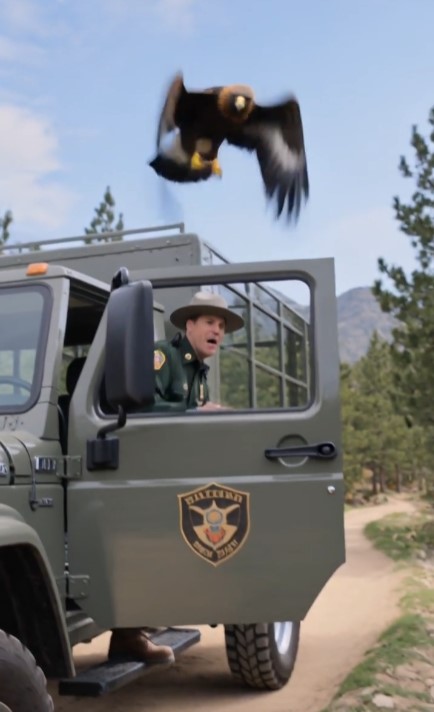
The first hit sounded like a rock smashing into glass.
Park Ranger Noah Bennett slammed on the brakes as his truck skidded to a stop on the narrow mountain road. For a second, he thought a branch had fallen from the trees above.
Then the shadow crossed his windshield again.
A giant eagle.
Its wings stretched wide across the front of the truck, powerful and dark against the pale morning sky. It struck the windshield with its talons, not hard enough to break the glass, but hard enough to make Noah’s heart jump.
Again.
And again.
“What in the world…” Noah whispered.
He had worked in the mountains for almost fourteen years. He had seen bears near campgrounds, elk on the road, coyotes beside cabins, and eagles circling above the cliffs.
But he had never seen one do this.
The eagle flew ahead of the truck, landed on a dead pine branch, and stared back at him.
Noah leaned forward.
The bird did not fly away.
Instead, it screamed once, a sharp cry that echoed between the rocks, then lifted into the air and flew farther up the road.
Noah waited.
The eagle landed again.
Looked back again.
Cried again.
It was almost like it wanted him to follow.
Noah shook his head.
“That’s impossible.”
But the eagle took off once more, this time flying low over a narrow service trail that led away from the main road and into the mountains.
Noah looked at the trail.
Then at the sky.
The park had been searching for a missing hiker since the previous evening. A twenty-two-year-old woman named Emily Carter had failed to return from a solo hike near Eagle Ridge. Search teams had worked until midnight, but darkness, steep terrain, and dropping temperatures had forced them to pause.
At sunrise, Noah had been driving to meet the search crew.
Now a wild eagle was slamming into his truck and leading him toward an unmarked trail.
His radio crackled.
“Ranger Bennett, what’s your location?”
Noah picked it up slowly.
“About two miles east of the ridge road.”
“Copy. Search team is assembling near the north trailhead.”
Noah looked at the eagle circling above the trees.
He should have continued to the team.
He should have followed procedure.
Instead, he opened the truck door.
Cold mountain air rushed in.
“I’m checking something first,” he said.
He grabbed his radio, first-aid pack, rope, and flashlight, then stepped onto the trail.
The eagle waited.
The moment Noah began walking, it flew forward.
The path was rough and half hidden under pine needles. It twisted between rocks, climbed over exposed roots, and narrowed along the side of a slope where one wrong step could send a person sliding down.
The eagle stayed ahead.
Not too far.
Not too close.
Every time Noah slowed, it landed on a rock or branch and looked back.
After ten minutes, Noah stopped and caught his breath.
“This is crazy,” he muttered.
The eagle screamed from above.
Noah looked up.
Its wings flashed in the sunlight as it circled once, then flew deeper into the mountains.
He followed.
The trail grew worse. Brush scratched his arms. Loose stones rolled beneath his boots. At one point, Noah had to climb over a fallen log blocking the path. The whole time, the eagle guided him forward, crying whenever he drifted too far from its direction.
Then the trees opened.
Noah stepped onto a rocky ledge overlooking a steep cliff.
The eagle landed near the edge.
For the first time, it went quiet.
Noah approached carefully.
Below, the cliff dropped into a narrow ravine filled with broken rocks and pine branches. At first, he saw nothing unusual.
Then he heard a faint sound.
Not a shout.
Not a scream.
A weak tapping.
Noah crouched and looked down harder.
His stomach dropped.
Far below, on a narrow shelf of rock, someone was trapped.
A young woman lay against the cliffside, one arm wrapped around a small backpack, her bright blue jacket barely visible beneath dust and leaves. She was too far down to climb out and too weak to call loud enough for the search teams to hear.
Noah’s radio slipped from his hand and clattered against the stone.
“Emily,” he breathed.
The eagle spread its wings and cried over the ravine.
Noah grabbed the radio.
“This is Ranger Bennett. I found her. I repeat, I found Emily Carter. She’s below the east ridge cliff, alive but trapped. I need rope rescue and medical support now.”
Static crackled.
Then the response came sharp and urgent.
“Copy. Stay in position. Rescue team moving.”
Noah leaned over the edge.
“Emily!” he shouted. “Can you hear me?”
The young woman moved slightly.
Her head lifted just enough for him to see her face.
She was pale, exhausted, and bleeding from a cut near her forehead.
“Help,” she whispered.
“I’m here,” Noah called back. “You’re not alone anymore.”
The eagle stood beside him, watching the girl below.
Only then did Noah understand.
The bird had not been attacking his truck.
It had been trying to get his attention.
For hours, maybe longer, it had known someone was down there. Maybe Emily had fallen near its nesting territory. Maybe her cries had drawn it. Maybe it had circled above her all night while no human could hear her.
And when morning came, the eagle had done the only thing it could.
It went looking for someone who would follow.
Noah tied his rope around a sturdy pine and prepared to descend just far enough to reach a better view. He could not safely pull Emily out alone, but he could get closer, check her condition, and keep her awake until the rescue team arrived.
“Emily, keep talking to me,” he shouted. “How long have you been there?”
She swallowed hard.
“Since yesterday.”
“What happened?”
“I slipped. My phone fell. I tried to climb, but my ankle…”
Her voice faded.
“Stay awake,” Noah said quickly. “Look at me. Help is coming.”
The eagle cried again.
Emily’s eyes moved toward it.
“That bird,” she whispered.
Noah looked at the eagle.
“You saw it?”
She nodded weakly.
“It stayed.”
Noah froze.
“What do you mean?”
“All night,” Emily said. “It kept landing near me. I thought it was waiting for me to die.”
Her eyes filled with tears.
“But then it flew away this morning. I thought it left.”
Noah looked up at the powerful bird on the cliff.
“No,” he said softly. “It went for help.”
Emily began to cry.
The rescue team arrived twenty minutes later, breathless and carrying ropes, a stretcher, and medical equipment. They moved quickly, anchoring lines and lowering two rescuers down the cliff face.
Noah stayed at the edge, guiding them.
The eagle did not leave.
It circled high above the ravine, then landed on a nearby branch, watching every movement.
One rescuer reached Emily first.
“She’s alive,” he shouted. “Possible broken ankle, dehydration, head injury, but responsive.”
The team secured her carefully into the rescue stretcher. Every movement had to be slow. The ledge was narrow, the rocks loose, and the drop below dangerous.
As they lifted her upward, Emily looked toward the eagle.
The bird was circling again.
For the first time since the rescue began, a small smile crossed her face.
When they pulled her onto the ridge, paramedics immediately wrapped her in a thermal blanket and checked her injuries. Emily was shaking, but she was safe.
Noah knelt beside her.
“You did great.”
Emily looked past him.
“Where is it?”
Noah turned.
The eagle had landed on the same dead pine from earlier. It watched from a distance, silent now.
Emily raised one trembling hand.
“Thank you,” she whispered.
The eagle lifted its wings.
Then, with one final cry, it rose into the sky and disappeared over the ridge.
Nobody spoke for a long moment.
One of the rescuers finally said, “I’ve never seen anything like that.”
Noah watched the empty sky.
“Neither have I.”
Emily was flown to the hospital and later made a full recovery. Doctors said she had survived a cold night with injuries that could have become deadly if she had not been found that morning.
Search crews admitted they had been looking in the wrong area.
The ravine where Emily fell was not marked on the main trail maps. Without the eagle, they might not have searched that cliff until much later.
Maybe too late.
When the story spread, people called Noah a hero.
He always corrected them.
“I followed the real hero,” he said.
Some people laughed when they heard that. Others said he was exaggerating. A few insisted animals did not think that way.
But Noah knew what he had seen.
The eagle had struck his windshield until he stopped.
It had flown ahead and waited.
It had led him through the mountains to a cliff nobody else had checked.
That was not random.
That was not an accident.
Weeks later, Emily returned to the park with her parents. She walked with a brace on her ankle and carried a small bundle wrapped in cloth.
Noah met them near the visitor center.
“I wanted to leave something,” she said.
Inside the cloth was a small wooden carving of an eagle.
Noah led her to a quiet place near the trailhead, where the mountains opened toward the ridge. Together, they placed the carving on a flat stone beneath a pine tree.
Emily looked out toward the cliffs.
“I was so scared,” she said. “I kept thinking nobody would find me.”
Noah nodded.
“Someone did.”
She smiled through tears.
“Not someone.”
Above them, a shadow moved across the sunlight.
Noah looked up.
High over the ridge, an eagle circled once, then vanished beyond the trees.
Emily covered her mouth.
“Was that…”
Noah smiled gently.
“I think the mountains were just saying hello.”
From that day on, Ranger Bennett never ignored strange behavior from wildlife again.
A bird circling too low.
A deer refusing to leave a trail.
A dog barking at an empty building.
He had learned that nature sometimes speaks in ways people are too busy to understand.
Sometimes a warning looks like an attack.
Sometimes a cry sounds like noise.
Sometimes a creature with no human words still knows exactly where help is needed.
And sometimes the greatest rescue begins with the one creature nobody understands.