
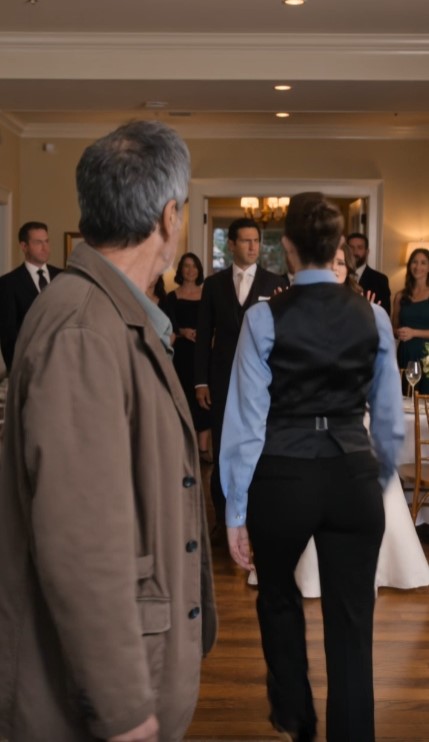
The wedding reception stopped when a homeless man appeared at the entrance.
His coat was worn.
His shoes were muddy.
And several guests immediately asked security to remove him.
But before anyone could touch him…
the bride screamed:
“STOP!”
She dropped her bouquet.
And ran straight toward him.
Then she hugged the stranger.
Nobody understood.
Not even the groom.
The bride was crying so hard she could barely speak.
Years earlier, when she was 16, she had run away from home after one of the worst nights of her life.
She spent hours alone at a bus station.
Cold.
Terrified.
With nowhere to go.
A homeless man named Samuel had found her.
He bought her food with almost the last money he had.
Stayed nearby all night.
And convinced her to call her family the next morning.
She never forgot him.
But she never found him again.
Until her wedding day.
Then something even stranger happened.
The groom walked closer.
He stared at Samuel.
His face changed.
“You know me too, don’t you?”
Samuel slowly looked at him.
The groom reached inside his jacket and pulled out an old photograph.
The bride stared at it.
Samuel was in the picture.
And what the groom revealed next explained why Samuel had appeared at their wedding after all these years.
The groom’s name was Daniel.
He turned the photograph around.
It showed Samuel standing outside a small diner.
Beside him was a teenage boy.
Daniel.
The bride, Emily, stared at him.
“You knew Samuel?”
Daniel nodded slowly.
“When I was seventeen.”
Samuel looked down.
For a moment, he seemed embarrassed.
Then Daniel said:
“He helped me too.”
The room became completely quiet.
Years earlier, Daniel had been sleeping in his car after his father died and his mother lost their apartment.
He had hidden the truth from almost everyone.
He kept going to school.
Kept telling friends everything was fine.
Then one night, his car broke down near the same bus station where Emily would later meet Samuel.
Samuel found him sitting behind the wheel.
Cold.
Hungry.
Trying not to cry.
He didn’t ask for an explanation.
He brought Daniel a sandwich.
Then found a mechanic willing to look at the car the next morning.
Daniel whispered:
“He stayed with me until sunrise.”
Emily looked at Samuel.
“You did this twice?”
Samuel shrugged.
“More than twice.”
That answer made several guests look at one another.
Daniel continued.
For nearly three weeks, Samuel quietly helped him.
Food.
A place to wash up.
Directions to a shelter Daniel was too proud to enter.
Then finally, Samuel convinced him to tell a teacher what was happening.
That teacher helped Daniel and his mother find temporary housing.
Daniel eventually graduated.
Went to college.
Built a life.
Then years later, he met Emily.
Neither had ever told the full story of the homeless man who helped them.
Not until months before the wedding.
Daniel and Emily were talking late one night about the hardest moments of their teenage years.
Emily described the bus station.
The sandwich.
The man named Samuel.
Daniel froze.
“What did he look like?”
Emily described him.
Daniel went to an old box and pulled out the photograph.
Same man.
Same bus station neighborhood.
Same kindness.
They had both been helped by Samuel years apart.
Emily whispered:
“So that’s why you have the photo.”
Daniel nodded.
“But how did he know about the wedding?”
Samuel smiled.
“I didn’t.”
That surprised everyone.
Emily looked confused.
“Then why are you here?”
Samuel reached into his coat.
He pulled out an envelope.
“I was looking for someone else.”
The envelope had Daniel’s name on it.
Daniel stared.
“My name?”
Samuel nodded.
Inside was an old letter.
Written by Daniel’s father, Michael.
Daniel’s hands began trembling.
His father had died when Daniel was sixteen.
He had not seen his handwriting in years.
Daniel opened the letter.
The first line said:
Samuel, if my boy ever finds you, tell him I knew.
Daniel looked up.
“Knew what?”
Samuel’s eyes filled.
“That you were struggling.”
Daniel stared.
Samuel explained.
Michael had met Samuel years earlier.
Long before Daniel knew him.
Michael volunteered occasionally at a downtown meal program.
Samuel was one of the people who came through regularly.
They became friends.
Michael never treated him like a project.
He sat with him.
Listened.
Helped when he could.
Then Michael became ill.
Before he died, he worried constantly about Daniel and his wife.
Money was already tight.
He feared things would become much worse after he was gone.
So he asked Samuel for something unusual.
“If you ever see Daniel around the bus station, don’t tell him I sent you.”
Daniel stopped breathing.
Emily whispered:
“Your father asked him to watch for you?”
Samuel nodded.
Michael knew Daniel was proud.
He knew his son would reject anything that felt like pity.
So he told Samuel:
“Just be there if he needs somebody.”
Daniel looked at the old photograph again.
All these years…
he thought Samuel found him by coincidence.
He hadn’t.
Not entirely.
Samuel had recognized him from a picture Michael had carried.
But he never told Daniel.
He simply helped.
Daniel’s voice broke.
“Why didn’t you tell me?”
Samuel smiled sadly.
“Your father told me not to.”
The letter continued.
If Daniel ever learns this, tell him I wasn’t trying to control his life from beyond the grave.
Several guests laughed softly.
Daniel did too.
That sounded exactly like Michael.
Then:
I just wanted one decent person nearby in case the world got too heavy.
Daniel stopped reading.
Emily took his hand.
Samuel said:
“Your dad helped me when nobody else knew my name.”
“I figured helping you was the least I could do.”
Daniel whispered:
“So you came here to give me this?”
Samuel shook his head.
“Not exactly.”
He had carried Michael’s letter for years.
Then his belongings were stolen.
The photograph disappeared.
The letter nearly did too.
Eventually Samuel moved to another city.
He lost track of Daniel.
Then, only a week earlier, a volunteer at a community shelter recognized Daniel from a local wedding announcement.
The photograph from the announcement matched the old picture Samuel still carried in memory.
The volunteer showed him the article.
Samuel saw Daniel’s name.
Then Emily’s.
And the location of the wedding.
He decided to come.
“I almost didn’t.”
Emily asked:
“Why?”
Samuel looked around at the elegant room.
“Because I didn’t exactly fit the dress code.”
Daniel walked toward him.
“You fit.”
Then Emily asked something that had been bothering her.
“If you came for Daniel, how did you recognize me?”
Samuel smiled.
“I didn’t.”
“Not at first.”
“When you ran toward me, I remembered.”
Emily laughed through tears.
“Remembered what?”
“The girl who argued with me for twenty minutes because she wouldn’t take the sandwich.”
Emily covered her face.
“That sounds like me.”
“It was definitely you.”
The room relaxed.
Then Samuel looked toward the security guard.
“He was just doing his job.”
The guard looked embarrassed.
Emily shook her head.
“No one’s throwing you out.”
Samuel smiled.
“Good. I haven’t eaten yet.”
The entire room laughed.
Daniel pulled out a chair.
Not at the back.
At the family table.
Samuel immediately objected.
“No.”
“Yes.”
“I’m not family.”
Emily looked at him.
“You were there on one of the worst nights of my life.”
Daniel added:
“And mine.”
“That qualifies.”
Samuel sat.
For the first time in years, he ate at a table where nobody was watching to see whether he belonged.
During dinner, guests began coming over.
Not to stare.
To listen.
One asked Samuel how many people he had helped.
Samuel shrugged.
“I don’t know.”
Another asked why he did it when he had so little himself.
Samuel answered:
“Because I knew what it felt like to need one person to stop.”
That sentence stayed with Emily.
Later that evening, she learned Samuel’s own story.
He had once been a carpenter.
Married.
Two children.
Then his wife died suddenly.
Samuel fell apart.
Missed work.
Started drinking.
Lost his home.
His children moved away.
Years passed.
He convinced himself they were better without him.
Helping strangers became easier than calling his own family.
Emily looked at him carefully.
“Do your children know where you are?”
Samuel looked away.
“No.”
Daniel said:
“Then maybe tonight isn’t only about us.”
Samuel immediately shook his head.
“Don’t.”
But Emily understood something.
Samuel had spent years telling frightened young people not to let one terrible night become an entire life.
Yet he had done exactly that with his own family.
She asked:
“What are their names?”
Samuel remained silent.
Then finally:
“Rachel and Thomas.”
Daniel remembered seeing those names somewhere.
He opened Michael’s letter again.
At the bottom, his father had written:
Samuel has two children. Rachel and Thomas. If he ever helps you, someday help him find his way back to them.
Daniel stared.
“My dad planned everything.”
Samuel laughed through tears.
“He was annoying.”
Daniel smiled.
“Yes.”
The wedding reception turned into something nobody had expected.
Daniel’s best man knew someone who worked in public records.
Another guest helped search social media.
Within an hour, they found a possible Rachel.
Same age.
Same hometown.
Daniel showed Samuel the picture.
His face changed instantly.
“That’s her.”
Samuel refused to call.
Emily handed him the phone.
“Eleven years ago, you made me call home.”
Samuel stared at her.
She smiled.
“Your turn.”
He laughed.
Then cried.
Finally, he dialed.
A woman answered.
“Hello?”
Samuel’s voice disappeared.
Emily whispered:
“Say her name.”
“Rachel?”
Silence.
Then:
“Dad?”
Samuel closed his eyes.
The entire table looked away.
Not because they weren’t curious.
Because that moment belonged to him.
Rachel cried.
Samuel apologized.
Not once.
Over and over.
She was angry.
She told him so.
She had spent years looking.
Their brother Thomas had too.
They believed Samuel might be dead.
Samuel didn’t defend himself.
He simply said:
“I was ashamed.”
Rachel answered:
“You should have called anyway.”
Samuel nodded even though she couldn’t see him.
“I know.”
Then something remarkable happened.
Rachel asked:
“Where are you?”
Samuel looked around.
“At a wedding.”
She paused.
“What?”
He laughed.
“I’ll explain later.”
Rachel lived less than two hours away.
She came the next morning.
Daniel and Emily delayed leaving for their honeymoon by one day.
Nobody argued.
Samuel waited in the hotel lobby.
When Rachel walked through the door, he stood.
She stopped.
Older now.
A mother herself.
Samuel whispered:
“I’m sorry.”
Rachel walked toward him.
Then hit him once on the shoulder.
“You idiot.”
Samuel nodded.
“I know.”
Then she hugged him.
Thomas arrived later that afternoon.
His reunion was harder.
More anger.
More questions.
But he stayed.
That mattered.
Samuel didn’t suddenly become a different man overnight.
His children helped him find stable housing.
He began counseling.
Stopped drinking again.
Found part-time work repairing furniture.
Daniel and Emily visited.
So did Rachel and Thomas.
Months later, Samuel built them a wedding gift.
A small wooden bench.
On the underside he carved one sentence:
For the people who stopped.
Emily placed it near their front door.
Years later, when they had children, they told them the story.
Not about a mysterious homeless man crashing a wedding.
About a person.
A carpenter.
A father.
A man who lost almost everything.
And who still had enough kindness left to help two teenagers he barely knew.
One of those teenagers became the bride.
The other became the groom.
Neither knew Samuel had shaped both of their lives until they found each other.
And Samuel had no idea that helping them would someday lead him back to his own children.
Daniel kept his father’s letter.
Emily kept the photograph.
Samuel kept a copy too.
Three young lives had once crossed through the same bus station for completely different reasons.
Michael helped Samuel.
Samuel helped Daniel.
Samuel helped Emily.
Then Emily and Daniel helped Samuel.
No one had kept score.
No one had known where the chain would end.
That was the part Samuel loved most.
Years after the wedding, someone asked him whether he believed everything happened for a reason.
Samuel shook his head.
“No.”
“Sometimes bad things are just bad.”
“But people can still decide what happens next.”
That was enough.
The wedding reception had stopped because guests saw a homeless man at the door and assumed he didn’t belong.
They were wrong.
Samuel belonged there more than almost anyone knew.
Years earlier, he had helped a frightened sixteen-year-old girl find the courage to go home.
He had helped a teenage boy survive the months after losing his father.
And on the day those two people married each other…
Samuel finally walked through the same kind of door he had spent years helping others reach.
Home.