
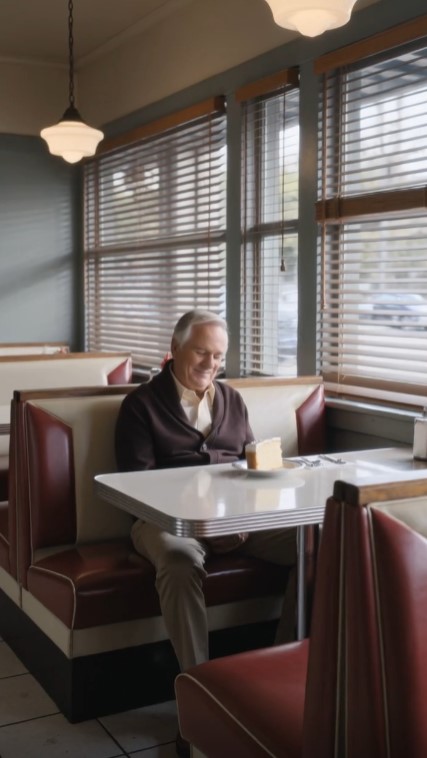
The elderly man came into the diner alone on his 80th birthday.
He ordered one slice of cake.
No candles.
No celebration.
When the waitress asked if anyone was joining him, he smiled.
“My daughter used to.”
They hadn’t spoken in 26 years.
The waitress felt terrible.
So she found one candle in the kitchen.
She placed it on his cake.
“Make a wish.”
The old man closed his eyes.
Then whispered:
“I just want to know she’s okay.”
The waitress froze.
Her mother said those exact words every year on her own birthday.
Not similar words.
Exactly those words.
The waitress asked the man his daughter’s name.
“Rebecca.”
Her hands started shaking.
That was her mother’s name.
She secretly called her.
“Mom… what was Grandpa’s first name?”
Her mother went completely silent.
Then whispered:
“Arthur.”
The waitress slowly looked at the customer receipt.
Arthur.
Her grandfather was sitting ten feet away.
And neither of them knew the other existed.
But when Rebecca finally arrived…
Arthur didn’t look surprised.
He reached into his coat.
“I knew eventually she’d send you.”
The waitress stared at him.
“Who?”
Arthur placed a sealed birthday card on the table.
It had been written 26 years earlier.
Rebecca stopped walking.
Her face changed the moment she saw the handwriting on the envelope.
“No.”
Arthur looked down.
The waitress, Emma, glanced between them.
“Mom?”
Rebecca didn’t answer.
Arthur pushed the card toward her.
“She told me to keep it until you came back.”
Rebecca sat down slowly.
“Who told you?”
Arthur looked at his daughter.
“Your mother.”
Rebecca’s eyes filled instantly.
Emma had always known her grandmother, Margaret, had died before she was born.
What she didn’t know was that Margaret had apparently been involved in whatever tore the family apart.
Arthur continued.
Twenty-six years earlier, Rebecca had been twenty-two.
She wanted to leave town with the man she loved.
Arthur hated the idea.
He thought the man was irresponsible.
He thought Rebecca was too young.
They argued.
Then Arthur said something he regretted before the sentence had even finished.
“If you leave with him, don’t come back expecting me to fix it.”
Rebecca left.
The relationship eventually failed.
But pride kept her from returning.
Arthur expected her to call.
Rebecca expected him to apologize.
Neither did.
Margaret tried to keep them connected.
She wrote letters to Rebecca.
She wrote letters to Arthur.
Some were answered.
Most were not.
Then Margaret became ill.
Before she died, she wrote one final birthday card for Rebecca.
But she didn’t mail it.
Instead, she gave it to Arthur.
“Why?” Emma asked.
Arthur stared at the candle burning low on the cake.
“Because she knew I’d keep it.”
Rebecca laughed bitterly.
“You kept a card for twenty-six years but couldn’t call your own daughter?”
Arthur nodded.
“Yes.”
No excuse.
No defense.
Rebecca looked surprised by the honesty.
Arthur continued.
Margaret had told him:
“One day, either Rebecca will come home or someone from her family will find you.”
Emma frowned.
“That’s weirdly specific.”
Arthur smiled.
“Your grandmother believed the universe enjoyed embarrassing stubborn people.”
Rebecca almost laughed.
Then Arthur tapped the envelope.
“She said when that day came, I was supposed to give you this.”
Rebecca stared at it.
Her name was written in Margaret’s handwriting.
She hadn’t seen it in decades.
Her hands trembled as she opened the card.
Inside was a simple birthday message.
Then a longer handwritten note.
Rebecca read silently at first.
Her face changed.
Emma asked:
“What does it say?”
Rebecca handed her the card.
Emma read aloud.
Rebecca,
If you’re reading this, then at least one of you finally stopped being stubborn.
Arthur closed his eyes.
“That sounds like her.”
Emma continued.
Your father loves you.
He is also very bad at saying the right thing when he is scared.
Rebecca looked at Arthur.
He nodded.
The card went on.
And you are exactly like him, which is why I am worried you may both spend years waiting for the other person to move first.
Rebecca started crying.
Emma kept reading.
Do not confuse silence with lack of love.
Sometimes silence is just pride wearing nicer clothes.
Arthur laughed softly through tears.
Rebecca covered her face.
Margaret had written that Arthur’s anger had never really been about Rebecca leaving.
He was terrified.
Terrified she would struggle.
Terrified she would need him and not call.
Terrified that if he apologized first, Rebecca would think he approved of everything.
So he waited.
Rebecca had been waiting too.
For one sentence.
“I was wrong.”
Arthur looked at her.
Then finally said it.
“I was wrong.”
Rebecca froze.
He repeated it.
“I was wrong to tell you not to come back.”
“I was wrong not to call.”
“I was wrong every birthday after that.”
Rebecca whispered:
“Every birthday?”
Arthur nodded.
For twenty-six years, he had come to the same diner.
Always alone.
Always one slice of cake.
Because this was where he used to bring Rebecca when she was a child.
Every birthday, after she turned eight, they came here.
Chocolate cake for her.
Coffee for him.
Margaret hated the coffee.
Rebecca stared at the slice on the table.
“You kept coming here?”
Arthur nodded.
“Every year.”
Emma looked at her mother.
“Mom… you say that same wish every year.”
Rebecca wiped her face.
“I know.”
Emma finally understood.
Every year on Rebecca’s birthday, she closed her eyes before blowing out the candles and whispered:
“I just want to know he’s okay.”
Emma thought she meant someone else.
A friend.
An old love.
She had never imagined Rebecca was talking about her father.
Arthur whispered:
“So we both wasted twenty-six years saying the same thing in different rooms.”
Nobody spoke.
Then Emma asked the question that had been bothering her.
“You said you knew eventually she’d send me.”
Arthur pointed at the card.
“Your grandmother.”
Emma looked confused.
“She died before I was born.”
“I know.”
“She didn’t literally send you.”
Arthur smiled.
“No.”
“But your grandmother told me once that children eventually find the doors their parents were too stubborn to open.”
Emma stared at him.
“That’s very dramatic.”
Rebecca laughed unexpectedly.
“She was very dramatic.”
Arthur smiled.
“She was.”
That small shared memory broke something open.
Rebecca sat across from her father.
For the first time in twenty-six years.
Neither knew where to begin.
So Emma did it for them.
“Tell me one thing about Mom when she was a kid.”
Arthur looked at Rebecca.
She rolled her eyes.
“Don’t.”
He smiled.
“She bit a boy in second grade.”
Emma nearly choked laughing.
“Mom!”
“He pulled my hair.”
Arthur pointed at her.
“You chased him around the playground.”
“He deserved it.”
Arthur laughed.
It was the first time Emma had ever seen her mother look twelve years old.
Then Rebecca asked:
“Tell me something about Dad that isn’t humiliating.”
Arthur frowned.
“That’s much harder.”
They stayed in the diner for three hours.
Arthur told stories.
Rebecca corrected half of them.
Emma listened.
Then Arthur asked about her.
School.
Work.
Everything he had missed.
Emma said:
“I’m your granddaughter.”
Arthur’s eyes filled.
“Yes.”
“I’m twenty-four.”
“Yes.”
“You missed my whole childhood.”
Arthur looked down.
“I know.”
That was the hardest sentence of the day.
Because no reunion could recover that.
No birthday card could create twenty-four lost years.
Rebecca watched him.
Then said:
“You didn’t even know she existed.”
Arthur shook his head.
“No.”
Rebecca admitted she had almost called him when Emma was born.
She even found the diner number.
But she hung up.
Arthur whispered:
“I wish you hadn’t.”
Rebecca answered:
“I wish you had called me first.”
Both were right.
Both were wrong.
That was the truth.
There was enough regret for everyone.
Emma interrupted.
“So what happens now?”
Arthur looked at Rebecca.
Rebecca looked at Arthur.
Neither answered.
Emma sighed.
“Great. Still stubborn.”
Arthur laughed.
Rebecca did too.
They agreed on coffee the next week.
Not forgiveness.
Not pretending the past disappeared.
Coffee.
That was manageable.
Arthur arrived thirty minutes early.
Rebecca arrived ten minutes late.
He looked terrified she wasn’t coming.
Then she walked through the door.
“Traffic.”
Arthur nodded too quickly.
“I knew that.”
She smiled.
“No, you didn’t.”
From there, things moved slowly.
Phone calls.
Lunches.
Arguments.
Stories.
Questions Rebecca had carried for decades.
Arthur answered what he could.
Sometimes badly.
Sometimes honestly.
Emma became the bridge.
Not because she tried to force them together.
Because both wanted to know her.
Arthur showed Emma old photographs of Rebecca.
Birthday parties.
School pictures.
One image stopped her.
Rebecca at ten, sitting in the same diner booth Emma served every weekend.
Arthur had one arm around her.
Margaret sat opposite them.
There was a single candle in Rebecca’s cake.
Emma smiled.
“The candle.”
Arthur nodded.
“That was your grandmother’s thing.”
Whenever one of them had a birthday, Margaret used exactly one candle.
“No matter how old you get, one wish is enough.”
That was why Arthur had looked so emotional when Emma brought him one.
He had not told her.
But she accidentally recreated Margaret’s ritual.
Rebecca cried when she heard.
Emma said:
“Okay, this family cries too much.”
Arthur smiled.
“You get used to it.”
Then there was another surprise.
Arthur still had a box of Rebecca’s belongings.
Nothing dramatic.
School ribbons.
A broken bracelet.
A handwritten recipe.
A tiny ceramic horse.
Rebecca picked it up.
“I thought Mom threw this away.”
Arthur shook his head.
“She gave it to me.”
Margaret had quietly moved pieces of Rebecca’s life between them.
Not enough to repair things.
Enough to prevent total disappearance.
At the bottom of the box was an envelope.
Arthur had written it.
Twenty-five years earlier.
Rebecca stared at him.
“You wrote to me?”
“Many times.”
“Why didn’t I get this?”
“I never mailed it.”
Rebecca closed her eyes.
Arthur looked ashamed.
“I would write, then think it sounded wrong.”
Emma stared at him.
“So you had her address?”
“Yes.”
“And letters?”
“Yes.”
“And stamps existed?”
Arthur sighed.
“Yes, Emma.”
“Just checking.”
Rebecca started laughing.
Then Arthur did too.
The letter said:
Rebecca,
I was wrong.
She stared.
“You wrote that twenty-five years ago.”
Arthur nodded.
“But never sent it.”
“No.”
Rebecca shook her head.
“We are idiots.”
Arthur smiled.
“Yes.”
That became a strange kind of relief.
There wasn’t one villain.
No secret conspiracy.
No hidden betrayal.
Just people who loved one another and made terrible decisions.
Margaret had understood that.
Her final card ended with:
If either of you gets the chance to fix this, do not waste time arguing about who should have moved first.
Someone move.
Emma framed that line.
She put it in her apartment.
Not because her family was suddenly perfect.
They weren’t.
Arthur and Rebecca still had painful conversations.
He sometimes became defensive.
She sometimes returned to old anger.
But now they came back.
That was the new rule.
No disappearing.
If they argued, someone called the next day.
If somebody left dinner angry, a text followed.
If pride started winning, Emma sent them both a picture of Margaret’s card.
Someone move.
Arthur hated that.
Rebecca loved it.
Years passed.
Arthur became part of birthdays again.
The first time he attended Rebecca’s birthday after the reunion, he brought a cake.
One candle.
Rebecca stared at it.
“You remembered.”
Arthur replied:
“I never forgot.”
She closed her eyes.
Emma asked:
“What are you wishing for?”
Rebecca smiled.
“Can’t tell you.”
Arthur whispered:
“Probably that I stop talking.”
Rebecca laughed.
“Too late.”
When Arthur turned eighty-five, the family returned to the same diner.
Emma no longer worked there, but the owner remembered them.
He brought one slice of cake.
One candle.
Arthur looked around the table.
Rebecca.
Emma.
Emma’s husband.
A baby great-granddaughter Arthur had thought he would never live to meet.
He closed his eyes.
This time he didn’t whisper his wish.
He said:
“I already got it.”
Rebecca reached across the table and held his hand.
There was no way to recover the years they lost.
But they stopped losing more.
When Arthur died several years later, Rebecca found Margaret’s birthday card inside his coat pocket.
He had carried it almost everywhere after their reunion.
Beside it was a newer card.
Written by Arthur.
Addressed to Emma.
It said:
You bought me a candle when I thought I had nobody left to celebrate with.
You gave your mother and me something neither of us was brave enough to give each other.
A first step.
Emma cried.
Then laughed at herself for crying.
At the funeral, she placed one candle beside Arthur’s photograph.
Rebecca saw it.
She smiled.
Years later, Emma continued the tradition with her own daughter.
One cake.
One candle.
One wish.
When the girl asked why only one candle, Emma said:
“Because one wish is enough if it’s the right one.”
The truth was that Arthur’s 80th birthday should have been ordinary.
An elderly man alone in a diner.
One slice of cake.
A declined invitation that never came.
Instead, a waitress heard him whisper a sentence she had heard her mother say every year.
One name connected them.
Rebecca.
One receipt confirmed another.
Arthur.
And a birthday card hidden for twenty-six years finally forced two people to admit the same thing.
Neither had stopped loving the other.
They had only stopped talking.
Sometimes family isn’t lost because people disappear.
Sometimes they’re sitting ten feet away…
waiting for somebody to recognize the name.