
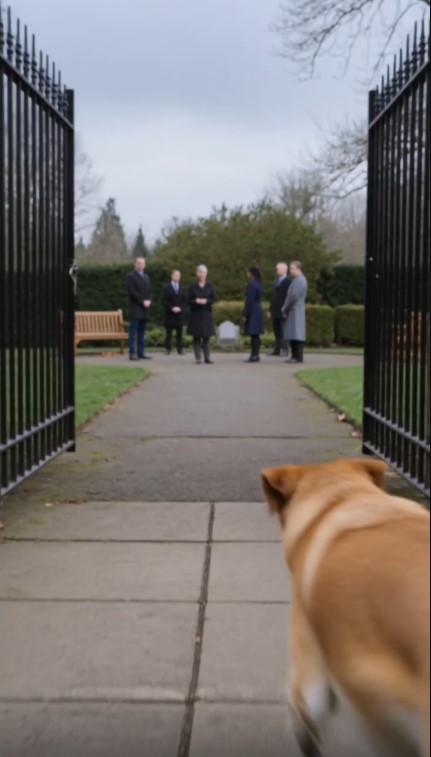
The funeral was almost over when a muddy dog suddenly appeared at the cemetery gate.
Nobody recognized him.
He ran past the people.
Past the flowers.
And stopped beside one elderly woman.
Then he rested his head against her knees.
The woman froze.
“Jack?”
Everyone looked at her.
Jack had been her husband’s dog.
But the dog had disappeared almost four years earlier.
Her husband searched for months.
He never stopped believing Jack was alive.
Then he passed away.
And somehow…
on the day of his funeral…
Jack came back.
The woman dropped to her knees and wrapped her arms around him.
People around them were crying.
But Jack suddenly pulled away.
He walked toward a nearby tree.
Stopped.
Then began scratching gently at the ground.
The groundskeeper checked the spot.
Beneath a layer of leaves was a small weatherproof pouch.
Inside was a photograph of Jack beside the woman’s husband.
But the woman immediately noticed something impossible.
Her husband looked much older than he had when Jack disappeared.
The picture had been taken recently.
Then she turned it over.
There was one sentence written on the back.
And when she read it…
she demanded to know who had brought Jack to the cemetery.
Her name was Margaret.
Her hands trembled as she read the sentence again.
He found me before I found the courage to come home.
Margaret looked around the cemetery.
“Who wrote this?”
Nobody answered.
Jack stood beside the tree, tail low, watching her.
Margaret turned the photograph back over.
There was no date printed on the front.
But she knew her husband, Walter.
She knew every stage of his face.
In the photograph, his hair was thinner.
His shoulders were narrower.
He was wearing the blue cardigan Margaret bought him less than a year earlier.
That meant the picture could not have been taken when Jack disappeared.
It had been taken recently.
Very recently.
Margaret stared at the dog.
“Where have you been?”
Jack whined.
Then someone near the back of the funeral crowd spoke.
“I can explain.”
Everyone turned.
A man in his early sixties stood beside an old pickup truck near the cemetery entrance.
He removed his cap.
Margaret had never seen him before.
Jack immediately ran toward him.
Margaret’s heart dropped.
“You know my dog.”
The man nodded.
“Yes.”
“Who are you?”
“My name is Daniel.”
Margaret stepped toward him.
“Did you have Jack?”
“For most of the last four years.”
Several family members reacted angrily.
Margaret’s son, Michael, moved forward.
“You kept somebody else’s dog for four years?”
Daniel raised both hands.
“I didn’t know where he belonged.”
Margaret stared at him.
“That photograph says otherwise.”
Daniel looked down.
“You’re right.”
He paused.
“I found out later.”
Margaret’s voice hardened.
“How much later?”
Daniel looked at Jack.
“About a year ago.”
That answer made everything worse.
Michael said:
“You knew for a year and never brought him back?”
Daniel nodded.
“I had reasons.”
Margaret snapped:
“They had better be good.”
Daniel looked toward Walter’s casket.
“They involve your husband.”
Silence.
Margaret felt the ground shift beneath her.
“Walter knew?”
Daniel nodded.
“He knew Jack was alive.”
Margaret stopped breathing.
“No.”
“He did.”
“No. Walter searched for that dog every week for months.”
“I know.”
“He put up flyers.”
“I know.”
“He drove half the county looking.”
Daniel looked devastated.
“I know.”
Margaret stared at him.
“Then explain.”
Daniel took a folded envelope from his coat.
Walter’s handwriting was on the front.
For Margaret, after I’m gone.
Margaret looked away immediately.
She had already spent the morning trying to survive her husband’s funeral.
Now strangers, hidden letters, and a dog she believed lost forever were pulling open something she hadn’t known existed.
Daniel held out the envelope.
Walter’s son Michael took it first.
“Mom doesn’t need this right now.”
Margaret looked at him.
“Yes, I do.”
Michael hesitated.
Then handed it to her.
Margaret opened the letter.
The first line said:
Maggie, before you get angry, let me admit that you have every right to be.
Margaret closed her eyes.
“That sounds like him.”
She continued.
Jack did not disappear the way we thought.
Margaret looked at Daniel.
Then back at the page.
Walter explained that four years earlier, Jack had escaped during a storm.
The backyard gate blew open.
By the time Walter noticed, the dog was gone.
He searched for months.
That part had been real.
Everything Margaret remembered had been real.
The flyers.
The phone calls.
The drives through neighboring towns.
Walter had not been pretending.
Then, almost three years later, he received a call.
A veterinarian had scanned Jack’s old microchip.
But the phone number attached to the registration was outdated.
The clinic eventually found Walter through county records.
Daniel had brought Jack in for treatment after the dog injured a paw.
That was how the truth began.
Margaret looked up.
“You found him three years after he vanished?”
Daniel nodded.
“Pretty much.”
“Where?”
“About seventy miles away.”
Daniel explained.
He owned a small farm.
One winter morning he found Jack sleeping beneath an equipment shed.
Thin.
Dirty.
Terrified of strangers.
Daniel left food.
Jack refused to come close.
The next day, he returned.
Then the next.
Eventually Jack followed Daniel into the barn.
Daniel assumed he had been abandoned.
There was no collar.
No tag.
He contacted nearby shelters.
No one recognized him.
Months became years.
Jack stayed.
Then the paw injury led to the veterinary visit.
That was when the microchip finally connected him to Walter.
Margaret stared at the dog.
“Why didn’t Walter tell me?”
Daniel looked toward the letter.
“The rest is in there.”
Margaret continued reading.
Walter had driven to Daniel’s farm the day after the call.
He expected to bring Jack home.
Instead, something strange happened.
Jack recognized him immediately.
The dog ran toward Walter.
Jumped against him.
Cried.
Walter cried too.
For nearly an hour they sat together.
Then Walter opened the truck door.
“Come on, boy.”
Jack climbed halfway in.
Then jumped back out.
Ran toward Daniel.
Walter tried again.
Same thing.
Jack loved him.
But the farm had become home.
Walter stayed for hours.
Daniel offered to let him take Jack anyway.
Walter refused.
“He told me he didn’t want Jack dragged away from another home just because he missed him,” Daniel said.
Margaret started crying.
That sounded exactly like Walter.
The letter continued.
I thought I had found Jack.
Then I realized he had found Daniel.
Margaret looked at the stranger.
Daniel lowered his eyes.
Walter had begun visiting.
At first every few weeks.
Then more often.
He never told Margaret where he was going.
He said he was meeting an old friend.
Margaret suddenly remembered.
Those unexplained afternoon drives.
The muddy shoes.
The smell of hay on his coat.
She had teased him.
“Who is this mysterious friend?”
Walter always answered:
“Someone who listens better than you.”
Margaret thought he meant an old fishing buddy.
He meant Jack.
She laughed through tears.
“That idiot.”
Michael looked shocked.
“Dad was visiting Jack for a year?”
Daniel nodded.
“Almost exactly.”
The photograph had been taken eight weeks earlier.
Walter was sitting beside Jack outside Daniel’s barn.
Daniel took the picture.
Margaret looked at it again.
Walter looked peaceful.
Not sick.
Not frightened.
Just old.
Happy.
Jack had his head on Walter’s knee.
Margaret whispered:
“He never looked that relaxed near the end.”
Daniel said:
“He loved coming out there.”
Then Margaret remembered the sentence on the back.
He found me before I found the courage to come home.
She frowned.
“That doesn’t sound like it’s about Jack.”
Daniel became still.
“It isn’t.”
Margaret looked at him.
“Then who?”
Daniel took a long breath.
“Me.”
The cemetery fell quiet again.
Daniel looked toward Walter’s photograph.
“Your husband and I were brothers.”
Margaret stared.
“No.”
Michael stepped forward.
“My dad was an only child.”
Daniel nodded.
“That’s what he believed for most of his life.”
Margaret shook her head.
“No. Walter would have told me.”
“He found out late.”
“How late?”
“Last year.”
The same year he found Jack.
Daniel explained.
Walter’s father had been married briefly before meeting Walter’s mother.
That first marriage produced a son.
Daniel.
The marriage ended badly.
Daniel grew up with his mother under a different surname.
Walter never knew.
Their father apparently intended to tell him someday.
He never did.
Daniel knew about Walter, though.
His mother had told him.
He had spent decades wondering whether he should make contact.
He never did.
Then Jack arrived at his farm.
Margaret stared at the dog.
“No.”
Daniel nodded.
“Jack connected us.”
At the veterinary clinic, when Walter’s name appeared on the microchip registration, Daniel recognized it immediately.
Walter Hayes.
The name he had heard his entire childhood.
The younger half brother he had never met.
Daniel said:
“When Walter called me, I almost hung up.”
Margaret whispered:
“But you didn’t.”
“No.”
When Walter arrived at the farm, Daniel didn’t tell him immediately.
They spent an hour with Jack.
Then Daniel brought out an old photograph.
Their father.
Young.
Standing beside Daniel’s mother.
Walter stared at it.
The same jaw.
Same eyes.
Same watch Walter had inherited.
Walter sat down.
Then asked:
“Are you saying what I think you’re saying?”
Daniel answered:
“I think I’m your brother.”
Walter laughed.
Then swore.
Then cried.
Then laughed again.
Margaret smiled through tears.
“That sounds like him too.”
The two men spent the next year getting to know each other.
Walter visited the farm to see Jack.
But eventually Jack became almost secondary.
They talked.
Compared childhoods.
Discovered habits they shared.
Both hated tomatoes.
Both woke before sunrise.
Both repaired things that should have been thrown away.
Walter had lived sixty-nine years believing he had no siblings.
Then suddenly, near the end of his life, he had a brother.
Margaret looked angry again.
“And he still didn’t tell me.”
Daniel nodded.
“He wanted to.”
“When?”
“Every week.”
“Why didn’t he?”
Daniel looked toward the letter.
Walter explained it himself.
Maggie, I had one year with Daniel after nearly seventy years without knowing he existed.
I was afraid that if I told everybody immediately, our relationship would become an event before it had time to become a relationship.
Margaret read more slowly.
Walter wanted time.
Ordinary time.
Coffee.
Arguments.
Silence.
Work around the farm.
Walking with Jack.
Not family meetings.
Not explanations.
Not questions about inheritance.
Just two old men figuring out what “brother” meant.
Then Walter became ill.
He planned to tell Margaret.
He kept postponing it.
One more test.
One more hospital visit.
One more week.
Then time ran out.
Margaret folded the letter.
“He always thought there would be one more week.”
Daniel nodded.
“I know.”
That was why Walter had made a plan.
If he died before telling Margaret, Daniel would bring Jack to the funeral.
Margaret looked at the dog.
“Walter planned this?”
“Yes.”
She shook her head.
“That’s ridiculous.”
Daniel smiled slightly.
“He thought you might say that.”
The letter continued:
If Jack reaches you before Daniel does, don’t blame the dog. He is terrible at keeping secrets.
Margaret laughed.
Everyone around her did too.
Then she cried again.
Walter had asked Daniel to bury the weatherproof pouch beneath the tree beside the family plot.
The photograph.
The message.
A second letter.
Daniel had placed it there the night before the funeral.
Jack knew the spot because Daniel had brought him along.
That explained why the dog scratched there.
No mystery.
No supernatural sign.
Just a dog remembering where he had watched someone kneel.
Margaret appreciated that.
The truth was powerful enough.
Daniel said:
“Jack wasn’t supposed to run ahead.”
Michael looked at him.
“Of course he did.”
Daniel nodded.
“He’s never been good with instructions.”
Margaret knelt beside Jack again.
“You really are Walter’s dog.”
Jack licked her hand.
Then Margaret asked the question everyone was avoiding.
“Who does he belong to now?”
Daniel looked down.
“He lives with me.”
Margaret nodded slowly.
It hurt.
But she understood.
Jack had been gone four years.
Daniel’s farm was home.
Walter had chosen not to uproot him.
Margaret wasn’t going to undo that.
Then Daniel said:
“But Walter wanted you to have a choice.”
“A choice about what?”
“Visits.”
Margaret looked confused.
Daniel smiled.
“He said you might like the farm.”
Margaret laughed.
“I hate farms.”
“Walter said that too.”
“He knew me.”
Daniel continued.
Walter had asked him to bring Margaret out whenever she wanted.
Jack could stay with her occasionally if he adjusted well.
No ownership fight.
No grand gesture.
Just family.
Margaret looked at Daniel.
“You’re family too, apparently.”
Daniel became emotional.
“I guess so.”
Michael stepped forward.
“So you’re my uncle.”
Daniel nodded.
“I suppose I am.”
Michael looked at him for a long moment.
Then said:
“Dad would have loved how awkward this is.”
Everyone laughed.
That afternoon, after the funeral, Daniel came to Margaret’s house.
Jack walked through the front door.
Then stopped.
He remembered.
Not perfectly.
But something.
He sniffed the hallway.
The old rug.
Walter’s chair.
Then he walked into the living room and sat beside the fireplace.
Exactly where his bed had once been.
Margaret cried.
She brought out the old blanket she had never thrown away.
Jack circled it twice.
Then lay down.
Daniel whispered:
“I think he remembers more than we know.”
Margaret sat beside him.
“Maybe.”
That night Daniel told her everything Walter had not had time to say.
The first visit.
The shock of discovering a brother.
How Walter kept bringing the same terrible coffee to the farm.
How he insisted on fixing Daniel’s broken gate even though his hands shook.
How he talked about Margaret constantly.
“He loved you,” Daniel said.
Margaret smiled.
“He annoyed me for fifty-two years.”
“Walter said that was the same thing.”
“It was.”
Daniel also gave her a small wooden box.
Walter had kept it at the farm.
Inside were copies of old documents.
Their father’s letters.
Photographs.
And a small notebook.
The first page said:
Things I learned about my brother too late.
Margaret read the list.
Daniel snores.
He lies about how much salt he uses.
He hates being called Dan.
He drives too slowly.
He kept Jack alive.
He deserves more time than we got.
Margaret stopped.
The final line:
If I don’t get more time, maybe my family can.
She looked at Daniel.
“That was for us.”
Daniel nodded.
Over the next few months, Margaret did visit the farm.
She complained the entire drive.
Then stayed six hours.
Jack showed her his favorite places.
The barn.
The pond.
The porch.
Walter’s old chair was still outside.
Daniel had left it exactly where Walter used to sit.
Margaret sat there.
Jack rested his head on her knee.
Just like at the funeral.
She whispered:
“You kept him company.”
Daniel answered:
“They kept each other company.”
That mattered.
Margaret had spent Walter’s final year worrying about him.
His health.
His fear.
His declining strength.
Now she discovered there had also been something joyful in that year.
A dog returned.
A brother found.
A secret friendship allowed to grow without an audience.
Walter’s last year had not only been about dying.
It had also been about finding things.
Margaret needed to know that.
Michael began visiting Daniel too.
At first because Margaret asked.
Then because he liked him.
Daniel taught Michael’s children how to fish.
Jack followed them everywhere.
The family story expanded.
Not replaced.
Walter remained Walter.
Father.
Husband.
Grandfather.
Daniel didn’t take his place.
He simply filled a space nobody knew existed.
One year after the funeral, Margaret returned to the cemetery.
Daniel came with her.
So did Jack.
Jack was slower now.
Gray around the muzzle.
He walked directly toward Walter’s grave.
Then sat.
Margaret smiled.
“No pouch this time?”
Daniel laughed.
“Not unless Walter planned another surprise.”
They stood quietly.
Then Margaret placed a new photograph beside the headstone.
It showed Walter and Daniel sitting together on the farm porch.
Jack between them.
On the back, Margaret had written:
You both came home late. You still came home.
Daniel read it.
His eyes filled.
“Walter would like that.”
Margaret nodded.
“He’d complain about my handwriting.”
“Also true.”
Jack lived two more years.
When he finally became too old to manage stairs, Margaret asked Daniel to bring him to her house for a while.
Jack slept beside Walter’s old chair.
Margaret talked to him every morning.
Not because she believed Jack understood every word.
Because Walter had talked to him too.
When Jack died peacefully one winter afternoon, Margaret called Daniel.
He arrived immediately.
They buried Jack on the farm beneath a maple tree near Walter’s chair.
No dramatic marker.
Just a small wooden plaque.
JACK
Lost. Found. Loved twice.
Margaret liked that.
Years later, after Daniel died, Michael inherited the photograph that started everything.
Walter.
Jack.
The blue cardigan.
That recent smile.
Michael framed it beside the old picture of Walter and Daniel’s father.
Two generations of hidden connections.
On the back of Walter’s photograph remained the sentence:
He found me before I found the courage to come home.
For years Michael assumed “he” meant Jack.
Now he understood.
It meant more than one thing.
Jack found Daniel.
Walter found Daniel.
Daniel found Walter.
And through all of them, a family found a missing piece of itself.
The dog at the funeral had looked like a miracle.
But the truth was quieter.
Jack had remembered a place.
Daniel had kept a promise.
Walter had left instructions.
And one muddy dog had carried the final chapter of an old man’s life straight through the cemetery gate.
Margaret thought she had buried her husband with nothing left unsaid.
She was wrong.
Walter had left behind one last story.
Not about death.
About returning.
About a lost dog.
A brother he never knew he had.
And the strange truth that sometimes the things we spend years searching for…
are also searching for us.