
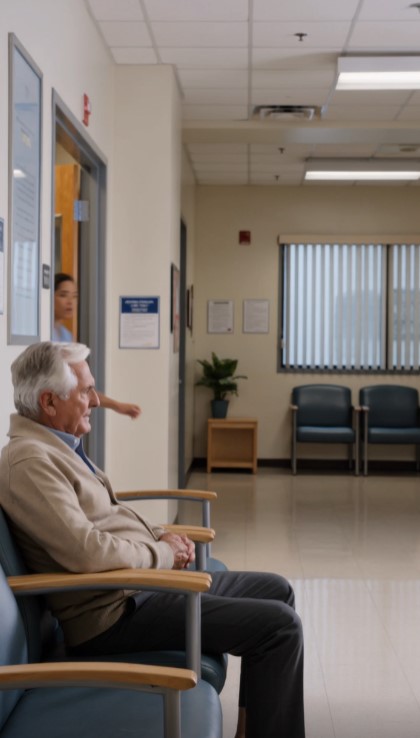
The elderly visitor had been sitting alone in the hospital lobby for almost two hours.
He wasn’t waiting for a doctor.
He wasn’t visiting a patient.
He just sat there…
quietly humming the same four notes.
A nurse walking past suddenly stopped.
She knew that melody.
Her mother had hummed it every night when she was a child.
The nurse turned around.
“Where did you learn that?”
The man looked up.
“My sister made it up when we were kids.”
The nurse felt her stomach drop.
Her mother had always claimed she had no siblings.
The elderly man slowly reached into his pocket.
He pulled out an old handmade cloth doll.
The nurse recognized it immediately.
Her mother had kept an identical doll in a locked drawer for decades.
The man said:
“My sister made two.”
The nurse called her mother.
She didn’t explain why.
She simply asked her to come.
Thirty minutes later, her mother walked into the lobby.
The moment she saw the old man…
she stopped.
He stood up.
Neither of them spoke.
Then her mother said:
“I thought you were dead.”
The elderly man’s eyes filled.
“So did I.”
The nurse, Emily, looked between them.
Her mother’s name was Margaret.
The man introduced himself as Samuel.
Her uncle.
A man Emily had never known existed.
Margaret sat down slowly.
Her hands were shaking.
“How?”
Samuel held up the cloth doll.
“You still have yours?”
Margaret stared at it.
Then nodded.
“In a drawer.”
Samuel laughed through tears.
“Of course you do.”
Emily sat beside her mother.
“Mom… why did you tell me you were an only child?”
Margaret looked down.
“Because for most of my life, I believed I was.”
Samuel closed his eyes.
Then began explaining.
He and Margaret had grown up in a small house with their mother.
Their father died when they were young.
Money was scarce.
Their mother sewed for neighbors to keep food on the table.
One winter, she made two simple cloth dolls from leftover fabric.
One for Margaret.
One for Samuel.
Margaret protested.
“Samuel had a doll?”
Samuel smiled.
“I was six. I didn’t care.”
He carried it everywhere.
The two children also had a little bedtime tune.
Four notes.
Margaret had made it up.
Their mother hummed it when one of them was scared.
Then something happened.
Their mother became ill.
Relatives stepped in.
Margaret, age nine, was sent to live with an aunt.
Samuel, seven, went to another branch of the family.
The adults promised they would reunite them.
They didn’t.
Letters stopped.
Addresses changed.
Then Margaret received news that Samuel had died.
She was told he had become sick shortly after the separation.
Margaret believed it.
For more than sixty years.
Samuel whispered:
“They told me something different.”
Emily asked:
“What?”
“That Margaret’s new family didn’t want me around.”
Margaret looked at him.
“What?”
Samuel nodded.
His relatives told him Margaret had been adopted into a “better home.”
That she was happy.
That trying to contact her would only disrupt her life.
When he cried and asked for her, they said:
“She’s moved on.”
Samuel eventually stopped asking.
Not because he stopped caring.
Because he was a child and adults had convinced him there was nothing left to find.
Margaret covered her face.
“I wrote to you.”
Samuel froze.
“So did I.”
Emily looked between them.
“Then what happened to the letters?”
Nobody knew.
Not yet.
Margaret remembered giving letters to her aunt.
Samuel remembered giving letters to his uncle.
Neither ever received one.
The truth was obvious enough.
The adults had kept them apart.
Maybe because of money.
Maybe because of family conflict.
Maybe because they believed separation was easier.
But whatever the reason…
two children lost decades.
Emily looked angry.
“Why?”
Margaret shook her head.
“Most of them are gone now.”
Samuel nodded.
“We may never know.”
That was hard.
But not every old wound comes with a perfect explanation.
Sometimes all that remains is what happened.
And what people do after learning it.
Emily asked Samuel:
“Why are you here?”
He looked around the hospital lobby.
“My wife died here two years ago.”
Emily’s expression softened.
Samuel explained.
His wife, Helen, had spent her final weeks in this hospital.
He returned every year on the anniversary.
Not to visit a grave.
Not for any formal reason.
Just because this was the last place he had held her hand.
He sat in the lobby.
Drank coffee.
Remembered.
And hummed the four notes Margaret had made up when they were children.
Emily whispered:
“You did that every year?”
“Yes.”
“So I could have walked past you before.”
Samuel smiled sadly.
“Maybe.”
Then Emily asked:
“How did you keep the doll?”
Samuel looked at it.
“It was all I had from home.”
Margaret started crying harder.
She reached into her handbag.
“My doll is in the car.”
Emily stared.
“You brought it?”
Margaret nodded.
“When you called, something about your voice scared me.”
She had grabbed the doll without knowing why.
She went outside.
Returned with a small cloth bundle.
The moment Samuel saw it, he stood.
The two dolls were almost identical.
Same faded fabric.
Same mismatched button eyes.
Same crooked stitching.
Samuel laughed.
“One of yours has a better face.”
Margaret smiled.
“Mom liked me more.”
“She absolutely did not.”
The argument sounded so natural that Emily started crying.
Not because it was sad.
Because they sounded like siblings.
Instantly.
After sixty years.
Margaret sat beside Samuel.
Then asked:
“What happened to you?”
Samuel told her.
He grew up with relatives in another state.
Left home at seventeen.
Worked construction.
Married Helen.
Had one son.
Then grandchildren.
He built a normal life.
But every few years, he searched for Margaret.
Nothing worked.
Her surname changed through adoption.
Then again through marriage.
Records were incomplete.
He assumed she wanted no contact.
Margaret said:
“I searched too.”
Samuel looked at her.
“For how long?”
“Until I was about thirty.”
“Why did you stop?”
“Because I thought you were dead.”
Samuel nodded.
That made sense.
Then Margaret asked the question Emily was afraid of.
“Did you ever know I was alive?”
“Yes.”
“When?”
“Twenty-three years ago.”
Margaret froze.
Emily looked at him sharply.
“What?”
Samuel lowered his head.
He had found a possible record.
A Margaret with the right birth date.
Same birthplace.
Same mother’s name.
But he didn’t contact her.
“Why?”
Samuel looked ashamed.
“I was afraid.”
Margaret stared at him.
“Afraid of what?”
“That it wasn’t you.”
“And if it was?”
“That you wouldn’t want me.”
Margaret laughed through tears.
“You idiot.”
Samuel nodded.
“I know.”
He found her again online years later.
A photograph.
A community event.
He knew immediately.
Same eyes.
Same smile.
But by then another fifteen years had passed.
The first phone call felt impossible.
Margaret looked angry.
“So you knew.”
“Yes.”
“For years.”
“Yes.”
“And still did nothing.”
“Yes.”
Emily expected Samuel to defend himself.
He didn’t.
That somehow made it easier to hear.
Samuel said:
“I spent my whole childhood being told you didn’t want me.”
“I thought I had outgrown that fear.”
“I hadn’t.”
Margaret looked away.
Then whispered:
“You should have called.”
“I know.”
“You should have shown up.”
“I know.”
“You should have given me the chance to decide.”
“I know.”
Silence.
Then Margaret said:
“I would have answered.”
Samuel cried.
“I know that now.”
Emily realized something.
The adults who separated them had caused the first silence.
But fear had extended it.
Years of it.
That part belonged to Samuel too.
Margaret wasn’t ready to forgive immediately.
That was okay.
She had just learned her brother had been alive all along.
And had known about her for twenty-three years.
Love and anger could exist together.
They did.
Then Samuel reached into his coat again.
Another envelope.
Margaret’s name.
Old handwriting.
She stared.
“What is that?”
“One of your letters.”
Margaret stopped breathing.
Samuel had found it in his uncle’s belongings after the man died.
A box of old papers.
Inside were letters from Margaret.
Never opened.
Never forwarded.
Samuel read them all.
The oldest was written when Margaret was ten.
Sammy,
Aunt Ruth says you are too far away to visit.
I drew you a house so you remember ours.
Margaret started sobbing.
Samuel continued.
Another said:
I still hum our song at night.
Another:
When I grow up, I’m going to find you myself.
Samuel had carried those letters ever since.
Margaret whispered:
“Why didn’t finding those make you call?”
Samuel looked broken.
“It should have.”
No excuse.
Only truth.
Then Margaret reached into her purse.
She had something too.
A folded note from their mother.
She kept it for decades.
It said:
Take care of each other.
Samuel stared.
“She wrote that?”
Margaret nodded.
“Before we were separated.”
Their mother had assumed family would keep her children together.
She had no idea they would spend most of their lives apart.
Emily took the note.
Then placed the two dolls beside it.
“Maybe start now.”
Margaret looked at her daughter.
Then at Samuel.
He whispered:
“If you let me.”
Margaret did not hug him immediately.
Instead, she said:
“Tell me about Helen.”
Samuel looked surprised.
“My wife?”
“Yes.”
“If I lost sixty years, I want the missing chapters.”
Samuel smiled.
So he told her.
Helen hated thunderstorms.
Made terrible meatloaf.
Loved old detective shows.
Met Samuel when he accidentally backed a truck into her father’s fence.
Margaret laughed.
“That sounds like something you’d do.”
“You haven’t known me since I was seven.”
“Apparently people don’t change that much.”
Then Samuel asked about Margaret’s husband.
Robert.
He had died ten years earlier.
Margaret told stories.
Robert danced badly.
Fixed everything with too much tape.
Loved Emily fiercely.
Samuel listened to all of it.
Then he looked at Emily.
“So you’re my niece.”
She smiled.
“Apparently.”
“Do you have children?”
“Two.”
Samuel covered his face.
“I’m a great-uncle?”
Emily laughed.
“Yes.”
“That sounds ancient.”
“You are ancient.”
Margaret smiled.
“Now you know why I like her.”
They stayed in the hospital lobby until evening.
Nobody planned a dramatic reunion.
No family dinner that night.
No instant decision to make up for six decades in a week.
They exchanged phone numbers.
Margaret made Samuel call her immediately so she could see his number appear.
“I don’t trust you not to disappear again.”
Samuel nodded.
“Fair.”
The next morning he called.
Then again two days later.
At first conversations were awkward.
Then longer.
They compared memories.
Some matched.
Some didn’t.
Margaret remembered their mother singing in the kitchen.
Samuel remembered her crying when she thought they were asleep.
Margaret remembered Samuel breaking a window.
Samuel blamed a neighbor.
Margaret said:
“You blamed him sixty years ago too.”
Samuel laughed.
Consistency.
Emily watched her mother change.
Not dramatically.
But something softened.
For decades, Margaret had carried a quiet sadness around childhood.
Now that sadness had a name.
Samuel.
And now Samuel could answer back.
Months later, they visited their childhood town together.
The house was gone.
A parking lot stood there.
Margaret stared at it.
“I expected more.”
Samuel nodded.
“Me too.”
Then they found the old church their mother attended.
Someone there had archived community records.
Inside one box was a photograph.
Their mother.
Margaret.
Samuel.
Together.
Neither sibling owned a copy.
Margaret cried.
Samuel laughed.
“We looked terrible.”
“You looked terrible.”
“Same family.”
They made copies.
Then Emily found something else.
A church assistance record from the year their mother became ill.
It showed that church members had tried to place both children with the same family.
The arrangement failed.
No explanation.
Another note said:
Relatives insist separate placements.
That was the closest they would ever get to understanding why.
Margaret stared.
“So someone tried.”
Samuel nodded.
“At least someone did.”
That mattered a little.
Not enough.
But a little.
Years passed.
Samuel became part of the family.
He came to Emily’s house for holidays.
At first he sat quietly.
Then eventually argued about politics with Robert’s brother and fell asleep in the recliner like he had always belonged there.
Margaret visited Samuel’s son.
Met his grandchildren.
One little girl asked:
“Are you Grandpa’s sister?”
Margaret smiled.
“Yes.”
“How come we never met you?”
Margaret looked at Samuel.
Then answered:
“We got lost.”
The girl accepted that.
Children often understand simple truths better than adults.
On Margaret’s eighty-second birthday, Samuel gave her a small wooden case.
Inside were the two cloth dolls.
Restored carefully.
Not altered.
Just protected.
Between them was a small music box.
When opened, it played four notes.
Their melody.
Margaret looked at him.
“How did you do this?”
“Emily helped.”
Emily smiled.
“I found someone who could make it.”
Samuel said:
“Now neither of us has to remember the tune alone.”
Margaret cried.
Then hit his arm.
“You’re still twenty-three years late.”
“I know.”
“Just checking.”
When Samuel became ill years later, he spent time at the same hospital.
Emily was still working there.
One evening she found Margaret sitting beside his bed.
Samuel was asleep.
Margaret was humming.
Four notes.
Emily smiled.
“Full circle.”
Margaret looked at her.
“No.”
She shook her head.
“Not full.”
“Nothing gives us those years back.”
Then she held Samuel’s hand.
“But this is enough.”
That distinction mattered.
The reunion didn’t erase what happened.
It didn’t make the lost decades beautiful.
They were lost.
But the ending no longer had to be.
Samuel died peacefully with Margaret nearby.
Afterward, she gave one of the cloth dolls to Emily.
She kept the other.
Emily asked:
“Which one was yours?”
Margaret smiled.
“I don’t remember.”
For a moment, Emily was surprised.
Then Margaret added:
“Maybe that’s better.”
Two dolls.
Two children.
Separated.
Reunited.
It no longer mattered which had belonged to whom.
Years later, Emily kept the doll in her home.
Her children knew the story.
So did their children.
No locked drawers.
No hidden sibling.
No unexplained melody.
One night, Emily’s granddaughter asked why the doll had mismatched eyes.
Emily smiled.
“Because your great-great-grandmother made it from scraps.”
“Was she good at sewing?”
“Not really.”
The girl laughed.
Then Emily hummed four quiet notes.
The same melody.
The one Margaret made up as a child.
The one Samuel carried for more than sixty years.
The one Emily heard in a hospital lobby and somehow recognized.
The elderly man had not come to the hospital looking for his sister.
The nurse had not gone to work looking for an uncle.
Neither expected anything.
He simply sat there humming.
She simply happened to hear him.
And four notes were enough to open a family secret that had been closed for most of a lifetime.
Margaret thought her brother was dead.
Samuel thought his sister had moved on without him.
Both were wrong.
And after more than sixty years…
they finally got the chance to say what the adults around them should have allowed them to say as children.
“I’m still here.”