
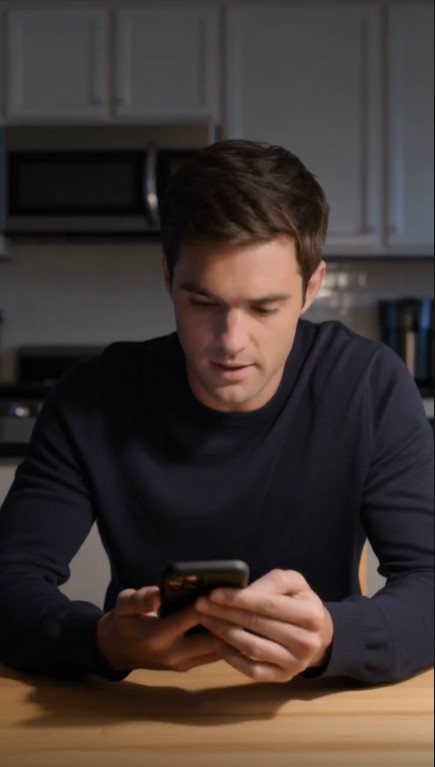
Every Sunday at exactly 6 PM, Daniel’s phone rang.
Same elderly woman.
Same question.
“Michael, are you coming for dinner?”
Every week Daniel gently explained:
“I’m sorry. You have the wrong number.”
And every week she apologized.
Then called again the next Sunday.
After two months, the phone stopped ringing.
Daniel couldn’t explain why…
but he became worried.
He called the number back.
An elderly woman answered.
Her voice was weak.
Daniel asked if she was okay.
She apologized again.
“My son Michael used to have your number. I haven’t seen him in twenty-three years.”
Daniel went quiet.
His own father’s name was Michael.
That evening, Daniel visited his father.
“Dad… did you ever have this phone number?”
His father looked at it.
And dropped his coffee.
“Who gave you this?”
Daniel explained the calls.
His father stood up immediately.
“Take me to her.”
They drove to the elderly woman’s home.
Daniel knocked.
She opened the door.
The moment she saw his father…
she covered her mouth.
“Michael?”
But Daniel’s father didn’t call her Mom.
He said:
“Mrs. Bennett… I finally know what happened to your son.”
The elderly woman gripped the doorframe.
Her name was Margaret Bennett.
For several seconds, she simply stared at Michael.
Then her expression changed.
“You knew him.”
Michael nodded.
“Yes.”
Margaret stepped aside.
“Come in.”
The dining table was still set for two.
Two plates.
Two glasses.
And a covered dish sitting between them.
Daniel looked at it.
Margaret noticed.
“Pot roast.”
She smiled sadly.
“It was his favorite.”
Michael pulled out a chair.
His hands were shaking.
Daniel had never seen his father like this.
“What happened?” Margaret asked.
Michael looked at Daniel.
Then back at her.
“Your son saved my life.”
Margaret frowned.
“My Michael?”
“Yes.”
Twenty-three years earlier, Michael Bennett and Daniel’s father had worked together at a warehouse.
Same first name.
Same age.
Completely different lives.
So everyone called them by their last names.
Bennett.
And Miller.
Margaret’s son was Bennett.
Daniel’s father was Miller.
They became close friends.
Then one winter night, everything changed.
Miller was driving home when his car hit ice.
The vehicle slid off the road and down an embankment.
He was injured.
The road was nearly empty.
No cell service.
No houses nearby.
Bennett had been driving several minutes behind him.
He spotted the broken guardrail.
Stopped.
Climbed down.
And found his friend trapped in the car.
Michael looked at Margaret.
“Your son stayed with me until help came.”
Margaret’s eyes filled.
Daniel asked:
“Why have I never heard this?”
His father looked ashamed.
“Because what happened afterward was complicated.”
Bennett rode to the hospital.
Stayed through the night.
Miller survived.
But Bennett never came to work again.
Michael tried calling.
No answer.
He went to Bennett’s apartment.
Empty.
He came to Margaret’s house.
Nobody answered.
Margaret stared at him.
“You came here?”
“Yes.”
“When?”
“Three days after the accident.”
Margaret shook her head.
“I was at my sister’s.”
That tiny timing difference had changed everything.
Margaret explained.
Her son had come home after the accident visibly shaken.
He told her his friend nearly died.
Then, two days later, he received a phone call.
Afterward he packed a bag.
Margaret asked where he was going.
He said:
“I need to fix something.”
That was the last time she saw him.
He called once a week for the first month.
Always short.
“I’m okay.”
“Don’t worry.”
“I’ll come home soon.”
Then the calls stopped.
Margaret contacted police.
No clear leads.
Her son was an adult.
There was no evidence of a crime.
Months became years.
Michael whispered:
“I searched too.”
Margaret stared.
“You did?”
“For a long time.”
Daniel looked between them.
“Then what did you finally learn?”
Michael reached into his jacket.
An old envelope.
Margaret’s name was written across the front.
Her hands trembled.
“His handwriting.”
She sat down.
“Where did you get this?”
“Three weeks ago.”
Michael explained.
After recovering from the accident, he returned to work.
Bennett’s locker had already been emptied.
But years later, when the warehouse was demolished, an old metal cabinet was discovered behind a wall in the break room.
Inside were forgotten documents.
Tools.
Photographs.
And a small envelope with Miller’s old contact information.
The property manager happened to know someone who knew Daniel’s father.
Eventually the envelope reached him.
Inside was a key.
And a note.
Miller, if you ever get this, Locker 214 at Central Bus Station.
Michael went there immediately.
The station had been renovated, but a storage office still held records from the old lockers.
Locker 214 had been emptied years earlier.
The contents had been boxed.
No one had claimed them.
Inside was a backpack.
Two photographs.
A small notebook.
And several letters.
One was addressed to Margaret.
Michael handed it to her.
She opened it.
Mom,
I know I said I’d come home soon.
Her breath caught.
I meant it when I said it.
Then Bennett explained.
The night he saved Miller, paramedics discovered Bennett had an emergency contact card in his wallet.
One of the responding officers recognized the surname.
Bennett.
He asked whether Michael was related to a man named Samuel Bennett.
Michael was.
Samuel was his father.
A man Margaret had told him died when Michael was young.
But the officer said Samuel might still be alive.
Margaret covered her mouth.
“No.”
Michael looked at her.
“You told your son his father was dead?”
Margaret started crying.
“I believed he was.”
Samuel had vanished when Bennett was eight.
He struggled with alcohol.
Moved from place to place.
After years without contact, Margaret received word through one of Samuel’s relatives that he had died.
She believed it.
So did Michael.
But the officer had recently encountered a Samuel Bennett at a shelter in another state.
Bennett became obsessed with finding out whether it was his father.
That was the phone call Margaret remembered.
A shelter employee confirmed it.
Samuel was alive.
Bennett left to find him.
Margaret whispered:
“That’s why he disappeared?”
Michael nodded.
“At first.”
Bennett found Samuel.
But the reunion was not what he expected.
Samuel was ill.
Homeless.
Ashamed.
He begged his son not to contact Margaret.
Bennett stayed.
One day became weeks.
Weeks became months.
He helped his father enter treatment.
Found temporary housing.
Worked odd jobs.
Every Sunday, he called Margaret.
Until Samuel disappeared again.
Bennett followed.
He was terrified his father would die alone.
Margaret read faster.
Then the letter changed.
Mom, I should have come home.
I kept thinking I needed to finish helping Dad first.
Then every month I stayed away made calling you harder.
Margaret cried.
Daniel looked at his father.
The pattern was painfully familiar.
Delay.
Shame.
More delay.
Bennett had eventually discovered Samuel had died.
By then nearly two years had passed.
He planned to return to Margaret.
Then something else happened.
He met a woman named Laura.
They married.
They had a child.
Margaret looked up sharply.
“A child?”
Michael nodded.
“Your son had a daughter.”
Margaret’s hand flew to her mouth.
Daniel whispered:
“There’s more family?”
His father nodded.
Bennett had built a life in another state.
But he never stopped thinking about home.
Every Sunday at six, he sat down for dinner.
Same time Margaret had always served Sunday meals.
And eventually, he began calling her old number.
But Margaret had changed telephone service by then.
The number no longer reached her.
Bennett believed she had moved.
Margaret stared at her phone.
“My number changed after a storm damaged the lines.”
That explained part of it.
Then Michael said:
“The number Daniel has now…”
Margaret looked at him.
“Yes?”
“It used to belong to your son.”
Silence.
That was the impossible coincidence behind the calls.
Years after Bennett stopped using it, the number was recycled.
Eventually it became Daniel’s.
Margaret had found the old number written in a recipe book.
She had begun calling it again as she grew older.
Maybe hoping.
Maybe forgetting that decades had passed.
Maybe both.
Daniel whispered:
“So when she called me Michael…”
His father nodded.
“She was calling Bennett.”
Margaret looked embarrassed.
“I knew sometimes it wasn’t him.”
Daniel turned toward her.
“What?”
She smiled sadly.
“The first few times, I knew.”
She had heard Daniel’s young voice.
She knew it wasn’t her son.
But hearing someone answer was better than hearing nothing.
So the next Sunday she called again.
And again.
Eventually memory and hope began mixing together.
Daniel didn’t judge her.
He asked:
“Why did you stop calling?”
Margaret looked down.
“I got sick.”
She had spent several days in the hospital.
That explained the silence that worried Daniel.
Then she looked at Michael.
“What happened to my son?”
Michael’s face changed.
“He died four years ago.”
Margaret closed her eyes.
No sound.
Just tears.
Daniel moved closer.
She whispered:
“How?”
“A heart condition.”
“Was he alone?”
“No.”
That mattered immediately.
Michael continued.
Bennett’s wife Laura was beside him.
So was his daughter.
Her name was Emily.
Margaret began crying harder.
“I have a granddaughter named Emily?”
“Yes.”
“Does she know about me?”
“Yes.”
That surprised her.
Michael pulled another photograph from the backpack.
Bennett older.
Gray hair.
Smiling beside a woman and a teenage girl.
On the back:
Laura and Emily — my second chance to do family right.
Margaret touched the photograph.
Then asked:
“If he knew I was alive, why didn’t he come?”
Michael answered honestly.
“Fear.”
Bennett wrote about it in the notebook.
Every year he planned to return.
Every year he imagined Margaret’s anger.
Then imagined her disappointment.
Eventually he convinced himself she might be better without him.
He was wrong.
He knew that before he died.
Daniel’s father had discovered all of this through the papers in the bus-station box.
Then he found Emily.
She was now twenty-seven.
Michael called her.
The moment he explained who he was, she started crying.
Her father had talked about “Miller” for years.
The friend he once pulled from a wreck.
The friend he never had the courage to find again.
Michael said:
“She’s outside.”
Margaret stared.
“What?”
Daniel looked toward the window.
A young woman was standing beside a car.
Holding another envelope.
Margaret stood so quickly her chair nearly fell.
Michael opened the door.
Emily stepped inside.
She looked like her father.
Margaret knew immediately.
Same eyes.
Same chin.
She whispered:
“Michael.”
Emily started crying.
“My dad.”
Margaret walked toward her.
Then stopped.
“May I?”
Emily nodded.
They hugged.
Twenty-three years of unanswered dinners collapsed into one embrace.
Emily had brought photographs.
Dozens.
Bennett at thirty.
Forty.
Fifty.
Birthday parties.
Christmas mornings.
Fishing trips.
Every missing year Margaret had imagined was suddenly visible.
She sat at the dining table looking through them.
“This is his daughter?”
“Yes.”
“This was his house?”
“Yes.”
“He had a dog?”
“Three.”
Margaret smiled.
“He always wanted a dog.”
Emily looked at the second place setting.
“My dad told me about this table.”
Margaret froze.
“What?”
Every Sunday, Bennett told Emily about his mother’s dinners.
Pot roast.
Mashed potatoes.
Too much gravy.
Same table.
Same six o’clock rule.
When Emily was young, Bennett recreated it.
Every Sunday at six.
Family dinner.
No excuses.
Emily smiled.
“He said his mother taught him that people should have at least one place every week where somebody expects them.”
Margaret cried.
“He remembered.”
“Everything.”
Then Emily handed her the envelope.
Bennett had written it shortly before he died.
Mom,
If this reaches you, it means somebody was braver than I was.
Margaret looked at Michael.
He lowered his eyes.
Bennett continued.
I spent years saying I would come home when I had the right explanation.
There isn’t one.
I left to find Dad.
Then I stayed away because I was ashamed of how long I had already stayed away.
Margaret nodded through tears.
Then:
You did nothing wrong.
I loved you every Sunday.
That line broke her.
Emily sat beside her.
Bennett wrote:
Every week at six, I thought about your table.
Even when I had my own family sitting around mine.
I wanted to call.
Sometimes I did.
Sometimes the number didn’t work.
Sometimes I hung up before it rang.
Then:
If Emily ever finds you, please don’t make her carry my apology.
She doesn’t owe anyone the years I wasted.
Margaret reached for her granddaughter’s hand.
“You don’t.”
Emily squeezed hers.
“I know.”
Then Margaret looked at Daniel.
“And neither do you.”
Daniel smiled.
“Good. Because I was only trying to stop wrong-number calls.”
Everyone laughed through tears.
That evening, dinner for two became dinner for five.
Margaret.
Daniel.
Daniel’s father Michael.
Emily.
And Laura, who joined later.
The pot roast was dry.
Margaret apologized.
Emily laughed.
“Dad said it always was.”
Margaret looked offended.
“He said that?”
“Constantly.”
The room filled with laughter.
That became the first Sunday.
Then came another.
And another.
Every Sunday at six.
Emily drove when she could.
Daniel visited too.
Michael became part of the gatherings because Bennett had saved his life decades earlier.
Laura brought stories.
Margaret supplied questions.
Thousands of them.
No one pretended it replaced the lost years.
It didn’t.
But Sundays stopped being about waiting.
They became about whoever actually showed up.
Months later, Emily brought something for Daniel.
An old contact card.
Her father’s.
On it was the telephone number Daniel now owned.
Daniel stared.
“That’s really my number.”
Emily smiled.
“Dad had it for almost fifteen years.”
Daniel shook his head.
A recycled telephone number had done what decades of searching had failed to do.
It put Margaret in contact with a stranger.
That stranger became worried when the calls stopped.
And because he became worried…
he asked his own father one simple question.
Did you ever have this number?
The answer reopened everything.
Daniel eventually changed phones.
The carrier offered him a new number.
He refused.
“No chance.”
Why?
“Family history.”
Years later, when Margaret died, Emily inherited the old dining table.
On the underside, she found writing.
Her father’s childhood handwriting.
Barely visible.
MICHAEL’S SEAT
Emily cried.
Then she found another mark beneath the opposite chair.
Margaret had added it after the reunion.
EMILY’S SEAT
When Emily eventually had a child, Sunday dinner continued.
Six o’clock.
Same table.
One evening her little boy asked why dinner always had to happen at exactly six.
Emily smiled.
“Because your great-grandmother waited a very long time for someone to come home.”
The boy asked:
“Did he?”
Emily looked at the photographs on the wall.
“Not the way she hoped.”
Then she looked around the table.
“But eventually, his family did.”
The phone calls had started as a mistake.
Every Sunday, Margaret dialed an old number and asked a stranger:
“Michael, are you coming for dinner?”
Daniel thought she had the wrong person.
She did.
But she had the right number from twenty-three years earlier.
And when Daniel finally traced it back through his own father…
he discovered that the missing Michael had once saved his father’s life.
He discovered the son Margaret spent decades waiting for had built another family.
And he brought that family back to the table.
Sometimes the person you wait for never walks through the door.
Sometimes they send the people who came after them.
And sometimes…
that is how somebody finally comes home.