
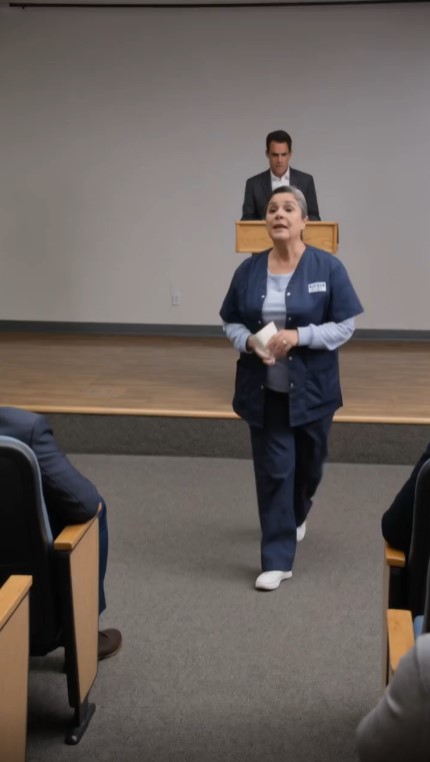
The entire room went quiet when the cleaning woman walked straight toward the stage.
The CEO was announcing hundreds of layoffs.
Nobody understood why Maria was approaching him.
Security started moving toward her.
But she raised one hand.
“Please. Before you do this… look at this.”
She placed an old folded receipt on the podium.
The CEO stared at it.
Then stopped speaking.
Twenty-seven years earlier, when he was broke and sleeping in his car, someone had paid for his first week in a cheap motel.
He never knew who.
Maria did.
Because the signature on that receipt belonged to her late husband.
The CEO looked at her in shock.
“Your husband was the man who helped me?”
Maria nodded.
Then she pointed toward the employees.
“He helped you when nobody else would. Don’t become the person who would have walked past you.”
Nobody moved.
The CEO slowly picked up the layoff papers.
Then tore them in half.
The room erupted.
But Maria wasn’t finished.
She reached into her cleaning cart.
And pulled out a second receipt.
This one was dated only two weeks earlier.
The CEO read the name on it…
and looked toward one employee in the back of the room.
His face went completely pale.
The employee’s name was Daniel Reed.
Thirty-one years old.
Quiet.
Worked in shipping.
Almost nobody in upper management knew him.
The CEO, Richard Hayes, stared at the receipt.
“Daniel?”
Daniel slowly stood.
Richard looked down again.
The receipt was from a pharmacy.
Under the total was a handwritten note:
Paid by Daniel Reed.
Richard frowned.
“I don’t understand.”
Maria did.
Two weeks earlier, she had been cleaning the employee break room late at night.
She found one of the warehouse supervisors, Mr. Lewis, sitting alone.
His wife needed medication.
Their insurance had changed.
He was short on money.
Daniel overheard the conversation.
He didn’t make a speech.
He didn’t start a collection.
He simply went to the pharmacy after his shift…
and paid the balance.
Mr. Lewis tried to repay him.
Daniel refused.
Maria had seen the receipt later when Lewis accidentally dropped it beside his locker.
Richard looked at Daniel.
“You paid for it?”
Daniel looked uncomfortable.
“It wasn’t a big deal.”
Maria turned toward the CEO.
“That’s exactly what my husband used to say.”
Richard looked at her.
Maria continued.
“Every person who helps somebody thinks it’s small.”
She tapped the first receipt.
“But twenty-seven years later, you’re standing here because somebody decided your life was worth one motel room.”
Then she touched the second receipt.
“And now somebody else is doing the same thing.”
The room became quiet again.
Richard slowly sat down on the edge of the stage.
For the first time all morning, he looked less like a CEO.
More like the frightened twenty-three-year-old he used to be.
Back then, Richard had nothing.
His father had died.
His mother was sick.
He had left college.
His car was both his transportation and his bedroom.
He worked temporary jobs during the day and washed dishes at night.
One winter evening, the car broke down.
Richard had forty-three dollars.
The mechanic told him the repair would cost several hundred.
He sat outside a diner wondering what to do.
That was when a stranger approached.
A man named Samuel.
Maria’s husband.
Samuel had noticed Richard sleeping in his car behind the diner several nights in a row.
He asked one question.
“You got somewhere warm tonight?”
Richard lied.
“Yes.”
Samuel looked at him.
“No, you don’t.”
Then he drove Richard to a small motel.
Paid for seven nights.
Bought him dinner.
And left.
Richard asked for his address.
Samuel refused.
Richard asked how he could repay him.
Samuel said:
“Don’t pay me back.”
Richard remembered the sentence perfectly.
“Help the next person who looks like they need somebody to stop.”
Richard had carried those words for twenty-seven years.
Or at least he thought he had.
Maria looked at the torn layoff papers on the stage.
“Did you?”
Richard lowered his eyes.
Not enough.
That was the answer.
He had built a company.
Thousands of employees.
Multiple warehouses.
A beautiful house.
He donated to charities.
Sponsored events.
Put his name on scholarship programs.
But somewhere along the way, helping people became an item on a budget.
A department.
A tax deduction.
A press release.
He had forgotten what it felt like when help came personally.
From someone who had nothing to gain.
Richard looked at Maria.
“How did you know that receipt was his?”
She smiled sadly.
“Samuel kept everything.”
After her husband died three years earlier, Maria went through boxes in their attic.
Inside one old folder were motel receipts.
Grocery receipts.
Handwritten notes.
Names.
Dates.
Small things Samuel had done over the years.
Most people never knew.
Richard’s receipt was one of them.
Samuel had written on the back:
Young man named Richard. Says he’ll be okay. Definitely not okay yet.
Richard laughed through tears.
“That sounds like him.”
Maria nodded.
“He never believed anyone when they said they were fine.”
Then Richard asked:
“Why did you bring it today?”
Maria looked around the room.
Because she had heard rumors of the layoffs.
Hundreds of workers.
People with mortgages.
Children.
Medical bills.
Some would recover quickly.
Some would not.
Maria knew the company had financial problems.
She wasn’t naïve.
She knew a corporation could not survive by pretending numbers didn’t matter.
But she also knew something else.
The layoffs were not the only option.
That was what bothered her.
Richard had approved executive bonuses less than a month earlier.
The company had delayed expansion plans but hadn’t canceled them.
Management salaries had not been touched.
The first people expected to carry the pain were the people with the least control.
Maria said:
“Samuel would’ve hated that.”
Richard nodded.
“So do I.”
The room remained silent.
Then his chief financial officer, Robert Collins, stepped forward.
“Richard, tearing up those papers doesn’t change the numbers.”
Richard looked at him.
“I know.”
“We still need to cut costs.”
“I know.”
Robert gestured around the room.
“Then what are you proposing?”
Richard stood.
“Everything gets reopened.”
Executive compensation.
Expansion.
Consulting contracts.
Management bonuses.
Vendor agreements.
Every expense.
No layoffs until they had examined what leadership could sacrifice first.
A few executives looked uncomfortable.
One actually whispered:
“This is emotional.”
Richard heard him.
“Yes.”
Then he added:
“So is losing your paycheck.”
No one responded.
The meeting ended without layoffs.
But Richard knew Maria’s challenge meant nothing if it became one dramatic morning followed by business as usual.
That afternoon, he asked Maria to come to his office.
She refused at first.
“I have work.”
“So do I.”
She eventually went.
Richard had the old motel receipt on his desk.
“Can I keep this?”
Maria shook her head.
“No.”
Richard looked surprised.
“It belonged to Samuel.”
“Exactly.”
“Then why bring it?”
“So you could remember.”
She held out her hand.
Richard returned it.
Then he asked:
“Did Samuel help many people?”
Maria smiled.
“More than I knew.”
After Samuel died, she found notebooks.
Not lists of good deeds.
Just reminders.
Call Frank about job interview.
Bring groceries to Mrs. Clark.
Ask Daniel whether daughter’s school fees got handled.
Check on Richard from diner if I see him again.
Richard froze.
“He wrote my name again?”
Maria nodded.
For nearly a year after paying for Richard’s motel, Samuel occasionally drove past the diner.
He wanted to know whether the young man had found his feet.
One note read:
Richard got work at the warehouse. Looks better. Pretended not to see me buying coffee. Good. Means he wants to pay for his own.
Richard laughed.
Then cried.
He had always thought Samuel disappeared from his life after one week.
He hadn’t.
He had quietly checked.
Then stepped back.
Maria said:
“That was him.”
Richard asked:
“Why did he never tell you?”
“He told me some stories.”
“Not yours.”
“Maybe because your story was still happening.”
That line stayed with Richard.
Your story was still happening.
He looked at Daniel’s pharmacy receipt.
Then asked Maria:
“What should I do with him?”
She frowned.
“Who?”
“Daniel.”
“Nothing.”
Richard looked confused.
“He helped someone.”
“So?”
“I want to recognize him.”
Maria shook her head.
“Then you’re going to ruin it.”
Daniel had not paid for the prescription because he wanted the CEO to notice.
He hadn’t even wanted Maria to notice.
Samuel would have understood that.
So Richard did something different.
He invited Daniel for coffee.
Not to an executive dining room.
Not in front of cameras.
Just coffee.
Daniel looked terrified when the message arrived.
He assumed he was being disciplined.
When he entered Richard’s office, he immediately said:
“If this is about the pharmacy, Mr. Lewis didn’t ask me to—”
Richard interrupted.
“I know.”
He pointed to a chair.
Daniel sat.
Richard asked:
“Why did you help him?”
Daniel shrugged.
“He needed help.”
“That’s it?”
“He’s helped me before.”
“How?”
When Daniel’s mother died the previous year, Mr. Lewis covered several of his shifts.
He organized meals.
Drove Daniel home after a particularly bad day.
Never asked for anything.
Daniel said:
“So when he needed something, I handled it.”
Richard leaned back.
A chain.
That was what he was seeing.
Samuel helped Richard.
Lewis helped Daniel.
Daniel helped Lewis.
Maria carried Samuel’s old receipt into a meeting.
No one was keeping score.
Except perhaps the receipts themselves.
Then Richard asked:
“Were you on the layoff list?”
Daniel hesitated.
“Yes.”
Richard’s face changed.
Daniel had known he was likely losing his job.
And two weeks earlier, he had still spent money helping another employee.
Richard whispered:
“You knew?”
“Rumors.”
“And you still paid for Lewis’s medication?”
Daniel shrugged.
“He needed it that night.”
Richard looked away.
Twenty-seven years earlier, Samuel had probably had his own bills too.
Kindness rarely arrives from people with absolutely nothing to lose.
Sometimes it costs something.
That was what makes it kindness.
The company review lasted three weeks.
The financial situation was real.
They needed to reduce expenses by millions.
But when leadership examined everything honestly, the original layoffs turned out not to be the only solution.
Executive bonuses were canceled.
Several expansion projects were postponed.
Consulting contracts were renegotiated.
Senior leadership accepted temporary salary reductions.
Unused office properties were sold.
Some open positions remained unfilled.
Voluntary reduced schedules were offered.
There were still painful decisions.
But the number of people who lost jobs dropped dramatically.
And no hourly employee was removed simply because cutting at the bottom was easier than cutting at the top.
Richard held another company meeting.
Maria stayed near the back.
He asked her to sit in front.
She refused.
“I can hear from here.”
Richard smiled.
Then he told employees:
“Three weeks ago, I was prepared to solve a leadership problem by making it an employee problem.”
No excuses.
He explained that the company still faced challenges.
He did not pretend generosity could replace responsible management.
But he promised one principle.
“If sacrifice is necessary, it starts with the people who have the most room to sacrifice.”
The applause was louder than before.
Maria didn’t clap.
Richard noticed.
Afterward he asked why.
She said:
“Promises get applause.”
Then:
“What you do next gets respect.”
Richard laughed.
“You’re difficult.”
“So was Samuel.”
“I believe that.”
Then Maria handed him something.
Not the original receipt.
A copy.
On the back she had written Samuel’s sentence:
Help the next person who looks like they need somebody to stop.
Richard framed it.
Not in the lobby.
In his office.
Facing his desk.
So visitors rarely saw it.
He did.
Every day.
Months later, Daniel received a promotion.
Not because he paid for someone’s prescription.
He earned it.
His performance had been strong for years.
Richard made sure the promotion went through normal review because he did not want generosity to become a shortcut to favoritism.
Daniel later told Maria:
“I thought he was going to make some big thing out of it.”
Maria smiled.
“He learned.”
Then another unexpected connection surfaced.
The second receipt had Mr. Lewis’s pharmacy information on it.
Lewis eventually learned why Maria had saved it.
He came to her one evening.
“You kept that receipt?”
“I found it.”
“You gave it to Richard?”
“Yes.”
He shook his head.
“Daniel is going to kill me.”
“He’ll survive.”
Then Lewis asked:
“Why did Samuel keep Richard’s receipt?”
Maria explained.
Lewis went quiet.
“My father knew Samuel.”
Maria stared.
“What?”
Lewis’s father, George, had worked at the same diner where Samuel met Richard.
George was the cook.
Samuel sometimes came in late at night.
Lewis called his sister.
She found an old photograph.
There was Samuel.
Standing outside the diner.
Beside George.
And a young Richard in the background unloading boxes from a truck.
Richard had been working there.
Samuel knew George.
The story was even more connected than anyone realized.
George had been the person who told Samuel:
“That kid sleeps in his car.”
That was why Samuel noticed Richard in the first place.
Richard stared at the photograph.
“So your father started this.”
Lewis shook his head.
“No.”
“He noticed.”
Maria smiled.
“That seems to be how most of these things start.”
Someone notices.
Someone stops.
Someone helps.
Then years later, somebody else does the same.
Richard had always told his success story one way.
He was homeless.
Worked hard.
Got lucky.
Built a company.
Now he changed the story.
Because “I did it myself” was not true.
He had worked hard.
Yes.
But someone had paid for a room when he needed warmth.
Someone at the diner had noticed he was sleeping in his car.
A warehouse manager later gave him a chance despite his unstable address.
People had helped.
Success had not erased that.
It had only made it easier to forget.
Maria retired two years later.
The company held a small gathering.
She specifically banned speeches longer than five minutes.
Richard ignored her.
His went twelve.
She glared at him the entire time.
At the end, he gave her a box.
Inside was not money.
Not jewelry.
The original motel receipt.
Maria stared.
“You made me give this back?”
“No.”
Richard smiled.
“That’s not yours.”
It was a copy printed on archival paper, framed beside a second copy.
Daniel’s pharmacy receipt.
Underneath:
27 YEARS APART. SAME DECISION.
Maria cried.
Then immediately complained that the frame was too expensive.
Richard laughed.
Before leaving, she gave him one final envelope.
Inside was a letter Samuel had written years earlier.
Never addressed to anyone.
Just a paragraph in one of his notebooks.
People think kindness means fixing somebody’s whole life.
Usually it means helping with the next ten feet.
A meal.
A room.
A ride.
A phone call.
Then they walk the rest themselves.
Richard read it twice.
That became the principle behind a company emergency-assistance fund.
But Maria insisted on one condition.
No giant portrait of Samuel.
No naming a building after him.
No publicity campaign turning his private kindness into corporate branding.
Richard agreed.
The fund quietly helped employees facing short-term emergencies.
Rent gaps.
Transportation problems.
Unexpected family expenses.
Medical bills.
Employees could also contribute voluntarily.
Daniel contributed every month.
So did Lewis.
Richard contributed personally.
No one called it charity.
Internally, employees simply called it:
The Next Ten Feet Fund.
Years later, when Richard retired, a reporter asked what decision he was proudest of.
The company had grown considerably.
There were acquisitions.
Awards.
New buildings.
Thousands of jobs.
Richard could have named any of them.
Instead, he talked about the day a cleaning woman interrupted him while he was preparing to fire hundreds of people.
The reporter asked:
“Did she really make you cancel all the layoffs?”
Richard corrected him.
“No.”
“She made me stop pretending layoffs were the only choice.”
That distinction mattered.
Maria had not magically fixed the company’s finances with an old receipt.
She had forced the people with power to examine themselves before deciding who should pay the price.
The receipt simply reminded Richard what being powerless felt like.
Then the second receipt showed him something even more important.
Samuel’s kindness had not disappeared.
It was still happening.
In a warehouse employee who quietly paid for someone’s prescription.
In a supervisor who covered another man’s shifts after his mother died.
In a cleaning woman brave enough to walk toward a stage while security moved toward her.
In thousands of ordinary acts no one photographed.
Richard kept the two framed receipts until the day he left the company.
Then he gave them to Daniel.
Daniel was shocked.
“Why me?”
Richard smiled.
“Because one of them has your name on it.”
Daniel looked at Samuel’s receipt.
“What about this one?”
“That one is why there was still a company here for you to work at.”
Daniel laughed.
Years later, Daniel became a senior operations director.
On his first day in the new office, he hung the frame behind his desk.
A young employee once asked what it meant.
Daniel gave him the shortest version.
“One man paid for a motel room.”
“Another man paid for medicine.”
“And a cleaning woman made sure nobody forgot either one.”
The employee frowned.
“That changed the company?”
Daniel smiled.
“Pretty much.”
Maria lived long enough to see the Next Ten Feet Fund help hundreds of families.
She hated whenever anyone credited her.
“It was Samuel.”
Richard always corrected her.
“It started before Samuel too.”
George had noticed Richard.
Samuel acted.
Others continued.
That was the point.
There was no single hero.
Only people deciding whether to walk past.
When Maria died many years later, Daniel attended her memorial.
So did Richard.
So did Mr. Lewis.
Near the entrance sat a small photograph of Maria and Samuel.
No corporate logos.
No awards.
Beside it was one line from Samuel’s notebook:
Help with the next ten feet.
Richard stood there for a long time.
Then Daniel joined him.
“You okay?”
Richard nodded.
“I keep thinking about what would’ve happened if she hadn’t walked toward that stage.”
Daniel looked at the photograph.
“Maybe you would’ve gone through with it.”
“I would have.”
Richard admitted it.
Hundreds of employees might have gone home that morning without jobs.
Daniel had been one of them.
So had people who later became managers.
Technicians.
Trainers.
People who stayed long enough to help rebuild the company.
Richard shook his head.
“All because she brought a receipt.”
Daniel smiled.
“No.”
“Because you looked at it.”
Richard glanced at him.
Daniel continued:
“Someone can put the truth in front of you.”
“You still have to decide what to do with it.”
Richard nodded.
That was probably the final lesson.
Twenty-seven years earlier, Samuel saw a broke young man sleeping in his car.
He paid for seven nights in a motel.
No cameras.
No recognition.
No expectation of repayment.
Decades later, that young man became a CEO standing on a stage with hundreds of layoff notices in his hand.
And Samuel’s widow walked toward him carrying proof of the person he had once been.
She reminded him that somebody had stopped for him.
Then she showed him a second receipt.
Proof that the same kind of quiet generosity was still happening inside his own company.
Richard tore up the layoff papers.
But that was not the real ending.
The real ending came afterward.
When the executives gave something up too.
When people stopped treating kindness like a story from twenty-seven years ago.
When one act became another.
And another.
Samuel once told Richard:
Don’t pay me back.
He never did.
Instead…
he finally learned what Samuel meant.
Pay it forward.