
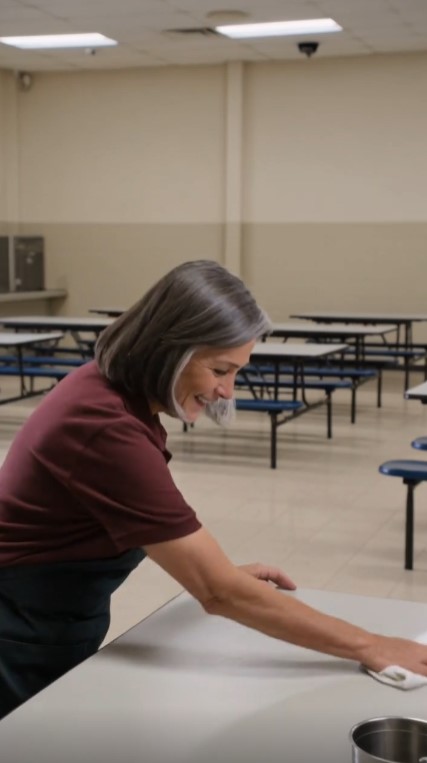
Everyone expected Marcus to celebrate graduation with his family.
Instead, he walked straight back into his old school cafeteria.
Still wearing his graduation gown.
Still holding his diploma.
The cafeteria was almost empty.
Then Marcus saw her.
Miss Rosa.
The woman who had served him lunch for six years.
She smiled.
“You graduated!”
Marcus didn’t answer.
He walked behind the counter…
and hugged her.
Then he started crying.
When Marcus was 12, his mother lost her job.
Some days, there simply wasn’t enough food.
Marcus never told anyone.
But Rosa noticed.
Every afternoon she quietly packed an extra sandwich into his backpack.
She never embarrassed him.
Never asked questions.
She just whispered:
“Growing boys need dinner too.”
Marcus never forgot.
Now, six years later, he placed his graduation cap in Rosa’s hands.
“I made it because you fed me when nobody knew I was hungry.”
Rosa broke down.
Then Marcus pointed toward the cafeteria entrance.
Dozens of former students were standing there.
Each holding a lunch bag.
Every single one had a story about Rosa.
But then a man stepped out from behind them.
Rosa saw him…
covered her mouth…
and whispered:
“My son?”
The man stopped.
For several seconds, nobody moved.
Marcus looked from Rosa to the stranger.
He had expected tears.
He had not expected this.
The man was maybe forty.
Tall.
Broad-shouldered.
Gray beginning around his temples.
He looked nothing like the students standing around him.
But the moment Rosa saw his face, she seemed to forget how to breathe.
The man whispered:
“Hi, Mom.”
Rosa grabbed the edge of the counter.
Marcus moved toward her.
“Miss Rosa?”
She shook her head.
“No.”
Not because the man was wrong.
Because the moment was too much.
She stared at him again.
“Daniel?”
He nodded.
Rosa started crying so hard she had to sit down.
Marcus looked at the former students.
None of them seemed surprised.
They knew.
He was the only one who didn’t.
Rosa covered her face.
“I thought…”
She couldn’t finish.
Daniel walked closer.
“I know.”
“You were gone.”
“I know.”
“Fifteen years.”
“I know.”
Rosa stood again.
Then slapped him lightly on the shoulder.
Then hugged him.
The cafeteria erupted in applause.
Daniel held her tightly.
Rosa cried against his chest.
“You couldn’t call?”
Daniel closed his eyes.
“I was ashamed.”
That answer made the room quiet again.
Marcus suddenly understood this was not just a reunion.
There was history here.
Pain.
Years of it.
Rosa eventually pulled away.
She looked around the cafeteria.
“What is happening?”
Marcus smiled.
“We were supposed to surprise you.”
Rosa looked at the dozens of lunch bags.
“Why?”
One former student stepped forward.
Her name was Tasha.
She had graduated eight years earlier.
“When my dad left, my mom worked nights.”
She held up a paper bag.
“You used to pack fruit for me because you knew I was going home to an empty apartment.”
Another student spoke.
“You paid my lunch balance three times.”
Another:
“You kept granola bars in your apron because I used to skip breakfast.”
Another:
“You gave me shoes.”
Rosa frowned.
“I did not give you shoes.”
The man laughed.
“You absolutely did.”
“They were used.”
“They were still shoes.”
One by one, the stories came.
Tiny things.
A banana slipped onto a tray.
An extra carton of milk.
A sandwich wrapped in foil.
A winter coat from the lost-and-found after Rosa made sure it had truly been abandoned.
Bus money.
A birthday cupcake for a student whose family forgot.
None of it seemed important to Rosa.
That was the strange part.
She remembered the children.
But not always the kindness.
Because to her, it had simply been what you did.
If a child was hungry, you fed them.
If somebody was cold, you found them something warm.
No ceremony.
Marcus said:
“You remember saying ‘Growing boys need dinner too’?”
Rosa laughed through tears.
“I said that to half the school.”
“That’s the point.”
Then she looked at Daniel.
“You knew about this?”
He nodded.
“I helped organize it.”
Rosa stared.
“You’ve been talking to Marcus?”
“For months.”
Marcus finally explained.
The whole thing started with a school assignment.
Seniors were asked to write about a person who changed their life.
Most students chose parents.
Teachers.
Coaches.
Marcus wrote about Rosa.
His English teacher asked if she could share the essay with alumni.
Marcus agreed.
Someone posted it in a private former-students group.
Within two days, comments flooded in.
She fed me too.
She used to keep crackers for me.
She bought my field-trip lunch.
She sat with me when my mom was in the hospital.
She remembered my birthday every year.
Marcus realized Rosa had been quietly doing the same thing for decades.
So he started contacting people.
Not for money.
Not at first.
Just stories.
Then one former student, Tasha, found an old article about Rosa.
A small community piece from years earlier.
It mentioned she had one son.
Daniel.
Marcus asked Rosa once:
“You have kids?”
Rosa answered:
“Just one.”
Then changed the subject.
That made him curious.
Eventually, through alumni connections, they found Daniel.
He was living three states away.
Marcus emailed him.
The first message was simple:
Hi, my name is Marcus. Your mom fed me when I was a kid and I didn’t have enough food. A lot of us are getting together to thank her. I thought maybe you should know.
Daniel did not reply for four days.
Then:
Is she okay?
Marcus wrote back:
Yes. We just want her to know what she did mattered.
Daniel answered:
It mattered to me too.
That was how the conversation started.
Daniel told Marcus why he had disappeared from Rosa’s life.
He had not been kidnapped.
He had not died.
Nothing dramatic.
He made mistakes.
At twenty-two, Daniel got into debt.
Then more debt.
He borrowed money from Rosa.
Promised to repay it.
Didn’t.
Then borrowed again.
Eventually, Rosa refused.
Daniel became angry.
He said things he regretted.
He accused her of caring more about “other people’s kids” at the school than her own son.
Rosa told him:
“I care about you enough to stop helping you destroy yourself.”
Daniel left.
At first, he expected Rosa to call.
She did.
He ignored her.
Then weeks became months.
He moved.
Changed numbers.
Got work.
Lost work.
Started rebuilding his life.
Every year, calling became harder.
Daniel said:
“I kept thinking I needed to become someone she could be proud of before I came home.”
Marcus had replied:
She’s already proud of you.
Daniel wrote:
You don’t know that.
Marcus answered:
I know Miss Rosa.
That message made Daniel agree to come.
Rosa listened to all of it.
Then looked at her son.
“You thought I needed you to become successful?”
Daniel nodded.
“I thought I had ruined everything.”
Rosa walked closer.
“You did ruin some things.”
The room went very quiet.
Daniel nodded.
“I know.”
“But you were still my son.”
Daniel’s face broke.
Rosa continued:
“You could have called me from a gutter.”
Somebody laughed softly.
Rosa pointed at Daniel.
“I would’ve been angry.”
Another laugh.
“I would’ve yelled.”
Daniel smiled through tears.
“I know.”
“I might’ve made you listen for two hours.”
“Definitely.”
“But I would’ve answered.”
Daniel started crying again.
Marcus looked down.
That sentence hit him.
Sometimes people don’t come home because they think home requires perfection.
Rosa apparently did not.
It required honesty.
Daniel whispered:
“I’m sorry.”
Rosa nodded.
“I know.”
“Can we start over?”
She looked at him.
“No.”
Daniel froze.
Rosa smiled.
“We start from here.”
Then she hugged him again.
That became the real celebration.
Not graduation.
Not even Rosa.
Something bigger.
People started opening the lunch bags.
Inside each was not food.
It was a note.
Every former student had written one memory.
One sentence about what Rosa did.
Marcus had collected hundreds.
They filled box after box.
Rosa picked one.
You gave me an extra sandwich for six months. You never asked why. I was embarrassed then. I’m grateful now.
Another:
My father died when I was fourteen. You sat beside me during lunch and didn’t force me to talk.
Another:
You paid for my lunch when my account was negative. I am now a teacher. I keep snacks in my classroom because of you.
Rosa covered her mouth.
Another:
You once told me I was not a bad kid, just a hungry kid having a bad day. I remembered that longer than you know.
Rosa stopped reading.
“Who wrote this?”
A man near the back raised his hand.
Rosa squinted.
“Anthony?”
He laughed.
“You remember me?”
“You threw mashed potatoes at a wall.”
The cafeteria exploded with laughter.
Anthony nodded.
“I was hoping you forgot that.”
“I never forget food abuse.”
Even Daniel laughed.
Then Marcus brought out one final bag.
It was larger.
Plain brown paper.
Rosa opened it.
Inside was a stack of envelopes.
Each contained a small donation.
Five dollars.
Ten.
Twenty.
Some more.
Rosa frowned.
“What is this?”
Marcus said:
“Everyone wanted to give something back.”
Rosa shook her head immediately.
“No.”
“It’s not for you.”
She paused.
“What?”
Marcus smiled.
“We knew you’d say no.”
The alumni had created a school meal assistance fund.
Not a huge flashy charity.
Something simple.
A quiet emergency fund for students whose families were struggling.
No public list.
No embarrassing announcements.
Counselors and staff could use it discreetly when needed.
Exactly how Rosa had helped.
She started crying again.
“You did this?”
Marcus nodded.
“We’re calling it Rosa’s Lunch Bag.”
Rosa pointed at him.
“No.”
Everybody laughed.
She hated the name.
Daniel said:
“I told them.”
Tasha shouted:
“We overruled you.”
Rosa shook her head.
“Call it something else.”
Marcus asked:
“What?”
Rosa thought.
Then smiled.
“Growing Kids Need Dinner Too.”
The room erupted.
The fund got its name.
But Daniel had another surprise.
He walked toward his mother and handed her a small envelope.
“This is different.”
Rosa opened it.
Inside was an old money order receipt.
Fifteen years earlier.
The exact amount Daniel owed her when he left.
Rosa stared.
“What is this?”
“I repaid you.”
“When?”
“Fourteen years ago.”
She frowned.
“I never got it.”
“I sent it to the old address.”
Rosa had moved shortly afterward.
The payment was returned.
Daniel had kept the receipt.
Not because he believed it fixed anything.
Because it reminded him of the first step he took toward changing.
Daniel explained.
After leaving home, he eventually found steady work as a mechanic.
He paid off his debts.
Stopped borrowing.
Started saving.
Then became shop manager.
Later, he bought into the business.
He wasn’t wealthy.
But he was stable.
He had a wife.
A teenage daughter.
Rosa stared at him.
“A daughter?”
Daniel smiled.
“Your granddaughter.”
Rosa’s knees nearly gave way again.
“What?”
He looked toward the cafeteria entrance.
A girl stepped inside.
About fourteen.
Dark curly hair.
Nervous smile.
Beside her stood a woman.
Daniel’s wife, Claire.
The girl whispered:
“Hi, Grandma.”
Rosa screamed.
Actually screamed.
Then ran toward her.
Marcus had never seen a woman in her sixties move that fast.
She wrapped her arms around the girl.
“What’s your name?”
“Emily.”
Rosa looked at Daniel.
“You named her Emily?”
Daniel nodded.
After Rosa’s mother.
Rosa cried harder.
Emily did too.
“I brought something.”
She held out a little paper bag.
Rosa laughed.
“Of course you did.”
Inside was a sandwich.
Peanut butter and jelly.
Cut diagonally.
Daniel smiled.
“I told her about the lunches.”
Emily said:
“Dad said you always cut sandwiches this way.”
Rosa hugged her again.
For fifteen years, Rosa thought Daniel had built a life somewhere without her.
She was right.
But she had imagined that life as proof he did not need her.
Now she learned the opposite.
He had told his daughter about Rosa constantly.
Stories.
Recipes.
The way she sang while cleaning.
The way she always burned the first pancake.
The way she packed food for anybody who visited.
Emily knew her grandmother before meeting her.
Just not personally.
Rosa looked at Daniel.
“Why didn’t you bring her sooner?”
Daniel answered honestly.
“Fear.”
That was all.
Not anger anymore.
Not pride.
Fear.
Rosa nodded.
“Then we don’t waste another year.”
They didn’t.
Daniel stayed in town for a week.
Then came back a month later.
Then Rosa visited him.
Emily started calling every Sunday.
At first, the conversations were awkward.
Then they became normal.
“What did you eat?”
“How’s school?”
“Why are you wearing that sweater?”
Grandmother things.
Rosa eventually attended Emily’s high school graduation.
When Emily walked across the stage, Rosa cried louder than anyone.
Daniel leaned over.
“You cried less at mine.”
Rosa whispered:
“You disappeared after yours.”
Daniel laughed.
“Fair.”
Meanwhile, Marcus went to college.
His first semester was hard.
He worked evenings.
Money was tight.
One afternoon, he opened a package from Rosa.
Inside were snacks.
Enough for two weeks.
And a note:
College boys need dinner too.
Marcus laughed so hard his roommate asked what happened.
He framed the note.
Four years later, Marcus graduated again.
This time from college.
He returned to the cafeteria.
Rosa was still there.
Older.
Moving slower.
Still noticing everything.
Marcus walked behind the counter.
She pointed at him.
“You’re not allowed back here.”
“You let me last time.”
“Graduation exemption expired.”
He hugged her anyway.
Then handed her another cap.
“You get two now.”
Rosa kept both.
By then, Rosa’s Lunch Bag—or Growing Kids Need Dinner Too, as she insisted everyone call it—had helped hundreds of students.
Most never knew where the assistance originated.
That was intentional.
No child had to stand in front of a committee and explain why there was no food at home.
Counselors handled it privately.
A grocery card.
A meal voucher.
A bag of food.
The next ten feet.
Just enough to help a family through a hard moment.
Marcus eventually became a school counselor.
He chose the work partly because of Rosa.
His office always had snacks.
Not hidden.
Not rationed.
A basket beside the door.
One day, a twelve-year-old boy started taking two granola bars every afternoon.
Marcus noticed.
He never said anything.
The fourth day, he quietly placed a small bag beside the boy’s backpack.
Sandwich.
Fruit.
Juice.
The boy stared.
Marcus whispered:
“Growing boys need dinner too.”
The words came out before he realized it.
He had to turn away.
Rosa’s voice had become his.
Years later, he told her.
She laughed.
“You stole my line.”
“I inherited it.”
“Better.”
Daniel changed too.
After reconnecting with Rosa, he began volunteering through his mechanic shop.
Not money.
Time.
He offered basic car repairs to single parents referred through local community organizations.
Rosa teased him:
“You’re finally feeding people.”
Daniel said:
“With brake pads.”
“Same idea.”
Then one winter, Rosa became ill.
Nothing sudden.
Age.
Complications.
She needed to stop working.
The cafeteria held a retirement gathering.
Rosa hated every minute of the attention.
Hundreds of former students came.
Some in person.
Some sent letters.
Teachers read messages from people across the country.
Doctors.
Mechanics.
Nurses.
Parents.
Truck drivers.
Teachers.
One former student was now a restaurant owner.
He said:
“I feed people because she fed me.”
Rosa shook her head.
“You became a chef because you liked food.”
He smiled.
“Both can be true.”
Marcus stood beside Daniel.
Emily sat in the front row.
Then the principal presented Rosa with a book.
A huge one.
Every page contained photographs and notes from former students.
The title:
THE PEOPLE YOU FED
Rosa opened the first page.
Marcus’s school photo at twelve.
Underneath:
I thought nobody knew I was hungry. She knew.
She closed the book.
“I can’t.”
Daniel put his hand on her shoulder.
“You can.”
So she kept going.
Page after page.
Then near the end, one page showed Daniel as a child.
Rosa froze.
He had submitted it himself.
Underneath:
Before she fed everybody else’s children, she fed me. I forgot for a while that love can say no. She never forgot me.
Rosa leaned her head against him.
“You were terrible.”
“I know.”
“I worried every day.”
“I know.”
“Fifteen years.”
“I know.”
Then she whispered:
“I’m glad you came back.”
Daniel answered:
“Me too.”
Rosa died peacefully several years later.
At her memorial, there were no flowers around the front table.
At her request, people brought lunch bags instead.
Each was donated to a local food program.
Hundreds filled the room.
Marcus gave the final speech.
He did not talk about Rosa saving his life.
She would have hated that phrase.
Instead, he said:
“She noticed.”
That was it.
She noticed when a kid ate too quickly.
When someone pretended not to be hungry.
When shoes no longer fit.
When a student sat alone.
When somebody needed help but was too embarrassed to ask.
Marcus looked at Daniel.
“Most of us think kindness is doing something huge.”
Then he looked at the lunch bags.
“Miss Rosa taught us it can be a sandwich.”
Daniel smiled through tears.
Emily held her grandmother’s old cafeteria apron.
Afterward, the family donated it to the school.
The school framed it.
Beside it was a small plaque.
Not Rosa’s biography.
Not a list of awards.
Just her sentence:
Growing kids need dinner too.
Years later, a new cafeteria employee asked Marcus who Rosa was.
Marcus smiled.
“She worked here.”
“That’s all?”
“No.”
Then he looked toward the lunch fund box.
“She noticed people.”
The employee nodded slowly.
Marcus continued walking.
Because that was really the whole story.
A twelve-year-old boy once went home hungry.
A cafeteria worker noticed.
She slipped an extra sandwich into his backpack.
No speech.
No questions.
No embarrassment.
Six years later, that boy came back in his graduation gown to tell her:
I made it because you fed me when nobody knew I was hungry.
He thought he was bringing Rosa a thank-you.
Instead, he brought back dozens of people she had helped.
Then one more person stepped through the door.
Her son.
Gone fifteen years.
Ashamed.
Afraid.
Still loved.
Rosa spent her life quietly feeding people who were missing something.
Sometimes it was lunch.
Sometimes dignity.
Sometimes hope.
And on the day everyone finally returned to thank her…
the person she had been missing most walked back into the cafeteria too.