
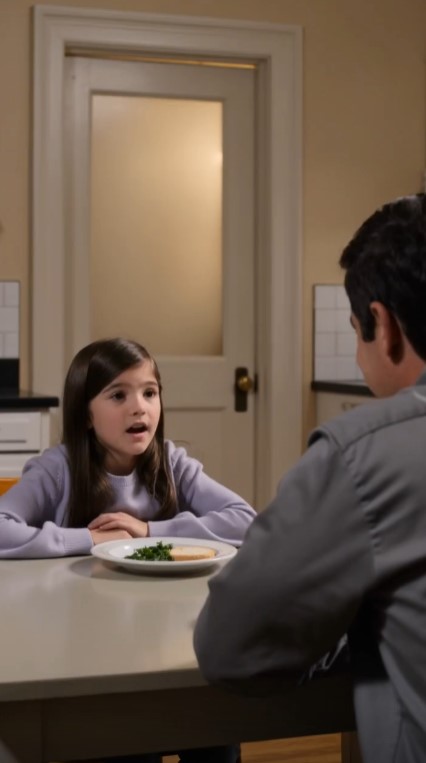
Every night, 11-year-old Sophie noticed the same thing.
Her father cooked dinner.
Put food on her plate.
Then sat across from her with nothing.
“Aren’t you eating, Dad?”
He always smiled.
“I ate at work.”
Sophie believed him.
Until one night she woke up thirsty.
She walked into the kitchen…
and found her father eating the crusts she had left on her plate.
He wasn’t full.
He was sacrificing his dinner for her.
Sophie quietly went back to bed.
The next afternoon, her teacher asked the class to write about their hero.
Most children wrote about athletes.
Famous people.
Superheroes.
Sophie wrote:
“My dad.”
At the school family night, her essay was read aloud.
Her father sat in the back row.
Then he heard:
“My dad tells me he already ate so I never know when there isn’t enough food.”
His face dropped.
Sophie walked off the stage and hugged him.
“You don’t have to pretend with me anymore.”
Her father started crying.
Then something happened neither of them expected.
One parent stood up.
Then another.
Then another.
Within seconds…
nearly every family in the room was standing.
And the man in the front row walked toward Sophie’s father.
He held out his hand.
“I think I have a job for you.”
Sophie’s father, Daniel, stared at him.
“What?”
The man smiled.
“My name is Robert Carter.”
Daniel recognized the name immediately.
Carter Construction was one of the largest building companies in the county.
Daniel had applied there twice.
No response.
Robert looked at his work-worn hands.
“Sophie says you used to do electrical work.”
Daniel glanced at his daughter.
“You wrote that too?”
Sophie nodded.
“A lot.”
Robert smiled.
“I’m looking for someone who knows commercial wiring and isn’t afraid of hard work.”
Daniel shook his head.
“Mr. Carter, I appreciate it, but you don’t know me.”
“No.”
Robert looked toward the stage.
“But your daughter does.”
Daniel’s eyes filled again.
Then Robert added:
“And I’m not offering you a job because she made everyone cry.”
A few parents laughed.
“I’m offering you an interview tomorrow morning.”
That distinction mattered.
Daniel nodded slowly.
“I’ll be there.”
Sophie squeezed his hand.
For the first time that night, Daniel smiled without pretending.
Their problems had not begun because Daniel was lazy.
Two years earlier, he had worked full-time for a small electrical contractor.
The pay wasn’t great.
But it covered rent.
Food.
School clothes.
Then the company lost a major contract.
Workers were cut.
Daniel was one of them.
He found temporary jobs.
Warehouse shifts.
Repairs.
Painting.
Deliveries.
Whatever he could get.
But nothing lasted.
Then his car needed a transmission repair.
Savings disappeared.
Rent increased.
And one unexpected bill became another.
Daniel began making choices Sophie never saw.
Electricity or groceries?
Gas or medication?
School field trip or new shoes?
He always chose Sophie first.
That was why he stopped eating dinner.
At first, it happened once.
Then twice.
He would tell her:
“I grabbed something on the way home.”
Or:
“They ordered pizza at work.”
There was no pizza.
Some nights there was no work either.
Daniel waited until Sophie went to sleep.
Then ate whatever remained.
Bread.
Cereal.
Her leftovers.
That night with the crusts was the first time she saw.
She never told him.
Not until the essay.
The next morning, Daniel arrived at Carter Construction twenty minutes early.
Clean shirt.
Old work boots.
A folder containing every certification he still had.
Robert interviewed him personally.
But there were other people in the room too.
No favors.
Questions.
Experience.
Safety.
Troubleshooting.
Daniel answered everything he could.
When he didn’t know something, he said so.
After forty minutes, Robert closed the folder.
“You’re rusty.”
Daniel nodded.
“I know.”
“You’ve been out of commercial work almost two years.”
“Yes.”
“We’d need to update some training.”
“I’ll do it.”
Robert leaned back.
“Can you start Monday?”
Daniel stared.
“You’re serious?”
Robert smiled.
“I don’t invite people here for entertainment.”
Daniel laughed.
Then asked the question he was afraid to ask.
“What’s the pay?”
Robert told him.
Daniel went silent.
It was more than his previous electrical job.
Not dramatically.
But enough.
Enough for food.
Rent.
Gas.
Maybe even savings eventually.
Daniel whispered:
“Thank you.”
Robert shook his head.
“Do the job well.”
“I will.”
“Then you won’t owe me anything.”
That afternoon, Daniel picked Sophie up from school.
He said nothing until they reached the car.
Then handed her a small paper bag.
Inside were two sandwiches.
Sophie looked confused.
“One for you.”
“And the other?”
Daniel smiled.
“Mine.”
She started crying immediately.
“Oh, come on,” Daniel laughed. “Now we’re crying over sandwiches?”
Sophie hugged him.
That night, they ate dinner together.
Both plates full.
Sophie watched him suspiciously.
Daniel took an exaggerated bite.
“See?”
She smiled.
But Daniel knew one job did not erase what had happened.
He sat with Sophie afterward.
“I need to apologize.”
“For what?”
“For pretending.”
Sophie shook her head.
“You were trying to protect me.”
“I was.”
“But I made you worry alone once you figured it out.”
She thought about that.
Then nodded.
“Yeah.”
Daniel smiled sadly.
“I should have told you we were having a hard time without making you feel responsible for fixing it.”
Sophie asked:
“Are we poor?”
Daniel laughed softly.
“We’re having money trouble.”
“Is that the same thing?”
“Sometimes.”
Then:
“But none of it is your fault.”
Sophie frowned.
“I know.”
Daniel was surprised.
“You do?”
“I’m eleven, Dad. Not four.”
Fair enough.
From then on, he became more honest.
Not burdening her with bills.
Not showing her every overdue notice.
Just truth.
“We’re saving this month.”
“That has to wait.”
“We’re okay, but we need to be careful.”
Sophie preferred it.
No more imaginary workplace dinners.
Daniel started work Monday.
It was hard.
His body had forgotten some of the rhythm.
His first week left him exhausted.
But he loved being back.
Wire.
Tools.
Plans.
Problems with answers.
Three months later, Robert stopped beside him on a job site.
“How’s it going?”
Daniel smiled.
“Still employed.”
“That’s usually a good sign.”
Then Robert asked:
“How’s Sophie?”
Daniel laughed.
“She asks every night if I ate lunch.”
Robert smiled.
“Smart kid.”
Daniel nodded.
“The smartest.”
But Sophie’s essay had affected more people than Daniel realized.
Her teacher, Mrs. Lewis, received calls from parents after family night.
Several said the same thing.
“We had no idea.”
Not specifically about Daniel.
About families in their own school.
Parents who quietly skipped meals.
Students who depended on school breakfast.
Families choosing between food and bills.
One parent suggested collecting groceries.
Mrs. Lewis hesitated.
Public charity could embarrass families.
So the school counselor proposed something different.
A confidential family support pantry.
No public lists.
No child carrying a box through a crowded hallway.
Families could discreetly request groceries, toiletries, or supermarket cards.
Local businesses donated.
Parents contributed when they could.
The school called it the Community Cupboard.
Sophie hated the name.
“It sounds like furniture.”
Mrs. Lewis laughed.
“What would you call it?”
Sophie thought.
“The Full Plate.”
The name stuck.
Daniel was embarrassed when he heard.
“You started a whole thing.”
“I wrote an essay.”
“Same thing apparently.”
The Full Plate program grew.
Not huge.
Not flashy.
Useful.
That mattered more.
Then something happened Daniel had not expected.
Robert invited him into the office six months after hiring him.
Daniel’s stomach dropped.
“You’re not firing me, right?”
Robert laughed.
“No.”
He handed Daniel a document.
The company wanted to pay for an advanced certification program.
Daniel stared.
“Why?”
“Because you’re good.”
That was it.
Not charity.
Not Sophie.
Work.
Daniel accepted.
A year later, he became a crew lead.
Two years later, assistant supervisor.
Life stabilized.
They moved into a slightly better apartment.
Daniel replaced the dying car.
Sophie got braces.
She complained constantly.
Daniel said:
“You wanted teeth.”
“I had teeth before.”
“Expensive straight teeth, then.”
Life became normal enough for jokes.
That was the real success.
Then one Saturday, Sophie found Daniel making three sandwiches.
She counted.
“One for me.”
“Yes.”
“One for you.”
“Yes.”
“Who’s the third?”
Daniel smiled.
“A guy at work.”
His name was Marcus.
Twenty-three.
New hire.
Living in his car after a family breakup.
Daniel noticed because Marcus always volunteered for early shifts but never seemed to go home.
One afternoon, Daniel saw blankets in the back seat.
He remembered.
Not exactly his own story.
But close enough.
So Daniel started packing extra food.
Sophie stared.
“Did you ask if he needed help?”
Daniel nodded.
“He said he’s fine.”
She raised one eyebrow.
“That means no.”
Daniel laughed.
“Where have I heard that before?”
Sophie helped make the sandwich.
Then slipped an apple into the bag.
“Growing men need dinner too.”
Daniel stared.
“Who taught you sarcasm?”
“You.”
Marcus eventually accepted help finding temporary housing.
Robert helped connect him with an employee assistance program.
Daniel helped him study for certification.
Nobody solved his entire life.
They simply kept him moving forward.
Years passed.
Sophie grew.
At sixteen, she got her first job.
Daniel showed up on her first day to take photographs.
She was horrified.
“Dad.”
“What?”
“You’re embarrassing me.”
“That’s a parental obligation.”
“You’ve taken twelve pictures.”
“Thirteen.”
She rolled her eyes.
Then during her first paycheck week, Sophie brought groceries home.
Daniel saw the bags.
“What is this?”
“Food.”
“I can see that.”
“I bought dinner.”
Daniel frowned.
“You need to save your money.”
Sophie smiled.
“I am.”
Then she took out a loaf of bread.
Daniel laughed.
For a moment, both remembered the kitchen years earlier.
The crusts.
The lie.
The empty plate.
Sophie said quietly:
“You fed me when there wasn’t enough.”
Daniel shook his head.
“That wasn’t your responsibility.”
“I know.”
She smiled.
“This isn’t responsibility.”
“It’s dinner.”
Daniel accepted that.
They ate together.
When Sophie graduated from high school, Mrs. Lewis attended.
So did Robert.
Daniel sat in the front row.
This time he was wearing a clean shirt with Carter Construction embroidered across the chest.
Sophie gave him a folded copy of her old hero essay.
He groaned.
“You still have this?”
“Of course.”
“I was hoping we could destroy it.”
“No chance.”
The last page had a new paragraph.
Written in Sophie’s older handwriting.
When I was eleven, I thought my dad was my hero because he went hungry so I could eat.
Daniel stopped reading.
Then:
Now I know that wasn’t the part I should admire most.
He looked at her.
Sophie smiled.
“Keep reading.”
What I admire is that when things got better, he remembered what being hungry felt like.
He notices people now.
He helps without making them feel small.
That is the part I want to copy.
Daniel cried.
Sophie laughed.
“You cry more than me now.”
“I’m old.”
“You’re forty-eight.”
“Ancient.”
She rolled her eyes.
Sophie went to college to become a teacher.
Daniel was surprised.
“I thought you wanted to be a lawyer.”
“I was eleven.”
“Children are unreliable.”
She became an elementary-school teacher.
In her first classroom, she kept snacks in a cabinet.
No sign.
No explanation.
If a child was hungry, they could quietly take something.
She also kept an eye on the parents.
The exhausted ones.
The embarrassed ones.
The people who said:
“We’re fine.”
Sometimes they were.
Sometimes not.
Sophie learned not to assume.
But she always noticed.
Years later, an eight-year-old student handed her an essay.
The assignment:
Write about your hero.
The child wrote about his grandmother.
She worked nights.
Packed his lunch.
Slept on the couch so he could have the bedroom.
Sophie had to stop reading for a moment.
The past had returned in another child’s handwriting.
She called the grandmother.
Not to expose her.
Not to embarrass her.
Just to say:
“Your grandson thinks you’re extraordinary.”
The woman cried.
Sophie understood.
Then she contacted the school counselor privately.
There were ways to help.
Respectfully.
Quietly.
That evening, Sophie called Daniel.
“You ruined my day.”
He laughed.
“What did I do?”
She told him.
Daniel was quiet.
Then:
“Did the kid get dinner?”
Sophie smiled.
“Yes.”
“Good.”
That was Daniel’s measure now.
Not speeches.
Not medals.
Dinner.
When Daniel eventually retired, Carter Construction held a small gathering.
Robert had retired years earlier.
His son now ran the company.
But Robert attended.
He was much older.
Walking with a cane.
Daniel saw him and smiled.
“You still hiring desperate fathers at school events?”
Robert laughed.
“Only the qualified ones.”
Then he handed Daniel something.
A copy of Sophie’s original essay.
Daniel groaned.
“Why does everybody have this?”
Robert smiled.
“Your daughter sent it to me years ago.”
He pointed to one paragraph.
My dad tells me he already ate so I never know when there isn’t enough food.
Robert said:
“That sentence brought you to my company.”
Daniel shook his head.
“No.”
“My experience got me hired.”
Robert smiled.
“Exactly.”
Daniel appreciated that.
The school-night moment opened a door.
Daniel still had to walk through it.
Work.
Learn.
Stay.
That distinction mattered.
Robert had never wanted Daniel to feel his career was a favor.
He had earned it.
Then Robert said:
“You know why I stood up that night?”
Daniel assumed it was the essay.
It wasn’t entirely.
Robert had grown up poor.
His own father often skipped meals.
He remembered asking at age nine:
“Why aren’t you eating?”
His father always answered:
“Not hungry.”
Years later, Robert understood.
When Sophie’s essay was read, he heard his own childhood.
He looked at Daniel and thought of his father.
Robert whispered:
“I couldn’t help him back then.”
“So I figured I could at least interview you.”
Daniel smiled.
“You did more than that.”
Robert shook his head.
“No.”
“Your daughter did.”
Again, everyone gave the credit away.
Maybe that was why the story kept moving.
Sophie eventually had a daughter of her own.
Her name was Emma.
One evening, when Emma was six, she left half a sandwich on her plate.
Daniel—now Grandpa Daniel—immediately reached for it.
Sophie slapped his hand away.
“We have food.”
Daniel laughed.
“Habit.”
She looked at him.
He looked back.
Both understood.
Some habits came from hunger.
Others from survival.
It had taken Daniel years to stop cleaning every plate simply because food was available.
Emma stared at them.
“Why is Grandpa stealing my sandwich?”
Sophie smiled.
“Long story.”
Daniel said:
“Your mother wrote an essay once.”
Sophie pointed at him.
“Absolutely not.”
He told Emma anyway.
Years later, after Daniel died peacefully, Sophie found a small envelope in his desk.
Inside was the old essay.
Folded.
Worn.
Beside it was a photograph from that school family night.
Eleven-year-old Sophie standing with Daniel.
His eyes red from crying.
Robert nearby.
Parents behind them.
On the back, Daniel had written:
The night my daughter found out.
Then below:
The night I learned hiding struggle isn’t the same as protecting someone.
Sophie cried.
There was another note.
Soph,
You called me your hero because you caught me eating crusts.
I wish you never had to see that.
But I’m glad you saw me afterward too.
Working.
Learning.
Helping Marcus.
Getting old.
Eating too much at Christmas.
Sophie laughed through tears.
Then:
Don’t remember me as the dad with the empty plate.
Remember all the dinners after.
That became the line Sophie kept.
Not the hunger.
The dinners after.
Because poverty had been part of their story.
It did not deserve to become the whole story.
Daniel struggled.
Then got an opportunity.
Then worked.
Then stabilized.
Then helped someone else.
Sophie grew up.
Then noticed other families.
The story moved forward.
Years earlier, an eleven-year-old girl had walked into the kitchen at night and discovered her father eating crusts from her plate.
She could have remembered only the sadness.
Instead, she wrote about love.
Her essay embarrassed Daniel.
Exposed a truth he wanted hidden.
Made an auditorium stand.
And brought one employer across the room to say:
I think I have a job for you.
But the job was only the beginning.
The real ending came years later…
when father and daughter sat across from each other at a table filled with food…
both eating…
neither pretending…
and both knowing that if they ever saw another person sitting with an empty plate…
they would notice.