
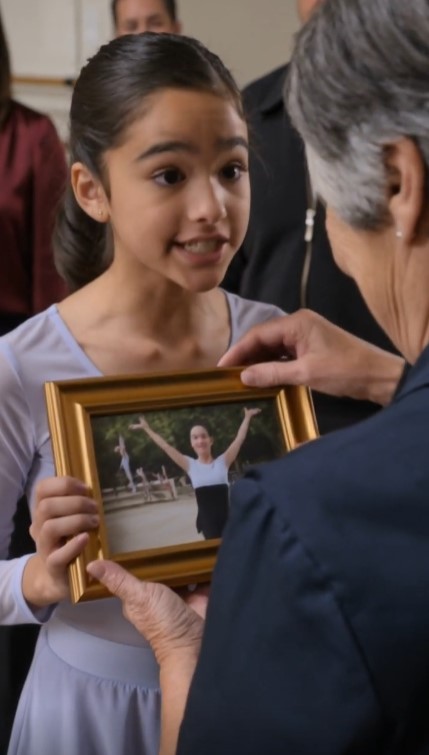
Fourteen-year-old Lily had just won her first major dance competition.
Her coach hugged her.
Her mother cried.
Everyone gathered for photographs.
But Lily suddenly walked away.
Still holding her trophy.
She crossed the entire room…
and stopped beside an elderly woman pushing a cleaning cart.
“Mrs. Helen?”
Helen looked embarrassed.
“Honey, go celebrate.”
Lily shook her head.
Then she handed Helen the trophy.
“This belongs to you too.”
Nobody understood.
Until Lily explained.
Two years earlier, Lily’s mother could no longer afford extra studio practice time.
Lily never complained.
She simply practiced quietly in the hallway while waiting for her ride.
Helen noticed.
Every evening after cleaning the studio…
she would leave one practice room open a little longer.
She never coached Lily.
Never broke any rules.
She simply finished that room last…
so Lily had somewhere safe to practice while her mother was on the way.
Sometimes Helen sat outside and applauded when Lily finally mastered a difficult step.
Lily looked at the crowd.
“Everybody saw me win tonight.”
“But she saw me when I wasn’t good yet.”
Helen began crying.
Lily hugged her.
Then the studio owner walked toward them.
He looked at Helen.
“Why didn’t you ever tell me?”
Helen smiled.
“She didn’t need people knowing she needed help.”
The owner looked at Lily.
Then back at Helen.
And said:
“There’s something you don’t know about Helen either.”
He walked to an old cabinet.
Pulled out a dusty framed photograph…
and handed it to Lily.
Lily stared at the young dancer in the picture.
Then looked at Helen.
“That’s you?”
Helen smiled through tears.
“Long before you were born.”
The photograph was nearly fifty years old.
A young woman stood beneath stage lights wearing a simple white costume.
Her arms were raised.
One foot pointed perfectly behind her.
At the bottom of the frame, faded gold lettering read:
Helen Carter — Regional Youth Dance Champion, 1978
Lily looked from the picture to the elderly woman beside the cleaning cart.
“You were a dancer?”
Helen laughed softly.
“A very long time ago.”
Lily’s coach, Maria, stepped closer.
“You never told any of us.”
Helen shrugged.
“Nobody asked.”
The studio owner, Robert, shook his head.
“That’s not the whole story.”
Helen gave him a warning look.
“Robert.”
But he continued.
“This building used to belong to Helen’s father.”
Lily stared.
“What?”
Before it became a modern dance studio, the building had been a small community arts hall.
Helen grew up there.
Her father, Samuel, repaired the floors and managed the building.
Her mother taught beginner dance classes.
Helen began dancing before she was five.
By fourteen, she was winning competitions.
By seventeen, people thought she might become a professional.
She was accepted into a prestigious dance program in another city.
Then everything changed.
Her father suffered a serious illness.
Her mother could not manage the building alone.
Helen stayed.
At first, she thought it would be temporary.
A semester.
Maybe a year.
She worked during the day.
Helped at the hall in the evenings.
Practiced whenever she could.
But life rarely follows the timetable people create for it.
Her father’s recovery took years.
The family struggled financially.
Helen eventually gave up her place at the dance program.
She stopped competing.
Then stopped performing altogether.
Lily looked horrified.
“You gave up dancing?”
Helen shook her head.
“No.”
“But you stopped.”
“That isn’t always the same thing.”
Helen still danced sometimes.
Alone.
Late at night.
After everyone went home.
For years, she continued helping at the community hall.
Eventually, the property was sold.
The building became the studio Lily knew.
Helen could have left.
Instead, she stayed on as part of the cleaning staff.
Not because she had nowhere else to go.
Because she liked being near the music.
Robert had bought the studio twenty-three years earlier.
He knew part of Helen’s story because his own mother had once taken classes from Helen’s mother.
But even Robert had never seen Helen dance.
Not really.
Lily looked down at the trophy still in Helen’s hands.
“Why didn’t you teach?”
Helen smiled.
“Because life went another direction.”
“That’s not fair.”
Helen’s expression softened.
“Sometimes life isn’t.”
Then she added:
“But that doesn’t mean the life you get is empty.”
Lily didn’t understand that yet.
At fourteen, she still believed every lost opportunity had to become a tragedy.
Helen didn’t.
She had married.
Raised two sons.
Cared for her parents.
Worked.
Laughed.
Travelled a little.
Lost her husband years later.
Became a grandmother.
Her dream of professional dance had ended.
But her life had not.
Still, Lily could not stop staring at the photograph.
The posture.
The confidence.
The same eyes.
Then Lily asked:
“Do you still remember?”
Helen laughed.
“Remember what?”
“The dance.”
Robert smiled.
“Oh no.”
Helen pointed at him.
“Do not encourage her.”
Lily stepped closer.
“Please.”
“I am seventy-two years old.”
“I didn’t ask you to jump.”
People nearby started laughing.
Helen shook her head.
“No.”
Lily held out her hand.
“One step.”
Helen stared at it.
The room became quiet.
Finally, she put the trophy down.
Then took Lily’s hand.
Maria turned the music lower.
Helen stood beside Lily.
At first, nothing happened.
Then Helen shifted her weight.
One foot moved.
Then the other.
Small.
Controlled.
Simple.
Not the movement of a fourteen-year-old competitor.
Something quieter.
More careful.
But when Helen lifted one arm, Lily saw it immediately.
The dancer in the photograph was still there.
The crowd began applauding.
Helen stopped.
“No, no.”
She laughed and waved everyone off.
But Lily was crying.
“You knew all that time.”
Helen looked at her.
“Knew what?”
“When you watched me practicing.”
Helen smiled.
“I knew how frustrating it is when your body won’t do what your head knows it should.”
Lily laughed.
“That happened a lot.”
“Yes.”
“Why didn’t you correct me?”
“Because I wasn’t your coach.”
“But you could have helped.”
Helen shook her head.
“You already had people teaching you.”
Then she tapped Lily gently on the shoulder.
“What you needed from me was a room.”
That sentence stayed with Lily.
Not every person who helps you needs to lead you.
Sometimes they simply make space.
The competition ended late.
Before everyone left, Robert asked Helen to keep the trophy overnight.
Helen refused.
“It’s hers.”
Lily refused too.
“It’s ours.”
They compromised.
Robert put it in the studio lobby for one week.
Underneath, Lily wrote a small card:
For Mrs. Helen, who made room before anyone knew I needed it.
The next Monday, students stopped to read it.
Some had seen Helen every day for years.
Few knew her name.
Now they did.
But Helen hated attention.
Within three days, she turned the card around.
Lily discovered it immediately.
“You can’t hide it.”
“I just did.”
“I’m turning it back.”
“I’ll turn it again.”
Lily crossed her arms.
Helen smiled.
They reached an agreement.
The card stayed.
But no giant celebration.
No social-media interview.
No dramatic spotlight.
Helen still wanted to be Helen.
The woman who cleaned mirrors.
Straightened chairs.
Found lost earrings.
And sometimes applauded from a hallway.
Over the next few months, something changed between them.
Lily stopped seeing Helen only as the person who had quietly helped her.
She began seeing her as a person with her own story.
Some evenings, after practice, they talked.
Not lessons.
Stories.
Helen told Lily about dance shoes that had to be repaired because her family couldn’t afford new ones.
About performing in a school gym where the stage lights overheated so badly that everyone nearly fainted.
About riding three hours in a van to competitions.
About losing.
A lot.
Lily was surprised.
“You lost?”
Helen stared at her.
“Constantly.”
“But you were good.”
“Those things can exist together.”
Lily thought about that.
She had spent years believing talented people won more easily.
Helen laughed when Lily said it.
“No.”
“Then what made you keep going?”
“Because I loved doing it when nobody was watching.”
That became another sentence Lily remembered.
Months later, Lily lost a competition badly.
Not second place.
Not third.
She didn’t make the final round.
She cried in the locker room.
Her coach tried to reassure her.
Nothing worked.
Lily felt embarrassed.
The previous trophy suddenly seemed like proof she had failed to live up to something.
When she returned to the studio two days later, Helen was cleaning.
Lily dropped her bag.
“I’m terrible.”
Helen kept wiping the mirror.
“No, you aren’t.”
“You didn’t even see the competition.”
“I don’t need to.”
“How do you know?”
Helen stopped.
“Because one bad result cannot erase the work I watched you do for two years.”
Lily looked away.
“It felt awful.”
“I know.”
“What did you do when you lost?”
Helen smiled.
“Usually complained.”
Lily laughed despite herself.
“Seriously?”
“I was dramatic.”
“You?”
“Extremely.”
Then Helen pointed toward the practice room.
“Go dance.”
“I don’t feel like it.”
“Then don’t practice.”
Lily frowned.
“What?”
“Put on a song you like.”
“And?”
“Dance badly.”
Lily stared.
Helen smiled.
“You’re allowed.”
So Lily did.
No competition routine.
No corrections.
No mirrors.
Just music.
By the end, she was laughing.
Helen applauded from outside.
Just like before.
That evening, Lily understood what Helen had meant.
Love of something had to survive losing at it.
Otherwise, it wasn’t love.
It was only approval.
Time passed.
Lily improved.
At sixteen, she won another major competition.
This time, when everyone applauded, she looked immediately toward the back of the room.
Helen was there.
No cleaning cart.
Robert had insisted she sit with the families.
Lily smiled.
Helen raised both thumbs.
That was enough.
Then came Lily’s senior year.
College applications.
Auditions.
Money became an issue again.
Her mother, Sarah, was doing better financially than two years earlier, but professional dance programs were expensive.
Travel.
Fees.
Shoes.
Tuition.
Lily began considering giving it up.
She didn’t tell Helen.
She didn’t tell Maria.
She only told her mother:
“Maybe I should study something practical.”
Sarah knew her daughter too well.
“You don’t mean that.”
“It would be easier.”
“That isn’t the same thing.”
Lily looked down.
Sarah said:
“If you decide you don’t want dance, I’ll support you.”
“But don’t quit because you think I need you to.”
That sounded strangely familiar.
The next evening, Helen found Lily sitting in the hallway.
Not dancing.
“What happened?”
“Nothing.”
Helen sat beside her.
At seventy-four, getting onto the floor required planning.
Getting up would require even more.
Lily eventually admitted the truth.
Helen listened.
Then said:
“I have something for you.”
She disappeared into the staff room.
Returned with an envelope.
Inside was a check.
Lily immediately pushed it back.
“No.”
Helen frowned.
“You haven’t even looked.”
“I know what it is.”
“Then you’re psychic.”
“I’m not taking your money.”
Helen sighed.
“It isn’t mine.”
Lily looked confused.
Years earlier, after the trophy story spread quietly through the dance community, several former students had learned about Helen.
Some remembered her family’s old community hall.
Others remembered Helen helping behind the scenes.
Robert had proposed creating a small scholarship.
Helen refused to have it named after her.
So they called it:
The Open Room Fund.
It was designed for students who needed help paying for extra studio time, audition fees, or travel.
Not full tuition.
Just the small gaps that sometimes made people quit.
Helen handed Lily the application.
“You’re eligible.”
Lily stared.
“You created this?”
“No.”
“You inspired it.”
“I complained about the name for six months.”
Lily laughed.
Then cried.
The fund helped with two audition trips.
Lily earned partial scholarships from two schools.
She chose one close enough for Sarah to visit.
Before leaving for college, Lily stopped by the studio.
Helen was alone.
Cleaning the same hallway where Lily used to practice.
Lily handed her a box.
Inside was a copy of the old 1978 photograph.
But beside Helen’s competition photo was a newer picture.
Lily holding her first trophy.
Helen beside her.
Underneath, Lily had written:
Two dancers. Different stages.
Helen stared at it.
“You put yourself next to me?”
Lily smiled.
“You put yourself next to me first.”
Helen hugged her.
College was hard.
Lily considered quitting twice.
Once after an injury.
Once after a professor told her she might never have the career she imagined.
Both times she called Helen.
Helen never said:
“Don’t quit.”
Instead, she asked:
“If nobody applauded again, would you still want to dance?”
The first time, Lily immediately said yes.
The second time, she took longer.
Then answered yes again.
So she stayed.
Years later, Lily became a professional dancer.
Not famous.
Not a star.
She joined a regional company.
Performed.
Taught workshops.
Built a good life.
Then, in her early thirties, an injury changed her path.
The career she had imagined ended sooner than expected.
For several months, Lily felt lost.
She called Helen.
By then, Helen was eighty-nine.
Her voice was weaker.
Her mind was sharp.
“I think I’m done,” Lily said.
Helen answered:
“With performing?”
“Yes.”
“With dancing?”
Lily went quiet.
Helen laughed softly.
“Those are not the same thing.”
Again.
The same lesson.
Lily eventually became a teacher.
Then a studio director.
Years later, when Robert retired, Lily returned to the building where everything began.
She became part-owner.
Her first major decision was to preserve the old practice room.
The same one Helen had cleaned last.
She installed a small plaque beside the door.
Helen hated plaques.
So Lily kept it simple.
It read:
THE OPEN ROOM
For anyone who needs a little more time.
No name.
Helen approved.
The room was reserved each week for students who could not afford additional practice hours.
Nobody had to explain.
Nobody had to feel embarrassed.
If the room was free, it was theirs.
One evening, Lily found a twelve-year-old girl practicing alone.
Her name was Ava.
She was struggling with a turn.
Again.
Again.
Again.
Finally, she got it.
Lily almost corrected something.
Then stopped.
She remembered Helen.
Ava didn’t need a coach at that moment.
She needed someone to notice.
Lily applauded from the doorway.
Ava spun around.
“You were watching?”
“Only the last one.”
Ava smiled.
Lily continued walking.
Years later, Helen died peacefully at ninety-one.
The memorial was small.
Family.
Friends.
Former coworkers.
Lily brought the original trophy.
The same one she had handed Helen at fourteen.
Helen’s son Michael smiled when he saw it.
“She kept the card.”
“What card?”
He gave Lily a small envelope.
Inside was the note from the studio lobby.
For Mrs. Helen, who made room before anyone knew I needed it.
Helen had pretended she hated the attention.
She had kept the card for more than thirty years.
Michael handed Lily another item.
The original 1978 dance photograph.
“She wanted you to have this.”
On the back, Helen had written something.
Lily turned it over.
I thought losing the stage meant dance was finished with me.
I was wrong.
Then one final line:
Sometimes your biggest contribution happens after the applause ends.
Lily cried.
She framed the photograph in the Open Room.
Beside it, finally, she placed Helen’s name.
Not because Helen had once been a champion.
Because generations of young dancers now had a room to practice in because one woman had noticed a child rehearsing in a hallway.
Years later, students asked Lily:
“Who was Helen Carter?”
Lily always smiled.
“She cleaned this studio.”
They looked confused.
“That’s why she has a picture here?”
“No.”
Lily pointed at the practice room.
“She made space.”
Then she told them the story.
A fourteen-year-old girl once won a trophy.
Everyone rushed toward her.
But instead of staying for photographs, she crossed the room toward an elderly woman pushing a cleaning cart.
The girl handed her the trophy.
And said:
“This belongs to you too.”
At the time, Lily thought she was thanking Helen for a few extra minutes in a practice room.
Years later, she understood it differently.
Helen had given her something much bigger.
She had shown Lily that people do not always change your life by standing in front of you.
Sometimes they stand quietly at the edge.
They keep a door open.
They give you time.
They notice before the world does.
And when everyone finally sees what you became…
you remember the person who saw you when you were still becoming it.