
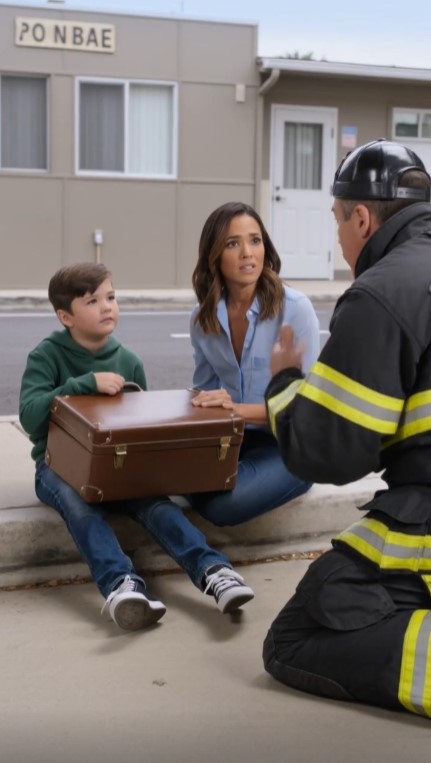
😱 The little boy wouldn’t let the firefighters touch the old suitcase.
The apartment building had already been safely evacuated.
Everyone was outside.
But 7-year-old Noah sat on the sidewalk…
hugging one battered suitcase against his chest.
A firefighter knelt beside him.
“Is something important inside?”
Noah nodded.
“Then let’s keep it safe.”
But Noah wouldn’t let go.
His mother rushed over.
The moment she saw the suitcase…
she froze.
“Where did you get that?”
Noah pointed toward the building.
“It was outside our door.”
His mother went pale.
“That suitcase disappeared before you were born.”
The firefighter looked at her.
“What do you mean?”
She slowly touched the handle.
“My father left with this suitcase seventeen years ago.”
“He never came back.”
Nobody spoke.
There was no address on it.
No note.
Nothing explaining how it had appeared outside her apartment that morning.
Once the family was safely away from the building…
Noah’s mother finally opened it.
Inside were neatly folded clothes.
An old watch.
And dozens of unopened birthday cards.
Every card had Noah’s mother’s name on it.
One for every birthday her father had missed.
Then Noah reached into the side pocket.
He pulled out one final envelope.
Unlike the others…
this one had his name on it.
His mother stared.
“Noah wasn’t even born when Dad disappeared.”
The firefighter looked at the envelope.
Then at her.
Noah whispered:
“So how did Grandpa know my name?”
😳
His mother, Emma, took the envelope from Noah with shaking hands.
The handwriting was unmistakable.
Her father’s.
Thomas Carter.
She had spent seventeen years trying to forget exactly what those letters looked like.
The way he crossed his T’s.
The tiny hook at the end of an H.
Even the way he wrote names slightly uphill.
This was him.
“Noah Carter,” she whispered.
Then she looked at her son.
“But you’re Noah Bennett.”
The firefighter, Marcus, frowned.
“What was your father’s name?”
“Thomas Carter.”
“And Noah’s middle name?”
Emma went still.
Noah answered proudly.
“Thomas.”
Marcus looked at her.
Emma nodded slowly.
“I named him after my father.”
That explained part of it.
But not enough.
The envelope didn’t say Noah Thomas.
It said:
For Noah Bennett, when he is old enough to ask about me.
Emma sat down on the curb.
There was no way her father could have written that seventeen years ago.
Noah hadn’t existed.
She hadn’t met her husband, Daniel, until six years after Thomas disappeared.
Marcus crouched beside her.
“Maybe the letter was written later.”
Emma stared at him.
That possibility was somehow worse.
“If he was alive later…”
She couldn’t finish.
If Thomas had lived long enough to know Noah’s name, then he had also lived long enough to know Emma had spent years believing he had abandoned her.
Noah touched her arm.
“Can we open it?”
Emma looked at the envelope.
Then at the dozens of birthday cards in the suitcase.
Seventeen years of questions.
She nodded.
“Okay.”
Inside was a folded letter.
The date at the top was only eight months old.
Emma stopped breathing.
Marcus noticed.
“What?”
She turned the page toward him.
“He was alive eight months ago.”
Noah stared.
“Is Grandpa alive now?”
Emma’s eyes filled.
“I don’t know.”
She began reading.
Dear Noah,
If you’re reading this, then your mother finally has the suitcase.
Emma stopped.
Finally?
The next line made her hands shake harder.
She is going to be angry with me. She has every right to be.
Emma laughed once.
Not because anything was funny.
Because seventeen years of anger had just been acknowledged by a man she thought had vanished from the world.
She continued.
You don’t know me, but I know about you.
Noah leaned closer.
Your mother named you Noah Thomas Bennett.
Emma whispered:
“How?”
Then she read the next sentence.
Your Aunt Sarah found me three years ago.
Emma’s entire expression changed.
“Sarah?”
Her older aunt.
Thomas’s younger sister.
The woman who lived less than twenty miles away.
The woman Emma spoke to every Christmas.
The woman who had told Emma for years:
“I wish I knew where your father went.”
Emma stood so quickly the suitcase almost fell.
Marcus steadied it.
“Careful.”
Emma pulled out her phone.
She called Sarah.
No answer.
Again.
Nothing.
Marcus said gently:
“Finish the letter first.”
Emma wanted to throw it.
Instead, she sat back down.
Do not blame Sarah.
Emma almost shouted.
“Too late.”
Noah looked worried.
She softened.
“Sorry.”
Then she continued.
I asked her not to tell you until I was ready. That was selfish. I know that now.
Thomas explained.
Seventeen years earlier, he had not simply walked out.
He had been in serious financial trouble.
Not because of gambling.
Not because of crime.
Because the small construction company he owned had collapsed after a business partner disappeared with money owed to subcontractors.
Thomas had personally guaranteed several debts.
He lost almost everything.
Then came the worst part.
One of the unpaid workers threatened legal action and accused Thomas of fraud.
Thomas panicked.
He believed he had destroyed the family.
Emma had been sixteen.
Her mother had died two years earlier.
Thomas was already struggling to parent alone.
Instead of admitting how bad things had become, he did what he had always done.
He tried to fix everything quietly.
He left town to find his former business partner.
He planned to be gone three days.
Then a week.
He never found him.
Instead, Thomas suffered a serious medical emergency while traveling.
He spent weeks hospitalized under circumstances that left him unable to return quickly.
By the time he recovered enough to go home, his shame had become heavier than the original problem.
He called Emma once.
A relative answered and told him Emma was furious.
Thomas interpreted that as:
She doesn’t want me back.
Emma whispered:
“No…”
She remembered that call.
She had been at school.
Her uncle Robert answered.
Robert later told her:
“Your father called. He said he needs time.”
Emma had screamed:
“Tell him I never want to hear from him again.”
She was sixteen.
Heartbroken.
Furious.
She expected her father to come home anyway.
He didn’t.
Thomas wrote in the letter:
You will probably wonder why I didn’t come back after that. There is no good answer.
I was ashamed.
Then every month away made the next month harder.
Eventually I convinced myself Emma was better without me.
Emma covered her face.
Marcus looked away, giving her privacy.
Noah whispered:
“Mom?”
She pulled him close.
“I’m okay.”
She wasn’t.
The letter continued.
Thomas spent years working under his own name in different towns.
He never intentionally hid from police.
There had never been a criminal case against him.
Emma had filed a missing-person report, but once authorities found signs he had left voluntarily and was alive, the case eventually became inactive.
Thomas moved again.
Worked.
Lived alone.
Every year, he bought Emma a birthday card.
Every year, he wrote inside.
And every year…
he failed to mail it.
Noah looked at the stack.
“All of them?”
Emma counted.
Seventeen.
Exactly.
Her seventh birthday.
Eighth.
Ninth.
All the way to twenty-three.
Then later birthdays.
Some cards were newer.
One was still in its store envelope.
She opened the first.
Emma,
You are seventeen today.
I should be there.
The next:
Eighteen. I wonder if you graduated.
Another:
Twenty-one. Your mother would tell me to stop being an idiot and call you.
Emma started crying harder.
Noah hugged her.
Then she found the card from the year she married Daniel.
Inside:
Sarah told me you’re getting married. His name is Daniel. She says he is good to you. I hope that’s true.
Emma froze.
Sarah had known earlier than three years ago.
Much earlier.
She called again.
Still nothing.
Then Marcus asked:
“Could Sarah be coming here?”
Emma looked toward the apartment building.
The evacuation had started because of a small electrical fire in a basement utility room.
Nobody had been injured.
Residents were being allowed back gradually.
The suitcase had been left outside Emma’s door before the fire alarm went off.
Someone had placed it there that morning.
Emma looked at the parking lot.
A car had just pulled in.
Sarah stepped out.
Emma stood.
Her aunt saw the suitcase.
Then stopped.
“Emma…”
Emma walked toward her.
“You knew.”
Sarah started crying.
“I can explain.”
“For how long?”
“Not everything.”
“For how long, Sarah?”
Sarah looked at Noah.
Then at Marcus.
“Eleven years.”
Emma stepped backward.
Eleven.
Sarah had known Thomas was alive for eleven years.
Not where he was constantly.
But alive.
Contact had been irregular.
Thomas called from different numbers.
Sent letters to a post-office box.
He refused to give a permanent address.
Sarah begged him to speak to Emma.
He always said:
“Soon.”
Then:
“Not yet.”
Then:
“She has a family now. Don’t ruin it.”
Emma was furious.
“You let him decide that for me?”
Sarah cried.
“I was wrong.”
“Yes.”
“I thought if I pushed too hard, he’d disappear again.”
“He already had!”
“I know.”
No excuse fixed it.
Sarah knew that.
So she didn’t try.
Instead she handed Emma a second envelope.
“This came yesterday.”
Emma stared.
“From Dad?”
Sarah nodded.
“He told me to bring the suitcase to you this morning.”
“You left it outside?”
“Yes.”
“Why not knock?”
Sarah looked ashamed.
“Because he told me you might refuse it if you saw me.”
Emma laughed bitterly.
“He knows me pretty well for someone who hasn’t seen me in seventeen years.”
Then Sarah said:
“Emma, there’s more.”
Emma looked at her.
“Is he alive?”
Sarah hesitated.
That hesitation said everything.
“He died three weeks ago.”
Emma closed her eyes.
Noah stopped moving.
Marcus lowered his head.
Sarah continued quickly.
“He was in hospice care.”
“You knew?”
“Yes.”
“And you didn’t call me?”
“He wouldn’t let me.”
Emma exploded.
“He wouldn’t let you?”
“Emma—”
“I am forty years old!”
“Thirty-three.”
“That is not the point!”
Even Marcus almost smiled.
Then Emma’s anger broke into grief.
“I could have seen him.”
Sarah stepped closer.
“I know.”
“I could have told him I didn’t hate him.”
“I know.”
“I could have asked why.”
“I know.”
Sarah reached for her.
Emma pulled away.
Not yet.
Maybe later.
Then Noah spoke.
“Did Grandpa know about me?”
Sarah nodded.
“Yes.”
“How?”
“I showed him pictures.”
Emma stared at her.
Sarah admitted she had sent Thomas occasional updates.
Wedding photograph.
Noah’s birth announcement.
His first school picture.
A video of him learning to ride a bicycle.
Thomas never contacted them directly.
But he watched from a distance.
That was why he knew Noah’s full name.
Why the final letter existed.
Why the suitcase had returned.
Noah looked at the envelope again.
“Did Grandpa write more?”
Emma returned to the letter.
The final pages were for Noah.
Your mother may tell you I was a good man.
Emma looked away.
She may tell you I was a coward.
Sarah started crying again.
Both can be true.
I loved her every day I was gone.
Love did not automatically make my choices good.
Emma stopped.
That sentence mattered.
Thomas wasn’t asking forgiveness from beyond the grave.
He was admitting failure.
He wrote:
If there is one thing I want you to learn from me, Noah, it is this: never let embarrassment become silence.
Tell people when you are scared.
Tell them when you failed.
Tell them before the distance becomes larger than the mistake.
Noah listened carefully.
Then:
And take care of your mother.
Not because she needs a man to take care of her. She never did.
Emma laughed through tears.
Take care of her because she has spent enough years wondering whether people she loves are going to disappear.
That broke her.
She hugged Noah.
Then the final paragraph:
There is one more thing in the suitcase.
Everyone looked inside.
Beneath the clothes was a thin wooden box.
Emma opened it.
Inside was an old brass key.
And a photograph.
Thomas.
Older.
Very thin.
But unmistakably her father.
He stood outside a small cabin.
On the back:
Lake Mercer. Cabin 14. Paid through this year. It belongs to Emma now.
Sarah explained.
Thomas had bought the cabin years earlier.
Nothing expensive.
Tiny.
Remote.
He spent summers there.
It was the closest thing he had to home.
Inside were the things he couldn’t fit in the suitcase.
Letters.
Photographs.
Records.
Emma’s childhood drawings.
The rest of his life.
Two weeks later, Emma went.
Daniel drove.
Noah came.
Sarah asked to join them.
Emma almost said no.
Then said yes.
Not because everything was forgiven.
Because she had learned enough about silence.
Cabin 14 sat beside a lake.
Simple wooden porch.
Green roof.
One rocking chair.
Emma unlocked it.
Inside, the walls were covered with photographs.
Emma at five.
Ten.
Sixteen.
Her graduation photograph from the newspaper.
Wedding.
Noah as a baby.
Noah at school.
Pictures Sarah had sent.
Thomas had watched Emma’s life in fragments.
On the desk were more birthday cards.
Several addressed to Noah.
Future birthdays.
Eight.
Nine.
Ten.
Nothing beyond thirteen.
Maybe Thomas knew he wouldn’t be around.
Noah opened the first only after Emma said yes.
Happy eighth birthday, Noah.
I hope you are still drawing dinosaurs. Sarah says you are very good.
Noah smiled.
“I am.”
Emma sat down.
On another shelf was her father’s old watch.
The same kind Noah found in the suitcase.
But this one was broken.
Beside it was a note:
Emma fixed this once with tape when she was six. It never worked properly afterward. I kept it anyway.
Emma laughed.
Then cried.
Daniel found a larger envelope.
For Emma — after the anger.
She opened it.
Thomas wrote:
If you are reading this while still furious, put it down.
Emma almost did.
Then kept reading.
I am not leaving you instructions about forgiveness.
You do not owe me that.
I only want you to know I never left because you were not enough.
I left because I believed I was.
That sentence changed something.
Not everything.
Nothing could restore seventeen years.
But Emma had spent much of her life secretly wondering whether her father’s disappearance reflected something about her.
Was she difficult?
Was he tired of raising her?
Did he want another life?
Now she knew.
His disappearance had been about his shame.
His failure to ask for help.
His inability to come home after making a mistake.
She still hated the decision.
But she no longer carried it as evidence that she had been unlovable.
They stayed at the cabin until sunset.
Then Noah asked:
“Can we come back?”
Emma looked at the lake.
“Yes.”
The cabin became part of their family.
Not a shrine.
Emma refused that.
They cleaned it.
Repaired the porch.
Replaced the curtains.
Noah drew new pictures and put them beside his mother’s childhood drawings.
Life entered the place Thomas had spent years using to hide from it.
Sarah came sometimes.
Her relationship with Emma took longer to heal.
Emma was angry that Sarah kept the secret.
Sarah accepted that.
No demands.
No:
“I was only trying to help.”
Eventually Emma asked:
“Why did you really keep his secret?”
Sarah answered honestly.
“Because I was afraid of losing him too.”
Thomas was her brother.
Once she found him, she became terrified that pushing him toward Emma would make him disappear again.
So she protected the connection she had.
At Emma’s expense.
It was wrong.
Sarah knew that now.
Emma nodded.
“Thank you for saying that.”
They didn’t hug.
Not that day.
But they spoke again the next week.
Then the next.
A year later, Noah turned eight at Cabin 14.
He opened Thomas’s card at breakfast.
Then Emma brought out a cake.
Sarah attended.
Daniel lit the candles.
Noah made a wish.
Afterward, he took the old suitcase from the closet.
Emma had repaired the handle but left the scratches.
Inside were all seventeen birthday cards.
She had read every one.
Some made her angry.
Some made her laugh.
Some contained nothing but:
I’m sorry.
Emma kept them all.
Noah asked:
“Why?”
Emma thought.
“Because they’re part of the story.”
“Even the bad part?”
“Especially the bad part.”
Years passed.
The suitcase became a family object.
Not because it had monetary value.
Because of what it represented.
Silence.
Regret.
Return.
When Noah was sixteen, Emma finally told him everything without simplifying it.
He listened.
Then asked:
“Do you forgive Grandpa?”
Emma thought for a long time.
“Some days.”
Noah smiled.
“That’s allowed?”
“Yes.”
Forgiveness had never arrived as one dramatic moment.
Some days Emma felt compassion.
Other days she was furious all over again.
Both were real.
What changed was that she stopped letting Thomas’s choices control how she handled her own relationships.
If she was angry with Daniel, she spoke.
If Noah made a mistake, she made sure he knew mistakes did not equal abandonment.
If Sarah upset her, she said so.
No disappearing.
No waiting seventeen years.
That became the real inheritance.
Not the cabin.
Not the watch.
Not even the cards.
A warning.
Silence grows.
Speak before it does.
Years later, Noah graduated high school.
Emma sat in the front row.
So did Daniel.
Sarah sat beside them.
Afterward, Noah handed Emma a small envelope.
“What’s this?”
“Open it.”
Inside was a card.
On the front:
To Mom
Inside:
You showed up. Every time.
Emma cried.
Noah hugged her.
Then he added:
“I put another one in the suitcase.”
She smiled.
“For who?”
“My kid someday.”
“You don’t have a kid.”
“Exactly.”
Emma laughed.
“Runs in the family.”
Decades later, when Noah had a daughter, he brought her to Cabin 14.
She found the old battered suitcase.
“What’s this?”
Noah sat beside her.
He told her.
About a seven-year-old boy standing outside an evacuated apartment building at two in the morning—
Actually, he corrected himself.
“It wasn’t two in the morning.”
His daughter laughed.
He started again.
A seven-year-old boy sitting on a sidewalk.
A firefighter kneeling beside him.
A suitcase that belonged to a grandfather nobody had seen in seventeen years.
Birthday cards.
A watch.
A letter addressed to a child who had not existed when the grandfather disappeared.
Then the truth.
Thomas had not predicted Noah’s birth.
He had simply lived long enough to learn his name.
Long enough to regret.
Long enough to write.
But not long enough—or not brave enough—to come home himself.
His suitcase did it for him.
Noah’s daughter asked:
“Was Grandpa Thomas bad?”
Noah shook his head.
“No.”
“Good?”
He thought.
“Complicated.”
She frowned.
“That means both.”
Noah smiled.
“Exactly.”
That was what Emma eventually understood too.
Thomas had loved his daughter.
He also hurt her.
He had been ashamed.
He had also been selfish.
He had tried to protect people.
He had also taken away their right to choose whether they wanted him back.
Love did not erase any of that.
But truth allowed the family to stop repeating it.
And it all began with an old suitcase sitting outside an apartment door.
A child refused to let firefighters take it away.
His mother recognized the handle.
Seventeen years of unanswered questions were hidden inside.
Then Noah pulled out one envelope.
His own name written across the front.
And asked the question that finally opened everything:
“So how did Grandpa know my name?”