
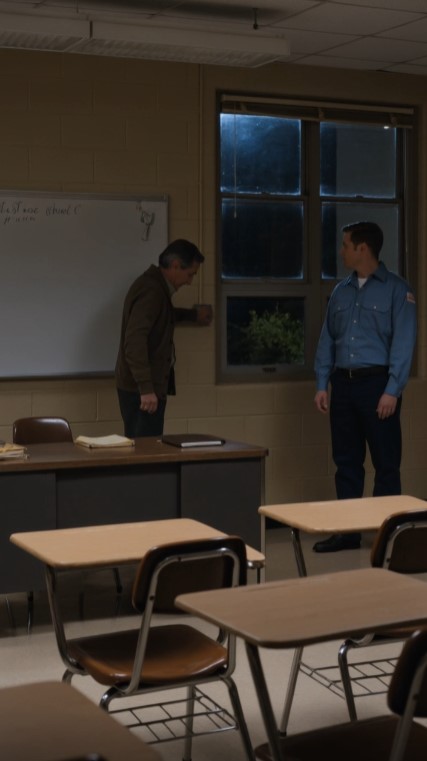
Every night at exactly 8:15…
the retired school janitor returned.
He turned on one classroom light.
Waited ten minutes.
Then left.
The new custodian finally asked why.
The old man pointed at one desk.
“Because somebody once promised she’d come back.”
Thirty-three years earlier, a frightened student had stayed after school there every evening.
He gave her a quiet place to study.
Then her family suddenly moved.
Before leaving she told him:
“When I become somebody, I’ll come back and tell you.”
She never did.
Until that night.
A car stopped outside.
A woman walked toward the school.
The janitor saw her through the window…
and dropped his keys.
Her name was Laura Bennett.
He knew before she reached the door.
Not because she looked exactly the same.
She didn’t.
The frightened sixteen-year-old with oversized glasses and a secondhand backpack was gone.
This woman was almost fifty.
Confident.
Well dressed.
Silver beginning to show in her dark hair.
But she still walked the same way.
Fast when nervous.
Then slower just before entering a room.
The old janitor, Henry, whispered:
“Laura.”
The new custodian, Marcus, looked at him.
“That’s her?”
Henry couldn’t answer.
Laura opened the classroom door.
For several seconds, she simply stood there.
Then she looked toward the third desk in the second row.
The desk Henry had pointed at.
Her eyes filled.
“You kept the light on.”
Henry finally found his voice.
“You took your time.”
Laura laughed.
Then she cried.
She crossed the room and hugged him.
Thirty-three years disappeared for a moment.
Marcus quietly stepped into the hallway.
This reunion did not belong to him.
Laura sat at the old desk.
It wasn’t technically the same desk anymore.
The school had replaced the furniture years earlier.
But Henry always made sure one remained in the same spot.
Third desk.
Second row.
Near the radiator.
That had been Laura’s place.
Back then, she rarely went home immediately after school.
Her father was angry most nights.
Her mother worked late.
Their apartment was crowded and loud.
Laura never described everything happening at home.
Henry never pressured her.
He just noticed.
Every afternoon around four, he would find her sitting in the hallway with textbooks on her knees.
One evening he asked:
“You waiting for somebody?”
Laura lied.
“My mom.”
Henry knew the school closed soon.
He also knew her mother’s shift ended after nine.
Instead of exposing the lie, he unlocked Room 18.
“You can wait in here.”
She looked suspicious.
“Am I allowed?”
Henry shrugged.
“You’re studying.”
That became the arrangement.
Every afternoon, Laura sat at the third desk.
Henry cleaned around her.
Sometimes he brought vending-machine crackers.
Sometimes hot chocolate from the staff room.
He never called it charity.
“Bought two by mistake.”
Laura always knew he was lying.
She never embarrassed him by saying so.
Then one evening she asked:
“Mr. Henry, do you think people can become completely different?”
Henry leaned on his mop.
“Different how?”
“Like… if everybody thinks you’ll end up one way.”
“Everybody is usually wrong.”
Laura smiled faintly.
She wanted to become a doctor.
Henry remembered almost laughing.
Not because he thought she couldn’t.
Because she said it like a confession.
“I know it sounds stupid.”
“No.”
“My grades aren’t good enough yet.”
“Yet.”
“We can’t afford college.”
“That’s a problem.”
“My dad says people like us don’t become doctors.”
Henry stopped cleaning.
“Your father sounds tired.”
Laura looked offended.
“He’s not tired.”
Henry chose his words carefully.
“Tired people sometimes mistake limits for facts.”
Laura remembered that sentence for the rest of her life.
From then on, Henry asked about her grades.
Not constantly.
Not like a teacher.
Just enough.
“How’d chemistry go?”
“Terrible.”
“So you’re quitting medicine?”
“No.”
“Good.”
Another week:
“Math?”
“B.”
“Congratulations.”
“I wanted an A.”
“Then be annoyed tomorrow. Tonight, enjoy the B.”
Laura laughed.
She slowly improved.
Then one Friday, she came into Room 18 crying.
There were boxes in the family car.
Her father had found work in another state.
They were leaving the next morning.
No warning.
No goodbye to friends.
No final day of school.
Nothing.
Henry sat beside her.
“What about your classes?”
“I don’t know.”
“Doctor plan?”
Laura wiped her eyes.
“I don’t know.”
Henry looked at her.
“Then don’t decide tonight.”
She nodded.
Before leaving, Laura stood beside the desk and made the promise.
“When I become somebody, I’ll come back and tell you.”
Henry smiled.
“You’re already somebody.”
She rolled her eyes.
“You know what I mean.”
“I do.”
Then she left.
For the first few years, Henry expected her.
Graduation season.
Summer.
Christmas.
Every unfamiliar car made him look up.
Nothing.
Then five years passed.
Ten.
Twenty.
Henry retired.
The promise should have become a sweet old memory.
Instead, once a year, on the anniversary of Laura’s final evening in Room 18, Henry returned at 8:15.
Then once a year became once a month.
After his wife died, it became every night.
Not because he truly expected Laura to walk in.
The ritual simply gave structure to a quiet evening.
He switched on the light.
Sat for ten minutes.
Remembered students.
Then went home.
Marcus eventually noticed.
At first he thought Henry was checking the building.
Then he asked.
And Henry told him about the girl who wanted to become a doctor.
Now Laura was sitting in front of him.
Henry smiled.
“Well?”
“Well what?”
“You said you’d come back when you became somebody.”
Laura looked at him for a long moment.
Then she opened her purse.
She removed an identification card.
DR. LAURA BENNETT
PEDIATRIC CARDIOLOGY
Henry stared.
Then laughed so loudly Marcus heard him from the hallway.
“You did it.”
Laura nodded.
“I did.”
Henry sat down.
For some reason, that made him emotional in a different way.
Not because of the title.
Because he remembered the girl who thought the dream sounded stupid.
Laura reached into her bag again.
“I brought something.”
She placed a worn notebook on the desk.
Henry recognized it.
Blue cover.
Bent corners.
The chemistry notebook she carried everywhere.
She opened the first page.
Written in teenage handwriting:
Dr. Laura Bennett
Over and over.
Testing how it looked.
Henry laughed.
“You practiced your signature?”
“Every night.”
Then she turned several pages.
Near the back was another line.
Mr. Henry says everybody is usually wrong.
Henry went quiet.
“You remembered that?”
“I remembered everything.”
Laura told him what happened after moving.
The new school was worse at first.
She hated it.
Her father’s job lasted only eight months.
The family moved again.
Her grades slipped.
She nearly dropped out.
Then a counselor found her old transcripts and noticed how much she had improved.
Laura told the counselor about Henry.
About Room 18.
About the doctor plan.
The counselor helped her apply for scholarships.
Laura attended community college first.
Then transferred.
Medical school came later.
Slowly.
Harder than she had imagined.
Possible anyway.
Henry asked:
“Why didn’t you come back sooner?”
Laura looked ashamed.
That question had followed her the entire drive.
“At first, I couldn’t.”
“Then?”
“Then I thought I’d come after college.”
“But?”
“I didn’t feel like I’d done enough yet.”
Henry smiled knowingly.
“So you changed the definition of ‘somebody.’”
Laura nodded.
“Then after medical school, I was in residency.”
“Still not enough?”
“No.”
“Then?”
“I got married.”
Henry lifted an eyebrow.
“Not enough?”
Laura laughed.
“Then divorced.”
“Ah.”
“Then Mom got sick.”
Laura’s mother died several years later.
Laura became consumed by work.
Years became decades.
Every time she thought about returning, embarrassment grew.
What if Henry was gone?
What if the school had closed?
What if he didn’t remember her?
Then three months earlier, Laura had been treating a twelve-year-old patient whose father worked for the school district.
During a conversation, he mentioned an elderly former janitor who still visited his old school.
Always around 8:15.
Laura stopped him.
“What school?”
When he named it, she nearly dropped her pen.
She searched online.
Found an old retirement photograph.
Henry.
Older.
But there.
Laura drove past the school twice.
Both times she kept going.
Henry laughed.
“You were outside?”
“Yes.”
“Why didn’t you come in?”
“I got scared.”
“You’re a cardiologist.”
“Apparently that doesn’t help with doors.”
Henry smiled.
“Third time?”
“Third time I parked.”
She looked around Room 18.
“And the light was on.”
Henry’s eyes filled.
Laura then asked the question she had wondered about for thirty-three years.
“Why did you let me stay?”
Henry seemed confused.
“Because you needed somewhere to stay.”
“That’s it?”
“What else?”
“You didn’t even really know me.”
“I knew enough.”
Laura shook her head.
“No. You don’t understand.”
Henry listened.
“There were nights I came here because I was afraid to go home.”
Henry’s expression changed.
He had suspected.
Never knew.
Laura continued.
“My father never hit me.”
She wanted that clear.
“He was just angry all the time.”
“Money.”
“Work.”
“Everything.”
“He yelled.”
“Broke things sometimes.”
“I couldn’t concentrate.”
“Here, I could.”
Henry looked toward the desk.
Laura said:
“You thought you gave me a quiet room.”
“You gave me a future I could hear myself thinking in.”
Henry wiped his eyes.
“I didn’t do that much.”
Laura smiled.
“You don’t get to decide how much it meant to me.”
He had no answer.
Then Laura brought out one final item.
An envelope.
“What’s that?”
“My first paycheck as a doctor.”
Henry stared.
“You kept it?”
“The check stub.”
She had written something on the back all those years ago:
Go back to Room 18.
Henry laughed.
“You ignored your own instructions for a long time.”
“Thirty-three years.”
“Terrible student.”
Laura smiled.
Then the classroom door opened again.
Marcus entered.
Behind him stood several adults.
Henry frowned.
“What’s this?”
Laura stood.
“I wasn’t the only person who came.”
One by one they entered.
Former students.
Not all from Laura’s year.
Some were older.
Some younger.
Laura had contacted people through an alumni group after learning Henry was still alive.
She asked one question:
Did Mr. Henry ever help you when nobody noticed?
The responses overwhelmed her.
A man named David remembered Henry repairing his backpack strap with duct tape because his family couldn’t afford another.
A woman named Alicia remembered Henry saving school lunch leftovers—only food that could be safely redistributed under school rules—for students staying late for activities.
A former athlete remembered Henry driving back to school after hours to unlock a locker containing medication he urgently needed.
Another woman remembered crying in a stairwell after her parents separated.
Henry sat nearby without demanding explanations.
He simply said:
“You don’t have to go back to class until you’re ready.”
Henry looked around the room.
“I don’t remember half of this.”
Laura smiled.
“We do.”
That was the point.
Henry had spent his career believing he cleaned classrooms.
Fixed doors.
Changed bulbs.
Mopped floors.
But students remembered something else.
He noticed.
The school principal arrived last.
She carried a small brass plaque.
Henry groaned immediately.
“No.”
Everyone laughed.
“You don’t even know what it says.”
“I know I don’t want it.”
Laura took the plaque.
It read:
ROOM 18
THE HENRY MILLER STUDY ROOM
A QUIET PLACE FOR ANY STUDENT WHO NEEDS ONE
Henry stared.
The school had approved a small after-school program.
Students needing a safe, supervised place to study before transportation or family pickup could use the room.
A staff member would always be present.
No child would have to invent a story about waiting for someone.
Henry looked at Laura.
“You did this?”
“We all did.”
“I just turned on a light.”
Laura shook her head.
“No.”
“You left it on.”
The program began that fall.
Henry volunteered once a week.
Only once.
The principal refused to let a man in his eighties work every night.
He complained.
Nobody listened.
Laura funded a small scholarship attached to the program.
Nothing extravagant.
Enough each year to help one student with application fees, books, transportation, or another practical obstacle.
She refused to name it after herself.
Instead:
THE 8:15 FUND
Henry called that ridiculous.
Laura kept the name.
A year later, a sixteen-year-old boy named Caleb became the first recipient.
He wanted to study engineering.
His family could afford tuition with financial aid but struggled with testing and application costs.
The fund covered them.
Henry met him in Room 18.
“What do you want to become?”
Caleb shrugged.
“Somebody.”
Henry smiled.
“That word again.”
“What?”
“Never mind.”
He pointed toward the desk.
“Sit.”
Years passed.
Laura visited whenever she could.
Not every night.
She had a life.
Patients.
Work.
Friends.
But she stopped postponing the people who mattered.
Henry became part of her life again.
She invited him to lectures.
He refused anything requiring a tie.
She brought him dinner.
He complained her hospital cafeteria food was terrible.
He was right.
On his eighty-fifth birthday, Laura asked him something.
“Did you really think I’d come back?”
Henry thought.
“At first.”
“And after thirty years?”
“No.”
Laura laughed.
“Then why keep turning on the light?”
He looked toward Room 18.
“Because promises aren’t only for the person who made them.”
Laura frowned.
“What does that mean?”
“Sometimes waiting changes the person waiting.”
Henry explained.
After retirement, especially after his wife died, he felt invisible.
The school had been his life.
Then suddenly, nobody needed keys from him.
Nobody asked him to fix anything.
Nobody shouted:
“Mr. Henry!”
Turning on the light reminded him that ordinary work could matter beyond the day it was done.
Laura stared at him.
“So I helped you too?”
Henry smiled.
“Took you thirty-three years.”
“Sorry.”
“Unacceptable.”
They laughed.
When Henry eventually died peacefully at eighty-eight, Room 18 was full at his memorial.
Former students.
Teachers.
Custodians.
Laura.
Marcus.
Caleb, now in college.
On Henry’s old key ring was one key marked:
18
The school gave it to Laura.
She kept it on her desk at the hospital.
Years later, a young medical student noticed it.
“What does that open?”
Laura smiled.
“Nothing anymore.”
“Then why keep it?”
She looked at the little metal key.
“Because once, it opened the only quiet room I had.”
She told him the story.
Not as a story about a heroic janitor.
Henry would have hated that.
It was about something much smaller.
A man saw a teenager sitting alone in a hallway.
Instead of asking too many questions, he unlocked a classroom.
He gave her ten quiet minutes.
Then an hour.
Then another evening.
He asked about chemistry.
Remembered her grades.
Believed her dream before she did.
And when she disappeared without warning, he remembered the promise she left behind.
“When I become somebody, I’ll come back and tell you.”
Thirty-three years later…
a woman walked toward the school.
Henry saw her through the window.
He dropped his keys.
Laura stepped into Room 18.
Looked at the light he had kept turning on.
And finally understood something Henry had tried to tell her when she was sixteen.
She had never needed to become somebody.
She already was.
But sometimes…
it takes one person leaving a light on long enough…
for us to find our way back to that truth.