
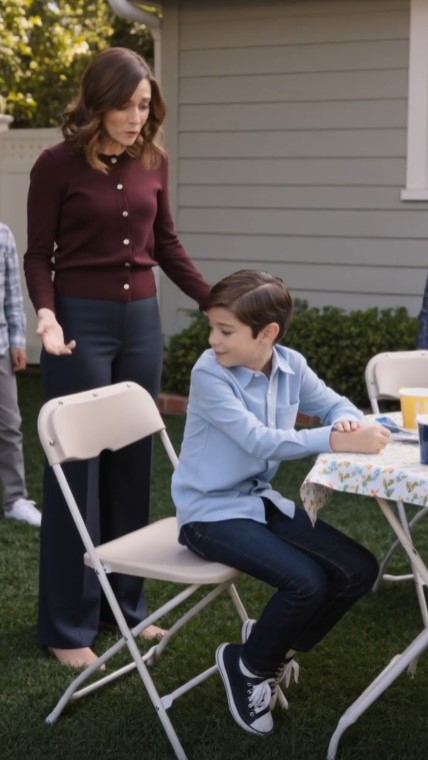
Everyone thought the empty chair was for his father.
It wasn’t.
Ten-year-old Ethan had invited every child in his class to his birthday.
His mother decorated the backyard.
His grandparents came.
The cake was ready.
But beside Ethan sat one empty chair.
Nobody was allowed to use it.
His mother finally asked:
“Who are we waiting for?”
Ethan pointed toward the sidewalk.
“The man who waits with me every morning.”
She didn’t understand.
Then an elderly crossing guard appeared at the gate.
Still wearing his plain work jacket.
Ethan ran to him.
“Mr. Walter!”
For months, Ethan’s mother had started work before sunrise.
Walter noticed Ethan reaching school early.
He never left him alone.
He stood nearby.
Talked with him.
Helped him practice spelling words.
And every morning said:
“Your mom is working hard for you. Make her proud.”
Ethan pulled out the chair.
“This one’s yours.”
Walter sat down…
already crying.
Then Ethan’s grandfather walked outside.
He saw Walter.
Stopped.
And dropped the gift in his hands.
Walter stood up too.
The two elderly men stared at each other.
Neither spoke.
Then Ethan’s grandfather whispered:
“Walter?”
Walter’s face seemed to collapse.
“Thomas.”
Ethan looked between them.
“You know each other?”
Neither man answered immediately.
Thomas slowly walked closer.
Thirty-eight years had changed both of them.
Walter’s hair was almost completely white now.
Thomas walked with a slight limp.
Their faces carried decades the other had never seen.
But recognition was immediate.
Thomas whispered:
“I thought you were dead.”
Walter shook his head.
“And I thought you never wanted to see me again.”
Ethan’s mother, Rachel, stepped forward.
“Dad… who is he?”
Thomas stared at Walter.
Then said something that silenced the entire backyard.
“He’s my brother.”
Rachel’s mouth opened.
“My uncle?”
Thomas nodded.
“My younger brother.”
Ethan looked at Walter with enormous eyes.
“So Mr. Walter is family?”
Walter laughed through tears.
“Apparently.”
Thomas didn’t laugh.
Not yet.
He was still trying to understand how the brother he had not seen in nearly four decades had spent months standing beside his grandson every morning.
Rachel stared at her father.
“You told me you didn’t have a brother.”
Thomas looked ashamed.
“I told you I had one.”
“You said he died when you were young.”
Thomas closed his eyes.
“That’s what I believed.”
Walter shook his head.
“No.”
Then he looked at Ethan.
“This probably isn’t the birthday story you expected.”
Ethan shrugged.
“It’s better.”
That finally made Walter smile.
Everyone moved inside after that.
The children returned to cake and games.
But in the kitchen, four adults sat around a table.
Thomas.
Walter.
Rachel.
And Rachel’s mother, Margaret.
Margaret kept staring at Walter.
“I knew it was you.”
Walter looked surprised.
“You did?”
“The second you stood up.”
She turned toward Thomas.
“I didn’t say anything because I thought I was imagining it.”
Walter looked down.
“I almost left when I saw you.”
Thomas asked:
“Why?”
Walter gave him a sad look.
“For the same reason you didn’t come looking for me.”
That opened an old wound.
The story began forty years earlier.
Thomas and Walter had grown up in a small house with their mother, Evelyn.
Their father died when they were teenagers.
Thomas became responsible early.
Too early.
At twenty-one, he worked two jobs.
Walter was seventeen.
Restless.
Angry.
Always convinced Thomas was trying to control him.
Then their mother became ill.
Bills piled up.
Thomas borrowed money.
Walter dropped out of school to work.
Neither told the other how scared he was.
One night, they had an argument.
A terrible one.
Walter wanted to leave town with a friend who had promised him construction work.
Thomas told him:
“If you walk out now, don’t come back when you need something.”
Walter shouted:
“Maybe I won’t.”
Their mother cried.
Walter left the next morning.
Thomas expected him home within days.
He wasn’t.
A week became a month.
Then three.
Thomas finally received a letter.
At least he thought it was from Walter.
It said:
I’m done with this family. Stop looking for me.
Thomas never forgot those words.
Walter stared at him.
“I never wrote that.”
Thomas frowned.
“What?”
“I sent letters.”
“Not that one?”
“No.”
Walter had written repeatedly.
The first:
I got the job. I’m okay. Tell Mom I’m sorry.
The second:
I want to come home for Christmas.
Another:
Tom, I know we were both angry. Can we start over?
No answers came.
Eventually Walter assumed Thomas was keeping his promise.
Don’t come back.
Thomas shook his head.
“I never saw those.”
Walter looked toward Margaret.
She was already crying.
Then she said:
“I know what happened.”
Thomas stared at his wife.
“What?”
Margaret had been dating Thomas at the time.
She remembered Evelyn’s older sister, Ruth, coming to help during the illness.
Ruth adored Thomas.
She thought Walter was irresponsible.
A bad influence.
A burden.
She blamed him for upsetting Evelyn.
After Walter left, Ruth handled much of the household mail while Evelyn recovered.
Margaret whispered:
“She used to say the family was calmer without him.”
Thomas’s face changed.
“You think Ruth hid the letters?”
“I don’t know.”
Walter pulled an old envelope from his coat.
“I do.”
Everyone stared.
He had carried it for years.
The envelope was addressed to Walter in Thomas’s handwriting.
But Walter had never received it while living away.
It came back to him almost thirty years later.
After Ruth died.
A cousin found a box among her belongings.
Inside were unopened letters from Walter to Thomas.
And letters Thomas had written back.
Never mailed.
Along with one draft in Ruth’s handwriting.
The same words Thomas remembered receiving:
I’m done with this family. Stop looking for me.
Thomas covered his face.
“No.”
Walter pushed the envelope toward him.
“I didn’t know until years later.”
Thomas opened one of his own old letters.
His handwriting at twenty-three.
Walter,
Mom asks about you every day.
I’m still angry.
Come home anyway.
Thomas stopped reading.
His hands shook.
Walter looked away.
Their mother died three years after Walter left.
Thomas had believed Walter knew.
Walter had not.
He learned from a newspaper notice months later.
He arrived at the cemetery alone.
After the funeral.
After everyone was gone.
Thomas whispered:
“You came?”
“Yes.”
“Why didn’t you call me?”
Walter’s eyes filled.
“Because I thought you didn’t want me.”
Thomas laughed bitterly.
“And I thought you didn’t want us.”
Thirty-eight years.
Built on pride.
One cruel argument.
And letters that never reached the people they belonged to.
Rachel sat quietly.
Then asked:
“What happened after you found out?”
Walter answered.
“By then, I was ashamed.”
He had spent decades building a life.
Married.
Raised a daughter.
Worked for the city.
Then his wife died.
His daughter moved overseas.
The cousin gave him the box of old letters.
Walter finally knew Thomas had never abandoned him.
He searched.
But Thomas had moved.
His phone number was private.
Social media wasn’t something Walter understood well.
Eventually he found the town.
Then froze.
He drove past Thomas’s old address twice.
Never knocked.
Rachel stared.
“You were already here?”
“Three years ago.”
Thomas looked furious.
“Three years?”
Walter nodded.
“Cowardice gets easier with practice.”
Thomas had no answer.
Then Ethan suddenly appeared in the kitchen.
He had frosting on his cheek.
“Are you done being mad?”
The adults looked at him.
Rachel said:
“Ethan, go play.”
“No.”
He pointed at Walter.
“He hasn’t had cake.”
Walter laughed.
Thomas did too.
The tension broke.
Ethan took Walter’s hand.
“Come on.”
Back outside, the empty chair was still waiting.
Walter sat.
Thomas pulled another chair beside him.
The boys and girls at the party didn’t understand the history.
They didn’t need to.
To them, Mr. Walter was simply Ethan’s crossing guard.
Now apparently his great-uncle too.
Ethan handed him a giant piece of cake.
Walter protested.
“That’s too much.”
“You always tell me breakfast matters.”
“This is cake.”
“Birthday breakfast.”
Walter surrendered.
Later, Thomas asked the question everyone had been avoiding.
“Did you know Ethan was my grandson?”
Walter shook his head.
“No.”
He knew Ethan’s surname was Carter.
But it was common.
He knew Rachel’s first name.
Not her maiden name.
He had never met her as an adult.
Walter simply noticed a ten-year-old boy arriving too early for school.
Rachel worked morning shifts at a hospital.
On certain days, transportation arrangements meant Ethan reached the school area before the doors opened.
He stayed in a safe public area near the crossing point, with adults nearby.
Walter noticed.
So he began waiting with him.
No grand plan.
No secret knowledge.
Just an elderly crossing guard seeing a child alone more often than he liked.
Ethan asked him spelling words.
Walter asked about soccer.
They became friends.
Then the birthday invitation came.
Ethan had written it by hand.
MR. WALTER, YOU HAVE TO COME BECAUSE YOU ARE MY MORNING FRIEND.
Walter had almost refused.
He didn’t like parties.
But Ethan insisted.
That was how two brothers finally ended up in the same backyard.
Thomas stared at his grandson.
“You invited him?”
Ethan nodded.
“Obviously.”
Thomas laughed.
“Of course you did.”
The following weeks were awkward.
Thomas and Walter did not suddenly become close again.
Too much time had passed.
Walter had memories Thomas wasn’t part of.
Thomas had children.
Grandchildren.
A whole family Walter had never known.
They had to learn each other again.
The first coffee lasted twenty minutes.
The second, an hour.
Then came the old letters.
Every Saturday they read a few.
Some hurt.
Some were ridiculous.
One from Walter at nineteen said:
I bought a car. It makes a noise like a dying refrigerator but it moves.
Thomas laughed so hard he had to stop reading.
Another from Thomas:
Mom says if you’re eating canned soup every night, at least buy vegetables.
Walter smiled.
“She worried about everything.”
“Yes.”
Then one letter stopped them both.
Thomas had written:
If you come home, I promise I won’t say I told you so.
Walter looked at him.
“You absolutely would’ve.”
Thomas smiled.
“Probably.”
That was the first time they laughed about the lost years without pain immediately following.
Rachel got something from the reunion too.
A piece of her father she never knew existed.
Walter had childhood photographs.
Thomas at thirteen.
Thomas with hair down to his shoulders.
Thomas wearing a ridiculous striped shirt.
Ethan loved them.
“Grandpa, you looked weird.”
Thomas pointed at Walter.
“He dressed worse.”
Walter objected.
Then pulled out evidence proving Thomas was wrong.
Family history returned one photograph at a time.
Walter became part of birthdays.
Sunday dinners.
School events.
Not instantly.
Naturally.
Ethan still saw him every morning at the crossing.
Now he sometimes yelled:
“Uncle Walter!”
Walter hated that.
“Great-Uncle Walter.”
“Too long.”
“Respect your elders.”
“You’re old either way.”
Walter secretly loved it.
One morning, Walter wasn’t at the crossing.
Ethan became worried.
Another guard had taken his shift.
Rachel later learned Walter had been taken to the hospital after feeling dizzy.
Nothing catastrophic.
Dehydration and an irregular heartbeat that needed monitoring.
But Ethan was frightened.
The next afternoon, he visited.
He brought a spelling sheet.
Walter looked at him.
“You brought homework to a hospital?”
“You always help.”
“I’m sick.”
“You’re sitting.”
Walter laughed.
Thomas was already there.
That mattered.
Thirty-eight years earlier, Walter had left believing Thomas would not come if he needed him.
Now Thomas sat beside his hospital bed for six hours.
No speech.
No dramatic promise.
He was simply there.
Walter looked at him late that evening.
“You can go home.”
Thomas shook his head.
“No.”
“I’m fine.”
“You said that at nineteen too.”
Walter smiled.
“So now you’re getting revenge?”
“Exactly.”
After Walter recovered, he reduced his hours.
Eventually he retired from crossing duty.
On his final morning, the school surprised him.
Children lined the sidewalk holding handmade cards.
Ethan stood at the front.
He carried a small wooden sign.
THANK YOU, MR. WALTER
Walter cried before anyone said a word.
Then Ethan handed him something else.
A folding chair.
Walter stared.
“What am I supposed to do with this?”
Ethan smiled.
“So you always have a seat at my birthdays.”
Thomas stood behind him.
Walter looked at his brother.
Thomas said:
“Don’t lose this one.”
Walter laughed.
Years passed.
Ethan grew.
The folding chair became a family joke.
It appeared at every birthday.
Graduation.
Barbecue.
Holiday gathering.
Someone always placed Walter’s name on it.
He complained every time.
Then sat in it anyway.
At Ethan’s high school graduation, Walter and Thomas sat beside each other.
Two elderly brothers.
Both slower now.
Both carrying the same old arguments but no longer feeding them.
Ethan walked across the stage.
Walter whispered:
“Your grandson.”
Thomas smiled.
“Our grandson.”
Walter looked at him.
Thomas shrugged.
“You helped raise him too.”
Walter cried.
“Stop.”
“Never.”
Eventually, Thomas died peacefully in his eighties.
Walter sat in the front row at the memorial.
On the table were family photographs.
One showed two boys standing beside their mother.
Thomas and Walter.
Another showed two old men sitting at Ethan’s tenth birthday.
The empty chair between those pictures told the entire story.
Walter spoke briefly.
“I lost my brother for thirty-eight years.”
He paused.
“Not because we stopped loving each other.”
“Because we stopped checking whether what we believed was true.”
Then he looked at Ethan.
“And a ten-year-old kid fixed it by saving me a chair.”
Years later, Walter died too.
Ethan was an adult by then.
He inherited the old box of letters.
He read every one.
Then he did something neither brother had thought to do.
He organized them chronologically.
Thomas’s letters on one side.
Walter’s on the other.
For the first time, the brothers’ conversation existed the way it should have happened.
One letter answered another.
One apology met the person it was intended for.
One invitation finally reached home.
Ethan kept the folding chair too.
When his own son eventually asked why an old chair had WALTER written beneath the seat, Ethan told him.
About a birthday.
An empty place.
A crossing guard.
A grandfather dropping a gift.
And two brothers who had spent almost forty years believing the other had chosen to disappear.
His son asked:
“Why didn’t they just call each other?”
Ethan smiled sadly.
“Because adults can be very bad at doing simple things when they’re hurt.”
“What fixed it?”
Ethan looked at the chair.
“A birthday invitation.”
That was the strange truth.
Walter had spent months standing beside Ethan every morning because he didn’t want a child waiting alone.
He had no idea the boy belonged to the brother he had lost.
Ethan had no idea his “morning friend” was family.
He only knew one thing.
Someone who showed up for him every day deserved a place at his birthday.
So he saved one empty chair.
And when Walter finally sat down…
an entire missing branch of the family sat down with him.