
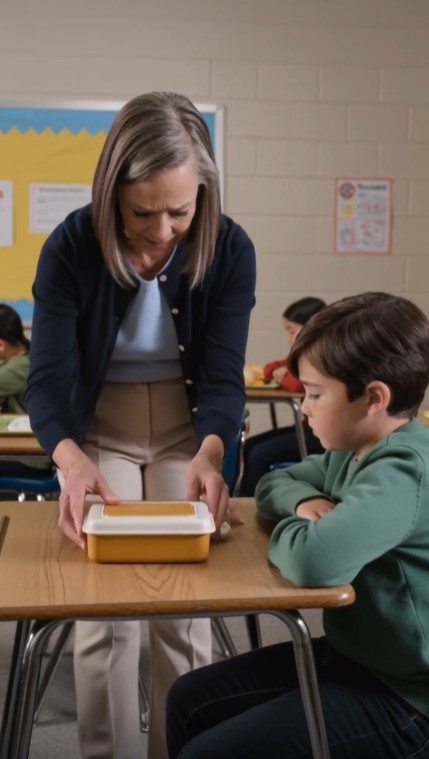
The teacher froze when she opened the boy’s lunchbox.
Inside was an old folded note.
Yellow with age.
She recognized the handwriting immediately.
Her own.
Twenty-eight years earlier, she had written the exact note for a student who came to school without lunch.
“Tomorrow will be better. Don’t give up.”
She had forgotten about it.
The boy hadn’t.
Because the note belonged to his father.
He had kept it his entire life.
Now his son carried it in his lunchbox for luck.
The teacher asked:
“What’s your father’s name?”
The boy answered.
Her eyes filled with tears.
Then the classroom door opened.
A man stood there.
Holding the other half of the note.
His name was Daniel.
The teacher, Mrs. Evelyn Carter, stared at him.
For a moment, she saw the twelve-year-old boy he had once been.
Too-thin shoulders.
Secondhand backpack.
Shoes that were always a little too small.
A child who tried very hard to make sure nobody noticed when something was wrong.
Daniel smiled.
“Hi, Mrs. Carter.”
Evelyn covered her mouth.
“Oh my goodness.”
The boy beside her looked between them.
“Dad?”
Daniel walked farther into the classroom.
In one hand was a folded piece of yellow paper.
The edges matched the note in the lunchbox perfectly.
Evelyn whispered:
“You kept both pieces?”
Daniel nodded.
“One stayed with me.”
He looked at his son.
“And one became Ethan’s.”
Ethan frowned.
“You said it was lucky.”
Daniel smiled.
“It is.”
Evelyn sat down slowly.
Twenty-eight years earlier, Daniel had been one of her quietest students.
He rarely caused problems.
Never asked for anything.
And almost never brought lunch.
At first, Evelyn assumed he preferred cafeteria food.
Then she noticed he never bought that either.
One afternoon she found him sitting alone near the back stairwell during lunch period.
No tray.
No sandwich.
Nothing.
She asked:
“Did you forget your lunch?”
Daniel immediately said:
“I’m not hungry.”
Evelyn had been teaching long enough to know that answer.
She didn’t embarrass him.
Didn’t ask questions in front of other students.
She simply returned to the staff room.
Made a sandwich.
Added an apple.
Then brought it back.
“I accidentally packed too much.”
Daniel looked at the single sandwich.
He knew.
She knew he knew.
Still, he accepted it.
The next day, his lunchbox was empty again.
So Evelyn wrote a note.
Just one sentence:
Tomorrow will be better. Don’t give up.
She tucked it beside another sandwich.
Daniel took the note home.
He never threw it away.
Evelyn looked at him now.
“I wrote that once.”
Daniel shook his head.
“More than once.”
She looked confused.
Then he held up his half.
On it were more words.
Faded.
Barely visible.
And when it is better, help someone else.
Evelyn stared.
“I forgot that part.”
“I didn’t.”
That sentence had become part of Daniel’s life.
He explained.
His mother had been raising him alone.
She worked nights.
Money was unpredictable.
Some weeks they were fine.
Others, they weren’t.
Daniel understood too much too young.
He stopped asking for school trip money.
Stopped mentioning when his shoes wore out.
And on the worst weeks, he stopped packing lunch because there was almost nothing to pack.
Evelyn never asked him to explain himself.
That mattered.
She simply made sure food appeared.
Not every day.
Only when she noticed.
Sometimes through the school office.
Sometimes through a quiet extra meal.
Always without announcing it.
Daniel told her:
“You made it feel temporary.”
Evelyn looked confused.
“What do you mean?”
“Like being hungry wasn’t who I was.”
That hit her harder than anything else.
Daniel continued.
“When you’re a kid, one bad year can feel like your whole identity.”
“Poor kid.”
“Kid with no lunch.”
“Kid with the wrong shoes.”
He looked at the note.
“But you wrote ‘tomorrow.’”
Evelyn’s eyes filled.
“So I started believing there might actually be one.”
Ethan sat quietly.
He had never heard the full story.
He only knew his father had carried the note for years.
Daniel looked at him.
“I told you it was lucky because I didn’t want to tell you everything yet.”
Ethan frowned.
“Why?”
“Because some stories belong to you after you’re old enough to understand them.”
Ethan looked at Evelyn.
“So you fed Dad?”
“Sometimes.”
Daniel corrected her.
“More than sometimes.”
Evelyn smiled.
“You were very skinny.”
Everyone laughed.
Then Ethan asked:
“Why did you rip the note?”
Daniel looked at the two pieces.
That happened years later.
When Daniel was eighteen.
He had graduated.
Evelyn came to the ceremony.
Afterward, Daniel showed her the old note.
Still folded in his wallet.
Evelyn laughed.
“You kept that?”
He nodded.
Then she said:
“You don’t need it anymore.”
Daniel disagreed.
So Evelyn took the paper.
Tore it carefully in half.
Daniel was horrified.
“What are you doing?”
She handed one half back.
“Keep this.”
Then she kept the other half.
“For what?”
“For proof you came back.”
Daniel laughed.
“You’re weird.”
“Teacher.”
“Same thing.”
Evelyn had stored her half in a desk drawer.
Then changed schools.
Moved houses.
Retired briefly.
Returned part-time.
Eventually, the piece disappeared into a box.
Years passed.
Daniel assumed it was gone.
But Evelyn still had it.
Until last month.
She found it while cleaning an old classroom cabinet.
The moment she saw the handwriting, she remembered Daniel.
Then this morning, Ethan’s lunchbox opened.
And the other half appeared.
Evelyn looked at him.
“How did Ethan get yours?”
Daniel smiled.
“Because he was scared.”
Ethan looked embarrassed.
It had been his first week at a new school.
He struggled with anxiety.
Nothing severe.
Just the ordinary fear of being twelve in a place where everyone else seemed to already know one another.
The night before school, Daniel packed his lunch.
Then took the note from a small box.
He gave it to Ethan.
“Carry this.”
Ethan asked:
“What is it?”
“Something somebody gave me when I thought things were harder than they’d always be.”
“Does it work?”
Daniel smiled.
“Not magically.”
“Then why carry it?”
“Because sometimes remembering that hard things ended before helps.”
So Ethan carried it.
Every day.
Then Evelyn happened to see it.
The coincidence felt impossible.
But Daniel knew Ethan had been assigned to her class.
He just didn’t realize Evelyn was the same Mrs. Carter until Ethan mentioned the name.
Daniel had planned to come after school.
He brought the other half.
That explained why he appeared in the doorway.
No mystery there.
Just timing.
Evelyn looked at Ethan.
“You know what the rest says?”
Ethan shook his head.
Daniel placed the two halves together.
For the first time in twenty-eight years, the note was whole.
Tomorrow will be better. Don’t give up.
And when it is better, help someone else.
Ethan read it twice.
Then asked his father:
“Did you?”
Daniel smiled.
“Try to.”
He had become a school social worker.
Evelyn stared at him.
“You work in schools?”
Daniel nodded.
“Mostly with students who are missing class, struggling at home, or pretending everything is fine.”
Evelyn laughed through tears.
“That sounds familiar.”
Daniel had spent most of his career making sure students knew where to find breakfast programs.
Emergency clothing.
Bus passes.
Counseling.
Fee assistance.
He never told them:
“I was you.”
Unless it helped.
Usually, he simply made the problem smaller.
Just as Evelyn had.
One extra meal.
One quiet conversation.
One adult who noticed.
Then Daniel told her something else.
His mother eventually recovered financially.
She found steadier work.
Daniel went to college with grants and part-time jobs.
The difficult years ended.
Not all at once.
But they ended.
And when his first paycheck came from his first school job, he bought lunch for every student in his small after-school group.
Evelyn smiled.
“You remembered the second half.”
“Always.”
That afternoon, Ethan asked if he could keep the whole note.
Daniel and Evelyn looked at each other.
Evelyn said:
“No.”
Ethan looked shocked.
“Why?”
She carefully separated the pieces again.
“One stays with your dad.”
She gave Daniel his half.
Then handed Ethan hers.
“And one stays with you.”
Ethan looked at it.
“But now the sentence is incomplete.”
Evelyn smiled.
“That’s the point.”
“You need somebody else to finish it.”
Years passed.
Ethan kept his half.
Not in his lunchbox forever.
Eventually, it moved to a desk drawer.
Then a small frame.
Daniel’s half stayed in his wallet until the paper became too fragile.
He finally framed that too.
Evelyn remained part of their lives.
She attended Ethan’s graduation.
Daniel joked:
“You collecting generations now?”
Evelyn replied:
“Apparently.”
At graduation, Ethan handed her something.
A new note.
Not old.
Not yellow.
Fresh paper.
His handwriting.
Tomorrow got better.
Evelyn started crying.
Underneath:
I’m working on the second part.
Ethan had decided to study education.
Not because of the note alone.
Not because of one teacher.
But because the story taught him something early.
Students carry invisible things into classrooms.
Hunger.
Fear.
Embarrassment.
Grief.
Sometimes the teacher never learns the whole story.
Sometimes they don’t need to.
They just need to notice enough to respond with care.
Years later, Ethan became a teacher himself.
On his classroom wall, he kept no dramatic plaque.
No framed story.
Just one small sentence near his desk:
Tomorrow can be different.
One afternoon, he noticed a student named Caleb sitting through lunch without eating.
Ethan did not announce anything.
He quietly checked with the school counselor.
The family was experiencing temporary financial hardship.
The school connected them with meal support.
The next morning, Caleb found a small note beside his breakfast.
Not the same words.
Ethan didn’t want to copy Evelyn like a ritual.
He wrote:
You don’t have to solve everything today.
Caleb folded it.
Put it in his pocket.
Ethan noticed.
Said nothing.
That evening, he called Daniel.
“I did something today.”
“What?”
“I wrote a note.”
Daniel became quiet.
Then smiled.
“Careful.”
“Why?”
“Those things can last twenty-eight years.”
Ethan laughed.
Evelyn lived long enough to hear that story.
She was in her eighties by then.
Retired for good.
Daniel and Ethan visited her at home.
She kept both copies of the original note framed on her wall.
Not the originals.
Those still belonged to them.
Photocopies placed side by side.
Evelyn looked at Ethan.
“So someone kept your note?”
“Maybe.”
She smiled.
“Good.”
Then she corrected herself.
“No.”
“What?”
“The keeping isn’t the important part.”
She pointed at the second sentence.
“The passing it on is.”
When Evelyn eventually died peacefully, Daniel attended the memorial with Ethan.
Former students filled the room.
Many had stories.
A teacher who stayed late.
A bus ticket paid quietly.
An extra pencil.
A phone call home that changed something.
A lunch.
Most of the moments were small.
Evelyn probably remembered only half of them.
Daniel understood.
That was what made it powerful.
People often imagine changing a life requires knowing you changed it.
It doesn’t.
Sometimes you write one sentence on a scrap of paper and forget it by the next semester.
The child does not.
At the memorial, Daniel placed his half of the note beside Evelyn’s photograph for a moment.
Then took it back.
Ethan asked:
“Why not leave it?”
Daniel smiled.
“Because she already did her part.”
Years later, Daniel became a grandfather.
Ethan had a daughter named Mia.
When Mia turned twelve, she found the old framed note.
Only half.
She asked:
“Where’s the rest?”
Ethan smiled.
“Grandpa has it.”
“Why?”
So Ethan told her.
About a boy who came to school without lunch.
A teacher who noticed.
A yellow note.
Twenty-eight years.
A lunchbox.
And a classroom door opening at exactly the right moment.
Mia asked:
“Did Grandma Evelyn know Dad would become a social worker?”
“No.”
“Did she know you’d become a teacher?”
“No.”
“Then how did she know things would get better?”
Ethan thought.
“She didn’t.”
“Then why write it?”
“Because sometimes someone needs to believe it before they can.”
Mia nodded.
Then pointed to the second half.
“And this?”
And when it is better, help someone else.
Ethan smiled.
“That part was a job.”
The original story sounded like it was about coincidence.
A teacher opens a lunchbox.
Finds handwriting from twenty-eight years earlier.
Discovers a student’s father was once the hungry child she helped.
Then the father appears holding the missing half of the note.
But Daniel never thought coincidence was the important part.
The important part was what happened between those moments.
A hungry boy grew up.
He remembered dignity.
He remembered being noticed.
He remembered one sentence.
And instead of treating kindness like a debt he had to repay to one teacher…
he passed it forward.
Then his son did the same.
The paper aged.
The handwriting faded.
But the message didn’t.
Tomorrow will be better. Don’t give up.
And when it is better, help someone else.
Twenty-eight years after Evelyn wrote it…
the note finally came back to her.
Not because Daniel had failed to move on.
But because he had carried the lesson far enough to return it through the next generation.