
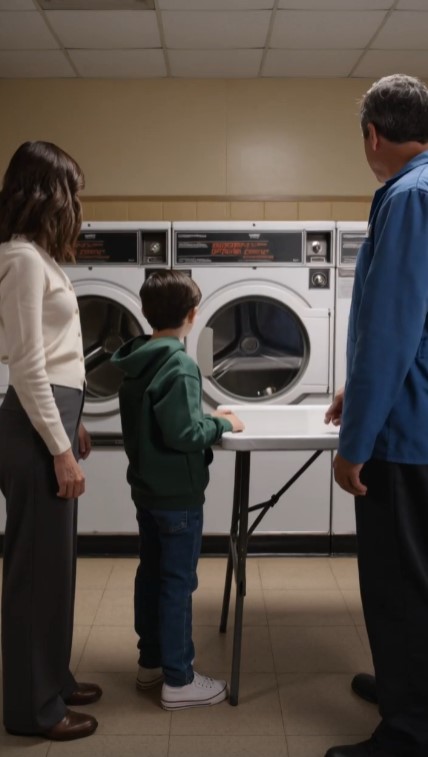
The little boy refused to leave the laundromat.
Not because he was waiting for clothes.
Because of one washing machine.
Every few minutes, an old alarm clock inside it started ringing.
The machine wasn’t running.
There were no clothes inside.
Just the clock.
The owner unplugged the machine.
The clock rang again.
The boy stared at it.
“My grandfather had one exactly like that.”
The laundromat owner opened the door and handed it to him.
The boy turned it over.
Scratched underneath were three initials.
His grandfather’s.
His mother saw them and went completely still.
She had been told that clock disappeared the night her father left home more than thirty years earlier.
Then an elderly man at the back of the laundromat stood up.
He had been sitting there silently the entire time.
He looked at the clock.
Then at the boy’s mother.
And whispered:
“I’ve been waiting for someone to recognize it.”
The boy’s mother, Rachel, tightened her grip on the clock.
Her son Noah looked between her and the elderly man.
“Mom?”
Rachel barely heard him.
The initials scratched beneath the metal casing were unmistakable.
T.J.C.
Thomas James Carter.
Her father.
Rachel had seen those initials on tools.
Old books.
A fishing tackle box.
Anything Thomas worried might get borrowed and never returned.
She stared at the elderly stranger.
“Who are you?”
The man walked closer.
Slowly.
Carefully.
“My name is Henry.”
Rachel frowned.
That name meant nothing to her.
At least not at first.
Then something surfaced.
A photograph in her grandmother’s house.
Two young men beside an old pickup.
Thomas.
And someone named Henry.
Her father’s closest friend.
Rachel whispered:
“Henry Miller?”
The man nodded.
“Yes.”
Her stomach dropped.
“My father said you were dead.”
Henry looked away.
“And your father died thinking I betrayed him.”
The laundromat owner, Daniel, quietly locked the old washing machine door open so nobody would use it, then stepped back.
This was no longer about laundry.
Rachel looked at the clock.
“Why is this here?”
Henry pointed toward it.
“Because I put it there.”
Noah’s eyes widened.
“You put Grandpa’s clock in a washing machine?”
Henry smiled faintly.
“Not one of my smartest ideas.”
Rachel didn’t smile.
“Why?”
Henry sat at a plastic table.
“Because this laundromat used to be a hardware store.”
Rachel stared.
The building had changed many times.
Hardware store.
Small grocery.
Storage space.
Then laundromat.
More than thirty years earlier, Thomas had worked at that hardware store.
So had Henry.
They were twenty-something then.
Best friends.
More like brothers.
Thomas had already married Rachel’s mother, Anna.
Rachel was six.
Her younger brother Michael was four.
Henry was unmarried.
Always at the Carter house.
Birthday dinners.
Sunday barbecues.
Christmas.
Rachel vaguely remembered a tall man who taught her how to shuffle cards badly.
“That was you.”
Henry smiled.
“You always cheated.”
“I was six.”
“Still cheating.”
Rachel almost laughed.
Then remembered why she was there.
“My father disappeared when I was seven.”
Henry’s face changed.
“No.”
Rachel stared.
“What do you mean, no?”
“He left.”
“That’s disappearing.”
“Not the way you were told.”
Rachel’s mother had always said Thomas left after an argument.
He packed one bag.
Took some cash.
Walked out.
The alarm clock disappeared that same night.
For years, Rachel believed her father chose another life.
Then, when she was sixteen, Anna told her Thomas had died in another state.
No details.
No funeral.
No grave they ever visited.
Just:
“He’s gone.”
Rachel looked at Henry.
“What really happened?”
Henry took a breath.
Thomas had not planned to abandon the family.
He had discovered something at the hardware store.
The owner at the time, Robert Gaines, had been skimming money from employee pension contributions.
Thomas noticed missing records.
Henry noticed too.
The two men planned to confront him.
But Robert found out first.
He accused Thomas of theft.
Threatened to call the police.
Thomas panicked.
Not because he was guilty.
Because the records looked bad enough that he feared being blamed.
Henry told him:
“Leave town for two days. Let me get copies of everything.”
Thomas agreed.
He went home.
Packed a small bag.
Told Anna he needed time.
But he expected to return.
Rachel whispered:
“Why didn’t he?”
Henry looked devastated.
“Because I failed him.”
The next morning, Henry found the proof.
Bank records.
Payroll slips.
Copies of altered ledgers.
Enough to clear Thomas.
He put everything in a satchel.
The alarm clock was inside too.
Thomas had left it at work weeks earlier.
Henry planned to return it.
Then Robert confronted Henry.
The two argued.
Robert took some records.
Henry kept others.
By that afternoon, police were involved.
Not against Thomas.
Against Robert.
But by then Thomas was already gone.
Henry tried calling.
No answer.
Thomas had checked into a cheap motel under another name because he feared being followed.
Then something worse happened.
Thomas was injured in a highway accident.
Not fatal.
But serious.
No identification beyond the alias.
No phone numbers.
He spent weeks hospitalized.
Rachel’s eyes widened.
“He was alive?”
“Yes.”
“Then why didn’t he come home?”
“He tried.”
Henry’s voice cracked.
By the time Thomas returned, everything had changed.
Anna had been told Thomas ran away with stolen money.
Robert’s family had spread rumors.
Even after Robert was charged, the damage remained.
Anna felt humiliated.
Angry.
Abandoned.
Thomas went to the house.
Anna wouldn’t let him in.
Rachel whispered:
“She told me he never came back.”
Henry nodded.
“She was hurt.”
Not lying for sport.
Not evil.
Hurt.
Thomas tried again.
Letters.
Calls.
Then Anna moved.
She didn’t leave a forwarding address for him.
Henry helped Thomas search.
For years.
Eventually Thomas found where Rachel’s family lived.
But by then Rachel was thirteen.
Michael was eleven.
Thomas stood across the street one afternoon.
He saw them.
Healthy.
Laughing.
Anna had remarried.
Thomas decided walking back into their lives would cause more damage.
Rachel’s voice rose.
“So he just left again?”
Henry nodded slowly.
“Yes.”
Rachel stood.
“That was his choice.”
“Yes.”
Henry didn’t defend him.
“He was wrong.”
Rachel looked shocked by the answer.
Henry continued.
“Your father was ashamed. He thought staying away was sacrifice.”
“It wasn’t.”
“No.”
“It was cowardice.”
“Yes.”
Noah looked between the adults.
The room had gone quiet.
Even the dryers seemed loud.
Rachel sat again.
“What happened after that?”
Thomas built another life.
Never remarried.
Worked repair jobs.
Moved often.
Kept photographs of Rachel and Michael.
Kept the alarm clock too.
Until one night, almost thirty-one years ago, he met Henry here.
Back when the place was still the old hardware store, abandoned and waiting to be sold.
Thomas brought the clock.
And a letter.
He told Henry:
“If they ever come looking for me, give them this.”
Henry frowned.
“I told him that was stupid.”
Rachel looked at the clock.
“Why hide it here?”
Thomas wanted to leave something in a place tied to the truth.
The old store.
The ledgers.
The accusation.
The beginning of everything.
He tucked the clock into an unused storage compartment that later became part of the laundromat renovation.
Years passed.
Henry assumed it had been removed.
Then two months earlier, Daniel renovated one old washing machine.
Inside a hollow space behind the drum, he found the clock.
Henry had been visiting the laundromat every few days ever since.
Daniel thought he was simply an elderly customer who liked the coffee.
Henry admitted:
“I was waiting to see if anybody recognized it.”
Rachel stared.
“For thirty years?”
“No.”
Henry shook his head.
“I only found out the clock survived recently.”
“Then why not contact me?”
He looked ashamed.
“Because I did not know if I had the right.”
Rachel almost laughed.
“Everyone in this story seems very good at waiting too long.”
Henry nodded.
“That’s fair.”
Then Noah asked:
“Why does the clock ring if it’s old?”
Daniel finally stepped closer.
He explained.
The alarm mechanism was mechanical.
The plug had nothing to do with the clock.
Someone had wound it.
Daniel had been testing it after finding it.
The alarm kept triggering because it was still set.
Nothing supernatural.
No haunted washing machine.
Just an old mechanical clock doing exactly what it had been built to do.
Rachel looked at Henry.
“Where’s the letter?”
Henry’s face changed.
He reached into his coat.
“I have it.”
Of course.
Another thing carried too long.
The envelope had Rachel’s name.
And Michael’s.
She opened it.
Her father’s handwriting.
Rachel and Michael,
If this reaches you, it means somebody finally did what I was too afraid to do.
Rachel stopped.
Noah slipped his hand into hers.
She continued.
Thomas admitted everything.
Leaving during the investigation.
Returning too late.
Letting Anna’s anger convince him that disappearing again was noble.
Watching his children from across the street.
Choosing silence.
He wrote:
I told myself you were better without confusion.
The truth is, I was afraid you would look at me and ask why I stayed gone.
Then:
There is no answer good enough.
Rachel cried.
That sentence mattered more than excuses.
Thomas did not ask for forgiveness.
He only asked them not to believe he stopped loving them.
He wrote about Rachel’s seventh birthday.
Michael’s first bicycle.
Anna singing while washing dishes.
Tiny memories.
Proof that the years before he left had mattered.
Then the last paragraph:
The clock sat beside your bed during thunderstorms, Rachel. You said the ticking made the room feel less empty.
Rachel gasped.
She remembered.
Barely.
A storm.
Being afraid.
Her father placing the alarm clock beside her pillow.
“Listen to the ticking.”
“As long as it keeps going, morning is coming.”
She covered her face.
Noah whispered:
“Mom?”
“I remember.”
Henry looked away.
The final line read:
If you ever hear it again, I hope your life is full enough that you do not need it.
Rachel folded the letter.
Then asked the question she feared most.
“When did he die?”
Henry answered:
“Six years ago.”
Rachel stared.
Six years.
Her father had been alive for most of her adult life.
Alive when she graduated college.
Alive when she married.
Alive when Noah was born.
Alive only a few states away.
She became angry all over again.
Not at Henry.
At Thomas.
At Anna.
At years.
At everyone who thought silence protected children.
Noah asked:
“Did Grandpa know about me?”
Henry smiled sadly.
“Yes.”
“How?”
Thomas eventually found Rachel online.
He never contacted her.
But he saw photographs.
He knew Noah’s name.
He even printed one picture of Rachel holding him as a baby.
Henry had it at home.
Rachel cried harder.
“Why didn’t he call?”
Henry repeated the only honest answer.
“He was afraid.”
Rachel whispered:
“That’s not enough.”
“No.”
It never would be.
A week later, Rachel brought her brother Michael to the laundromat.
She didn’t tell him much beforehand.
She placed the clock on the table.
Michael stared.
“No way.”
Then saw the initials.
His eyes filled.
Unlike Rachel, he remembered almost nothing about Thomas.
The clock became his first tangible object from their father.
They read the letter together.
Michael reacted differently.
Less anger.
More grief.
“You got more years with him.”
Rachel felt guilty.
Michael shook his head.
“That’s not your fault.”
Then Henry arrived carrying a cardboard box.
Inside were Thomas’s remaining belongings.
Photographs.
A pocketknife.
Old work badges.
Receipts.
Letters never sent.
And one cassette tape.
Michael laughed.
“Does anyone even have a player?”
Daniel did.
The laundromat owner kept an old radio-cassette unit in the office.
They played it.
Thomas’s voice filled the room.
Older.
Rougher than Rachel remembered.
He spoke for nearly forty minutes.
Not a polished confession.
He rambled.
Stopped.
Started again.
At one point he forgot what he was saying.
Then laughed.
Rachel cried at the laugh.
That she remembered perfectly.
Thomas said:
“I don’t know if you’ll hear this.”
Then:
“If you do, don’t turn me into a better man than I was just because I’m gone.”
Rachel looked at Michael.
That sounded brutally honest.
Thomas continued:
“I loved you.”
“I also failed you.”
“Both are true.”
Michael paused the tape.
“That’s enough.”
Rachel nodded.
They did not need sainthood.
They needed truth.
Over the next months, Henry filled in details.
He showed them where the old hardware store office had been.
Where Thomas discovered the altered records.
Where the clock originally sat.
Daniel even found an old metal sign in storage with the store’s name.
Rachel laughed.
“This place has too much history for a laundromat.”
Daniel smiled.
“Mostly people just lose socks.”
Noah became fascinated by the alarm clock.
Rachel eventually let him keep it in his room.
Not because she wanted the past turned into a shrine.
Because he liked mechanical things.
They had it professionally cleaned without erasing the initials.
Every night, the clock ticked.
Noah never used the alarm.
Too loud.
One evening he asked:
“Did Grandpa love you?”
Rachel answered immediately.
“Yes.”
“Was he a good dad?”
She hesitated.
“For a while.”
“Then?”
“He made choices that hurt us.”
“Can both be true?”
Rachel smiled.
“Yes.”
That became the lesson she valued most.
People can love you and still fail you.
People can hurt you and still regret it.
Forgiveness, if it comes, does not require pretending nothing happened.
Rachel never decided whether she fully forgave Thomas.
She didn’t have to.
She understood him better.
That was different.
Years later, Henry died peacefully in his eighties.
Before he died, he gave Rachel one final envelope.
Not from Thomas.
From himself.
I should have looked for you sooner.
I told myself it was Thomas’s family and not my place.
That was another form of fear.
I’m sorry.
Rachel kept that too.
Not because she wanted a collection of apologies.
Because she had learned something from the clock.
Silence leaves space.
People fill space with assumptions.
Thomas assumed Rachel hated him.
Rachel assumed Thomas forgot her.
Henry assumed contacting her would cause harm.
Anna assumed keeping the children away from Thomas would protect them.
Everybody guessed.
Almost nobody asked.
Years later, when Noah became an adult, he still had the clock.
His own daughter once noticed the initials underneath.
“Who’s T.J.C.?”
“My great-grandfather.”
“Did he give you the clock?”
“No.”
“Then how did you get it?”
Noah smiled.
“That’s a long story.”
So he told her.
A laundromat.
One empty washing machine.
An alarm clock that kept ringing because its mechanical alarm was wound.
A little boy who recognized it.
A mother who recognized the initials.
An elderly man sitting quietly in the back.
And one sentence:
“I’ve been waiting for someone to recognize it.”
The child asked:
“Was Henry waiting every day?”
“No.”
“Did Grandpa Thomas hide the clock so your mom would find it?”
“Sort of.”
“Did it work?”
Noah thought.
“Eventually.”
More than thirty years late.
But eventually.
Rachel had spent most of her life believing her father disappeared because he wanted another life.
The truth was more complicated.
He ran because he was afraid.
Returned.
Was rejected.
Then made the worst decision of all.
He let shame convince him that staying gone was kindness.
The clock did not excuse that.
It simply brought the truth back.
And sometimes truth is not a happy ending.
Sometimes it is something quieter.
A chance to stop carrying the wrong story.
That old alarm clock had once helped a frightened little girl through thunderstorms.
Decades later, it did something similar.
It kept ticking inside a laundromat until the right person finally heard it.
And when Rachel turned it over and saw her father’s initials…
the life she thought she understood opened again.
Not perfect.
Not repaired.
But finally honest.