
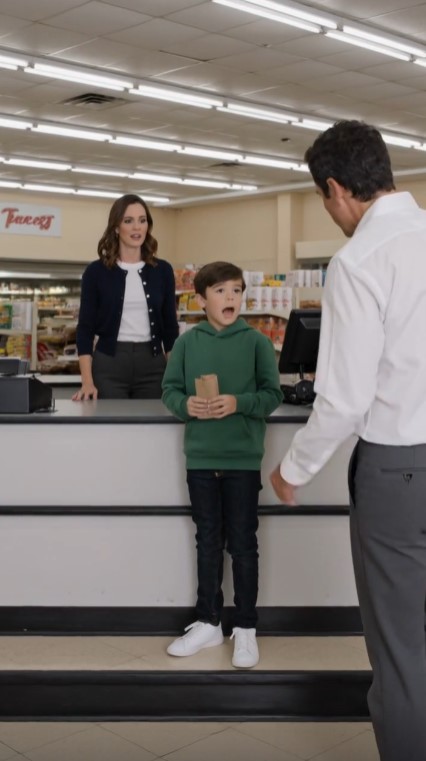
The entire grocery store went quiet when the little boy climbed onto the customer-service counter.
He wasn’t lost.
He wasn’t crying.
He was holding a small paper bag.
A manager hurried over.
“Hey, buddy, what are you doing up there?”
The boy looked across the store.
“I’m looking for the man who keeps leaving food at our door.”
His mother froze.
For six months, groceries had appeared outside their apartment every Sunday morning.
No note.
No name.
No explanation.
She assumed it was a neighbor.
The boy didn’t.
He had started waking up early.
Watching through the curtains.
That morning…
he finally saw the man.
An elderly grocery employee.
Now the boy pointed across the store.
“There!”
The elderly worker stopped pushing his cart.
Everyone looked at him.
The boy climbed down and ran over.
Then emptied the paper bag.
Inside were coins he’d saved for months.
“I wanted to pay you back.”
The old man shook his head.
“You don’t owe me anything.”
The mother walked closer.
“Why did you do this?”
The employee looked at her son.
Then answered:
“Because forty years ago, somebody did it for me.”
But before he walked away…
the store manager said:
“Wait.”
Then turned to the mother.
“You need to know who that somebody was.”
The mother’s name was Rachel.
Her son, Noah, stood beside her clutching the little paper bag.
The elderly employee was Henry.
He had worked at the grocery store part-time for almost eleven years.
Stocking shelves.
Collecting carts.
Helping older customers carry bags.
Never talking much about himself.
The manager, Daniel, looked at Rachel.
“Your mother.”
Rachel blinked.
“What?”
Henry closed his eyes.
Daniel continued.
“The person who helped Henry forty years ago was your mother.”
Rachel stared at Henry.
“My mother?”
Henry nodded slowly.
“Anna.”
Rachel’s face changed.
Her mother had died seven years earlier.
She had never mentioned Henry.
At least not by name.
Rachel whispered:
“How did you know who I was?”
Henry looked at Noah.
“Because he looks like her.”
Noah looked confused.
“Like Grandma?”
Henry smiled.
“Especially when you’re trying to look serious.”
Rachel sat down on a bench near customer service.
The store had slowly resumed moving around them, but several employees still watched from a distance.
Daniel told another supervisor to cover Henry’s section.
Then he brought three chairs.
Henry sat last.
He seemed uncomfortable being the center of attention.
Rachel asked:
“Tell me what happened.”
Henry looked at the floor.
“It was 1986.”
He was nineteen.
Anna was twenty-two.
Both worked at a textile warehouse across town.
Henry had come from a difficult home.
His father drank heavily.
His mother had left years earlier.
By nineteen, Henry lived alone in a basement room.
He worked every shift he could find.
But one winter, hours were cut.
Rent took almost everything.
Food came last.
Henry stopped bringing lunch.
At first, nobody noticed.
Then Anna did.
She worked two rows over.
Quiet.
Sharp-eyed.
The kind of person who noticed when someone’s shoes were wet in winter or when a coworker suddenly stopped buying coffee.
One Monday morning, Henry opened his locker.
Inside was a paper grocery bag.
Bread.
Peanut butter.
Soup.
Apples.
A small bag of rice.
No note.
He looked around.
Nobody admitted anything.
The next week, another bag appeared.
Then another.
Henry tried catching the person.
Failed.
Finally, one snowy morning, he arrived early.
Anna was standing at his locker.
Holding groceries.
Henry stared at her.
“You?”
She froze.
Then looked annoyed.
“You weren’t supposed to see me.”
“I can’t take this.”
“Why?”
“Because I can pay for my own food.”
Anna looked at him.
“No, you can’t.”
Henry felt humiliated.
He started to argue.
Anna interrupted.
“I’m not giving you charity.”
“What is it then?”
“Temporary groceries.”
Henry almost laughed.
Anna continued.
“You’re working.”
“You’re trying.”
“You’re short.”
“That happens.”
Then she said the words Henry never forgot:
“When things get better, do it for somebody else.”
Rachel covered her mouth.
“That sounds exactly like Mom.”
Henry smiled.
“Yes.”
He took the groceries.
Things did get better.
Hours returned.
Henry moved into a better place.
Eventually he married.
Raised two children.
Worked thirty-five years in maintenance.
But he never forgot Anna.
For a few years they stayed in touch.
Then she married.
Moved.
Henry moved too.
Life separated them.
No argument.
No betrayal.
Just years.
Rachel asked:
“So how did you find me?”
Henry looked toward Daniel.
The manager answered.
“Your mother shopped here.”
Rachel stared.
“She did?”
For the final years of Anna’s life, she came to this grocery store every Thursday.
Henry recognized her almost immediately.
She did not recognize him.
At first.
Forty years changes a face.
Then one afternoon Henry helped load groceries into her car.
Anna looked at his name badge.
“Henry?”
He smiled.
“Temporary groceries.”
Anna froze.
Then laughed so hard she had to sit in the car.
After that, they became friends again.
Nothing romantic.
Anna had been widowed.
Henry’s wife had already died.
They simply talked.
Once a week.
Sometimes ten minutes.
Sometimes half an hour.
Henry learned about Rachel.
About Noah.
About Anna’s grandchildren.
Anna showed photographs.
She was proud of them.
Rachel started crying.
“She talked about us?”
“Constantly.”
Henry smiled.
“I knew what Noah looked like before I ever saw him in person.”
Rachel asked:
“Then why didn’t I know about you?”
Henry shrugged.
“Your mother had a lot of stories.”
Apparently he wasn’t important enough to make every dinner conversation.
That made Rachel laugh.
Then Henry’s face became more serious.
A few months before Anna died, she asked him for a favor.
Not money.
Not help for herself.
She said:
“If Rachel ever has a hard season, don’t embarrass her.”
Henry remembered the exact wording.
Rachel stared.
“How would she know?”
Anna knew her daughter.
Rachel hated asking for help.
Always had.
Then seven years passed.
Henry never acted on the request.
There was no reason.
Until six months ago.
He recognized Rachel in the store.
She looked tired.
Her cart had only basics.
She put back cereal.
Then meat.
Then a bag of oranges.
At checkout, her card declined once.
She removed two items.
Paid again.
Henry noticed.
He did not approach.
That would have embarrassed her.
Instead, he quietly asked Daniel if employees could purchase groceries after shift and deliver them anonymously.
Daniel frowned at first.
Then Henry explained the history.
The manager agreed under one condition.
No misuse of customer information.
Henry could only deliver if he already knew the address legitimately.
He did.
Anna had once mailed him a Christmas card years earlier.
Rachel still lived in the same apartment complex.
So every Sunday, Henry bought a small bag.
Never too much.
Bread.
Eggs.
Milk.
Fruit.
Sometimes chicken.
Sometimes cereal.
He left it at the door before sunrise.
Rachel whispered:
“You paid for all that yourself?”
Henry nodded.
“I get an employee discount.”
“That’s not the point.”
“I know.”
“Why didn’t you stop after once?”
Henry looked at Noah.
“Because the cereal kept disappearing.”
Noah looked guilty.
Everyone laughed.
Then Rachel asked the question that bothered her most.
“Why didn’t you just tell me Mom asked you to look out for us?”
Henry answered immediately.
“Because she didn’t ask me to look out for you.”
Rachel frowned.
“She asked me not to embarrass you if you ever had a hard season.”
That distinction mattered.
Henry wasn’t trying to become family.
He wasn’t trying to supervise Rachel’s life.
He saw a temporary problem.
He responded the same way Anna had responded to his.
Quietly.
No conditions.
No debt.
No announcement.
Rachel looked at Noah’s paper bag of coins.
“How much did you save?”
Noah shrugged.
“Twenty-three dollars and eighty cents.”
Henry looked impressed.
“That’s a lot.”
“I didn’t buy snacks.”
Rachel stared at him.
“You told me you stopped liking snacks.”
Noah looked away.
Henry laughed.
“Kid’s got principles.”
Noah pushed the coins toward him again.
“Please.”
Henry shook his head.
“No.”
“Why?”
“Because your grandma didn’t take repayment either.”
Noah frowned.
“That’s not fair.”
Henry thought.
Then said:
“Okay.”
He took one coin.
A quarter.
“That’s payment.”
Noah looked suspicious.
“For six months?”
“Inflation.”
Daniel burst out laughing.
Then Henry slid the remaining coins back.
“Keep these.”
Noah crossed his arms.
“I don’t want to.”
Henry leaned closer.
“Then do what Anna told me.”
Noah understood.
“Help somebody else?”
“Exactly.”
That became the agreement.
Noah took his coins home.
But the story didn’t end there.
Rachel wanted to know more about her mother.
Not the mother she remembered.
The young woman Henry had known.
He brought photographs.
One showed Anna standing outside the textile warehouse.
Twenty-two.
Hair tied back.
Holding a coffee.
Another showed six coworkers at a picnic.
Henry beside her.
Rachel studied it.
“She looks so young.”
“She was.”
“Was she happy?”
Henry thought carefully.
“Sometimes.”
That answer surprised Rachel.
She expected nostalgia.
Instead, Henry told the truth.
Anna had struggles too.
Her father was ill.
Money was tight.
She was helping support a younger sister.
The groceries she gave Henry had not come from abundance.
She bought them because she understood what being short felt like.
Rachel whispered:
“She never told me any of this.”
“Parents edit.”
Henry smiled.
“They want their children to think they had everything figured out.”
Rachel laughed.
“Mom definitely did not.”
Then Henry showed her something else.
An old envelope.
Anna’s handwriting.
Dated almost forty years earlier.
Inside was a receipt.
Bread.
Soup.
Rice.
Apples.
Peanut butter.
At the bottom, Anna had written:
Henry — $8.42
Rachel smiled.
“She kept track?”
Henry nodded.
“I found this years later.”
On the back, another line:
Not a loan. Reminder.
Below it:
When you can, pass it on.
Henry had carried the receipt in his wallet for decades.
Rachel stared.
“You really kept that?”
“Some people keep photographs.”
“I keep grocery receipts.”
Noah laughed.
Then Rachel asked:
“Did you ever pass it on before us?”
Henry nodded.
Many times.
Not dramatically.
A coworker who needed gas.
A young father short at checkout.
An elderly neighbor who needed groceries during winter.
A teenager working two jobs.
Henry never created a charity.
Never kept count.
He simply remembered.
One bag in a locker.
One instruction.
Pass it on.
Rachel’s situation had been different.
After her husband Daniel—not the store manager, another Daniel—lost his job following a company closure, Rachel’s income became the main support.
They were not starving.
They still had housing.
Utilities.
Basic food.
But every week required calculation.
What could wait?
What had to be paid?
How far could groceries stretch?
Then Daniel found new work.
Slowly, things improved.
By the time Noah confronted Henry, the family was already stabilizing.
Rachel said:
“You don’t have to bring anything anymore.”
Henry nodded.
“I know.”
“Seriously.”
“I know.”
The next Sunday, nothing appeared outside the door.
Noah seemed disappointed.
Rachel smiled.
“This is what we wanted.”
“I know.”
But Noah had a new plan.
He took his twenty-three dollars and eighty cents.
Added allowance money.
Then asked his mother to take him shopping.
“What for?”
“Temporary groceries.”
Rachel almost cried.
They bought pasta.
Sauce.
Cereal.
Shelf-stable milk.
Peanut butter.
Not random items.
Rachel called a local family resource center first and asked what they actually needed.
The center accepted the donation.
Noah handed over the bag.
No cameras.
No social media.
No dramatic speech.
On the way home, he asked:
“Does this count?”
Rachel smiled.
“Yes.”
The next time they saw Henry, Noah told him.
Henry nodded.
“Now we’re even.”
Noah smiled.
“Not really.”
Henry laughed.
“You’re learning.”
Over the next few years, Henry became part of the family in a quiet way.
Sunday lunch sometimes.
Noah’s school events occasionally.
Christmas once.
Rachel never called him Uncle Henry.
He wasn’t family by blood.
He didn’t need a title.
He was Henry.
The man her mother once helped.
The man who remembered.
Then one afternoon, Rachel found a box while cleaning Anna’s old belongings.
Inside were dozens of recipe cards.
Family documents.
And one note addressed to Henry.
Rachel called him.
“You need to see this.”
Henry came over.
The note was dated shortly before Anna died.
He opened it.
Henry,
You spent forty years telling me you still owed me groceries. You don’t.
Henry laughed.
Then continued.
If you really want to repay me, notice somebody.
That’s all I did.
Notice somebody.
Henry stopped.
His eyes filled.
Rachel whispered:
“She knew.”
“Yes.”
“About what?”
“That I made the story bigger than it was.”
Anna did not view herself as someone who saved Henry.
She had noticed a hungry coworker.
Bought groceries.
That was all.
Henry had turned it into a lifelong rule.
Maybe that was fine.
But Anna wanted him to remember kindness did not need mythology.
Just attention.
Henry folded the letter carefully.
“I wish she’d given me this sooner.”
Rachel smiled.
“You probably would’ve argued.”
“Definitely.”
Years passed.
Noah grew.
At sixteen, he got his first job.
At the same grocery store.
Rachel thought it was funny.
Henry called it dangerous.
“Another generation around discounted cereal.”
Noah worked weekends.
Bagging groceries.
Collecting carts.
Then one evening, he saw a woman at checkout remove several items after her card was declined.
He thought about Henry.
His grandmother.
The paper bag.
Then he stopped himself.
He didn’t secretly follow the woman home.
He didn’t assume he knew her situation.
Instead, he asked Daniel, the manager, whether the store’s community assistance program accepted employee contributions.
It did.
Noah donated part of his paycheck.
Not to one person.
To the fund.
When Henry heard, he smiled.
“You improved the system.”
Noah shrugged.
“Grandma said notice somebody.”
“She did.”
“But you also need to ask what actually helps.”
Henry nodded.
“Smart kid.”
When Henry eventually retired, the grocery store held a small farewell.
Nothing elaborate.
Cake.
Coffee.
A card signed by employees.
Daniel handed him one final gift.
A framed grocery bag.
Not the real one.
Just a printed image.
Underneath:
WHEN YOU CAN, PASS IT ON.
Henry groaned.
“That’s painfully sentimental.”
Rachel smiled.
“You deserve it.”
Noah handed him something else.
A small paper bag.
Henry opened it.
Inside were twenty-three dollars and eighty cents in coins.
He stared at Noah.
“You kept track?”
“Every cent.”
“You were supposed to donate that.”
“I did. These are different coins.”
Henry laughed.
“Then what am I supposed to do with them?”
Noah smiled.
“Your turn again.”
Henry shook his head.
“It never ends.”
“That’s the point.”
Henry died peacefully many years later.
By then Noah was an adult.
At the memorial, Rachel brought the old receipt Anna had kept.
The one for $8.42.
Next to it she placed Henry’s worn copy of Anna’s note:
Not a loan. Reminder.
Noah stood beside her.
He asked:
“Do you think Grandma knew all this would happen?”
Rachel smiled.
“No.”
Anna never expected a grocery bag to become a forty-year story.
She wasn’t trying to create a tradition.
She saw someone hungry.
Helped.
Then moved on.
That was what made it powerful.
Years later, Noah told the story to his own children.
They loved the beginning.
A little boy standing on a customer-service counter.
Pointing across a grocery store.
An elderly worker freezing beside a cart.
A paper bag of coins.
Then a manager saying:
“You need to know who helped him first.”
His daughter once asked:
“So Great-Grandma started everything?”
Noah thought.
“No.”
“Who did?”
“Nobody.”
She looked confused.
“Then how did it start?”
Noah smiled.
“It starts whenever somebody notices.”
That was the lesson.
Not that every kindness circles back perfectly.
It doesn’t.
Not that people should secretly solve other people’s lives.
They shouldn’t.
But sometimes someone sees a need they can meet safely and respectfully.
Anna saw Henry skipping meals.
Henry saw Rachel quietly putting food back.
Noah saw groceries arriving at his door and decided gratitude should move somewhere too.
Forty years separated the first grocery bag from the last.
But the idea stayed the same.
Help without humiliating.
Give without keeping score.
And when life finally gets easier…
notice somebody else.