
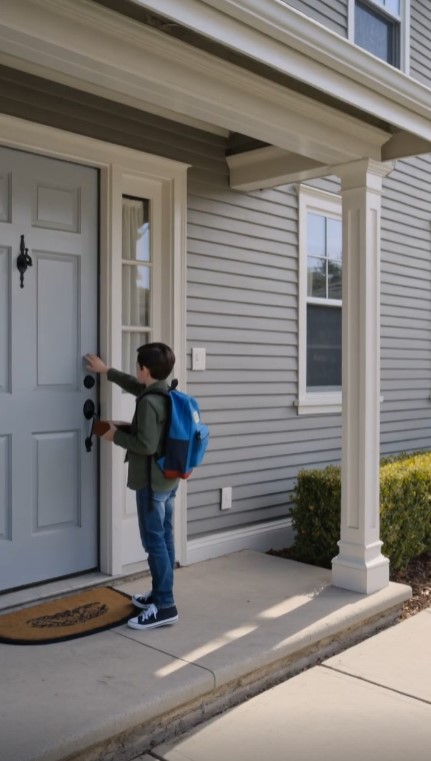
I noticed the boy because he’d knocked on the same empty house three afternoons in a row.
Always at exactly 4:15.
Same blue backpack.
Same little brown box.
Nobody ever answered.
On the fourth day, I finally asked:
“Who are you waiting for?”
The boy looked at me.
“My dad.”
I knew the house.
Nobody had lived there for years.
I gently asked when he’d last seen his father.
The boy pointed at the brown box.
“He told me if he ever missed four Thursdays, bring this here.”
That was the fourth Thursday.
His mother arrived minutes later.
She had no idea her son had been carrying the box.
When she saw it…
she went completely pale.
“Where did you get that?”
“Dad gave it to me.”
She stared at the house.
Then whispered:
“Your father never lived here.”
We contacted the property owner before doing anything else.
He came with the key.
The door opened.
The house was empty.
Except for one wooden chair in the hallway.
And sitting on it…
was another brown box.
Exactly like the boy’s.
His mother opened her son’s box.
Inside was a key.
The property owner looked at it.
Then at a small locked cabinet beneath the stairs.
The key fit.
And inside was something the boy’s father had been preparing for years.
The boy’s name was Noah.
His mother, Rachel, stood beside him while the property owner slowly opened the cabinet.
Inside were folders.
Photographs.
Letters.
A small metal cash box.
And on top…
a sealed envelope marked:
FOR NOAH
Rachel stared at it.
Then at her son.
“Your dad did all this?”
Noah nodded.
“He said it was important.”
Rachel’s face changed.
Not angry.
Not exactly.
More like someone watching an old story rearrange itself.
Noah’s father was Daniel.
He had disappeared from their lives six weeks earlier.
Not vanished in the legal sense.
He had called.
Once.
Said he needed time.
Said he was dealing with something complicated.
Then stopped answering.
Rachel had already filed a missing-person report.
Police found no sign of foul play.
No abandoned car.
No suspicious bank activity.
Nothing.
Daniel had simply gone quiet.
And every Thursday at 4:15, Noah waited for him.
That had been their time.
For years.
Daniel picked Noah up after school every Thursday.
They got burgers.
Went to the library.
Sometimes just drove around.
Noah called it:
“Dad Thursday.”
Four weeks ago, Daniel missed the first one.
Then another.
Then another.
But before he disappeared, he had given Noah the brown box.
He told him:
“If I ever miss four Thursdays, take this to the old house on Miller Road.”
Noah never told Rachel.
He thought the instruction was only for him.
Rachel turned to him.
“Why didn’t you tell me?”
Noah looked down.
“Dad said not to open it.”
“That doesn’t mean don’t tell me.”
“I thought it did.”
She closed her eyes.
He was ten.
To him, instructions were literal.
The property owner, Mr. Harris, stood quietly beside the cabinet.
Rachel asked him:
“Who owned this house before you?”
Mr. Harris answered:
“My brother.”
Rachel froze.
“What was his name?”
“Thomas.”
Daniel’s father.
Noah looked up.
“Grandpa?”
Mr. Harris nodded.
“Yes.”
Rachel stared at the walls.
“You said Daniel never lived here.”
She was right.
Daniel had always told her he grew up in another town.
That was true.
But this house belonged to Thomas later.
After Daniel left home.
He bought it quietly.
Never moved in full-time.
Used it as a workshop and storage place.
Daniel knew about it.
Rachel did not.
Mr. Harris said:
“Daniel came here sometimes.”
“When?”
“Over the years.”
“Why?”
Mr. Harris looked at the cabinet.
“Probably because of that.”
Rachel opened the first folder.
Inside were copies of old legal documents.
Medical bills.
Bank statements.
Property records.
Then she found a photograph.
Daniel as a teenager.
Thomas beside him.
Both standing in front of this house.
Rachel whispered:
“He told me he barely spoke to his father.”
Mr. Harris nodded.
“He didn’t.”
That was the contradiction.
Daniel and Thomas had a difficult relationship.
Thomas drank heavily when Daniel was young.
Not constantly.
But enough.
He missed school events.
Forgot promises.
Borrowed money.
Daniel learned not to depend on him.
At seventeen, Daniel left.
They barely spoke for years.
Then Thomas got sober.
Really sober.
Not for a month.
Not for appearances.
For good.
He bought the old house.
Fixed it slowly.
Started writing letters to Daniel.
Daniel ignored most of them.
But he kept them.
That mattered.
Rachel opened another folder.
Dozens of envelopes.
All from Thomas.
Some opened.
Some not.
One read:
Daniel,
I know apologies get cheaper every time I repeat them without changing anything.
So I’m trying to change something first.
Another:
You don’t have to forgive me.
But I’m putting money aside. Not for me. For you someday, or your child if you ever have one.
Rachel looked at the cash box.
Mr. Harris shook his head.
“Probably not much cash. Thomas wasn’t wealthy.”
He was right.
The box contained only a few hundred dollars.
The real value was in the documents.
A savings account.
Small investments.
A life insurance policy.
Nothing enormous.
But meaningful.
All designated eventually for Daniel.
Then later amended.
Part for Noah.
Rachel sat down.
“Why would Daniel hide this?”
Mr. Harris answered:
“Pride.”
That word appeared a lot in the family.
Thomas’s pride.
Daniel’s pride.
Years of silence built from it.
Noah asked:
“Did Dad hate Grandpa?”
Rachel started to answer.
Then stopped.
Mr. Harris said:
“Sometimes.”
Noah frowned.
“Can you hate someone and still keep their letters?”
Mr. Harris smiled sadly.
“Yes.”
That answer was better.
Rachel opened the envelope marked for Noah.
Inside was a letter from Daniel.
Not old.
Written three months earlier.
Noah,
If you’re reading this, then I missed four Thursdays.
That means I still haven’t fixed what I needed to fix.
Rachel gripped the paper.
Daniel continued:
First, this is not your fault.
Second, your mother deserves the truth.
Rachel’s eyes filled.
Noah leaned closer.
The house belonged to Grandpa Thomas.
I told you he was gone before you could know him. That part is true.
What I didn’t tell you is that before he died, he tried very hard to become someone better than the father I remembered.
Noah looked at Rachel.
“Why didn’t Dad tell me?”
She whispered:
“I don’t know.”
The letter did.
Daniel had spent most of his life defining himself against Thomas.
I’m not him.
I won’t make his mistakes.
I’ll always show up.
I’ll never disappear.
Then Daniel lost his job.
Not through misconduct.
Company closure.
Then debts piled up.
He started drinking.
At first occasionally.
Then more.
Nothing like Thomas at his worst.
But enough for Daniel to notice the pattern.
And it terrified him.
He wrote:
I caught myself missing things.
Being late.
Making excuses.
Then I realized I had started saying the same sentence Grandpa used to say:
“I’ll make it up next week.”
Rachel stopped reading.
Her face changed.
She knew.
There had been signs.
Daniel coming home tired.
Short-tempered.
Two missed dinners.
A school event he nearly forgot.
She thought it was stress.
Maybe it was.
But something deeper had been happening.
Daniel’s letter continued.
So I left before I became the thing I hated.
Rachel whispered:
“That was still leaving.”
Mr. Harris said nothing.
Noah looked confused.
Rachel folded the paper slightly.
“Your dad thought he was protecting us.”
That did not mean he was right.
Daniel had checked himself into a residential recovery program.
Privately.
He did not tell Rachel because he was ashamed.
He had not wanted Noah seeing him struggle.
He planned to return quickly.
Four weeks, maybe six.
Then treatment lasted longer.
He stayed.
He kept the Thursday rule as a deadline.
If he missed four, Noah would open the path to the truth.
It was a flawed plan.
Complicated.
Unfair to a child.
But it was Daniel’s attempt to force himself not to hide forever.
Noah asked:
“Is Dad sick?”
Rachel answered carefully.
“He needs help.”
That was the right wording.
Mr. Harris found a phone number in the documents.
Not a clinic name.
Just a contact.
Rachel called.
After several transfers, someone confirmed only that Daniel had authorized contact from Rachel if she used a specific code from the letter.
She did.
Then Daniel came to the phone.
Rachel didn’t say hello.
She said:
“You made our ten-year-old carry a secret box to an abandoned house.”
Silence.
Then Daniel:
“I know.”
“That was a terrible idea.”
“I know.”
“You could have told me.”
“I know.”
No excuses.
That helped.
Then Noah grabbed the phone.
“Dad?”
Daniel started crying.
“Hey, buddy.”
“You missed Thursday.”
“I did.”
“Four.”
“I know.”
“You said four.”
“I know.”
Noah’s voice broke.
“Are you coming back?”
Daniel did not promise something he couldn’t guarantee immediately.
That mattered too.
“I’m getting better.”
“Then yes?”
“Yes.”
“When?”
“I don’t know exactly.”
Noah looked furious.
“That’s not an answer.”
Daniel cried harder.
“No.”
“It’s not.”
Then Noah said:
“Don’t miss five.”
Daniel whispered:
“I’m trying not to.”
After the call, Rachel sat in the old house for almost an hour.
Noah explored carefully with Mr. Harris.
Nothing dangerous.
Nothing dramatic.
Just empty rooms.
Dust.
Old nail holes.
A place Thomas once hoped might become something.
Then Rachel opened the second brown box.
The one sitting on the wooden chair.
Inside were objects.
A sobriety coin.
Old photographs.
Thomas’s watch.
A small wooden car Daniel played with as a child.
And another letter.
This one from Thomas to Daniel.
Never opened.
Rachel hesitated.
“It’s his.”
Noah asked:
“Can we read it?”
“No.”
That boundary mattered.
It belonged to Daniel.
They took the box home.
Weeks passed.
Daniel remained in treatment.
This time, no secrecy.
He called.
Not every day.
But regularly.
Noah stopped going to the empty house.
On Thursdays, he sat by the phone at 4:15.
Daniel called at exactly that time.
Once he was three minutes late.
Noah answered:
“You’re slipping.”
Daniel laughed.
“Terrifying.”
Recovery was not a straight line.
Daniel had bad days.
Shame.
Anger.
Temptation.
He stayed longer than planned.
Rachel was frustrated.
But she preferred that to a rushed return.
Then one Thursday, the doorbell rang at 4:15.
Noah ran.
Daniel stood outside.
Thinner.
Nervous.
Carrying nothing.
No dramatic suitcase.
No flowers.
No promises.
Just:
“Can I come home?”
Rachel stood behind Noah.
She answered:
“You can come inside.”
Not the same thing.
Trust had to be rebuilt.
Daniel understood.
The first few months were awkward.
Noah watched him constantly.
If Daniel went to the store, Noah asked:
“When are you back?”
If he was ten minutes late, Noah’s face changed.
Daniel never said:
“You need to trust me.”
Instead:
“I understand why you don’t.”
That mattered.
He attended meetings.
Continued treatment.
Found new work slowly.
Went to counseling with Rachel.
Sometimes with Noah.
Eventually the Thursday routine returned.
But changed.
No secrets.
No mysterious boxes.
Just burgers.
Library.
Walks.
One Thursday, Daniel finally opened Thomas’s sealed letter.
Rachel gave him privacy.
Later he came downstairs carrying it.
He looked wrecked.
Noah asked:
“What did Grandpa say?”
Daniel sat beside him.
“That he was sorry.”
“That’s it?”
“Pretty much.”
Noah frowned.
“That was a lot of paper.”
Daniel laughed.
There was more.
Thomas wrote about sobriety.
About how stopping drinking was only the beginning.
The harder part was facing people after you had become reliable at disappointing them.
He wrote:
You may never forgive me.
But if you ever see yourself becoming like me, don’t waste years hating yourself for the resemblance.
Change earlier than I did.
Daniel had never read it.
He had carried the unopened envelope for years.
Then, just as Thomas predicted, Daniel saw the same patterns in himself.
And panicked.
Noah asked:
“So Grandpa helped Dad?”
Rachel answered:
“Eventually.”
Not perfectly.
Not in time to repair everything.
But enough.
Months later, Daniel returned to the old house.
First time in years.
He stood by the height marks Thomas had made of him on another wall.
Noah found them.
Age six.
Seven.
Eight.
Then nothing.
Daniel stared.
“Dad stopped measuring me after Mom left.”
Noah looked at him.
“Families really like writing on walls.”
Daniel laughed.
Then he showed Noah the cabinet.
Now empty.
“You know why I put all that there?”
Noah nodded.
“So I’d find it.”
“Partly.”
Daniel knelt.
“So I couldn’t keep lying to myself.”
That was closer to the truth.
Daniel had spent years saying:
I’m nothing like Thomas.
Then when signs appeared that he could make similar mistakes, he almost collapsed under the contradiction.
Eventually he learned a better lesson.
You are not doomed by resemblance.
Patterns can be interrupted.
But only if you admit they exist.
Mr. Harris later transferred the old house properly according to Thomas’s estate documents.
Part of it had been left to Daniel, though legal complications delayed everything.
Daniel didn’t move in.
He didn’t want to.
Instead, after discussion with Rachel and Noah, he sold it.
A portion of the proceeds went toward Noah’s education fund.
Another portion went to a local family recovery program.
No giant public donation.
No building named after anyone.
Just practical help.
Daniel kept the wooden chair.
Noah kept the two brown boxes.
One day Rachel asked:
“Why those?”
Noah shrugged.
“They caused enough trouble.”
Years passed.
Daniel remained sober.
Not because one letter fixed him.
Not because one scare changed everything forever.
Because he kept doing the work.
That distinction mattered.
Noah grew up.
At eighteen, he asked Daniel something.
“Why did you choose four Thursdays?”
Daniel smiled.
“Because Grandpa used to say four weeks is long enough to turn a mistake into a habit.”
Noah nodded.
“Was he right?”
Daniel thought.
“Sometimes.”
“Why 4:15?”
“That was our time.”
Noah smiled.
“Still is.”
Even when Noah left for college, Daniel called every Thursday at 4:15.
Sometimes Noah answered.
Sometimes class.
Sometimes life.
But the call came.
Noah once joked:
“If you miss four, I’m opening every cabinet in town.”
Daniel laughed.
“Fair.”
Years later, when Daniel died peacefully at an old age, Noah found the brown boxes again.
Inside were new letters.
Not secret ones.
Daniel had told him they existed.
One was addressed:
FOR NOAH — NOT UNTIL YOU’RE READY
Noah waited three months.
Then opened it.
Daniel wrote:
The worst thing I ever taught you was that love sometimes arrives as disappearance.
I hope the rest of my life taught you something better.
Noah cried.
Then read the final line:
Showing up late is not the same as showing up never.
That became the sentence he remembered.
Not because late is good.
It isn’t.
But because people sometimes fail.
Disappear.
Hide.
Make terrible choices.
And if they return willing to tell the truth and do the work…
the story does not have to end at the empty house.
Years later, Noah drove past Miller Road with his own daughter.
The house had new owners.
Fresh paint.
Flowers.
No locked cabinet beneath the stairs.
No wooden chair in the hallway.
His daughter asked:
“Why are you looking at that house?”
Noah smiled.
“My dad left me something there once.”
“What?”
“The truth.”
She rolled her eyes.
“That’s not a thing.”
Noah laughed.
“You’re right.”
So he told her.
A ten-year-old boy.
A blue backpack.
Four Thursdays.
A little brown box.
A key.
A cabinet.
A father who had become terrified he was repeating his own father’s mistakes.
And a family that almost lost years because shame felt easier than honesty.
His daughter asked:
“Was Grandpa bad?”
Noah answered carefully.
“No.”
“Was Great-Grandpa bad?”
“No.”
“Then why did they hurt people?”
Because people can love you and still make choices that hurt you.
Because addiction, fear, pride, and shame can distort love.
Because getting better does not erase what happened before.
And because families become stronger when they stop pretending mistakes make someone unworthy of returning.
Noah looked at the old house one last time.
As a child, he thought his father had left a treasure there.
Money.
Something valuable.
In the end, the cabinet held documents, letters, and proof that Daniel’s history was more complicated than he had ever admitted.
But what Daniel had really been preparing for years was not an inheritance.
It was a way back.
And on that fourth Thursday…
when a key turned inside a small cabinet beneath the stairs…
the door it opened was much bigger than the house.