
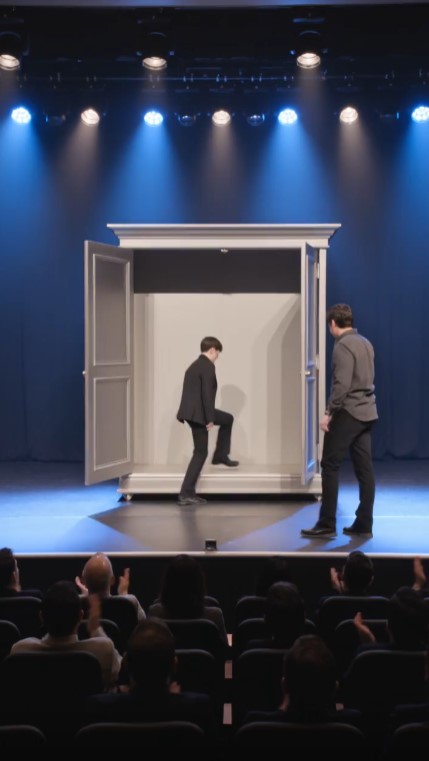
My twelve-year-old son had practiced the trick hundreds of times.
But he’d never performed it in front of a crowd this large.
He stepped inside the cabinet.
The doors closed.
Three seconds later…
they opened.
Empty.
The audience erupted.
That was exactly what was supposed to happen.
My son was supposed to reappear behind them seconds later.
But he didn’t.
Three seconds passed.
Then five.
Then ten.
The applause slowly died.
His instructor ran backstage.
The cabinet was empty.
The hidden passage was empty.
Then everyone heard it.
Three knocks.
Not from backstage.
From underneath the stage.
His instructor dropped to his knees.
“Ethan?”
Three knocks answered.
The theater manager rushed over with the maintenance key.
They opened the access panel.
My son was down there.
Safe.
But his instructor didn’t immediately reach for him.
He was staring past him into the darkness.
Then he slowly turned toward the theater manager.
“Who built this stage?”
The manager looked confused.
“Why?”
The instructor raised his flashlight.
Because behind my son was another door.
And someone had just knocked from the other side.
The theater went silent.
Not the quiet of an audience waiting for a trick.
A different kind.
The kind that comes when hundreds of people suddenly realize something wasn’t part of the show.
My son’s instructor, Daniel, climbed carefully into the access space.
“Ethan, come toward me.”
My son didn’t move immediately.
He pointed behind him.
“Someone’s in there.”
Daniel kept his voice calm.
“Come here first.”
That mattered.
No investigating.
No dramatic opening of hidden doors with a child still underground.
Ethan crawled toward him.
Daniel pulled him out.
I reached him before anyone else did.
I grabbed both shoulders.
“Are you hurt?”
He shook his head.
“No.”
“What happened?”
“I took the wrong turn.”
There was supposed to be only one turn.
That was the problem.
The cabinet trick used a simple concealed route.
Nothing dangerous.
A narrow passage behind the stage wall allowed Ethan to move from the cabinet to a curtain behind the performers.
He had practiced it repeatedly.
The route was marked.
Lit.
Inspected.
But that night, after stepping through the concealed opening, Ethan saw something he had never noticed before.
A small gap in the wall.
He thought it was part of the route.
He pushed through.
The floor dipped.
Then he slid down into the old maintenance space beneath the stage.
The opening above him shifted shut.
He couldn’t climb back.
So he knocked.
Three times.
That was their signal.
Daniel had taught him:
If something goes wrong, knock three times.
Stop moving.
Wait.
Ethan did exactly that.
And that may have prevented a bad situation from becoming worse.
But now there was the second knocking.
Behind the old door.
The theater manager, Mr. Harris, looked genuinely shaken.
“I didn’t know there was a door down there.”
Daniel stared at him.
“You manage the building.”
“I’ve been here nine years.”
“Who was here before?”
Mr. Harris looked toward the stage.
“The building is almost a hundred years old.”
That explained some things.
Not enough.
The fire marshal and police were called.
The audience was asked to leave calmly.
No one was allowed under the stage again until professionals inspected the area.
Ethan protested.
“But someone knocked.”
I looked at him.
“That’s exactly why you’re not going back.”
He didn’t argue.
For once.
About twenty minutes later, responders entered the access space.
Daniel showed them where Ethan had been.
They found the door.
Old wood.
Painted black.
Almost invisible against the surrounding structure.
No modern handle.
Just a metal ring.
One responder knocked.
Three times.
Nothing.
Then again.
Nothing.
Daniel looked confused.
“I heard it.”
“So did I,” Mr. Harris said.
Several people had.
The responders opened the door carefully.
Behind it was not a room full of people.
Not some trapped stranger.
Not a hidden criminal.
It was a narrow corridor.
And at the far end…
another door.
This one partly blocked by debris.
A maintenance specialist checked structural plans.
The corridor did not appear on the current drawings.
They stopped everything until the city records office could be contacted.
The performance was over.
I took Ethan home.
He talked the entire drive.
Not because he wasn’t scared.
Because he was.
Talking was how he handled fear.
“Do you think someone lives down there?”
“No.”
“Could it be part of the old theater?”
“Yes.”
“What if the knock was a person?”
“We don’t know.”
“What if—”
“Ethan.”
He stopped.
“You’re safe.”
He nodded.
That was the part I needed him to remember.
The mystery could wait.
His safety came first.
The next morning, Daniel called.
“Don’t let him come to the theater.”
Ethan was standing close enough to hear.
“That means something happened.”
Daniel sighed.
“Yes.”
City records had found older architectural plans.
Much older.
The theater had been built in 1928.
Then renovated in the 1950s.
Again in the 1970s.
Again in the 1990s.
Each renovation covered parts of the previous structure.
The hidden corridor belonged to the original stage system.
Back then, theaters often used trap spaces, storage tunnels, and mechanical access areas for scenery and effects.
The mysterious door had once led to a room used by stagehands.
It had been sealed during a renovation more than fifty years earlier.
Ethan looked disappointed.
“So no ghost?”
“No ghost.”
“Then who knocked?”
Daniel paused.
“That’s the strange part.”
Workers cleared the second door.
Behind it was a small room.
Empty.
Mostly.
Old ropes.
Pulley pieces.
A wooden stool.
A broken prop trunk.
And one loose section of wall.
When someone knocked on the stage above, vibration traveled through the old framing.
A hanging metal counterweight inside the sealed room swung slightly.
It tapped the back of the wooden door.
Three times.
Daniel explained it.
The second “knock” had not necessarily been a person.
It may have been a mechanical echo caused by movement above.
That should have ended the story.
It didn’t.
Because inside the room, workers found something else.
A small wooden case.
Locked.
And on the lid were two faded letters:
E.H.
Ethan’s initials.
He loved that.
I did not.
“Coincidence.”
I said it immediately.
Daniel agreed.
“Almost certainly.”
The case was logged with the theater’s historical materials.
No one opened it privately.
The building owner contacted the local historical society.
The lock was fragile.
A conservator opened it several days later.
Inside were old photographs.
Programs.
Letters.
And a magician’s notebook.
The owner’s name was written on the first page.
Edward Hale
E.H.
Not Ethan.
Edward Hale had performed at the theater in the 1930s.
A stage magician.
Not famous nationally.
But locally well known.
His signature act involved a disappearance cabinet.
Ethan nearly shouted when Daniel told him.
“You’re kidding.”
“No.”
“Same trick?”
“Similar idea.”
That got everyone’s attention.
The historian explained that disappearance illusions using cabinets, curtains, trap spaces, and hidden routes had existed for generations.
Nothing supernatural.
Nothing unique.
Still, the coincidence was remarkable.
Ethan had been performing a modern version of a classic stage effect.
He accidentally entered part of an old route once used for similar performances.
Then landed beside a sealed room containing materials from a magician who had worked there almost ninety years earlier.
The notebook described the theater.
Stage measurements.
Lighting notes.
Safety warnings.
Then Daniel found something that changed his expression.
A page titled:
UNDERSTAGE ROUTE – DO NOT USE AFTER RAIN
I looked at him.
“What?”
The old theater had once had moisture problems beneath the stage.
Edward Hale had written that wooden sections could swell.
Doors could stick.
Trap mechanisms could shift.
He had stopped using the route after one assistant became temporarily trapped.
No one was injured.
But the incident frightened him badly enough that he abandoned that version of the trick.
Ethan stared at the notebook.
“Someone got trapped there before?”
“Almost ninety years ago.”
“Doing magic?”
“Yes.”
He looked at me.
“That’s insane.”
I agreed.
Then the historian showed us one photograph.
Edward Hale stood beside a young assistant.
Behind them was a cabinet.
Not identical to Ethan’s.
But close enough to make the connection obvious.
Ethan leaned in.
“Who’s the kid?”
The assistant’s name was Thomas.
Fifteen years old.
A theater errand boy who later became a professional stagehand.
Daniel flipped through the notebook.
One note said:
Thomas remembers the three-knock rule. Good.
We all went quiet.
Ethan looked at Daniel.
“You taught me three knocks.”
Daniel nodded.
“That’s standard enough.”
Still.
Three knocks.
The same emergency signal.
Again, not evidence of anything mystical.
Just a sensible convention.
Three distinct knocks are easy to recognize.
But the similarity was eerie.
Then Mr. Harris, the theater manager, asked:
“Thomas what?”
The historian checked the records.
Thomas Miller.
Mr. Harris froze.
“My grandfather was Thomas Miller.”
Everyone looked at him.
He laughed nervously.
“No.”
Then called his mother.
She confirmed it.
Thomas had worked at the theater as a teenager.
Later became a carpenter.
Mr. Harris had heard stories about it growing up.
But never knew about the magic act.
He had spent nine years managing the same theater where his grandfather once worked…
without knowing his grandfather had been part of its stage history.
That became the real story.
Not a ghost.
Not someone trapped behind the door.
Not some impossible message meant for Ethan.
A building had layered decades of history on top of itself.
Old spaces forgotten.
Old notes sealed away.
Then one mistake during a children’s magic performance reopened part of it.
The theater closed for inspection.
Every hidden route was mapped.
Unsafe sections sealed properly.
The performance cabinet was removed until Daniel and the theater developed a safer setup that did not rely on backstage paths.
He took responsibility.
“I should have checked the surrounding structure better.”
I appreciated that.
Nobody blamed Ethan.
But nobody turned the accident into a heroic adventure either.
He had followed the wrong opening.
That was dangerous.
The lesson was simple.
Illusions depend on careful control.
If something unexpected appears during a trick, stop.
Do not improvise in concealed spaces.
Ethan understood.
Mostly.
Then came the question he had been waiting to ask.
“Can we perform again?”
I stared at him.
Daniel laughed.
“Maybe not this week.”
Three months later, the theater reopened.
Ethan performed again.
Different trick.
No cabinet.
No trap route.
Just cards and rope.
He complained it was less exciting.
I told him that was the point.
The audience knew the story by then.
Some people came hoping something strange would happen.
Nothing did.
Ethan performed cleanly.
Finished.
Bowed.
Walked offstage normally.
I had never been happier to see a boring ending.
Afterward, Mr. Harris invited us to a small display in the lobby.
The theater had created an exhibit about Edward Hale and Thomas Miller.
Old photographs.
Programs.
The magician’s notebook.
A reproduction of the page mentioning the three-knock rule.
At the bottom was a newer photograph.
Ethan and Daniel.
No dramatic caption.
Just:
STAGE SAFETY REVIEW, 2026
Ethan hated it.
“It makes me look like a warning label.”
Daniel said:
“You are a warning label.”
Years passed.
Ethan kept doing magic.
But something changed.
He became obsessed with how tricks were built.
Not only performance.
Engineering.
Stage design.
Mechanisms.
Safety.
At sixteen, he volunteered with the theater crew.
Mr. Harris showed him old pulley systems.
Counterweights.
Trap doors that were no longer used.
The hidden corridor remained permanently inaccessible except to trained maintenance staff.
Ethan never entered it again.
That mattered.
Respecting a mystery sometimes means leaving the dangerous part alone.
At eighteen, Ethan built his own illusion cabinet.
No hidden stage passage.
The mechanism worked entirely within a controlled prop system.
He tested every latch.
Every panel.
Every emergency release.
Daniel watched.
“You’re paranoid.”
Ethan smiled.
“Three knocks.”
Daniel nodded.
“Fair.”
Years later, Ethan studied theatrical design.
Not because of one accident alone.
But that night shaped him.
He learned that magic only feels impossible when everything behind it is carefully understood.
Neglect is not magic.
Unknown spaces are not mystery.
They are hazards.
The old notebook stayed in the theater archive.
Once, while working on a research project, Ethan asked permission to read it again.
He found a line he had missed as a child.
Edward Hale had written:
A trick is only good if the assistant comes home safely.
Ethan copied it.
Framed it in his workshop.
That became his rule.
Eventually he designed illusions for professional performers.
People praised the spectacle.
Trap systems.
Vanishing effects.
Mechanical transformations.
But Ethan cared most about what audiences never saw.
Backup exits.
Manual overrides.
Lighting marks.
Clear routes.
Communication signals.
Three knocks.
Always three.
When people asked why, he told the short version.
“At twelve, I took the wrong turn during a disappearance trick.”
“How bad?”
“I ended up under a stage.”
“Seriously?”
“Yes.”
“Were you scared?”
“Eventually.”
Then he smiled.
“The first thing I did was knock.”
Years after the original incident, Mr. Harris retired.
At his farewell event, he told Ethan something.
“My grandfather would’ve liked you.”
Ethan laughed.
“You never met him.”
“No.”
“But I found one of his letters.”
Thomas Miller, the teenage stagehand from the 1930s, had later written about working with Edward Hale.
He described the day the old passage nearly trapped him.
Then wrote:
I learned that night not to confuse bravery with continuing after something goes wrong.
Ethan went quiet.
That sentence felt familiar.
Not because history repeated exactly.
Because good lessons do.
Stop when something changes.
Pay attention.
Ask for help.
Don’t push deeper into a dangerous situation just to finish the show.
The first night, when Ethan vanished longer than expected, the audience thought they were watching a trick fail.
In a way, they were.
But the failure revealed something useful.
An unsafe hidden route.
A forgotten section of a historic theater.
A family connection Mr. Harris had never known.
And a lesson Ethan carried for the rest of his life.
People still asked about the second knocking.
“Was someone really behind the door?”
No.
Most likely, it was the old counterweight shifting against the wood.
Simple mechanics.
Old framing.
Bad timing.
Nothing supernatural.
Ethan actually preferred that explanation.
Because if someone had been hiding behind the door, the story would have ended with fear.
Instead, it ended with history.
A magician named Edward.
A stagehand named Thomas.
A forgotten corridor.
A notebook.
And one twelve-year-old boy who took the wrong turn during a magic trick…
then remembered exactly what he had been taught to do when the trick stopped going according to plan.
Three knocks.
Wait.
And let someone find you.