
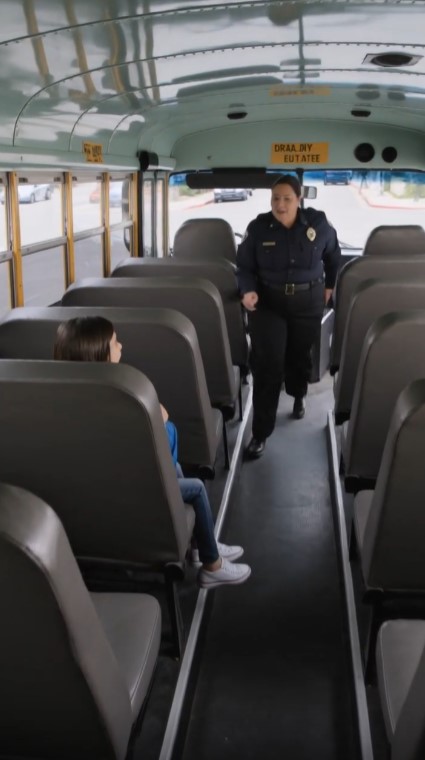
I thought the little girl had fallen asleep.
Every other child had already gone home.
But Emma was still sitting in the last row.
Her backpack rested on her lap.
Both hands were gripping the straps so tightly that her knuckles had turned pale.
I checked the clock on the dashboard.
We were already several minutes past the final stop.
I walked down the aisle.
“Emma, we’re at your stop.”
She looked up at me.
Then shook her head.
“I can’t get off.”
I smiled, thinking she was nervous about something.
“Your mom is waiting outside.”
Emma slowly looked toward the windshield.
A woman stood beside the bus stop.
She was smiling.
Waving.
At first, I assumed she was Emma’s mother.
Then Emma whispered:
“That’s not my mom.”
Everything inside me changed.
I looked at the woman again.
She was standing completely still now.
Still smiling.
Still watching the bus.
I moved back toward Emma.
“What do you mean?”
Emma lowered herself in the seat.
“She knows my name.”
I immediately closed the bus doors.
Then I contacted the school.
The woman walked toward the bus.
She stopped a few feet from the front door and knocked on the glass.
Once.
Twice.
Then she held up her phone.
There was a photograph on the screen.
A photograph of Emma.
I stepped closer but kept the door locked.
“Who are you?”
The woman didn’t answer my question.
Instead, she said:
“Ask Emma about the yellow room.”
Emma heard her.
Her face went completely white.
I had never heard of any yellow room.
But apparently Emma had.
Before I could ask anything else, the school called me back.
I answered immediately.
The administrator’s voice was unusually quiet.
“Is she carrying a red umbrella?”
I looked outside.
The woman was.
A long silence followed.
Then the administrator said:
“Do not open that door.”
I stared at the woman.
She was still holding the red umbrella.
“Who is she?”
The administrator didn’t answer.
“Where is Emma’s mother?”
Another silence.
Then:
“Keep Emma on the bus.”
Before I could ask why, Emma whispered from behind me:
“She found us again.”
That sentence stayed with me.
Because Emma didn’t say it like a frightened child guessing what might happen.
She said it like someone recognizing something she had already survived.
I sat beside her.
“Emma, I need you to tell me what you mean.”
She stared at the floor.
“I can’t.”
“You can.”
“No.”
“Emma, you’re safe on this bus.”
She shook her head.
“She said that last time.”
My stomach tightened.
“What last time?”
Emma looked toward the woman outside.
“The yellow room.”
I looked back at the woman.
She had lowered the phone.
Now she was simply watching us.
I called the school again.
This time, the administrator answered immediately.
“Is Emma still with you?”
“Yes.”
“Good.”
“Tell me what’s happening.”
“We’re sending someone.”
“Who?”
“Her mother.”
“Then who is the woman outside?”
The administrator took a breath.
“That’s what we’re trying to determine.”
That answer frightened me more than anything else.
The school knew about the red umbrella.
They knew about the yellow room.
And they clearly knew something about the woman.
But they weren’t telling me.
I asked Emma again.
“What is the yellow room?”
She squeezed her backpack.
“It was at the old building.”
“What old building?”
“The one where Mom used to work.”
I remembered hearing that Emma’s mother worked for a community organization.
But I had never asked where.
Emma continued quietly.
“There were lots of rooms.”
“Was one of them yellow?”
“All the walls.”
“What happened there?”
Emma looked toward the front of the bus.
“Mom told me never to talk about it.”
The woman outside suddenly stepped closer.
She lifted her phone again.
This time, the screen displayed a different photograph.
A picture of Emma standing beside another little girl.
I couldn’t see the other girl’s face clearly.
I turned toward Emma.
She saw the image.
And started crying.
“That’s Mia.”
“Who is Mia?”
“My friend.”
“Where is she?”
Emma wiped her cheek.
“I don’t know.”
The woman knocked again.
Three times.
Then she spoke through the glass.
“Emma, your mother wants you home.”
Emma shook her head.
“My mom isn’t here.”
The woman smiled.
“She will be.”
I called the school.
Again.
This time the administrator answered on the first ring.
“She showed me another photograph,” I said.
“What photograph?”
“Emma with another girl.”
There was silence.
“Was the other girl wearing a blue sweater?”
I looked at Emma.
She nodded.
“Yes.”
The administrator’s voice became even quieter.
“Do not let that woman speak to Emma.”
“Who is she?”
“We don’t know.”
“You clearly know something.”
“We know enough to be careful.”
I looked through the windshield.
The woman had stopped smiling.
She was staring directly at me now.
Then a car pulled into the parking area.
Emma’s mother jumped out.
She ran toward the bus.
“Emma!”
Emma stood.
“Mom!”
I opened the door only after I recognized her.
Emma ran straight into her mother’s arms.
Her mother held her tightly.
Then looked at me.
“Thank you.”
I nodded.
“There was a woman here.”
Her expression changed.
“What woman?”
I pointed toward the sidewalk.
But the woman with the red umbrella was gone.
Only a few drops of rain remained on the pavement.
Emma’s mother looked around.
“Did she talk to you?”
“Yes.”
“What did she say?”
I hesitated.
“She mentioned the yellow room.”
Her mother’s face drained of color.
Emma grabbed her hand.
“Mom.”
Her mother looked down.
“It’s okay.”
“No.”
Emma shook her head.
“She found us again.”
Her mother looked at me.
For a moment, neither of us spoke.
Then she said:
“We need to go.”
I watched them leave.
But I couldn’t stop thinking about the photograph.
And the red umbrella.
The next morning, I arrived at the bus depot earlier than usual.
The school administrator was already waiting.
So was a police officer.
He introduced himself as Detective Harris.
He didn’t accuse anyone.
He didn’t make dramatic statements.
He simply asked me to describe exactly what happened.
I told him everything.
The woman.
The photograph.
The yellow room.
The red umbrella.
Emma saying she’d found them again.
When I finished, Detective Harris looked at the school administrator.
Then back at me.
“Did the woman ever touch the bus?”
“No.”
“Did she try to open the door?”
“No.”
“Did she threaten you?”
“No.”
“Then why were you told not to open the door?”
He looked at the administrator.
She answered.
“Because we had a similar incident three years ago.”
I sat up.
“With Emma?”
“No.”
“With another child.”
She placed a photograph on the table.
It showed a little girl.
Maybe nine years old.
The girl was standing outside an old building.
Behind her was a faded yellow door.
Detective Harris pointed to the photograph.
“This child disappeared for several hours after leaving school.”
“Was she found?”
“Yes.”
“Where?”
“She was found at an abandoned community center.”
My heart sank.
“The yellow room?”
The administrator nodded.
“That’s where the police found her.”
“What happened?”
The administrator looked uncomfortable.
“The child said a woman had taken her there.”
“Did they find the woman?”
“No.”
“Did the child know her?”
“She said the woman knew her name.”
I thought about Emma.
The same pattern.
A child.
A woman.
A photograph.
A strange room.
A name spoken by someone who shouldn’t know it.
Detective Harris leaned forward.
“But there is something different this time.”
“What?”
“The old community center was demolished last year.”
I frowned.
“So how could this woman be connected to it?”
“That is what we’re trying to find out.”
Then he showed me another photograph.
This one was older.
It showed a group of children standing outside the same community center.
One of them was Emma.
Not the Emma I knew.
A much younger Emma.
She couldn’t have been more than five.
I stared at the photograph.
“That’s impossible.”
Detective Harris shook his head.
“No.”
He pointed to a woman standing in the background.
She was holding a red umbrella.
I felt cold.
“That is her.”
The administrator nodded.
“We know.”
“But Emma was five.”
“Yes.”
“And this photograph was taken when?”
“Five years ago.”
I looked at the date.
Emma was eight now.
The math worked.
But another question didn’t.
“Why was Emma at that building?”
No one answered.
Finally, Detective Harris said:
“Her mother was part of a temporary housing program there.”
“What kind of program?”
“Families stayed there while they were waiting for permanent housing.”
I remembered Emma’s mother mentioning that Emma had lived in several places when she was younger.
But I’d never known why.
Detective Harris continued.
“Emma wasn’t supposed to remember much about the building.”
“But she does.”
“Yes.”
“And the yellow room?”
“Yes.”
“What happened there?”
He closed the folder.
“We don’t know everything.”
That wasn’t good enough for me.
“What do you know?”
He looked at me.
“We know there was a woman who volunteered there.”
“Her name?”
“Claire Morgan.”
The name meant nothing to me.
Until the administrator said:
“She was never officially employed.”
“Then how did she get inside?”
“She knew the staff.”
Detective Harris added:
“And she had photographs of several children.”
“Why?”
“We don’t know.”
I thought about the phone screen.
Emma’s face.
Mia beside her.
I asked:
“Who was Mia?”
The room became silent.
Detective Harris looked at the administrator.
Then he opened another folder.
A photograph slid across the table.
It showed two little girls.
Emma.
And Mia.
Behind them was the yellow room.
Mia was smiling.
Emma wasn’t.
On the back of the photograph was a handwritten sentence.
They promised we’d never be separated.
I stared at it.
“Who wrote that?”
“We don’t know.”
“Where is Mia now?”
Detective Harris looked at me.
“She was never officially reported missing.”
“What?”
Her family moved away.
No forwarding address.
No school records after that year.
No confirmed contact.
“But Emma remembers her.”
“Yes.”
“And Claire Morgan?”
“Disappeared too.”
I leaned back.
“So the woman outside the bus…”
“We believe she may be Claire.”
“May be?”
“We haven’t confirmed her identity.”
“Then why does she know Emma?”
“That is the question.”
That afternoon, I drove past the old community center.
There was nothing left.
Just an empty lot surrounded by fencing.
But near the back of the property stood one remaining structure.
A small storage building.
Its door was painted yellow.
I stopped the car.
I didn’t know why.
Maybe because I wanted to understand what Emma had been talking about.
Maybe because I couldn’t shake the feeling that there was something everyone was missing.
I called Detective Harris.
He told me not to enter.
So I didn’t.
Instead, I stood outside the fence.
Then I noticed something.
A red umbrella.
It was leaning against the yellow door.
I called him again.
This time he arrived within minutes.
The umbrella was gone when he got there.
But there was something else.
A small envelope had been pushed beneath the fence.
It had one name written on it.
Emma.
Detective Harris opened it carefully.
Inside was a photograph.
Emma and Mia again.
But this time they were older.
The photograph had been taken recently.
Very recently.
On the back were five words.
She never forgot the promise.
Detective Harris stared at the photograph.
Then his phone rang.
He answered.
His expression changed.
“What?”
He listened.
Then said:
“Are you sure?”
He hung up.
I asked what happened.
He looked at me.
“They found Mia.”
My heart jumped.
“Where?”
“At a hospital two counties away.”
“Is she okay?”
“She is.”
“Does she know Emma?”
Detective Harris nodded.
“She asked for her.”
That evening, Emma’s mother agreed to let Detective Harris speak with her and Emma together.
Mia was brought in the next morning.
She was fourteen now.
Older.
Taller.
But Emma recognized her immediately.
“Mia.”
Mia started crying.
Emma ran to her.
They hugged.
Neither said anything for several seconds.
Then Mia whispered:
“I knew you’d remember.”
Emma pulled back.
“Remember what?”
“The promise.”
Emma looked confused.
“What promise?”
Mia looked at Emma’s mother.
Her mother closed her eyes.
Then finally said:
“Tell her.”
Mia took a breath.
“When we were little, your mom told us something.”
“What?”
“She said if anything ever happened, we were supposed to find the yellow room.”
Emma frowned.
“Why?”
“Because that’s where she kept the photographs.”
“What photographs?”
Mia looked at Detective Harris.
“Photographs of children whose parents couldn’t be found.”
Emma’s mother began crying.
“I was trying to help them.”
Mia continued.
“There was a woman who said she could help too.”
“Claire?”
Mia nodded.
“She knew everyone’s names.”
“Why?”
“She said she was helping families reconnect.”
Emma looked frightened.
“But Mom didn’t trust her.”
“No.”
Mia explained what had happened years earlier.
Claire had been collecting information about children and families.
She told some parents she could help them find relatives.
But she also took photographs.
Names.
Addresses.
School schedules.
Everything.
Emma’s mother discovered what was happening.
She reported it.
But before authorities could investigate fully, Claire disappeared.
The families were moved.
The community center eventually closed.
Mia’s family left the area.
Emma’s mother thought the danger was over.
Until the woman with the red umbrella appeared again.
Detective Harris asked:
“Why now?”
Mia looked at Emma.
“Because Claire believes Emma has something.”
Emma looked confused.
“What?”
Mia pointed toward her backpack.
“The yellow key.”
Emma froze.
Her mother closed her eyes.
I remembered Emma gripping her backpack the entire time on the bus.
Detective Harris asked:
“What key?”
Emma slowly opened the front pocket.
She pulled out a small brass key.
I had seen it many times.
I had assumed it belonged to her house.
It didn’t.
Her mother finally explained.
“When Emma was little, she was given that key.”
“By Claire?”
“No.”
“Then who?”
“An older woman who worked at the center.”
“What did it open?”
Her mother shook her head.
“We never found out.”
Mia stared at it.
“I know.”
Everyone looked at her.
“It opens the yellow room.”
Detective Harris immediately took the key.
The old storage building was searched that afternoon.
The yellow door was still locked.
The key fit.
Inside was a small room.
There were shelves.
Empty boxes.
Old children’s drawings.
And hundreds of photographs.
Not stolen photographs.
Family photographs.
Some belonged to families who had been reunited.
Others belonged to people who had never found each other.
On the wall was a handwritten list of names.
Emma’s name was there.
So was Mia’s.
But beneath them was another name.
Claire Morgan.
Detective Harris stared at it.
Then noticed something taped underneath.
A recent photograph.
It showed Claire.
Older now.
Standing beside the bus stop.
Holding the red umbrella.
On the back was a message.
I wasn’t trying to take Emma.
I was trying to return what belonged to her.
There was one final photograph.
It showed Emma’s mother as a young woman.
Beside her was another woman.
A woman none of us recognized.
Detective Harris looked at Emma’s mother.
“Who is she?”
Her mother stared at the photograph.
Then whispered:
“My sister.”
Everyone became silent.
“You had a sister?”
“She disappeared when we were teenagers.”
“What’s her name?”
Her mother looked at the photograph again.
“Claire.”
I felt the pieces fall into place.
The woman with the red umbrella wasn’t a stranger.
She wasn’t Emma’s mother.
She wasn’t trying to abduct Emma.
She was Emma’s great-aunt.
And the yellow room wasn’t a trap.
It was an old family archive.
Claire had spent years collecting photographs and records because she believed families separated by circumstances deserved a chance to find each other.
But somewhere along the way, fear, secrecy, and accusations had turned everything into something frightening.
Detective Harris eventually found Claire.
She was sitting in a small café several miles away.
She had the red umbrella beside her.
She didn’t run.
She didn’t resist.
She simply asked one question.
“Did Emma get the photograph?”
Detective Harris said yes.
Claire closed her eyes.
“Then I can finally stop.”
Emma’s mother met her later.
Their conversation was private.
But afterward, Emma’s mother told us the truth.
She had believed her sister had abandoned the family decades earlier.
Claire believed her sister had deliberately cut her out.
Both had been carrying different versions of the same misunderstanding.
Neither knew the other had spent years trying to find a way back.
And the yellow room had been Claire’s attempt to preserve the memories of people who had lost one another.
Emma eventually asked her mother:
“Why didn’t you tell me?”
Her mother knelt beside her.
“Because I was scared.”
“Of Claire?”
“Of what happened before.”
Emma looked at the little brass key.
“I thought she was going to take me.”
“I know.”
“She wasn’t.”
“No.”
Emma looked toward the window.
“Can I see her?”
Her mother hesitated.
Then nodded.
A few days later, Emma met Claire.
Claire cried the moment she saw her.
“I knew you’d remember the room.”
Emma looked at her.
“I remembered because I was scared.”
Claire nodded.
“I know.”
“Why did you come to my bus?”
Claire looked down.
“Because I didn’t know how else to reach your mother.”
“You scared me.”
“I know.”
Emma was quiet.
Then asked:
“Why the red umbrella?”
Claire smiled sadly.
“Your grandmother gave it to me.”
Emma looked at her mother.
Her mother nodded.
“That was hers.”
For the first time, the red umbrella wasn’t frightening.
It was simply an old family object.
Something that had survived years of confusion.
The photograph from the bus was framed.
So was the photograph of Emma and Mia.
And the brass key was placed in a small box.
Not because Emma needed to be afraid of it.
But because it reminded everyone of what had been forgotten.
The next week, I drove Emma home from school.
When we reached her stop, she stood immediately.
No hesitation.
No fear.
She grabbed her backpack.
Then paused beside my seat.
“Thank you.”
“For what?”
“For keeping the doors closed.”
I smiled.
“That was my job.”
Emma shook her head.
“No.”
She looked toward the window.
“That day, you believed me.”
Then she stepped off the bus.
Her mother was waiting.
And this time, Emma ran toward her.
No woman with a red umbrella.
No strange photograph.
No yellow room.
Just a mother and daughter standing together at the end of the day.
I watched them walk away.
Then I looked at the empty last row.
For weeks afterward, I kept thinking about what Emma had said.
She had been afraid because someone knew her name.
But the truth was more complicated.
Sometimes the people who know our names are strangers.
Sometimes they’re family.
And sometimes, after years of secrets and misunderstandings, the most frightening thing isn’t discovering who has been looking for you.
It’s discovering why.
Emma never stopped carrying the little brass key.
But she stopped gripping it like something dangerous.
Eventually, she attached it to her backpack.
Not as a warning.
As a reminder.
Because the yellow room had never really been about a locked door.
It was about everything people had left behind it.
Names.
Photographs.
Promises.
And families who had spent years believing they were lost to one another.
The woman with the red umbrella hadn’t come to take Emma away.
She had come because, after years of searching, she finally believed she had found the person who could open the door.
And this time…
Emma wasn’t afraid to walk through it.