
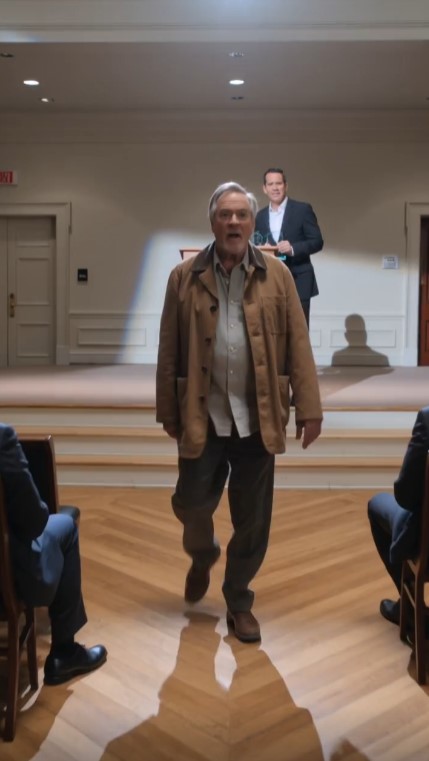
A homeless-looking elderly man walked into a packed awards ceremony and headed straight for the stage.
Security immediately moved toward him.
People started whispering.
But the old man ignored everyone.
He pointed directly at the businessman holding the night’s biggest award and shouted:
“You still owe me five dollars.”
The entire room went silent.
The businessman stared at him.
Then his trophy slipped from his hand.
He ran down the steps and hugged the old man.
Nobody understood what was happening.
Then the businessman took the microphone.
“When I was seventeen, I had nowhere to sleep.”
“This man found me behind a grocery store.”
“He bought me dinner and gave me the last five dollars in his pocket.”
The old man smiled.
“I told you you’d become something.”
The businessman started crying.
Then he reached into his wallet, pulled out five dollars, and placed it in the man’s hand.
But the old man wouldn’t take it.
Instead, he reached inside his worn coat.
And pulled out something he’d been carrying for thirty years.
The businessman looked at it and completely broke down.
It was a photograph.
Faded.
Bent at the corners.
Almost torn in half.
It showed a skinny seventeen-year-old boy standing beside a grocery store.
The boy was Daniel Carter.
And beside him stood the elderly man, thirty years younger.
Daniel stared at it.
“You kept this?”
The old man smiled.
“For thirty years.”
Daniel turned the photograph over.
There was writing on the back.
His own handwriting.
When I make it, I’ll come find you.
Underneath was a date.
October 14, 1996.
Daniel covered his face.
The ballroom disappeared around him.
The cameras.
The executives.
The expensive suits.
The applause.
For a moment, he was seventeen again.
Hungry.
Cold.
And sleeping behind a grocery store because he had nowhere else to go.
The elderly man’s name was Henry Walker.
Thirty years earlier, Henry hadn’t been wealthy.
Far from it.
He worked nights cleaning offices.
During the day, he repaired bicycles in a tiny rented garage.
He lived alone in a one-bedroom apartment.
And on the night he found Daniel, he had only eleven dollars left until payday.
Daniel had been sitting behind the grocery store with a backpack beneath his head.
Henry almost walked past him.
Then he stopped.
“You hungry?”
Daniel didn’t answer.
Henry asked again.
“Son, when did you last eat?”
Daniel finally looked up.
“Yesterday.”
Henry took him to a diner.
Daniel ordered the cheapest thing on the menu.
A bowl of soup.
Henry ordered nothing.
Daniel noticed.
“Aren’t you eating?”
“Already did.”
It wasn’t true.
After dinner, Henry paid.
Then he reached into his pocket.
He had five dollars left.
He handed it to Daniel.
Daniel refused.
“I can’t take that.”
“Yes, you can.”
“I’ll pay you back.”
Henry laughed.
“When you’re rich.”
Daniel almost smiled.
“I’m serious.”
“So am I.”
Henry pushed the bill into his hand.
“Pay me back when you become somebody.”
Those words stayed with Daniel.
Henry helped him find a temporary place at a youth shelter.
Then he gave Daniel something even more valuable than money.
Work.
Every afternoon, Daniel came to Henry’s garage.
He swept floors.
Organized tools.
Changed bicycle tires.
Henry paid him whatever he could.
Sometimes it was ten dollars.
Sometimes twenty.
Sometimes dinner.
But Daniel never forgot the original five.
One afternoon, Henry took the photograph outside the grocery store.
“You’ll want this someday,” he told him.
Daniel laughed.
“I look terrible.”
“You look like somebody who’s going somewhere.”
Daniel wrote the promise on the back.
When I make it, I’ll come find you.
Then life moved quickly.
Daniel finished school.
He earned a scholarship.
He left town.
Henry closed the bicycle shop several years later.
They exchanged letters for a while.
Then one was returned.
Henry had moved.
Daniel tried finding him.
No luck.
Years passed.
Daniel built a small logistics company.
The company grew.
One truck became five.
Five became fifty.
Eventually, Daniel’s company operated across several states.
But he never forgot Henry.
Every few years, he searched again.
Old addresses.
Phone directories.
Former neighbors.
Nothing.
Eventually, Daniel began wondering if Henry had died.
Now Henry was standing in front of him.
Alive.
Holding the photograph.
Daniel looked at the audience.
“I’ve received a lot of awards.”
His voice cracked.
“But the reason I’m standing here is because one night, when almost everyone else walked past me, this man stopped.”
The room remained completely silent.
Daniel turned back to Henry.
“Where have you been?”
Henry smiled.
“Around.”
“No. I’m serious. I’ve looked for you for years.”
Henry’s smile faded slightly.
“I know.”
Daniel stared at him.
“You knew?”
Henry nodded.
That answer confused Daniel more than anything else.
“If you knew I was searching, why didn’t you contact me?”
Henry looked around the ballroom.
“Because you didn’t owe me anything.”
Daniel held up the five-dollar bill.
“You literally told me I did.”
Henry laughed.
“That was a joke.”
“Then why come tonight?”
Henry looked down at the photograph.
“Because I needed to know you remembered who you were before all this.”
Daniel didn’t understand.
Henry reached inside his coat again.
This time he pulled out a folded newspaper clipping.
It was several months old.
The headline featured Daniel’s company.
But Henry had circled one paragraph.
Daniel read it.
His company was opening a training program for young adults aging out of foster care and teenagers experiencing homelessness.
The program offered paid work, temporary housing assistance and vocational training.
Daniel looked at Henry.
“You saw this?”
“Yes.”
“That’s why you came?”
“Partly.”
Henry explained that he’d spent the previous decade volunteering at a small community shelter.
Several young people from that shelter had applied to Daniel’s program.
One had been accepted.
A nineteen-year-old named Marcus.
“He starts Monday,” Henry said.
Daniel smiled.
“I know Marcus.”
Henry nodded.
“He reminds me of you.”
Daniel looked down.
That was when he finally understood.
Henry hadn’t come for money.
He hadn’t come because Daniel was receiving an award.
He’d come because something Daniel had created had reached another frightened teenager with nowhere to go.
Henry had wanted to see whether the boy behind the grocery store had kept the most important part of his promise.
Not the five dollars.
The kindness.
Daniel placed the bill back in Henry’s hand.
“Keep it anyway.”
Henry shook his head.
“No.”
“Henry.”
“I don’t want your five dollars.”
Daniel laughed through his tears.
“Then what do you want?”
Henry thought for a moment.
“Give it to the next kid.”
Daniel stared at him.
Then folded the bill and put it carefully into his jacket pocket.
“I can do that.”
The audience stood.
The applause lasted nearly two minutes.
But Daniel barely heard it.
After the ceremony, he took Henry to dinner.
Not to the expensive restaurant where the award organizers had reservations.
To a small diner.
Daniel ordered soup.
Henry laughed when he saw it.
“You’re really doing this?”
“You started it.”
They talked until after midnight.
Daniel learned what had happened during the missing years.
Henry had moved away to care for his older sister after she became ill.
After she died, he returned.
He never reopened the bicycle shop.
Instead, he began helping at shelters.
Daniel looked at Henry’s worn coat.
“Where are you living now?”
Henry hesitated.
That was the first moment Daniel realized something was wrong.
“Henry?”
The old man looked embarrassed.
“The shelter has a room upstairs.”
Daniel’s smile disappeared.
“You’re staying at the shelter?”
“Temporarily.”
“For how long?”
Henry didn’t answer.
“Henry.”
“Eight months.”
Daniel leaned back.
The man who had once found him homeless was now without a permanent home himself.
“You should have called me.”
“For what?”
“For help.”
Henry shook his head.
“I didn’t help you thirty years ago so you would owe me thirty years later.”
Daniel leaned forward.
“This isn’t repayment.”
“What is it?”
Daniel paused.
“It’s my turn to stop.”
Henry’s eyes filled with tears.
The next morning, Daniel didn’t buy Henry a mansion.
He knew Henry would never accept it.
Instead, they talked.
Really talked.
Henry wanted independence.
He wanted useful work.
He wanted somewhere small and quiet to live.
So Daniel contacted the community organization his company already supported.
A modest apartment became available.
Henry insisted on paying part of the rent from his pension.
Daniel agreed.
Then Henry began working three afternoons a week in Daniel’s youth training center.
Not as an executive.
Not as a motivational speaker.
He taught bicycle repair.
The first day, Marcus walked into the workshop.
Henry handed him a wrench.
“You ever fixed a bike?”
“No.”
“Good.”
Marcus looked confused.
“Why is that good?”
“Means I get to teach you.”
Within months, the workshop became one of the program’s most popular spaces.
Daniel visited often.
Sometimes he’d stand quietly near the doorway and watch Henry work with teenagers who reminded him of himself.
Henry never lectured them.
He never told them they were lucky.
He simply gave them something useful to do.
And when they made mistakes, he handed the tool back and said:
“Try again.”
One afternoon, Daniel brought the old photograph.
He’d had it carefully restored and copied.
The original still belonged to Henry.
Daniel framed the copy and hung it in the training center.
Beneath it, he placed a small plaque.
It didn’t mention Daniel’s company.
It didn’t mention the award.
It simply said:
SOMEONE STOPPED.
Years later, Henry’s health began to decline.
Daniel visited him every week.
During one visit, Henry pointed toward Daniel’s jacket.
“You still carrying my money?”
Daniel smiled.
The original five-dollar bill was still inside a small protective sleeve in his wallet.
“You told me to give it to the next kid.”
“And you didn’t listen.”
“I gave a lot more than five dollars.”
“That wasn’t the deal.”
Daniel laughed.
“Fine.”
Several days later, Daniel visited the training center.
A new teenager had arrived.
His name was Ethan.
He was eighteen.
He owned one backpack.
He’d spent the previous week sleeping wherever he could.
Daniel found him sitting alone in the cafeteria.
“You hungry?”
Ethan shrugged.
“A little.”
Daniel bought him dinner.
Then he sat across from him.
They talked.
When it was time to leave, Daniel opened his wallet.
He removed the old five-dollar bill.
For a moment, he hesitated.
Thirty years.
That tiny piece of paper had traveled from Henry’s hand to Daniel’s.
Through homelessness.
College.
Failure.
Success.
Marriage.
Children.
A company.
An awards ceremony.
And back to a young man who needed somebody to stop.
Daniel placed it on the table.
Ethan frowned.
“I can’t take that.”
Daniel smiled.
“Yes, you can.”
“I’ll pay you back.”
Daniel’s eyes filled with tears.
He had heard those exact words once before.
“When?”
Ethan shrugged.
“When I make it.”
Daniel pushed the bill toward him.
“Then pay me back when you become somebody.”
Ethan took it.
Daniel immediately shook his head.
“No. Actually, forget that.”
The teenager looked confused.
Daniel smiled.
“You already are somebody.”
A week later, Daniel told Henry what he’d done.
The old man laughed.
“Finally.”
“You happy now?”
“Almost.”
“What else do I owe you?”
Henry smiled.
“Nothing.”
When Henry died two years later, Daniel stood at his funeral holding the old photograph.
There were no television cameras.
No business reporters.
No awards.
But the room was full.
Former shelter residents.
Young people from the training program.
Neighbors.
Firefighters.
Teachers.
Mechanics.
People Daniel had never met.
One after another, they told stories about Henry.
A meal he’d bought.
A tire he’d repaired.
A ride he’d given.
A phone call he’d made.
Twenty dollars slipped quietly into someone’s hand.
A couch offered for a night.
A job recommendation.
A conversation at exactly the moment someone needed one.
Daniel finally understood something.
He had spent years believing Henry’s greatest act of kindness was helping him.
It wasn’t.
Daniel was simply one person among many.
Henry had lived his entire life stopping for people others walked past.
After the funeral, Daniel returned to the training center.
He stood beneath the photograph.
On the back of the original were still the words his seventeen-year-old self had written:
When I make it, I’ll come find you.
Daniel smiled sadly.
For decades, he thought “making it” meant becoming successful enough to repay Henry.
He’d been wrong.
Henry had never wanted his money back.
The real debt was much simpler.
Someone had stopped for Daniel.
So Daniel needed to stop for someone else.
And one day, that person would stop for another.
Five dollars.
One meal.
One chance.
Passed from hand to hand.
Until nobody could remember where the kindness had started.
Except Daniel.
He always remembered.
It started behind a grocery store with an ordinary man who had almost nothing himself.
A man who looked at a frightened seventeen-year-old boy and somehow saw the person he might become.
Thirty years later, when Daniel stood on a stage receiving the biggest award of his career, Henry appeared from the back of the room and shouted:
“You still owe me five dollars.”
Technically, Daniel eventually paid him back.
Just not in the way either of them expected.