
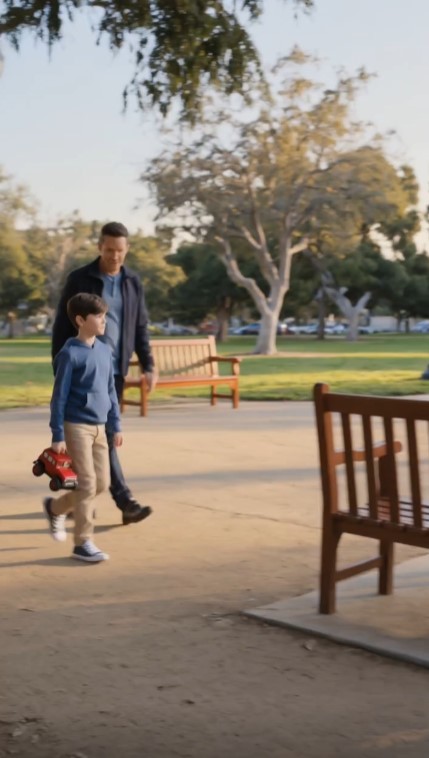
Every Friday after school…
A little boy walked to the same park bench.
And left one toy underneath it.
A toy truck.
A stuffed bear.
A baseball glove.
Then he walked away.
A woman who visited the park every afternoon finally became curious.
One Friday she asked:
“Why do you keep leaving your toys here?”
The boy looked at the empty bench.
“They’re for my friend.”
“What friend?”
The boy pointed to the seat.
“The old man who sits here.”
The woman looked confused.
She had visited that park almost every day for years.
No old man ever sat there.
Then the boy pulled out his phone.
“I have a picture.”
He showed her.
The woman’s face went white.
Sitting beside the boy…
Was her father.
The father who had died years earlier.
“That can’t be him…”
The boy shook his head.
“He isn’t dead.”
The woman stared at him.
“What did you say?”
The boy reached beneath the bench…
And pulled out a small envelope.
“He told me you’d come eventually.”
Her name was written across the front.
EMILY.
She tore it open.
Inside was something that made her sit down immediately.
A photograph.
It showed Emily as a little girl, perhaps six years old, sitting on her father’s shoulders.
She remembered the day instantly.
Her yellow coat.
The red balloon tied around her wrist.
Her father’s ridiculous green baseball cap.
But it wasn’t the photograph that frightened her.
It was what had been written on the back.
Emily, if you’re holding this, then Noah found you.
Emily slowly looked at the boy.
“Your name is Noah?”
He nodded.
Her hands began trembling.
Underneath that sentence was another.
Please don’t be angry with him. He only did what I asked.
Emily looked at Noah.
“Where have you been seeing this man?”
Noah pointed beyond the park.
“Not here.”
Emily stared at him.
“But you said he sits on this bench.”
“He used to.”
“Then where do you meet him?”
Noah pointed toward a row of buildings across the street.
“At the old people’s house.”
Emily’s heart began pounding.
There was an assisted-living residence three blocks from the park.
She knew it well.
Her father had spent his final months there.
At least, that’s what she’d been told.
“Noah.”
She crouched in front of him.
“What is the man’s name?”
“Henry.”
Emily couldn’t breathe.
Her father’s name was Henry Carter.
“Show me where.”
Noah hesitated.
“He said I shouldn’t take you until you got the letter.”
“I have it.”
“There are more pages.”
Emily looked inside the envelope again.
He was right.
She’d been so shaken by the photograph that she hadn’t noticed the folded letter beneath it.
She opened it.
The handwriting was unmistakable.
Her father’s.
My dear Emily,
There is no easy way to explain what happened.
You were told I died seven years ago.
That wasn’t true.
Emily stopped reading.
She looked at Noah.
“This isn’t possible.”
Noah said nothing.
Emily continued.
Seven years earlier, Henry had suffered a severe stroke while traveling with Emily’s older brother, Daniel.
Emily was living several states away.
Daniel called her.
He said their father had been taken to a hospital.
Two days later, he called again.
Henry was gone.
Emily had been devastated.
There had been no traditional funeral.
Daniel explained that Henry had requested cremation and a private memorial.
Emily questioned it.
But she was grieving.
And Daniel handled everything.
Or so she believed.
Henry’s letter told a different story.
He had survived.
But the stroke left him unable to speak clearly and needing months of rehabilitation.
During that period, Daniel discovered something.
Their father had changed his will.
Not to punish his children.
Not to leave everything to a stranger.
Henry had decided to sell a large piece of inherited property and donate much of the money to a community program for children in foster care.
Daniel was furious.
He believed the property belonged to the family.
Arguments followed.
Then Daniel did something Henry never imagined his own son would do.
He told Emily their father had died.
He told distant relatives the same thing.
And he moved Henry into a care facility under Henry’s middle name, where almost nobody from his former life would know to search.
Emily lowered the letter.
“No.”
She stood.
“No, no, no.”
Noah watched her quietly.
Emily immediately called Daniel.
No answer.
Again.
Nothing.
She turned toward Noah.
“Take me to him.”
They crossed the park.
As they walked, Emily asked how Noah knew Henry.
Noah lived with his mother in an apartment behind the assisted-living residence.
Every Friday, Noah’s mother worked late.
He waited for her at an after-school program nearby.
One afternoon, Noah lost his baseball beneath a fence.
Henry was sitting outside the residence.
He helped Noah retrieve it with his walking cane.
They became friends.
Noah visited him every Friday.
Henry told stories.
Noah brought toys.
Eventually, Henry showed him an old photograph of the park bench.
It had once been Henry and Emily’s special place.
When Emily was little, Henry took her there every Sunday.
They fed ducks.
Ate sandwiches.
And played a game.
Emily would hide one of her toys beneath the bench.
Henry had to find it.
Emily stopped walking.
She suddenly understood the toys.
“Noah…”
The boy looked at her.
“He told you to leave them there?”
“Yes.”
“Why?”
“So you’d notice.”
Emily covered her mouth.
Henry remembered.
After all those years, he remembered their game.
The truck.
The bear.
The baseball glove.
They weren’t random toys.
They were signals.
Henry knew Emily still lived nearby because he’d seen her once from the residence van.
He also knew she frequently visited the park.
But he was afraid to contact her directly.
“Why?” Emily asked.
Noah shrugged.
“He said somebody reads his mail.”
They reached the residence.
Noah led her through the lobby.
The receptionist looked confused when Emily asked for Henry Carter.
“There isn’t anyone here by that name.”
Emily’s stomach dropped.
Then Noah spoke.
“Henry James.”
The receptionist checked.
Her expression changed.
“Mr. James is in room 214.”
Emily grabbed the counter.
James.
Her father’s middle name.
They walked down the hallway.
Noah stopped outside room 214.
“He’s in there.”
Emily couldn’t move.
Seven years.
She had mourned her father for seven years.
She’d visited the cemetery where Daniel placed a memorial stone.
She’d cried on Henry’s birthday.
She’d told her own daughter stories about the grandfather she would never see again.
Now there was a door.
And supposedly, her father was behind it.
Noah knocked.
A weak voice answered.
“Come in.”
Emily opened the door.
An elderly man sat beside the window.
His hair was completely white.
He was thinner.
His left hand rested stiffly against his leg.
But Emily knew him immediately.
Henry looked toward the doorway.
His face changed.
“Em…”
Emily covered her mouth.
“Dad?”
Henry tried to stand.
His legs weren’t strong enough.
Emily crossed the room before he could fall.
She wrapped her arms around him.
Henry held her with one arm.
Neither spoke.
They simply cried.
Noah quietly closed the door behind them.
Emily remained against her father’s shoulder.
“I buried you.”
Henry’s voice was slow.
“I know.”
“I thought you were dead.”
“I know.”
“Why didn’t you call me?”
Henry looked toward a drawer.
“Tried.”
Inside were dozens of envelopes.
Every one addressed to Emily.
Every one returned.
Emily picked one up.
The address was wrong.
One digit in her apartment number had been changed.
Another envelope had her old address from nine years earlier.
“Who mailed these?”
Henry lowered his head.
“Daniel.”
Emily understood.
Her brother had offered to handle Henry’s correspondence.
He’d made sure the letters never reached her.
But something still didn’t make sense.
“You had nurses. Staff. Doctors. Why didn’t you tell someone?”
Henry looked ashamed.
After the stroke, his speech was severely affected.
His memory was inconsistent.
He struggled with names and dates.
Daniel had legal authority over much of his care.
Staff believed Henry’s claims about another daughter were part of his confusion.
And whenever Henry became upset, Daniel explained that Emily lived far away and didn’t want contact.
Eventually, Henry stopped trying to convince people.
Then Noah appeared.
A child who didn’t know anything about Henry’s family history.
A child who simply listened.
Henry showed him photographs.
He told him about Emily.
And eventually, they created the Friday plan.
Emily looked at the toys.
“You used our old game.”
Henry smiled.
“Knew you’d remember.”
“I didn’t.”
“You noticed.”
Emily laughed through her tears.
“Yes.”
Then her expression changed.
“Where is Daniel?”
Henry’s smile disappeared.
“I don’t know.”
Emily contacted an attorney that afternoon.
She also contacted the appropriate authorities and the facility administrator.
What followed wasn’t solved in a single dramatic confrontation.
Records had to be examined.
Financial documents reviewed.
Statements taken.
Emily learned that some things Henry believed were accurate.
Others had become confused over time.
But one fact was undeniable.
Daniel had told Emily their father was dead when Henry was alive.
He had also concealed where Henry was living.
The reason became clearer when Henry’s financial records were reviewed.
Daniel had been managing several accounts.
Money had been withdrawn.
Property had been sold.
Some funds were legitimately used for Henry’s care.
Others required explanation.
Emily felt sick.
She didn’t care about inheritance.
She cared about seven stolen years.
When she finally confronted Daniel, he didn’t deny the original lie.
He claimed he’d panicked.
He said Henry had become difficult after the stroke.
He said Emily was far away.
He said he thought he could handle everything himself.
Then money became involved.
Then one lie required another.
And eventually, telling the truth felt impossible.
Emily listened.
Then asked one question.
“Did Dad ever ask for me?”
Daniel looked away.
That was enough.
Emily left.
The legal issues would be handled separately.
She wasn’t interested in revenge.
She wanted time.
Whatever remained of it.
Henry moved to a residence closer to Emily’s home.
She visited every day.
Her daughter met the grandfather she’d believed was dead.
The first meeting lasted almost three hours.
Henry showed her old photographs.
He told embarrassing stories about Emily as a child.
Emily protested.
Her daughter demanded more.
For the first time in seven years, Henry had family surrounding him again.
And Noah kept visiting on Fridays.
One afternoon, Emily found him sitting beside Henry.
A toy truck was between them.
“You know,” Emily said, “technically that’s mine now.”
Noah frowned.
“I brought it.”
“But you left it under my bench.”
Henry laughed.
It was the strongest laugh Emily had heard from him since finding him.
Months passed.
Henry’s health improved slightly.
He never fully recovered from the stroke.
But his speech became clearer.
One Sunday, Emily took him back to the park.
Noah came too.
They reached the bench.
Henry ran his hand across the wood.
“Remember?” he asked.
Emily sat beside him.
“Everything.”
Henry reached beneath the bench.
Emily smiled.
“What are you doing?”
His hand emerged holding a tiny wooden box.
Emily stared.
“When did you put that there?”
Henry pointed at Noah.
The boy grinned.
Inside was an old brass key.
Emily recognized it.
It had belonged to the first house she remembered living in as a child.
That house had been sold decades earlier.
Beside the key was a folded piece of paper.
Henry had written only four words.
YOU ALWAYS FOUND ME.
Emily began crying.
“No, Dad.”
She took his hand.
“This time Noah found you.”
Henry looked toward the boy.
Noah was pushing his toy truck along the edge of the path.
Henry smiled.
“Good kid.”
“He is.”
Henry died peacefully almost two years later.
This time, Emily was there.
There was no false phone call.
No secret facility.
No empty memorial.
She held her father’s hand.
Her daughter stood on the other side.
And Noah, now older, visited the day before to say goodbye.
After Henry’s funeral, Emily went to the park alone.
She sat on their bench.
For a long time, she did nothing.
Then she reached into her bag.
She removed the old toy truck Noah had left beneath the bench years earlier.
She placed it underneath.
Then she walked away.
The following Friday, Noah found it.
On the driver’s seat was a tiny note.
For my friend.
Noah looked toward the bench.
Emily was sitting there.
He smiled and sat beside her.
Years later, people still used that bench.
Joggers rested there.
Parents watched their children play.
Older couples sat beneath the trees.
Nobody knew why a small brass plaque had eventually been attached to the back.
It contained no dates.
No explanation.
Just four words:
YOU ALWAYS FOUND ME.
For most people, it meant nothing.
For Emily, it meant seven lost years.
A father’s impossible return.
A child’s strange friendship.
And a trail of toys that began with a truck beneath an ordinary park bench.
Noah had been right from the beginning.
The toys were for his friend.
But without realizing it, he had also been leaving them for Emily.
One every Friday.
Until she finally stopped…
asked the right question…
and found the father she’d already said goodbye to.